A mini PC can free up desk space without giving up the familiar flexibility of a desktop. The right choice depends less on size than on what you need it to do: browse and stream, handle daily work, or run more demanding apps.
These 10 options span entry-level Intel N95 systems and higher-spec AMD Ryzen models. Use the comparisons below to narrow your shortlist, then check the exact configuration and connectivity before buying.
Best 10 Mini PC Picks for 2026
Networking Pick

- Dual 2.5GbE LAN ports
- 16GB RAM; upgradeable to 64GB
- Two M.2 NVMe slots
Best For: Home networking projects and daily office work
Everyday Basics

- Intel N95 for routine tasks
- Dual HDMI 4K@60Hz output
- 8GB RAM and 256GB SSD
Best For: Basic office work, browsing, and streaming
Expandable Workstation
- Ryzen 7 7730U for office multitasking
- RAM upgradeable to 64GB
- Four 4K display outputs
Best For: Expandable, multi-monitor office workstations
Performance Pick
GMKtec M6 Ultra Ryzen 5 7640HS

- Ryzen 5 7640HS and Radeon 760M
- 32GB DDR5 memory and 1TB SSD
- Three displays and dual 2.5GbE LAN
Best For: Demanding multitasking and moderate gaming
Everyday Office Pick

- Ryzen 5 3501U for routine tasks
- Three display outputs
- Gigabit Ethernet and VESA mount
Best For: Basic home-office and classroom setups
Best for Comfort
GMKtec NucBox G10 Ryzen 5 3500U

- 16GB DDR4 and 512GB PCIe SSD
- Three 4K@60Hz display outputs
- Dual M.2 slots and 2.5GbE
Best For: Expandable multimonitor office setups
Best for Multitasking

- Ryzen 7 7730U and 32GB RAM
- Triple-display support
- Dual 2.5GbE and Wi-Fi 6E
Best For: Multitasking and connected workstations
Best Heavy-Duty Pick
- Intel N95 with 8GB RAM
- Dual 4K HDMI outputs
- Gigabit Ethernet and Wi-Fi 5
Best For: Browsing, office tasks, and media playback
Best for Storage-Heavy Work

- 16GB RAM and 1TB NVMe SSD
- Three 4K display outputs
- 2.5GbE and Wi-Fi 6
Best For: Storage-heavy office and multimonitor setups
Compact Multitasker – KAMRUI Pinova P2 Ryzen 3 7330U
The KAMRUI Pinova P2 is a mini pc for everyday work that benefits from more than basic entry-level processing. Its four-core, eight-thread Ryzen 3 7330U pairs with 16GB of RAM, while HDMI, DisplayPort, and USB-C can connect three 4K displays at 60Hz.
Best For: Home offices that need a small, three-monitor workstation for multitasking.
Pros:
- Ryzen 3 7330U has four cores and eight threads for everyday productivity.
- Supports three 4K@60Hz displays through HDMI, DisplayPort, and USB-C.
- Includes a VESA mount and two M.2 storage slots.
Cons:
- The included 256GB SSD may require an upgrade for large files.
- LPDDR4X memory is not described as upgradeable.
Choose this model for its balance of compact size and display flexibility, but plan for more storage if you keep extensive media or project files locally.
Networking Pick – BOSGAME E5 Ryzen 3 5300U
The BOSGAME E5 mini pc stands out for its two 2.5GbE ports, which make it worth considering for a home network project as well as a desk PC. Its Ryzen 3 5300U, 16GB of DDR4 RAM, and 512GB NVMe SSD cover routine office work, while three video outputs support a multi-monitor setup.
Best For: Home-server and firewall enthusiasts who also want a capable everyday desktop.
Pros:
- Two 2.5GbE ports provide flexible wired-network connections.
- Dual SODIMM slots support up to 64GB of RAM.
- A second M.2 NVMe slot allows storage expansion without removing the included drive.
- HDMI, DisplayPort, and USB-C support three 4K@60Hz displays.
Cons:
- Not intended for demanding 3D rendering or intensive AAA gaming.
- Built-in wireless networking is Wi-Fi 5.
The E5 makes the strongest case when its dual LAN ports and upgrade options will see real use; otherwise, its office-friendly specifications are the main draw.
Everyday Basics – GMKtec G3 S Intel N95
The GMKtec G3 S is a mini pc aimed at web browsing, office documents, and streaming rather than heavy workloads. Its Intel N95 processor comes with 8GB of DDR4 RAM and a 256GB SSD, and two HDMI ports can run a pair of 4K@60Hz displays.
Best For: A compact basic desktop or dual-screen media and office station.
Pros:
- Two HDMI outputs support dual 4K@60Hz monitors.
- Includes Wi-Fi 5, Bluetooth 5.0, and Gigabit Ethernet.
- Includes a VESA mount for placement behind a monitor.
Cons:
- 8GB of RAM leaves less room for heavier multitasking.
- The included 256GB SSD is modest for a large local library.
This is a sensible choice when basic computing and two displays are the priorities. For more demanding applications or many simultaneous tasks, consider a model with more memory and processing headroom.
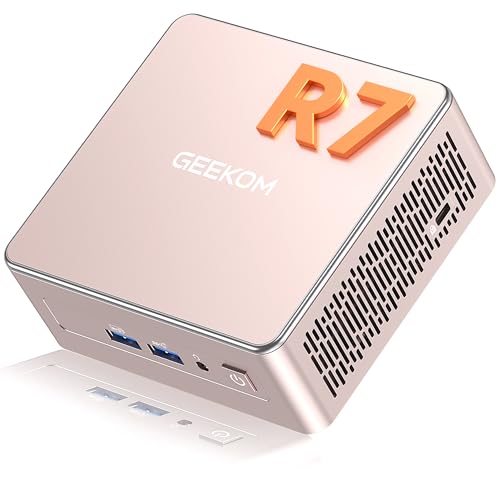
Expandable Workstation – GEEKOM A5 Ryzen 7 7730U
The GEEKOM A5 is a mini pc for buyers who want room to grow beyond its included 16GB of RAM and 512GB NVMe SSD. Its Ryzen 7 7730U targets office productivity and multitasking, while two HDMI and two USB-C ports support up to four 4K displays.
Best For: Multi-monitor workstations that need substantial memory and storage expansion.
Pros:
- Dual-slot DDR4 memory is upgradeable to 64GB.
- Offers an extra M.2 2242 slot and a 2.5-inch drive bay.
- Supports up to four 4K displays, with 8K output via USB-C.
- Includes a three-year limited warranty.
Cons:
- Comes with 16GB of RAM and a 512GB SSD; reaching its higher stated capacities requires separate upgrades.
- Its cloud AI workflow features should not be mistaken for a claim of dedicated local AI hardware.
The A5 is most compelling if you expect to add memory, drives, or displays over time. Its standard configuration is already suited to office use, but expansion is what distinguishes it here.
Performance Pick – GMKtec M6 Ultra Ryzen 5 7640HS
If you want a mini pc for demanding multitasking and moderate gaming, the GMKtec M6 Ultra pairs a Ryzen 5 7640HS with 32GB of DDR5 memory and a 1TB SSD. Its Radeon 760M integrated graphics and three display outputs also make it a capable compact workstation.
Best For: Buyers who want stronger processing, generous included memory, and multiple monitors in a small desktop.
Pros:
- Six-core, 12-thread Ryzen 5 7640HS with Radeon 760M graphics.
- Includes 32GB dual-channel DDR5 and a 1TB SSD.
- Supports three displays and offers dual 2.5GbE LAN ports.
Cons:
- Uses integrated graphics rather than a dedicated gaming GPU.
- Memory and storage upgrades are not included.
The M6 Ultra is the most performance-focused option here. Choose it if its processing power and connectivity matter more than keeping your setup basic.
Everyday Office Pick – BOSGAME E2 Plus Ryzen 5 3501U
The BOSGAME E2 Plus is a mini pc aimed at everyday office work, browsing, online meetings, and streaming. Its Ryzen 5 3501U, 8GB of DDR4 memory, and 256GB SATA SSD provide a straightforward starting configuration for a space-saving desk setup.
Best For: Home offices and classrooms that need a compact computer for routine tasks and multiple monitors.
Pros:
- Four-core, eight-thread processor suited to everyday computing.
- Supports up to three displays through two HDMI ports and USB-C.
- Includes Gigabit Ethernet, Wi-Fi 5, Bluetooth 5.0, and a VESA mounting bracket.
Cons:
- The listed 8GB memory and 256GB storage may feel restrictive with many apps or large files.
- Its SATA SSD and Wi-Fi 5 are less capable specifications than the PCIe storage and Wi-Fi 6 listed for the M6 Ultra.
Pick the E2 Plus for a simple work or study station, especially if three-screen support matters. The supplied specifications conflict on installed RAM, so confirm the seller’s current configuration before ordering.
Best for Comfort – GMKtec NucBox G10 Ryzen 5 3500U
The GMKtec NucBox G10 is a mini pc for buyers who want a compact office computer with room to expand. It combines a Ryzen 5 3500U and Radeon Vega 8 graphics with 16GB of dual-channel DDR4 memory and a 512GB PCIe SSD.
Best For: Multimonitor office setups and home users who value storage expansion and fast wired networking.
Pros:
- Includes 16GB of dual-channel memory and a 512GB PCIe SSD.
- Supports three 4K@60Hz display outputs via HDMI, DisplayPort, and USB-C.
- Provides 2.5GbE networking and two M.2 2280 storage slots.
Cons:
- Wi-Fi 5 is older than the Wi-Fi 6 specified for the M6 Ultra.
- Vega 8 is integrated graphics, so keep gaming expectations modest.
The G10 offers a useful middle ground between the E2 Plus’s basic configuration and the M6 Ultra’s stronger processor. Its extra storage slot and 2.5GbE port are particularly useful if your workspace may grow.
Best for Multitasking – GMKtec M5 Ultra Ryzen 7 7730U
This mini pc pairs an eight-core Ryzen 7 7730U with 32GB of RAM and a 512GB SSD, making it a practical choice for busy workdays, multiple displays, and light gaming.
Best For: Users who want ample memory, triple-display support, and fast wired networking in a compact desktop.
Pros:
- 32GB dual-channel RAM is expandable to 64GB.
- Supports three displays, including 4K at 60Hz through HDMI.
- Dual 2.5GbE ports and Wi-Fi 6E offer flexible networking.
Cons:
- Integrated Radeon graphics are less suited to demanding gaming than a dedicated GPU.
- Storage and memory upgrades are not included.
Choose the M5 Ultra if memory capacity and connectivity matter more to you than dedicated gaming graphics. Its second SSD slot also leaves room to expand beyond the included 512GB drive.
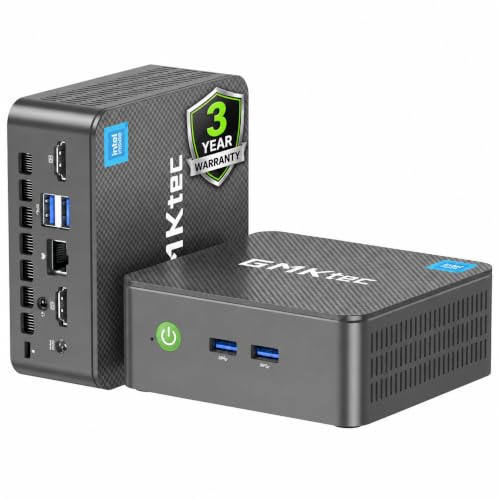
Best Heavy-Duty Pick – GMKtec G3S Intel N95
This mini pc uses a four-core Intel N95, 8GB of RAM, and a 256GB SSD for routine browsing, office tasks, and home entertainment. Its two HDMI ports make a dual-monitor setup straightforward.
Best For: Everyday computing and 4K media playback on one or two screens.
Pros:
- Two HDMI 2.0 ports support dual 4K displays at 60Hz.
- Includes Gigabit Ethernet, Wi-Fi 5, and Bluetooth 5.0.
- Wake-on-LAN, PXE boot, and auto power-on suit unattended setups.
Cons:
- 8GB of RAM and 256GB of storage may feel limiting for larger workloads.
- Intel N95 and integrated graphics are aimed at basic tasks, not demanding games.
The G3S is the sensible pick when your workload stays light but you still want two displays and wired networking. Look to a higher-spec model if you regularly run memory-heavy applications.
Best for Storage-Heavy Work – GMKtec M2 Pro Core i7-1185G7
This mini pc combines a four-core Intel Core i7-1185G7 with 16GB of RAM and a roomy 1TB NVMe SSD. It is a useful fit for office work or casual creative tasks that benefit from local storage and multiple monitors.
Best For: Users who want a 1TB drive, three 4K displays, and room for memory and storage upgrades.
Pros:
- Includes a 1TB NVMe SSD and supports an additional M.2 SATA drive.
- Two HDMI outputs and USB-C support three 4K displays at 60Hz.
- 16GB DDR4 RAM can be expanded up to 64GB.
Cons:
- Its four-core processor may be less appealing for heavily threaded work than an eight-core alternative.
- Intel Iris Xe graphics are integrated, so demanding games may require a different PC.
The M2 Pro stands out for its included storage and display flexibility. Its 2.5GbE port and Wi-Fi 6 also make it well equipped for a networked desk setup.
How We Picked These Mini PCs
We focused on the listed processor, RAM, storage, and intended use of each of the 10 selected configurations. The lineup covers inexpensive everyday systems, midrange work machines, and higher-spec options with more memory and faster-class processors. Listing specifications are a starting point, not a substitute for independent performance, noise, or reliability testing.
Some names appear in more than one configuration, including the GMKtec G3S. Compare the exact listing rather than assuming two similarly named units have identical memory, storage, or ports.
Quick Mini PC Comparison
For basic browsing, streaming, and documents, the Intel N95-based GMKtec G3S listings are the simplest starting points; the specified 8GB/256GB version offers less headroom than most 16GB models here. The BOSGAME E2 Plus and Ryzen 5 3500U GMKtec provide older AMD alternatives, while the BOSGAME E5 and KAMRUI Pinova P2 sit in the everyday-work range. The GEEKOM A5 2027 Edition and GMKtec M5 Ultra pair Ryzen 7 7730U processors with different listed memory and storage amounts. The GMKtec M6 Ultra stands out on paper with a Ryzen 7640HS, 32GB DDR5, and 1TB SSD. The Intel Core i7-1185G7 GMKtec lists 16GB RAM and a 1TB SSD; verify its unusually stated clock speed before using it to compare performance.
Key Buying Factors for a Mini PC
Processor and Workload
Match the chip to your heaviest routine task. An N95 system can suit light use, while a recent Ryzen U-series model offers more breathing room for multitasking. The Ryzen 7640HS is the more performance-oriented option in this list, but sustained speed also depends on cooling and power settings. Treat “gaming” in a product name cautiously: check real game benchmarks and settings expectations, especially when relying on integrated graphics.
Memory, Storage, and Connectivity
Choose 16GB RAM when you regularly keep many browser tabs or apps open; 32GB gives more margin for heavier workflows. An 8GB/256GB configuration is better suited to lighter tasks and may fill up quickly. Check whether RAM and storage can be upgraded rather than assuming they can.
Before ordering, confirm the number and type of USB ports, monitor outputs and supported resolutions, Ethernet speed, Wi-Fi standard, and headphone or audio connections on the specific configuration. Also check whether the operating system is included, what comes in the box, and whether a VESA mount fits your setup.
Who Should Buy Which Mini PC?
Pick an N95-based G3S for a modest secondary computer or basic home tasks if its confirmed configuration meets your needs. For a primary everyday desktop, start with the 16GB BOSGAME E5 or KAMRUI Pinova P2 and weigh their listed storage against your files and apps. Consider the GEEKOM A5 or GMKtec M5 Ultra when you want more multitasking headroom; the M5’s listed 32GB is especially relevant if memory matters. Look at the GMKtec M6 Ultra for the strongest listed processor and largest listed SSD in this group, while checking benchmarks for your actual workload before paying extra.