Choosing an audio interface with low latency can make the difference between a smooth take and a frustrating session. If you record vocals, instruments, podcasts, or stream live, the right interface keeps monitoring responsive and workflow simple.
Below, we focus on 10 strong options for 2026 that balance driver stability, direct monitoring, I/O, and overall value for different studio needs.
Best 10 Audio Interface with Low Latency Picks for 2026
Compact Low-Latency Recording Pick
MOTU M4 4x4 USB-C Audio Interface

- 4-in/4-out USB-C with low latency monitoring
- Two mic preamps plus MIDI I/O and loopback
- LCD screen for quick level checks
Best For: Home studios, podcasting, and simple low-latency tracking
Desktop Low-Latency Upgrade
Audient iD4 MKII USB-C Interface

- Class A mic preamp in a compact desktop unit
- USB-C connection with monitor mix controls
- All-metal build for durability
Best For: Solo recording and compact desktop monitoring
High-Input Low-Latency Studio Hub
Focusrite Scarlett 16i16 4th Gen USB-C Audio Interface

- 16 inputs and 16 outputs for expanded routing
- 4th Gen preamps with Auto Gain and Clip Safe
- 24-bit/192kHz conversion with ADAT, S/PDIF, MIDI
Best For: Project studios and producers needing lots of I/O
Ultra-Compact Low-Latency Budget Pick
MOTU M2 2x2 USB-C Audio Interface

- ESS Sabre32 Ultra DAC technology
- 120 dB dynamic range on outputs
- -129 dBu EIN on mic inputs
Best For: Solo creators wanting a compact 2x2 interface
Low-Latency Studio Pick
Yamaha URX22C USB-C Audio/MIDI Interface

- Latency-free DSP monitoring with onboard effects
- 32-bit/192kHz USB-C audio plus MIDI I/O
- 2 combo inputs, Hi-Z support, and metal chassis
Best For: Home studios and musicians who want real-time monitoring and durable hardware
Streaming and Recording Pick
Zoom AMS-24 USB Audio Interface

- Music and Streaming modes simplify routing
- Direct Monitoring and Loopback use hardware switches
- 2 inputs, 2 headphone outs, and 2 main outputs
Best For: Streamers and podcasters who want fast switching between recording and live output
Simple Solo Recording Pick
Focusrite Scarlett Solo 3rd Gen USB-C Interface

- 24-bit/192kHz conversion with Air mode
- 1 XLR mic input and 1 Hi-Z instrument input
- Low-noise balanced outputs for clear playback
Best For: Solo creators who want a compact interface for voice and guitar recording
Compact Solo Recording Pick

- 1-channel USB interface with 1 preamp
- Supports up to 96 kHz recording
- Includes phantom power for mics
Best For: Solo recording and simple desktop setups
Budget Dual-Input Choice
M-AUDIO M-Track Duo USB Audio Interface
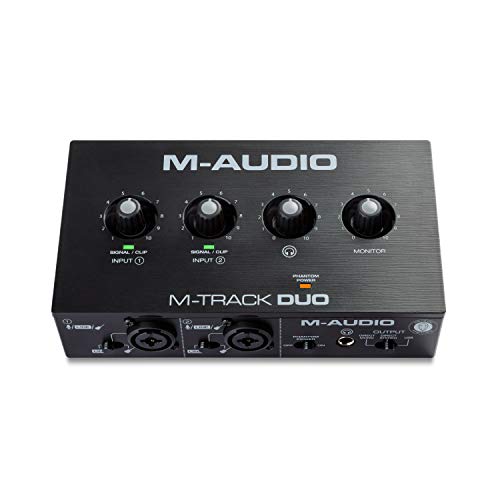
- USB/Direct switch for zero-latency monitoring
- Two combo XLR/Line/Instrument inputs
- Includes phantom power and headphone output
Best For: Beginners, streamers, and podcasters
Feature-Rich Low-Latency Option

- Zero-latency monitoring with 4 modes
- 24-bit/192 kHz recording support
- Two combo inputs plus +48V phantom power
Best For: Flexible home studios and livestreaming
Compact Low-Latency Recording Pick – MOTU M4 4×4 USB-C Audio Interface
If you want an audio interface with low latency for recording, mixing, or podcasting, the MOTU M4 is built around fast USB-C connectivity, hardware monitoring, and a practical 4×4 layout. It also adds MIDI I/O, loopback, and a front LCD screen, making it a versatile desktop option for Mac, PC, or iOS use.
Best For: Home studios, podcasters, and creators who want simple low-latency monitoring plus extra routing features.
Pros:
- 4-in/4-out USB-C design with low latency monitoring.
- Includes hardware monitoring, MIDI I/O, and loopback.
- Two microphone preamps for basic vocal and instrument recording.
- LCD screen helps with clear level monitoring.
Cons:
- Only two mic preamps, so larger tracking sessions will need more inputs.
- Does not include a dedicated software platform in the notes beyond bundled content.
The M4 is a strong pick if you want straightforward performance and useful extras without overcomplicating your setup. Its low-latency monitoring and flexible connectivity make it easy to build around for small studio work.
Desktop Low-Latency Upgrade – Audient iD4 MKII USB-C Interface
The Audient iD4 MKII is a compact audio interface with low latency-friendly USB-C connectivity and a Class A console microphone preamp. It is aimed at home recording users who want a small, durable desktop unit with clean monitoring tools and Mac, PC, and iOS compatibility.
Best For: Solo recording setups that need a premium-feeling compact interface with simple monitoring control.
Pros:
- High-speed USB-C connection for easier handling and power.
- Class A microphone preamp based on Audient’s ASP8024 HE console.
- Monitor mix and monitor panning functions improve headphone workflow.
- All-metal housing adds durability for desktop or travel use.
Cons:
- 2-channel design limits it to small recording setups.
- Maximum sample rate is 96 kHz, which is lower than some larger interfaces.
The iD4 MKII stands out if you value a small footprint and a refined monitoring experience more than input count. For solo artists and mobile recording, it offers a practical balance of build quality and low-latency usability.
High-Input Low-Latency Studio Hub – Focusrite Scarlett 16i16 4th Gen USB-C Audio Interface
If you need an audio interface with low latency and a much larger I/O count, the Focusrite Scarlett 16i16 4th Gen is built for flexible studio routing. It combines 16 inputs and 16 outputs with mic preamps, line inputs, ADAT, S/PDIF, MIDI I/O, and workflow tools that simplify recording sessions.
Best For: Producers and project studios that need lots of connectivity plus fast, organized recording workflows.
Pros:
- 16-in/16-out layout with mic, line, ADAT, S/PDIF, and MIDI connections.
- 4th Gen preamps offer 69 dB of gain and 24-bit/192kHz conversion.
- Auto Gain and Clip Safe help manage levels during recording.
- Air modes add presence and harmonic drive for vocals and instruments.
Cons:
- Bulkier than compact 2-channel interfaces.
- Designed for more complex setups, so it may be more interface than casual users need.
This is the strongest choice here for users who need expansion room and professional routing in one box. Its low-latency workflow support is paired with enough I/O to grow with a more demanding studio setup.
Ultra-Compact Low-Latency Budget Pick – MOTU M2 2×2 USB-C Audio Interface
The MOTU M2 is a compact audio interface with low latency-friendly USB-C connectivity and a focus on sound quality. Its ESS Sabre32 Ultra DAC technology, strong measured dynamic range, and low-noise mic input performance make it a practical choice for straightforward recording and playback.
Best For: Solo creators and small home setups that want a simple 2×2 interface with strong measured audio performance.
Pros:
- ESS Sabre32 Ultra DAC technology for high-quality analog sound.
- Measured 120 dB dynamic range on outputs.
- Measured -129 dBu EIN on mic inputs for low-noise recording.
- USB-C connectivity with a compact 2-channel layout.
Cons:
- Two-channel design limits flexibility for larger sessions.
- Windows is listed in the notes, so platform support appears narrower than some rivals.
The M2 is a clean, no-frills interface for users who care more about audio performance than extra I/O. If you want a low-latency interface that stays simple and compact, it makes an easy starting point.
Low-Latency Studio Pick – Yamaha URX22C USB-C Audio/MIDI Interface
If you want an audio interface with low latency for recording, monitoring, and small studio work, the Yamaha URX22C is built around fast USB-C connectivity and latency-free DSP-powered monitoring. Its 2-in/2-out layout, 32-bit/192kHz support, and included mixing and effects tools make it a practical fit for musicians who want clean capture and real-time monitoring without adding extra complexity.
Best For: Home studio users and musicians who want direct monitoring, onboard effects, and solid build quality in a compact interface.
Pros:
- Latency-free DSP-powered monitoring with REV-X reverb, Channel Strip, and Guitar Amp Classics
- 32-bit/192kHz USB 3.0 audio with 2 combo inputs, MIDI I/O, and 2 TRS main outputs
- D-PRE mic preamps with +48V phantom power and one Hi-Z input for guitar
- Rugged full-metal housing and cross-platform support for Windows, macOS, and iOS
Cons:
- Only 2 analog inputs and 2 outputs, so it is not aimed at larger setups
- Included software is centered on Steinberg tools, which may not suit every workflow
The URX22C stands out if low-latency monitoring matters more than extra channels. It combines onboard DSP, high-resolution conversion, and durable construction in a straightforward interface that works well for focused recording and overdubbing.
Streaming and Recording Pick – Zoom AMS-24 USB Audio Interface
The Zoom AMS-24 is a useful audio interface with low latency for creators who move between recording and live streaming. Its hardware controls, direct monitoring, and simple music/streaming switch make it easy to route audio efficiently on PC, Mac, iOS, and Android without a steep learning curve.
Best For: Musicians, streamers, and podcasters who need a simple interface that can switch between recording and streaming quickly.
Pros:
- Music/Streaming switch separates DAW recording from streaming output
- Direct Monitoring and Loopback are controlled with dedicated hardware switches
- 2 XLR/TRS inputs, 2 headphone outputs, and 2 main TRS outputs
- Bus-powered and compatible with PC, Mac, iOS, and Android devices
Cons:
- 48kHz maximum sample rate is lower than some competing interfaces
- Best suited to compact setups rather than multi-input recording rigs
The AMS-24 is most appealing when ease of use matters more than advanced specs. If you want quick hardware control for streaming and recording, it delivers a practical setup with straightforward monitoring and routing.
Simple Solo Recording Pick – Focusrite Scarlett Solo 3rd Gen USB-C Interface
The Focusrite Scarlett Solo 3rd Gen is a compact audio interface with low latency-friendly performance for solo recording setups. With 24-bit/192kHz conversion, Air mode, and low-noise balanced outputs, it gives singers, guitarists, and podcasters a simple way to capture clean audio and listen back clearly.
Best For: Solo musicians and podcasters who want a straightforward interface with strong preamps and clean monitoring.
Pros:
- 24-bit/192kHz recording with high-performance converters
- 1 XLR mic preamp and 1 Hi-Z instrument input for guitar or bass
- Air mode adds extra clarity for acoustic recordings
- Low-noise balanced outputs and broad software bundle included
Cons:
- Only one mic input and one instrument input, so it is limited for larger sessions
- No onboard DSP effects or MIDI I/O
The Scarlett Solo 3rd Gen is a strong choice if you need a simple, reliable interface rather than a feature-heavy unit. It focuses on clean conversion, useful input options, and easy setup for focused home recording.
Compact Solo Recording Pick – Rode AI-1 USB Audio Interface
If you want an audio interface with low latency for simple one-channel recording, the Rode AI-1 keeps the setup focused and straightforward. It uses USB connectivity, offers one preamp, and supports up to 96 kHz recording, making it a practical choice for voice, instrument, or basic desktop studio use on Windows.
Best For: Solo creators who want a compact USB interface for single-mic or single-input recording.
Pros:
- 1 preamp and 1-channel design keep the workflow simple.
- USB connectivity makes it easy to connect to a computer.
- Supports up to 96 kHz sample rate for higher-resolution recording.
- Includes phantom power for compatible microphones.
Cons:
- Only 1 channel, so it is not built for multi-input recording.
- Notes list Windows operating system compatibility, which may limit flexibility for some users.
The AI-1 is a no-frills option if you mainly need a clean, compact interface for one source at a time. It is best suited to users who value simplicity over expandability and want a small USB box that covers the basics well.
Budget Dual-Input Choice – M-AUDIO M-Track Duo USB Audio Interface
The M-AUDIO M-Track Duo is a practical audio interface with low latency monitoring built into its USB/Direct switch, which helps when you need to hear yourself without distracting delay. With two combo XLR/Line/Instrument inputs, phantom power, and 48 kHz recording, it fits home recording, streaming, podcasting, and lightweight music capture.
Best For: Beginners and content creators who want two inputs with simple zero-latency monitoring.
Pros:
- USB/Direct switch enables zero latency monitoring.
- Two combo inputs handle mics, guitars, and line sources.
- Phantom power supports condenser microphones.
- Includes headphone output and stereo outputs for flexible monitoring.
Cons:
- Maximum sample rate is 48 kHz, lower than some higher-end interfaces.
- Limited to 2 channels, so it is not ideal for larger sessions.
For straightforward recording and streaming, the M-Track Duo covers the essentials without adding complexity. It is a sensible pick if you want dual inputs and easy monitoring in a portable USB interface.
Feature-Rich Low-Latency Option – BlueAVS USB Audio Interface
If you are shopping for an audio interface with low latency and more advanced monitoring control, the BlueAVS AR013 stands out with zero-latency monitoring and four monitoring modes. It also brings dual XLR/TRS combo inputs, USB-C connectivity, 24-bit/192 kHz recording, and +48V phantom power for a flexible home studio or streaming setup.
Best For: Creators who want flexible zero-latency monitoring and higher-resolution recording in a compact USB-C interface.
Pros:
- Zero-latency monitoring with OFF, MONO, Crossfeed, and STEREO modes.
- Records up to 24-bit/192 kHz with support for multiple sample rates.
- Two XLR/TRS combo inputs handle microphones, guitars, and line-level sources.
- USB-C plug-and-play design works with Mac and Windows setups.
Cons:
- Limited to 2 channels, so it is not meant for bigger multi-input rigs.
- At 1.3 pounds, it is less featherweight than some ultra-compact options.
This model offers the most monitoring flexibility in the group, which makes it attractive if you care about hearing your performance in real time. It is a strong fit for recording vocals, guitars, podcasts, or livestreams where low-delay monitoring matters.
How We Picked the Best Audio Interface with Low Latency
We looked for interfaces that are practical for real-world recording, not just strong on paper. Priority went to stable USB-C connectivity, reliable direct monitoring, solid driver performance, clean preamps, and enough inputs and outputs for common home-studio and content-creation setups. We also considered included software, build quality, and how well each model fits solo creators versus growing studios.
Quick Comparison
For simple vocal recording or streaming, compact 1-in/2-out and 2-in/2-out models are usually the easiest choice. If you need to record multiple sources at once, step up to interfaces with more inputs, better monitoring control, and extra outputs for speakers or outboard gear. An Audio Interface with Low Latency should also offer straightforward direct monitoring so you can hear yourself without distracting delay.
Key Buying Factors for an Audio Interface with Low Latency
Driver Stability and Monitoring
Low-latency performance depends on more than the advertised sample rate. Look for an interface with dependable drivers for your operating system, plus direct monitoring or zero-latency monitoring options for live tracking.
Inputs, Outputs, and Workflow
Choose enough combo inputs for your microphones, instruments, and future expansion. Extra line outputs can help with studio monitors, headphone routing, or external processing. If you record podcasts or stream, loopback and flexible monitor routing are especially useful.
Preamp Quality and Gain
Clean preamps matter when you track quiet microphones or dynamic vocals. More gain and a lower noise floor can reduce the need for extra boosters and improve overall signal quality.
Resolution and Extra Features
High sample-rate support and 24-bit or 32-bit recording can be nice, but they should not outweigh core usability. DSP effects, MIDI, bus power, and bundled software are helpful bonuses when they match your workflow.
Who Should Buy Which Audio Interface with Low Latency?
Solo singers, guitarists, and streamers usually do best with compact 1- or 2-input interfaces that keep setup fast and latency low. Podcasters and duet creators should look for two combo inputs, direct monitoring, and loopback. Home studios that plan to expand should favor multi-input models with more routing flexibility and additional outputs. If your priority is an Audio Interface with Low Latency for everyday recording, pick the model that best matches your input count and monitoring needs rather than chasing the largest spec sheet.