Switching a keyboard, mouse, printer, or other USB device between Windows computers should not require repeatedly unplugging cables. The right USB switch box lets you share peripherals from a button, wired remote, or desktop control.
These 10 options cover everyday USB 2.0 models, faster USB 3.0 and USB-C designs, higher-port-count switches, and setups that connect two or more computers. Use the guide below to match port layout, speed, and power requirements to your workspace.
Best 10 USB Switch Boxes for Windows Picks for 2026
Best Overall

- Shares four USB devices between two computers
- Up to 5Gbps USB 3.0 data transfer
- Windows-compatible plug-and-play design
Best For: Sharing several everyday USB peripherals between two Windows computers
Best for Maximum Connectivity

- Shares up to seven USB-A and USB-C devices
- Includes an external controller and adapter
- Supports up to 5Gbps USB 3.0 transfers
Best For: Large Windows workspaces with many mixed USB peripherals
Best Remote-Controlled Pick
BENFEI USB 3.0 Switch with Remote

- Includes button and remote switching
- Three USB-A and one USB-C device ports
- Up to 5Gbps transfer with optional USB-C power
Best For: Windows desks where the switch should be controlled from a distance
Best Mixed-Port Value

- One USB-C and three USB-A device ports
- Button and controller switching options
- Up to 5Gbps USB 3.0 data transfer
Best For: Compact Windows setups using both USB-C and USB-A peripherals
Best Multi-Device Pick
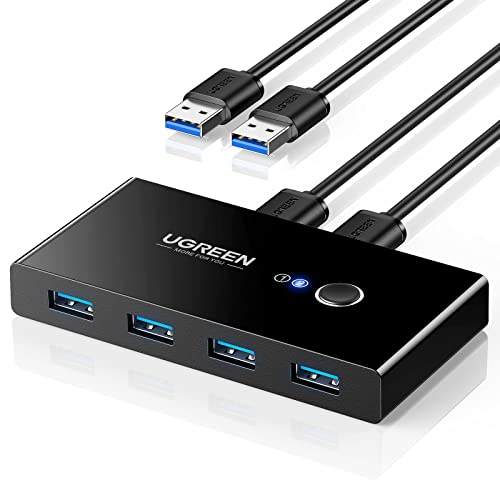
- Shares four USB devices between two computers
- Up to 5Gbps USB 3.0 data transfer
- One-button switching; no monitor or video support
Best For: Windows workstations with several shared USB peripherals
Best Value Alternative

- Connects four shared USB devices to two computers
- Supports Windows and other major operating systems
- Includes Type-C power cable for stable operation
Best For: Everyday keyboard, mouse, printer, and webcam sharing
Best Compact Setup

- Shares two USB devices between two computers
- Up to 5Gbps transfer with USB 2.0 backward compatibility
- Includes two 5-foot USB 3.0 cables
Best For: Small desks sharing a keyboard, mouse, or printer
Best Multi-Device Value

- Shares four USB peripherals between two computers
- Driver-free compatibility with Windows and other major systems
- One-button switching with optional power support
Best For: Two-PC setups sharing several everyday USB devices
Best Compact USB 3.0 Pick
2-in-2 Computer USB 3.0 Switch

- Shares two USB devices between two computers
- Up to 5Gbps USB 3.0 transfer speeds
- Includes cables and one-button plug-and-play control
Best For: Dual-PC keyboard, mouse, and printer sharing
Best High-Speed Multi-PC Option

- Shares USB-A and USB-C devices across four computers
- Up to 10Gbps transfer speeds with remote switching
- Includes USB-C adapter and optional 5V power input
Best For: Multi-computer workstations needing fast mixed-port connectivity
Best Overall – BENFEI 4-Port USB 3.0 Switch
For shoppers comparing usb switch boxes for windows, the BENFEI 4-Port USB 3.0 Switch is a straightforward way to share four USB peripherals between two computers. It supports Windows and other major operating systems, offers plug-and-play operation, and includes a button and LED indicator for quick switching.
Best For: Windows users who need to share a keyboard, mouse, printer, scanner, or other USB devices between two computers.
Pros:
- Shares four USB devices between two computers.
- Supports USB 3.0 data speeds up to 5Gbps and is backward compatible with USB 2.0.
- Works with Windows, macOS, Linux, and Chrome OS without requiring drivers.
- Includes an optional USB-C power input for higher-power devices.
Cons:
- The supplied notes specify that the connection requires BENFEI USB-A-to-USB-A cables.
- The power adapter is not included.
This is a practical general-purpose pick when four USB-A peripherals are enough. Consider the optional power connection when using devices such as hard drives, cameras, or headphones that draw more power.
Best for Maximum Connectivity – UGREEN 7-Port USB Switch
Among usb switch boxes for windows, the UGREEN 2-in-7-out model stands out for its unusually large device capacity and mix of USB-A and USB-C ports. It lets two computers share up to seven peripherals, with switching available from the unit or its included external controller.
Best For: Windows setups with many USB-A and USB-C accessories and a need for convenient desktop switching.
Pros:
- Supports up to seven shared devices: four USB-A and three USB-C.
- Provides USB 3.0 transfer speeds up to 5Gbps on four ports.
- Includes a USB-C-to-USB-A adapter for mixed computer connections.
- Works with Windows, macOS, Chrome OS, and Linux.
Cons:
- It is not a KVM switch and does not transmit video or include HDMI.
- The USB ports are intended primarily for data transfer, not charging.
If your workspace has more peripherals than a typical four-port switch can handle, this UGREEN model offers the most flexible port selection in the group. Its clear video limitation makes it important to pair it with a separate display setup.
Best Remote-Controlled Pick – BENFEI USB 3.0 Switch with Remote
For a Windows desk where the switch needs to stay out of reach, this BENFEI USB switch adds remote control operation to a four-port layout. It provides three USB 3.0 ports and one USB-C port for sharing peripherals between two computers, with LED status feedback and optional USB-C power.
Best For: Windows users who want to switch shared USB devices from a remote controller rather than reaching for the main unit.
Pros:
- Offers three USB 3.0 ports plus one USB-C port.
- Allows switching with either the device button or included remote control.
- Supports data transfer up to 5Gbps and USB 2.0 backward compatibility.
- Works with Windows, macOS, Chrome OS, and Linux without drivers.
Cons:
- The supplied notes specify that BENFEI USB-A-to-USB-A cables are required for connection.
- High-power devices may require a separate power source.
The remote is the main reason to choose this model over a conventional button-only switch. Its combination of USB-A and USB-C device ports also suits a mixed-peripheral setup, provided the available port count is sufficient.
Best Mixed-Port Value – UGREEN 4-Port USB Switch
This UGREEN model is a compact option among usb switch boxes for windows, combining one USB-C port with three USB-A ports. Two computers can share four peripherals, and users can switch through either the onboard button or the included controller.
Best For: Windows users who need a compact switch for a mix of USB-C and USB-A keyboards, mice, printers, or other peripherals.
Pros:
- Shares four devices between two computers.
- Combines one USB-C and three USB-A device ports.
- Supports up to 5Gbps USB 3.0 data transfer and USB 2.0 compatibility.
- Offers both button and controller switching.
Cons:
- It is not a KVM switch and does not support monitor or video transmission.
- USB-C computer inputs may require a USB-C-to-USB-A adapter.
- The USB-C port does not support video output.
This is a sensible middle-ground choice for a mixed USB setup that does not need seven shared ports. Its compact design and controller help keep the desk organized, while the optional power input can improve stability with multiple devices.
Best Multi-Device Pick – UGREEN 4-Port USB 3.0 Switch
For shoppers comparing usb switch boxes for windows, this UGREEN model is a practical choice when two computers need to share several peripherals. It connects up to four USB devices and switches between PCs with one button, but it does not handle monitors or video.
Best For: Windows users sharing keyboards, storage devices, printers, scanners, cameras, or other USB peripherals between a work and personal computer.
Pros:
- Four USB 3.0 ports support data transfers up to 5Gbps.
- Driver-free compatibility with Windows, macOS, Chrome OS, and Linux.
- One-button switching with an LED status indicator.
- Includes two 1.5-meter USB 3.0 cables and offers a 24-month warranty.
Cons:
- It is not a KVM and cannot switch a monitor or transmit video.
- A power adapter is not included.
- External power may be needed when using multiple or high-power devices.
This is the stronger fit when port capacity matters. Its extra USB-C power input adds flexibility for demanding peripherals, though buyers should plan for a separate power source if their setup needs it.
Best Value Alternative – USB 3.0 4-Port Switcher
This USB switch box for Windows gives two computers access to four shared USB peripherals through a simple push-button selector. It supports common operating systems without drivers and includes a Type-C power cable for more stable operation with supported devices.
Best For: Users who need to share a keyboard, mouse, printer, scanner, webcam, or USB storage device between two computers.
Pros:
- Four USB 3.0 ports provide transfer speeds up to 5Gbps.
- Backward compatible with USB 2.0, 1.1, and 1.0 devices.
- Works with Windows, macOS, Chrome OS, and Linux without drivers.
- LED indicator and one-button switching simplify source selection.
Cons:
- Keyboard hotkeys are not supported for switching.
- External power is needed for devices the host computer cannot adequately power, such as some hard drives.
- It does not provide monitor or video switching.
Its combination of four ports, broad compatibility, and included power cable makes it a versatile everyday option. The lack of hotkey switching is worth noting if you prefer changing sources from the keyboard.
Best Compact Setup – UGREEN 2-Port USB 3.0 Switch
Among usb switch boxes for Windows, this compact UGREEN selector suits simpler desks where two computers need to share only a keyboard, mouse, printer, or similar device. Its two USB outputs keep the setup focused while retaining USB 3.0 transfer speeds.
Best For: Windows users sharing two USB peripherals between a desktop and laptop or between work and personal computers.
Pros:
- Shares two USB devices between two computers.
- USB 3.0 supports data transfer speeds up to 5Gbps and is backward compatible with USB 2.0.
- Driver-free operation works with Windows, macOS, Chrome OS, and Linux.
- Includes two 5-foot USB 3.0 A-to-A cables.
Cons:
- Only two USB devices can be connected at once.
- It is not a KVM and does not support monitor or video transmission.
- The USB output is for data transfer, not video.
This is a sensible choice for a minimal peripheral-sharing setup. It avoids paying for unused ports, but users with several shared devices should choose a four-port model instead.
Best Multi-Device Value – UGREEN 2-in-4 USB 2.0 Switch
For shoppers comparing usb switch boxes for windows, the UGREEN selector is a practical choice when two computers need to share up to four USB peripherals. Its one-button switching and driver-free setup keep everyday device sharing simple.
Best For: Windows users sharing several keyboards, mice, printers, scanners, or storage devices between two computers.
Pros:
- Shares four USB 2.0 devices between two computers.
- Works with Windows 10/8/8.1/7/Vista/XP, plus macOS, Linux, and Chrome OS.
- Includes two USB A-to-A cables and offers one-button switching with an LED indicator.
- Optional micro-USB power can improve stability with multiple or higher-power devices.
Cons:
- Does not support monitors or video transmission, so it is not a KVM switch.
- Power adapter and charging cable are not included.
- USB 2.0 is slower than newer USB 3.x alternatives.
This is a solid fit for a straightforward two-PC workstation, particularly if you value four shared ports over high-speed transfers. Make sure your setup does not require display switching.
Best Compact USB 3.0 Pick – 2-in-2 Computer USB 3.0 Switch
This 2-in-2 USB switch is a focused option among usb switch boxes for windows, letting two computers share two peripherals without repeatedly unplugging cables. USB 3.0 support makes it better suited to faster data-transfer tasks than USB 2.0 models.
Best For: Home offices and dual-PC workstations that mainly share a keyboard and mouse, with occasional printer or storage use.
Pros:
- Supports two computers sharing two USB devices.
- USB 3.0 provides transfer speeds up to 5Gbps and remains backward compatible with USB 2.0/1.1.
- One-button switching, LED status indication, and plug-and-play operation require no drivers.
- Includes two 3.28-foot USB 3.0 A-to-A cables and has an aluminum alloy shell.
Cons:
- Only two shared output ports are available.
- It switches USB peripherals, not monitors or video connections.
- The supplied notes do not mention an included external power adapter.
Choose this model when two shared devices are enough and faster USB performance matters. Its compact, simple design is especially appropriate for keyboard-and-mouse sharing between Windows and another compatible computer.
Best High-Speed Multi-PC Option – 4-Computer USB 3.2 Switch
For demanding usb switch boxes for windows setups, this USB 3.2 selector supports four computers and combines USB-A and USB-C connectivity. Its 10Gbps performance, remote control, and four-device switching make it the most flexible option in this group.
Best For: Workstations with up to four computers and a mix of USB-C and USB-A peripherals such as storage drives, printers, scanners, and webcams.
Pros:
- Lets four computers share three USB-A 3.2 and one USB-C 3.2 peripheral ports.
- Offers transfer speeds up to 10Gbps and includes a USB-C-to-USB-A adapter.
- Supports both top-button and remote-control switching.
- Micro-USB 5V power input helps support higher-power devices.
Cons:
- It is not a KVM switch and does not support monitors.
- The remote-control batteries are not included.
- High-power peripherals may require an independent power source for proper operation.
This model is the strongest choice when four-computer support, modern port types, and high-speed transfers outweigh simplicity. It is best reserved for users who can manage the extra power considerations and do not need display switching.
How We Picked the Best USB Switch Boxes for Windows
We focused on switches that clearly support Windows computers and common USB peripherals, including keyboards, mice, printers, scanners, webcams, and storage devices. We compared the number and type of downstream ports, USB generation, computer inputs, switching method, included cables, and whether the unit is designed for simple peripheral sharing or broader KVM-style use.
Compatibility claims matter, but so does practical setup. A switch that supports USB 3.0 or USB-C may be a better fit for external drives and webcams, while a USB 2.0 model can be entirely adequate for input devices and printers. Products with four shared ports suit a typical desk; seven-port designs are better for more involved workstations.
Quick Comparison
| Best For | What to Look For |
|---|---|
| Keyboard and mouse | USB 2.0 or USB 3.0, reliable one-button switching |
| Printers and scanners | At least two shared ports and broad Windows compatibility |
| External drives | USB 3.0 or newer, with appropriate power support |
| Modern laptops | USB-C ports or a suitable adapter |
| Many peripherals | Four to seven downstream ports and external power compatibility |
Key Buying Factors for USB Switch Boxes for Windows
Port Type and Count
Count the devices you intend to share before buying. Four USB-A ports cover most keyboard, mouse, printer, and scanner combinations. A USB-C option helps newer laptops and peripherals, while a seven-port switch provides room for a webcam, storage drive, or additional accessories.
Speed and Device Compatibility
USB 2.0 is sufficient for keyboards, mice, and many printers, but USB 3.0 is preferable for faster storage and high-bandwidth devices. USB 3.2 models can offer still higher throughput, although actual performance depends on the computer, cable, and connected device. A USB switch does not automatically transfer video or provide full monitor KVM control unless explicitly designed to do so.
Power and Switching Controls
Bus-powered models are convenient, but several connected devices may need more power than a computer port can provide. Check whether the switch accepts external power, particularly when using storage, webcams, or several accessories. Physical buttons and wired remotes are both useful; choose the control style that will be easiest to reach.
Who Should Buy Which USB Switch Boxes for Windows?
Choose a compact USB 2.0 switch if you only need to share a keyboard, mouse, or printer between two Windows PCs. Select a four-port USB 3.0 model for a general home office, gaming desk, or dual-computer workstation. Users with newer laptops should prioritize USB-C connectivity or verify which adapters are required. Pick a seven-port model when several peripherals must remain connected, and consider external power for demanding devices. Finally, choose a four-computer or USB 3.2 switch only when its extra inputs or bandwidth directly match your setup; otherwise, a simpler two-computer design is usually easier and more economical.