School 3D-printing labs need more than reliable printers. The right air purifier can help manage fine particles, odors, and volatile organic compounds while students and staff work nearby.
This roundup compares 10 options for different classroom setups, including enclosed printers, resin workflows, FDM systems, and shared makerspaces. Use the guide below to match filtration, airflow, noise, and maintenance needs to your lab.
Best 10 3d Printer Air Purifiers for Schools Picks for 2026
Best Overall for Enclosed Printers

- Four-stage HEPA and carbon filtration
- Adjustable fan speed for classroom use
- Supports select Bambu Lab and ELEGOO models
Best For: Compatible enclosed Bambu Lab and ELEGOO printers
Best for Flexible School Installations

- HEPA H13 and activated carbon filtration
- Up to 60 m³/h airflow
- Adapters support multiple printer brands
Best For: Schools with mixed enclosed-printer fleets
Best for Resin Printer Rooms

- Quiet 35 dB operation
- 6W low-power design
- VOC sensor signals filter replacement
Best For: Compatible ELEGOO resin-printer classrooms
Best for Bambu Lab Classrooms

- Purpose-built for P1S and X1C
- HEPA H13 plus activated carbon
- Quick-swap maintenance design
Best For: Bambu Lab-focused classrooms and makerspaces
Quiet Resin-Printing Pick
ELEGOO Marsmate Large Air Purifier
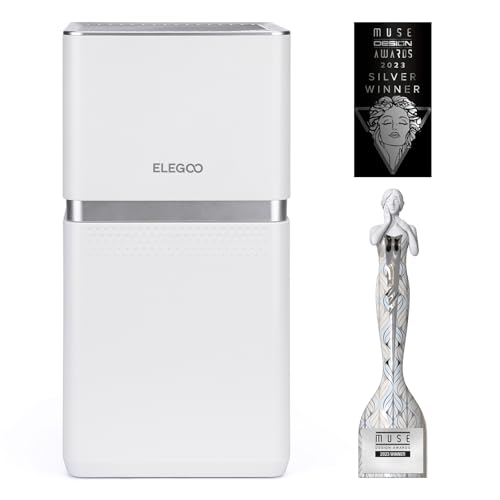
- 35 dB low-noise operation
- VOC and filter-life reminders
- Two fan modes with automatic switching
Best For: Quiet resin-printing classrooms with compatible printers
High-Airflow Classroom Option
Creality 3D Printer Air Purifier

- Up to 250 m³/h airflow
- Real-time PM2.5 display
- Five-stage dust and odor filtration
Best For: Makerspaces needing airflow and visible air-quality monitoring
Compact Resin-Odor Pair
ELEGOO Mini Air Purifier 2-Pack

- Fits inside compatible resin printers
- 10 dB stated noise level
- Rechargeable battery lasts at least 24 hours
Best For: Small resin stations needing compact odor control
Best Overall

- Six-layer HEPA and activated-carbon filtration
- Compatible with resin and FDM printers
- Quiet 42 dB, three-speed operation
Best For: Mixed-printer school makerspaces
Best Enclosed Setup
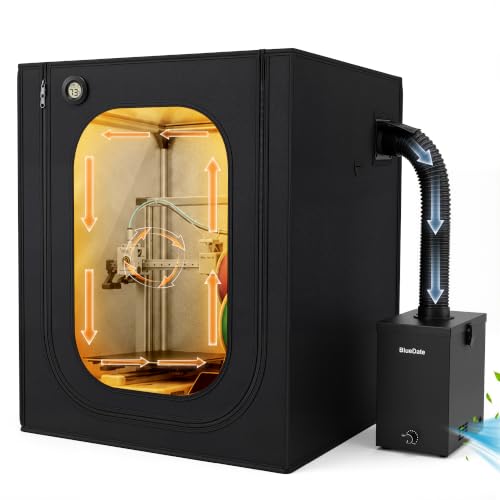
- Enclosure combines filtration and printer containment
- HEPA and activated-carbon multi-stage system
- Includes pipe, extractor, LED, and spare pre-filters
Best For: Dedicated school print stations
Best for Creality K2

- Designed for Creality K2 and K2 Pro
- Compact HEPA and activated-carbon filtration
- Includes hose, magnetic hoods, and spare pre-filters
Best For: Creality K2-series school makerspaces
Best Overall for Enclosed Printers – BD-60B Smoke Purifier
For schools seeking 3d printer air purifiers for schools, the BD-60B is a flexible choice for compatible Bambu Lab and ELEGOO enclosed printers. Its multi-stage filtration combines HEPA and activated carbon media, while adjustable fan speed helps classrooms balance airflow and noise.
Best For: Schools using compatible Bambu Lab or ELEGOO enclosed 3D printers and needing adjustable smoke, odor, and particulate capture.
Pros:
- Four-stage filtration uses pre-filter, HEPA, and activated carbon layers.
- Claims 99.97% capture of particles as small as 0.3 microns.
- Stepless speed control supports different printer and noise requirements.
- Includes pipework, magnetic hoods, power supply, and replacement pre-filters.
Cons:
- Compatibility is focused on specified Bambu Lab and ELEGOO models.
- The P2S requires a separately printed riser bracket.
- Its listed noise level is 55 dB, higher than some quieter options.
The BD-60B stands out when a school wants broad compatibility within supported printer families and hands-on airflow control. Verify the exact printer model and available placement space before ordering.
Best for Flexible School Installations – Mintion V1 Filter System
The Mintion V1 is a compact option for schools comparing 3d printer air purifiers for schools across multiple enclosed-printer brands. Its pre-filter, HEPA H13, and activated carbon design targets particles, odors, and VOCs, with a stated airflow of up to 60 m³/h.
Best For: Educational institutions with mixed enclosed-printer fleets that need a compact, adaptable filtration system.
Pros:
- Three-stage filtration combines pre-filter, HEPA H13, and activated carbon.
- Designed for common filaments including PLA, PETG, ABS, ASA, and nylon.
- Supports multiple brands through optional printed adapters.
- Filters are accessible for quick replacement, and the set includes installation hardware.
Cons:
- Adapters may be needed for printers beyond the factory-configured P1S/X1C setup.
- The notes do not specify a decibel rating.
- Adapter installation may require access to printed connector files or parts.
With its cross-brand compatibility and included setup accessories, the Mintion V1 is practical for school makerspaces that expect to add or change printers over time. Confirm the adapter requirement for each model before deployment.
Best for Resin Printer Rooms – ELEGOO MARSMATE Air Purifier
For resin-focused classrooms, the ELEGOO MARSMATE offers a quiet, low-power approach to 3d printer air purifiers for schools. It uses activated carbon filtration, automatic low- and high-speed modes, and an internal VOC sensor designed to alert users when the filter needs attention.
Best For: Schools and labs using compatible ELEGOO resin printers where low operating noise and VOC monitoring are priorities.
Pros:
- Operates at a stated 35 dB with 6W power consumption.
- Automatic fan-speed switching supports quieter operation.
- Built-in VOC sensor provides a filter-replacement reminder.
- Compatible with a broad selection of listed ELEGOO resin printers.
Cons:
- Uses activated carbon only; the notes do not list HEPA filtration.
- Designed primarily for compatible resin printers with an extension port.
- The listed filter lifespan is up to two months, depending on use.
The MARSMATE is a strong fit for resin-printing areas where quiet operation matters, but its activated-carbon-only design makes it less suitable when particulate filtration is a primary requirement. Check the printer’s extension-port compatibility before purchase.
Best for Bambu Lab Classrooms – V1 HEPA Carbon Filter System
This V1 system is purpose-built for Bambu Lab P1S and X1C printers, making it a focused option among 3d printer air purifiers for schools. Its pre-filter, HEPA H13 layer, and activated carbon bed are designed to address particles and fumes from common filaments while maintaining stable airflow.
Best For: Classrooms, workshops, and makerspaces centered on Bambu Lab P1S or X1C enclosed printers.
Pros:
- Triple-layer filtration includes a pre-filter, HEPA H13, and activated carbon.
- Stated airflow reaches up to 60 m³/h with stable negative-pressure support.
- Quick-swap filter modules simplify maintenance.
- Adapter options extend compatibility to several other enclosed-printer brands.
Cons:
- The default connector is optimized for Bambu Lab P1S and X1C.
- Other printer models may require adapter kits or printed connectors.
- The notes do not provide a noise rating or filter replacement interval.
This system is especially appealing when a school standardizes on Bambu Lab enclosed printers and wants purpose-built filtration with straightforward maintenance. For mixed fleets, account for the extra adapter requirements.
Quiet Resin-Printing Pick – ELEGOO Marsmate Large Air Purifier
For schools seeking 3d printer air purifiers for schools, the ELEGOO Marsmate is a large, quiet option designed primarily for photocuring and compatible resin printers. Its activated-carbon filter, VOC monitoring, and selectable fan speeds make it practical for classrooms where noise and maintenance awareness matter.
Best For: Resin-printing classrooms using compatible ELEGOLOO Saturn or Mars printers and needing low operating noise.
Pros:
- Operates at a stated noise level as low as 35 dB.
- Offers low- and high-fan modes, plus automatic switching.
- Built-in reminders track VOC concentration and filter life.
- Large 210 x 247 x 410 mm body is designed for more substantial purification.
Cons:
- Its large 14-pound design requires more classroom or workbench space.
- Compatibility is strongest with specified ELEGOO resin printers or printers with expansion interfaces.
The Marsmate is a strong fit when quiet operation and VOC awareness are priorities. Schools should confirm printer compatibility and available space before choosing this larger unit.
High-Airflow Classroom Option – Creality 3D Printer Air Purifier
Among 3d printer air purifiers for schools, the Creality model stands out for high airflow and visible particulate monitoring. Its 360-degree intake, real-time PM2.5 display, and five-stage filtration make it suited to classrooms running FDM printers or longer printing sessions.
Best For: School makerspaces that want strong airflow and an at-a-glance PM2.5 reading during extended printing.
Pros:
- Provides up to 250 m³/h airflow and 1700 Pa suction.
- Uses a 360-degree surrounding airflow design.
- Displays ambient PM2.5 levels in real time.
- Five-stage filtration is specified to remove dust and odors, with filter options lasting up to 1,000 or 1,500 hours.
Cons:
- Its listed 28-pound weight may make moving it between classrooms less convenient.
- The supplied details do not state an operating noise level.
- Schools may need to select the appropriate filter version for their printing needs.
This is the most monitoring-focused option in the group, particularly for schools that value visible PM2.5 feedback. Its heavier build and unspecified noise level are worth considering for shared learning spaces.
Compact Resin-Odor Pair – ELEGOO Mini Air Purifier 2-Pack
For schools needing compact 3d printer air purifiers for schools, the ELEGOO Mini Air Purifier 2-pack is designed to fit inside compatible LCD, DLP, or MSLA resin printers. Its activated-carbon filter targets resin odor, while the rechargeable battery supports flexible placement without adding much noise.
Best For: Small resin-printing stations that need an unobtrusive purifier inside compatible printer enclosures.
Pros:
- Compact 44 x 44 x 107 mm design fits inside compatible printers.
- Two units provide coverage for multiple compatible printers or work areas.
- Activated carbon targets irritating resin odors.
- Runs for at least 24 hours on its 2,000 mAh battery and operates at a stated 10 dB.
Cons:
- Designed for resin odor control rather than broad room-air purification.
- Carbon filters require replacement approximately every three to six months.
- Fit depends on whether the school’s printer can accommodate the unit inside.
This two-pack is a practical space-saving choice for small resin stations, especially where quiet operation matters. It is best treated as printer-level odor control rather than a substitute for whole-room ventilation.
Best Overall – Phrozen Air Purifier Max
For schools seeking 3d printer air purifiers for schools, the Phrozen Air Purifier Max is a versatile standalone option for both resin and FDM printing areas. Its six-layer filtration, activated carbon, three fan speeds, and relatively quiet 42 dB operation suit classrooms, makerspaces, and overnight printing setups.
Best For: School makerspaces using both resin and FDM 3D printers.
Pros:
- Works with both resin and FDM printers.
- Six-layer filtration includes HEPA and activated carbon for dust, odors, VOCs, and fumes.
- Three-speed control and 42 dB operation support quieter classroom use.
- Slide-out filter design and replacement reminder light simplify maintenance.
Cons:
- Its 17-inch height and 10 kg weight require dedicated floor or tabletop space.
- The supplied notes do not specify coverage area or replacement-filter cost.
The Phrozen is the most flexible choice when a school needs one purifier that can move between different printer types. It is a practical fit for shared workspaces, provided staff plan for filter replacements and adequate ventilation.
Best Enclosed Setup – BD-60A 3D Printer Enclosure
The BD-60A combines an enclosure with smoke and fume purification, making it a substantial option among 3d printer air purifiers for schools. Its four-stage filtration, fire-resistant construction, noise reduction, and broad printer compatibility can help schools organize a more contained printing station.
Best For: Dedicated school printing stations needing enclosure, filtration, and printer protection together.
Pros:
- Enclosure helps reduce noise, retain heat, and limit dust release.
- Four-stage system uses pre-filter, HEPA, and activated-carbon filtration.
- Stepless speed control accommodates different printer and noise requirements.
- Includes extractor, smoke pipe, LED light, enclosure, and spare pre-filters.
Cons:
- The 650 × 750 × 800 mm enclosure needs considerable dedicated space.
- At 55 dB and 20 pounds, it is less discreet and portable than a compact purifier.
- Compatibility should be checked carefully against the school’s exact printer models.
This is the strongest choice for a controlled, purpose-built printing area rather than a small classroom desk. Its enclosure and included accessories add installation flexibility, but the larger footprint makes space planning essential.
Best for Creality K2 – BD-60C Fume Extractor
BlueDate 3D printer Air Purifier Compatible With CREALITY K2,K2 Pro FDM 3D Printer
Check Price On AmazonSchools running Creality K2-series printers may prefer the compact BD-60C over a general-purpose unit. This 3d printer air purifier for schools uses HEPA and activated-carbon filtration, adjustable suction, and included magnetic hoods to capture odors and particles at the printer connection.
Best For: Makerspaces using Creality K2 or K2 Pro FDM printers.
Pros:
- Designed to fit Creality K2 and K2 Pro printers without needing to print adapter parts.
- Four-stage filtration targets particles, odors, and VOC-related emissions.
- Compact metal housing measures approximately 10.3 × 9.8 × 5.9 inches.
- Includes replacement pre-filters, hose, two magnetic suction hoods, and power supply.
Cons:
- It is not compatible with the Creality K2 Plus.
- Other printer models require a separately printed exhaust-port adapter.
- Its stated 55 dB noise level may be noticeable in quiet classrooms.
The BD-60C is a focused, space-saving solution when a school standardizes on compatible Creality printers. Its model-specific fit is convenient, but buyers with mixed equipment should choose a more broadly compatible purifier.
How We Picked the Best 3d Printer Air Purifiers for Schools
We focused on features that matter in classrooms and makerspaces: filtration design, stated airflow, compatibility, operating noise, controls, footprint, and replacement-filter practicality. Models with HEPA filtration and activated carbon received particular attention because schools may need to address both airborne particles and odors or vapors.
Compatibility is also important. A purifier designed for a specific Bambu Lab, ELEGOO, Creality, or Phrozen printer may integrate more neatly than a general-purpose unit, while an enclosure with built-in purification may suit a compact workstation. Product claims such as TVOC reduction, particle removal, and airflow should be treated as manufacturer specifications rather than guarantees of complete exposure control.
Quick Comparison
| Best For | Look For | Why It Matters |
|---|---|---|
| Shared FDM lab | Higher airflow, HEPA, carbon | Helps support multiple active workstations |
| Resin-printing area | Carbon filtration, odor control | Useful for resin odors and vapors |
| Quiet classroom | Low-noise operation | Reduces disruption during lessons |
| Enclosed printer | Printer-specific compatibility | May improve fit and recirculation |
| Budget setup | Compact size and affordable filters | Makes deployment across several printers easier |
Key Buying Factors for 3d Printer Air Purifiers for Schools
Filtration
Prefer a clearly specified HEPA grade, such as H13, paired with activated carbon. HEPA media targets fine particles, while carbon is used for odors and some gaseous contaminants. A purifier that only advertises generic “dust removal” may provide less information for a school purchasing decision.
Airflow and Coverage
Compare stated airflow with the enclosure or room where the unit will operate. Higher airflow can be useful for busy labs, but performance depends on placement, filter condition, enclosure leakage, and whether contaminated air is exhausted or simply recirculated. Do not use a purifier as a substitute for appropriate room ventilation.
Noise, Safety, and Maintenance
Choose a quiet model for classrooms, and check whether controls, cables, and moving parts can be kept away from students. Confirm filter availability and replacement intervals before purchasing. Schools should also follow printer-material guidance, use suitable ventilation, supervise resin handling, and consider local occupational or facility requirements.
Compatibility and Installation
Check the exact printer model, enclosure dimensions, power requirements, and connection method. A purpose-built unit may be easier to install, while a standalone purifier offers more flexibility if equipment changes frequently.
Who Should Buy Which 3d Printer Air Purifiers for Schools?
Choose a higher-airflow model for a shared makerspace with several FDM printers or frequent use. Choose a carbon-focused resin purifier for classrooms using resin printers, especially when odor control is a priority. Choose a compact mini unit when each printer needs localized filtration and space is limited. Choose an enclosure with purification when you want a more integrated workstation and can verify that its dimensions fit the printer.
For most schools, the best approach is layered control: enclosed printing where practical, local filtration, adequate room ventilation, safe material handling, and a documented filter-replacement schedule.