Printing in a small room can concentrate fine particles, odors, and volatile organic compounds faster than many users expect. The right purifier can help improve air quality without taking over your desk or workspace.
These 10 best 3D printer air purifiers for small spaces include printer-mounted filters, compact dedicated units, and smart room purifiers. Use the buying guide below to match filtration, airflow, noise, and placement to your printer and materials.
Best 10 3d Printer Air Purifiers for Small Spaces Picks for 2026
Best Purpose-Built Pick
Bambu Lab HEPA H13 Filter System

- Three-stage particle and odor filtration
- Up to 60 m³/h airflow
- Compact, quick-swap design
Best For: Bambu Lab P1S and X1C users in compact workspaces
Best Quiet Resin-Printer Option

- 35 dB operation with 6W power use
- VOC sensor provides filter reminders
- Designed for compatible resin printers
Best For: Quiet ELEGOO resin-printing setups
Best General-Room Alternative
Levoit Core Mini-P Air Purifier

- Compact 6.5-inch desktop footprint
- 25 dB operation and 255 sq. ft. rating
- 3-in-1 filter for particles and odors
Best For: Mixed-use rooms with a desktop printer
Best Multi-Stage Extractor
BD-60B 3D Printer Air Purifier

- Four-stage HEPA and carbon filtration
- Stepless speed control
- Includes hose, hoods, and spare pre-filters
Best For: Bambu Lab and ELEGOO printer extraction
Best Overall
Mintion V1 Enclosed-Printer Filter

- Three-stage filtration with HEPA H13 and activated carbon
- Up to 60 m³/h airflow for enclosed printers
- Compatible with many brands using the right adapter
Best For: Broad filament coverage in compact enclosed-printer setups
Best Mini Option
ELEGOO Mini Air Purifier 2-Pack

- Compact 44 × 44 × 107 mm design
- Activated carbon helps control resin odor
- Rechargeable battery lasts at least 24 hours
Best For: Small LCD, DLP, or MSLA resin printers
Best Dedicated Extractor

- Multi-stage HEPA and activated-carbon filtration
- Stepless speed control for airflow adjustment
- Ready-made fit for Creality K2 and K2 Pro
Best For: K2 and K2 Pro owners needing external exhaust filtration
Best Smart Mini Pick
GoveeLife Smart Mini Air Purifier

- 376-square-foot coverage
- App and voice control
- 24 dB sleep mode
Best For: Small rooms needing quiet, connected air cleaning
Best Purpose-Built DIY Option
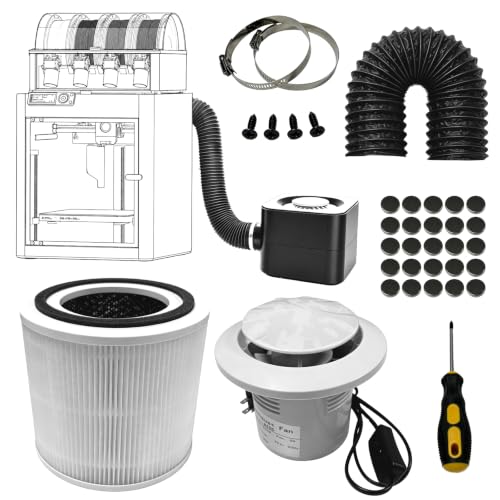
- Made for desktop FDM printers
- HEPA and activated carbon filtration
- Includes hardware and STL shell files
Best For: Makers willing to print and assemble a custom filtration system
Best High-Coverage Room Purifier

- Up to 1,200-square-foot coverage
- Sealed HEPA and carbon filtration
- PM1.0, PM2.5, and PM10 sensors
Best For: Larger hobby rooms needing monitored, quiet air cleaning
Best Purpose-Built Pick – Bambu Lab HEPA H13 Filter System
For shoppers seeking 3d printer air purifiers for small spaces, this purpose-built filtration system is designed to manage emissions from enclosed printers rather than general household pollutants. Its compact 5.3-inch design combines pre-filtration, HEPA H13 filtration, and chemically activated carbon for particles, odors, and selected printing fumes.
Best For: Bambu Lab P1S and X1C owners who want a compact, printer-connected filtration system for home offices, classrooms, or workshops.
Pros:
- Triple-layer design includes a pre-filter, True HEPA H13 filter, and activated carbon bed.
- Targets ultrafine particles and odors associated with materials including PLA, PETG, ABS, ASA, and Nylon.
- Delivers airflow up to 60 m³/h while maintaining a space-saving footprint.
- Tool-free, quick-swap filter modules simplify maintenance.
Cons:
- The default connector is intended for Bambu Lab P1S and X1C; other printers may require adapter kits or printed connectors.
- It is designed primarily for enclosed-printer integration, not general room air purification.
This is a strong small-space option when compatibility with an enclosed 3D printer matters most. Confirm the connector requirements for your printer before buying, particularly if you do not use a Bambu Lab P1S or X1C.
Best Quiet Resin-Printer Option – ELEGOO MARSMATE Air Purifier
The ELEGOO MARSMATE is a specialized choice among 3d printer air purifiers for small spaces, particularly for resin-printing setups. Its activated carbon filter is designed for photocuring applications, while automatic fan control, a VOC sensor, and 35 dB operation make it practical for quieter rooms.
Best For: ELEGOO resin printer users who prioritize low noise, low power consumption, and a filter-change reminder.
Pros:
- Designed specifically for the photocuring field and compatible with numerous ELEGOO resin printers.
- Operates at a stated 35 dB and uses 6 watts of power.
- Built-in VOC sensor monitors concentration and alerts users when the filter needs attention.
- Replaceable activated carbon filter is designed for simple installation.
Cons:
- Its 8.26-by-9.72-by-16.14-inch body is relatively large for a small-space desktop device.
- The supplied filtration is activated carbon rather than a listed HEPA filter.
- The stated filter lifespan is up to two months, so replacement costs and availability should be considered.
MARSMATE makes the most sense when you need a quiet purifier dedicated to a compatible resin printer. Measure your available space first, since its tall profile may be less convenient beside a compact printer.
Best General-Room Alternative – Levoit Core Mini-P Air Purifier
Unlike printer-specific extractors, the Levoit Core Mini-P is a general-purpose option for shoppers comparing 3d printer air purifiers for small spaces. Its 3-in-1 filter addresses dust, smoke, odors, pet dander, and listed VOCs, making it useful when your printer shares space with everyday household activities.
Best For: Bedrooms, offices, dorm rooms, or desktop printing areas where general air cleaning is more important than direct printer enclosure connection.
Pros:
- Compact 6.5-by-6.5-by-10.4-inch design fits on or near a desktop.
- Rated for up to 255 square feet and operates at a stated 25 dB.
- 3-in-1 filtration addresses particles, smoke, odors, pet-related pollutants, and listed VOCs.
- Includes a filter-change indicator, sleep mode, auto-off display, and aroma pad.
Cons:
- It is not presented as a 3D-printer-specific fume extractor or enclosure accessory.
- Its general-purpose design may not capture emissions at the source as directly as a connected printer filter system.
- Performance claims and the 255-square-foot rating apply to room air cleaning, not necessarily printer-chamber extraction.
Choose the Core Mini-P if you want one small purifier for a mixed-use room rather than a dedicated printer attachment. For substantial resin or ABS printing, a source-capture system may be a more targeted complement.
Best Multi-Stage Extractor – BD-60B 3D Printer Air Purifier
The BD-60B is a dedicated option for buyers looking at 3d printer air purifiers for small spaces and wanting direct smoke and fume extraction. Its four-stage arrangement combines pre-filters, HEPA media, and activated carbon, while stepless speed control lets users adjust airflow for different printer setups.
Best For: Bambu Lab and ELEGOO owners who need a flexible, ready-to-use extractor with included hose, joints, magnetic hoods, and replacement pre-filters.
Pros:
- Four-stage filtration uses pre-filter, HEPA, and activated carbon layers for particles and odors.
- Compatible with several Bambu Lab and ELEGOO models, including X1C, P1S, Centauri Carbon, and 2 Series printers.
- Stepless speed adjustment supports different airflow and noise preferences.
- Includes connection accessories, one HEPA/carbon filter, and five pre-filters.
Cons:
- Its stated 55 dB noise level is higher than the quieter alternatives in this roundup.
- At 10.6 pounds, it is less lightweight than some compact desktop purifiers.
- P2S users need to print their own riser bracket, according to the product notes.
The BD-60B offers the most complete extraction-oriented package here, especially if your printer matches its compatibility list. Its heavier build and higher noise level are trade-offs for multi-stage filtration and included connection hardware.
Best Overall – Mintion V1 Enclosed-Printer Filter
For shoppers comparing 3d printer air purifiers for small spaces, the Mintion V1 is a versatile external filtration system for enclosed printers. Its pre-filter, HEPA H13 filter, and activated carbon filter target particles and odors from materials including PLA, PETG, ABS, ASA, and nylon.
Best For: Home workspaces, studios, and enclosed-printer users who want broad filament compatibility.
Pros:
- Three-stage filtration combines a pre-filter, HEPA H13 filter, and activated carbon filter.
- Up to 60 m³/h airflow with a radial fan designed for quiet operation.
- Compact external design works with many enclosed-printer brands using the appropriate adapter.
- Accessible, replaceable filters and included installation accessories simplify maintenance.
Cons:
- Adapters may be needed for brands other than the factory-configured P1S/X1C.
- It is intended for enclosed printers rather than as a standalone room purifier.
The Mintion V1 stands out when you need one compact system that addresses both ultrafine particles and VOC-related odors across several filament types. Verify your printer and adapter requirements before ordering.
Best Mini Option – ELEGOO Mini Air Purifier 2-Pack
If space inside your printer is limited, the ELEGOO Mini Air Purifier 2-pack is a compact option for 3d printer air purifiers for small spaces. Each battery-powered unit uses activated carbon to help control resin odor and measures just 44 × 44 × 107 mm.
Best For: LCD, DLP, and MSLA resin printers with enough internal room for a small purifier.
Pros:
- Very compact design fits compatible LCD 3D printers.
- Activated carbon targets resin odor.
- Rechargeable 2000mAh battery provides at least 24 hours of continuous operation per charge.
- Two units are included, with low listed noise of 10 dB.
Cons:
- It uses activated carbon only, without a HEPA filtration stage.
- Carbon blocks generally need replacement every three to six months, and replacements are sold separately.
- Fit depends on the available space inside the printer.
This is a practical low-profile choice for resin odor control when you prioritize portability and minimal size. Its filtration is more limited than multi-stage systems, so confirm that the unit physically fits your printer.
Best Dedicated Extractor – BD-60C K2/K2 Pro Purifier
BlueDate 3D printer Air Purifier Compatible With CREALITY K2,K2 Pro FDM 3D Printer
Check Price On AmazonThe BD-60C is a dedicated exhaust and filtration unit for compatible Creality printers, making it a targeted pick among 3d printer air purifiers for small spaces. It combines pre-filters, HEPA filtration, and activated carbon with adjustable fan speed for managing particles and odors during printing.
Best For: Creality K2 and K2 Pro owners who want a ready-to-use external extractor.
Pros:
- Four-stage filtration design uses pre-filtration, HEPA, and activated carbon stages.
- Adjustable speed lets users balance airflow and noise.
- Includes a smoke pipe, magnetic suction hoods, power supply, and five pre-filters.
- Metal housing and compact form are designed for K2 and K2 Pro printers.
Cons:
- It is not compatible with the Creality K2 Plus.
- Other printer models require a 3D-printed exhaust-port adapter.
- The listed 55 dB noise level is higher than that of miniature carbon-only purifiers.
Choose the BD-60C when direct exhaust handling and multi-stage filtration matter more than ultra-quiet operation. Its strongest fit is the Creality K2/K2 Pro ecosystem; compatibility should be checked carefully before purchase.
Best Smart Mini Pick – GoveeLife Smart Mini Air Purifier
For shoppers comparing 3d printer air purifiers for small spaces, the GoveeLife Smart Mini is a compact general-purpose option for a bedroom, office, or hobby area. Its HEPA filtration, odor coverage, app controls, and quiet sleep mode make it convenient when you want everyday air cleaning without a large footprint.
Best For: Small rooms and users who want app, Alexa, scheduling, and aromatherapy features.
Pros:
- Compact design rated to purify a 376-square-foot room once per hour.
- App, Alexa, Google Assistant, and IFTTT support provide flexible control.
- Sleep mode operates as quietly as 24 dB.
- HEPA filtration targets smoke, odors, pet hair, pollen, and wildfire smoke.
Cons:
- It does not support 5GHz Wi-Fi.
- The optional air-quality monitor is sold separately for automatic PM2.5-based control.
- It is a general room purifier rather than a purpose-built 3D-printer enclosure system.
This is a strong small-space choice when convenience and quiet operation matter more than direct printer ventilation. For active printing, place it near the printer while maintaining appropriate room ventilation.
Best Purpose-Built DIY Option – 3D Printer Air Purifier
Among 3d printer air purifiers for small spaces, this kit is the most directly focused on desktop FDM printing. It combines HEPA and activated-carbon filtration with a duct and hose hardware, but plan on printing the outer shell yourself before assembly.
Best For: Makers who want a customizable filtration project for a desktop FDM printer.
Pros:
- Designed specifically for most mainstream desktop FDM printers.
- Three-layer filtration uses HEPA and activated carbon to address fine particles, fumes, and odors.
- Package includes the fan, filter cartridge, duct, clamps, screws, magnets, and screwdriver.
- Provided STL files allow customization of the shell’s shape, size, and color.
Cons:
- The outer housing must be 3D printed by the user.
- Assembly is required, so it is less convenient than a ready-to-use room purifier.
- The filter cartridge requires periodic replacement.
This is the clearest match for a printer-centered setup, especially for hobbyists comfortable with printing parts and following an assembly tutorial. Its compact footprint is listed as 9.06 by 9.06 by 7.09 inches, but confirm that the duct arrangement suits your printer and workspace.
Best High-Coverage Room Purifier – Levoit Eleva 300X
For a larger hobby room or shared living area, the Levoit Eleva 300X offers substantially more stated coverage than many compact 3d printer air purifiers for small spaces. Its sealed HEPA design, activated-carbon filter, air-quality sensors, and smart controls make it suited to monitoring and cleaning the surrounding room while a printer runs.
Best For: Larger rooms where broad coverage, air-quality monitoring, and quiet operation are priorities.
Pros:
- Rated to cover up to 1,200 square feet and provides 161 CFM CADR.
- Fully sealed HEPA filtration captures 99.97% of allergens down to 0.3 microns, according to the supplied specifications.
- PM1.0, PM2.5, and PM10 sensors provide real-time air-quality information.
- VeSync app, Alexa, Google Assistant, scheduling, and filter-life tracking add convenient control.
Cons:
- Its 15.1-inch height and 7.7-pound weight make it less compact than mini purifiers.
- The listed 1,200-square-foot coverage may be more than needed for a very small workspace.
- It is a room purifier, not a dedicated printer-mounted or ducted filtration kit.
The Eleva 300X is a practical choice when the printer shares air with a larger room and you want measurable air-quality feedback. For concentrated printing emissions, position it near the workspace and continue using sensible ventilation practices.
How We Picked the Best 3d Printer Air Purifiers for Small Spaces
We focused on compact purifiers that suit desktop printers, bedrooms, dorms, offices, and enclosed hobby areas. The selection includes printer-specific systems for Bambu Lab, ELEGOO, and Creality machines, along with portable room purifiers that can filter the surrounding air.
We compared the stated filtration approach, including HEPA or HEPA-style particle filters and activated carbon for odors and some gaseous pollutants. We also considered footprint, compatibility, airflow claims, controls, replacement-filter practicality, and whether a unit is better suited to an enclosure or an entire small room.
Quick Comparison
| Type | Best For | Main Advantage | Watch For |
|---|---|---|---|
| Printer-mounted filter | Enclosed or compatible 3D printers | Targets emissions close to the source | Limited compatibility and airflow |
| Mini desktop purifier | Small workspaces and short print sessions | Small footprint and simple placement | May have limited room coverage |
| Compact room purifier | Bedrooms, offices, and hobby rooms | Circulates and filters room air | Requires more floor or desk space |
| Smart purifier | Users wanting remote controls | App, scheduling, and voice features | Extra connectivity may not improve filtration |
Key Buying Factors for 3d Printer Air Purifiers for Small Spaces
Filtration and Materials
A HEPA filter is primarily intended to capture airborne particles, while activated carbon helps reduce odors and can adsorb some VOCs. Carbon quantity matters, so do not judge gas filtration solely by the word “carbon” in a listing. If you print ABS, ASA, nylon, or other higher-emission materials, source control and ventilation remain especially important.
Compatibility and Placement
Check the exact printer model, enclosure design, mounting method, power connection, and available clearance before buying a printer-specific system. A room purifier should be positioned where it can draw in contaminated air without blocking the printer, exhaust, or workspace.
Airflow, Coverage, and Noise
Match the purifier’s stated airflow or room rating to the size of the space. For a small enclosure, a compatible high-flow filter may be more useful than a large room unit. For a bedroom or office, prioritize sufficient air changes at a noise level you can tolerate during long prints or sleep.
Maintenance and Running Costs
Look for replacement filters that are easy to source and reasonably priced. Check filter-life estimates, prefilter cleaning instructions, power consumption, and whether replacement indicators are available. A purifier that is inexpensive initially can cost more if its filters are difficult to replace.
Who Should Buy Which 3d Printer Air Purifiers for Small Spaces?
Choose a printer-specific filter when you own a compatible enclosed machine and want emissions addressed near the print chamber. Pick a mini purifier when desk space is limited or you need a simple supplemental filter beside a printer. Choose a compact room purifier for open-frame printers, shared bedrooms, offices, or any space where emissions spread beyond the machine. A smart model is worthwhile if scheduling, app monitoring, or Alexa control fits your routine.
No purifier replaces ventilation, an enclosure designed for the printer, safe material handling, or following the manufacturer’s recommendations. For frequent printing, especially with materials that produce stronger odors or emissions, combine filtration with sensible ventilation and avoid occupying the room during printing when appropriate.