The best sensor microcontroller starter kits make it easier to move from wiring basics to working electronics projects. The options in this roundup range from compact sensor assortments to fuller kits with boards, displays, motors, tutorials, and IoT features.
Before buying, confirm board compatibility, included components, documentation quality, and the kinds of projects you want to build. A kit designed for Arduino beginners may not be the best fit for ESP32 networking or Raspberry Pi experimentation.
Best 10 Sensor Microcontroller Starter Kits Picks for 2026
Versatile Sensor Lab
37-in-1 Arduino Sensor Modules Kit

- 37 modules for sensing, displays, timing, and control
- Works with compatible UNO, MEGA, Nano, ESP-32, and STM32 boards
- Tutorials, wiring diagrams, and example code included
Best For: Arduino learners building a broad sensor and electronics lab
Organized Learning Kit
46-in-1 TinkerBlock Sensor Kit

- 46 labeled modules with displays, sensors, inputs, and memory
- Supports digital, analog, I2C, SPI, PWM, and IR interfaces
- Storage case, tutorials, wiring diagrams, and reference code included
Best For: Beginners and educators using ESP32, Pico, STM32, or Arduino boards
Connected Project Starter

- ESP-32 board with dual-core processing, Wi-Fi, and Bluetooth 4.2
- Includes 35-plus modules and components for electronics projects
- 30-plus guided projects with code and circuit diagrams
Best For: Beginners building connected Arduino IDE and IoT projects
Budget Sensor Assortment
37-in-1 Arduino and Raspberry Pi Sensor Kit

- 37 modules for light, sound, temperature, touch, motion, and more
- Includes joystick, relay, encoder, and obstacle-avoidance modules
- Designed for Arduino and Raspberry Pi projects
Best For: Hobbyists expanding an existing Arduino or Raspberry Pi setup
Best Wi-Fi Sensor Kit for Beginners
LAFVIN ESP32 Basic Starter Kit

- ESP32 board with Wi-Fi and Bluetooth
- Includes OLED, DHT11, PIR, and obstacle sensors
- Tutorial includes lessons and example code
Best For: Introductory electronics, programming, and IoT projects
Best Project-Focused Sensor Kit
ELEGOO UNO R3 Super Starter Kit

- Includes 22-plus guided hands-on projects
- Combines sensors, motors, displays, and inputs
- Solderless setup supports beginner learning
Best For: Arduino lessons, STEM classes, and family projects
Best Simple ESP32 IoT Learning Kit
QIQIAZI ESP32 Sensor Starter Set

- ESP32 board supports Wi-Fi and Bluetooth
- Includes GPIO, I2C, SPI, UART, and USB
- Arduino IDE compatible for beginner projects
Best For: Introductory ESP32 programming and IoT exploration
Best All-Around Starter
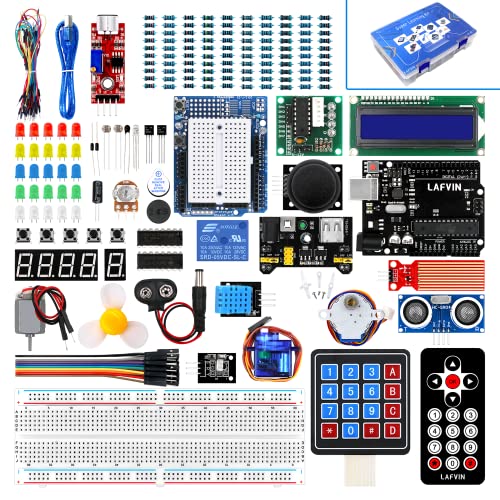
- 20+ guided lessons with code and libraries
- Includes displays, sensors, and three motor types
- Works with Arduino IDE on major desktop operating systems
Best For: Beginners wanting varied Arduino-compatible electronics projects
Best Sensor-Focused Value

- Includes 37 sensors and modules
- 37 illustrated, step-by-step Arduino projects
- Controller not included; supports several Arduino boards and Raspberry Pi
Best For: Learners building a sensor collection around an existing controller
Best for IoT Learning

- Original Arduino Uno R4 WiFi included
- 300+ components and 50+ guided projects
- 60+ video lessons plus WiFi and Bluetooth projects
Best For: Learners progressing from basic circuits to Arduino IoT projects
Versatile Sensor Lab – 37-in-1 Arduino Sensor Modules Kit
The ELEGOO 37-in-1 kit is a practical choice for building a sensor microcontroller starter kit around a compatible UNO R3, MEGA 2560, Nano, ESP-32, or STM32 board. Its mix of input sensors, displays, timing parts, and control modules supports guided classroom experiments and custom Arduino projects.
Best For: Arduino users who already have a controller board and want broad coverage for prototyping, STEM activities, and maker builds.
Pros:
- Includes 37 modules covering motion, distance, light, sound, temperature, touch, and more.
- Adds useful project-building parts such as an LCD1602, real-time clock, joystick, relay, buzzers, and RGB LEDs.
- Includes tutorials, datasheets, wiring diagrams, and example code for supported boards.
Cons:
- Controller board, breadboard, USB cable, and jumper wires are not included.
- Power and pin requirements need to be checked before wiring.
This is a strong expansion kit rather than a complete plug-and-play starter package. It offers particularly good variety for learners who want to move from individual sensor tests to clocks, alarms, displays, and automated experiments.
Organized Learning Kit – 46-in-1 TinkerBlock Sensor Kit
The Lonely Binary 46-in-1 kit gives sensor microcontroller starter kit shoppers an unusually broad, labeled collection for ESP32, Raspberry Pi Pico, STM32, and Arduino-compatible projects. Standard 2.54mm connections, printed pin labels, and included reference materials make it approachable for experimentation without soldering.
Best For: Beginners, STEM educators, and makers who want many clearly identified modules for classroom activities, games, displays, and sensor experiments.
Pros:
- Includes 46 modules, including a TFT LCD, LED matrix, displays, joystick, keypad, memory, and multiple sensor types.
- Supports digital, analog, I2C, SPI, PWM, and IR interfaces across major microcontroller platforms.
- Labeled PCBs, wiring diagrams, reference code, tutorials, and a storage case improve organization and setup.
Cons:
- Development board and jumper wires are not included.
- The large module selection may require learning several interface types and voltage requirements.
Its labeling and organization set it apart from loose assortments, while the wide interface support leaves room to advance beyond basic sensor readings. Plan to supply a compatible board and jumper wires separately.
Connected Project Starter – ESP-32 Super Starter Kit
The ELEGOO ESP-32 Super Starter Kit is a complete-leaning option for sensor microcontroller starter kit buyers who want wireless projects as well as basic electronics. Its dual-core ESP-32 board includes Wi-Fi and Bluetooth 4.2, while the included components support more than 30 guided Arduino IDE projects.
Best For: Beginners and makers progressing from basic circuits to IoT, smart-home, remote-control, weather-station, and interactive-device projects.
Pros:
- Includes an ESP-32 development board with dual-core processing, Wi-Fi, Bluetooth, and USB-C.
- Provides more than 35 modules and components, including sensors, displays, motors, an OLED screen, servo, and keypad.
- Offers 30-plus projects with code, circuit diagrams, and step-by-step instructions.
Cons:
- The kit centers on the included ESP-32 platform rather than being a controller-free module assortment.
- Its broader IoT capabilities may be more than needed for simple sensor-only exercises.
Choose this kit when connectivity is part of the learning goal. The included board and guided projects create a clearer path to working prototypes than a module-only assortment, especially for users interested in Wi-Fi and Bluetooth applications.
Budget Sensor Assortment – 37-in-1 Arduino and Raspberry Pi Sensor Kit
HiLetgo 37 Sensor Assortment Kit for Arduino & Raspberry Pi - 37 in 1 Robot Project Starter Kit
Check Price On AmazonThe HiLetgo 37 Sensor Assortment is a straightforward sensor microcontroller starter kit for Arduino and Raspberry Pi experiments. It focuses on individual detection, input, lighting, sound, magnetic, temperature, and relay modules, making it useful for exploring common robot-project building blocks.
Best For: Hobbyists and learners who want a large selection of basic sensor modules for Arduino or Raspberry Pi projects.
Pros:
- Includes 37 different modules across light, sound, temperature, touch, motion, magnetic, and infrared categories.
- Provides project-oriented parts such as a joystick, rotary encoder, relay, obstacle-avoidance sensor, and heartbeat module.
- Compatible devices listed include Arduino and Raspberry Pi.
Cons:
- The supplied notes do not indicate that a controller board, wiring, or tutorial materials are included.
- The assortment includes many basic modules, so users may need to source additional project hardware.
This kit is best viewed as a broad parts assortment for trying common sensor functions rather than a guided curriculum. It can be a cost-conscious way to expand an existing Arduino or Raspberry Pi setup if you already have the supporting hardware.
Best Wi-Fi Sensor Kit for Beginners – LAFVIN ESP32 Basic Starter Kit
If you want a straightforward way to explore sensor microcontroller starter kits, this LAFVIN ESP32 set offers a beginner-oriented starting point. It combines an ESP32 board with Wi-Fi and Bluetooth connectivity, an OLED display, breadboard, and practical sensors for Arduino IDE projects.
Best For: Beginners learning introductory electronics, programming, sensors, and basic IoT projects.
Pros:
- Includes an ESP32 development board with Wi-Fi and Bluetooth.
- Provides useful modules including DHT11, PIR motion, obstacle-avoidance, photosensitive, and OLED modules.
- Includes a tutorial with lessons and example code for assembly and programming.
- Offers a broad selection of resistors, LEDs, switches, a relay, buzzer, and jumper wires.
Cons:
- The kit is positioned for introductory learning rather than advanced development.
- Users need to download the tutorial after receiving the kit.
With wireless connectivity and a varied collection of sensor and output modules, this is a practical choice for beginners who want to move from basic Arduino IDE code into simple connected projects.
Best Project-Focused Sensor Kit – ELEGOO UNO R3 Super Starter Kit
For learners comparing sensor microcontroller starter kits around structured projects, the ELEGOO UNO R3 kit stands out with 22-plus guided lessons. It pairs an Arduino-compatible controller with sensors, displays, motors, and a solderless breadboard for hands-on experimentation.
Best For: Families, homeschool learners, coding clubs, STEM classrooms, and beginners who want guided Arduino projects.
Pros:
- Includes more than 22 guided projects covering sensing, displays, inputs, and motion.
- Comes with DHT11 and ultrasonic sensors, joystick, IR receiver, LCD1602, servo, and stepper motor.
- Solderless breadboard and pre-soldered LCD help beginners focus on wiring and code.
- Includes example code and support for Arduino IDE.
Cons:
- The UNO R3 platform does not list built-in Wi-Fi or Bluetooth connectivity.
- The power module should not be used with voltage higher than 9V.
- Some younger learners may need experienced adult supervision.
This is a strong all-purpose learning kit when project variety matters more than wireless IoT features. Its organized components and guided lessons make it especially suitable for classroom or family instruction.
Best Simple ESP32 IoT Learning Kit – QIQIAZI ESP32 Sensor Starter Set
This QIQIAZI set is a compact option for shoppers seeking sensor microcontroller starter kits for introductory IoT learning. Its ESP32 ESP-32S board supports Wi-Fi, Bluetooth, GPIO, I2C, SPI, UART, and USB, while the included modules enable basic sensor and circuit experiments.
Best For: Beginners, students, makers, and home users exploring ESP32 programming and foundational IoT concepts.
Pros:
- Uses an ESP32 board with dual-core processing and integrated Wi-Fi and Bluetooth.
- Supports common interfaces including GPIO, I2C, SPI, UART, and USB.
- Compatible with Arduino IDE for writing, uploading, and testing programs.
- Suitable for STEM education, classroom activities, and DIY practice.
Cons:
- The supplied notes do not specify the individual sensors or modules included.
- The kit is described for foundational projects rather than advanced applications.
Choose this kit if wireless ESP32 capability and broad interface support are priorities. Its general-purpose learning focus makes it a flexible entry point, though shoppers wanting a precisely itemized component list may prefer a more detailed kit.
Best All-Around Starter – LAFVIN Super Starter Kit
The LAFVIN Project Super Starter Kit is a practical entry point for anyone comparing sensor microcontroller starter kits. It combines Arduino-compatible boards, sensors, displays, motors, and a tutorial manual with more than 20 guided lessons, making it suitable for learning electronics and programming through hands-on projects.
Best For: Beginners who want a broad Arduino-compatible kit with both sensor experiments and motor, display, and actuator projects.
Pros:
- Includes a tutorial manual with more than 20 lessons, code, libraries, and datasheets.
- Includes LCD displays, a 7-segment display, servo, stepper, and DC motors.
- The LCD 1602 module includes a pin header, so it does not require soldering.
- Works with Windows, macOS, and Linux through USB and is compatible with the Arduino IDE.
Cons:
- The kit’s wireless compatibility is limited to infrared.
- The included components may be more extensive than needed for someone focused only on sensor modules.
Choose this LAFVIN kit if you want a single package that moves beyond basic sensors into displays, motors, and other Arduino-compatible electronics. Its included documentation also makes it a strong starting point for structured self-guided learning.
Best Sensor-Focused Value – KEYESTUDIO 37-in-1 Sensor Kit
The KEYESTUDIO 37-in-1 Sensor Kit focuses specifically on learning sensor fundamentals. With 37 sensors and modules, step-by-step Arduino tutorials, and modules designed for solderless breadboards or Dupont wires, it is a straightforward option among sensor microcontroller starter kits—though the main controller must be purchased separately.
Best For: Beginners who already own, or plan to buy, an Arduino or Raspberry Pi and want a broad collection of introductory sensor modules.
Pros:
- Provides 37 basic sensors and modules for exploring different inputs and functions.
- Includes 37 step-by-step projects with pictures and code.
- Modules expose three to four pins for easy breadboard or Dupont-wire connections.
- Compatible with Arduino R3, Mega 2560, Nano, Raspberry Pi, and other platforms.
Cons:
- The main controller is not included.
- The supplied tutorials are for Arduino rather than Raspberry Pi.
- It is focused on sensors and modules rather than a complete standalone starter setup.
This is a sensible add-on for learners who already have compatible hardware and want maximum sensor variety at the center of their projects. Confirm that you have a controller, breadboard, and connecting wires before ordering.
Best for IoT Learning – SunFounder Elite Explorer Kit
The SunFounder Elite Explorer Kit is a complete, connected learning package for buyers seeking sensor microcontroller starter kits with modern wireless features. It includes an original Arduino Uno R4 WiFi, more than 300 components, and 50-plus projects spanning basic electronics, creative builds, and IoT applications.
Best For: Beginners, students, teachers, and engineers who want guided Arduino projects that can expand into WiFi- and Bluetooth-enabled IoT experiments.
Pros:
- Includes the original Arduino Uno R4 WiFi with built-in WiFi and Bluetooth.
- Offers more than 300 components and sensors for a wide range of projects.
- Includes 60-plus video lessons and more than 50 projects with open-source code.
- Supports Arduino C++ programming and Arduino IoT Cloud integration.
Cons:
- The large component count may feel overwhelming for someone seeking only basic sensor exercises.
- Its strongest connected-project features depend on using the included Uno R4 WiFi board.
For buyers who want a complete curriculum and a path from beginner circuits to IoT, this is the most feature-rich option in the group. The included support resources and one-year guarantee add reassurance for new learners working through programming challenges.
How We Picked These Sensor Microcontroller Starter Kits
We focused on kits that support hands-on learning across common platforms, including Arduino Uno and Nano boards, ESP32 development boards, Raspberry Pi, Pico, STM32, and Mega-compatible hardware. We also considered the range of sensors and modules, the usefulness of included tutorials, board and software compatibility, expansion potential, and suitability for beginners.
A sensor-only assortment can be a good value if you already own a compatible controller. Full starter kits cost more but may include the board, breadboard, jumper wires, displays, motors, and other parts needed to begin immediately. Because component quality and exact contents can vary by seller or revision, check the current parts list before ordering.
Quick Comparison
| Kit type | Best for | What to check |
|---|---|---|
| 37-in-1 sensor assortment | Basic sensor experiments and Arduino projects | Whether a controller board is included |
| ESP32 starter kit | Wi-Fi, Bluetooth, and IoT learning | ESP32 board version and Arduino IDE support |
| Arduino project kit | Structured beginner lessons and robotics | Tutorial quality and included accessories |
| Multi-platform sensor kit | Experimenters using Pico, STM32, or Raspberry Pi | Voltage levels, pinouts, and example code |
| Advanced Uno R4 or IoT kit | Connected projects and broader expansion | Wireless features, displays, and ecosystem support |
Key Buying Factors for Sensor Microcontroller Starter Kits
Board Compatibility
Match the kit to the board you own or plan to buy. Arduino-compatible modules often use simple digital or analog connections, while ESP32 projects may require attention to 3.3-volt logic, pin limitations, and wireless libraries. A kit advertised for several platforms is useful, but verify that examples and wiring diagrams cover your preferred board.
Component Range and Usefulness
Look beyond the headline number of parts. Useful kits combine practical inputs—such as light, temperature, sound, motion, and buttons—with outputs including LEDs, buzzers, displays, servos, and relays. A well-organized assortment with standard headers and labeled modules can be more valuable than a larger collection of repetitive parts.
Documentation and Learning Support
Clear tutorials reduce setup time. Look for wiring diagrams, tested code, library guidance, troubleshooting notes, and projects that progress from simple readings to interactive builds. PDF or online documentation is especially important when the kit is intended for children, classrooms, or first-time programmers.
Power, Safety, and Expansion
Check whether the kit includes a power supply, USB cable, breadboard, jumper wires, and resistors. Confirm voltage requirements before connecting modules, particularly when mixing 5-volt Arduino hardware with 3.3-volt ESP32 boards. Expansion headers, standard pin layouts, and broad library support help a kit remain useful after the introductory projects.
Who Should Buy Which Sensor Microcontroller Starter Kits?
Choose a basic Arduino project kit if you want the clearest beginner path, guided lessons, and conventional electronics exercises. Pick a 37-in-1 sensor assortment if you already own a compatible controller and mainly need variety for experiments. ESP32 kits are the better choice for Wi-Fi, Bluetooth, web dashboards, and connected-home projects.
For learners who use several development boards, a multi-platform kit offers flexibility, provided its voltage requirements and examples are clearly documented. More advanced users may prefer an Uno R4 WiFi or similarly connected kit with stronger expansion potential. Whichever option you choose, prioritize reliable documentation and compatible hardware over the largest advertised component count.