The best programmable bench power supplies make it easier to deliver stable, repeatable power while testing circuits, charging batteries, and troubleshooting electronics. The models in this roundup range from compact single-output units to multi-channel laboratory supplies.
We compare output range, resolution, programming features, controls, safety functions, and connectivity so you can choose a supply that fits your bench, budget, and workload.
Best 10 Programmable Bench Power Supplies Picks for 2026
Best High-Power Compact Pick
OWON SPE8205 80V/20A Programmable Supply
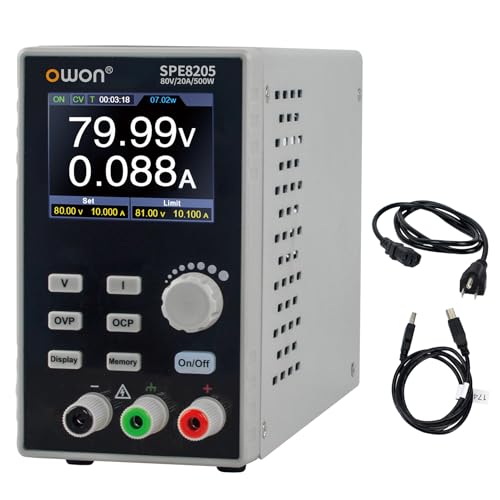
- 80V, 20A, and 500W constant-power output
- Waveform and timed output programming
- Compact design with extensive protection
Best For: High-power bench testing in a compact footprint
Best Multi-Channel Lab Choice
UNI-T UDP3305S-E Four-Channel Supply

- Four outputs with up to 328W total power
- Up to 2,048 list entries and 99,999 cycles
- USB, RS232, LAN, and digital I/O interfaces
Best For: Automated multi-output laboratory testing
Best Triple-Output Linear Pick
Siglent SPD3303X-E Triple Output Supply
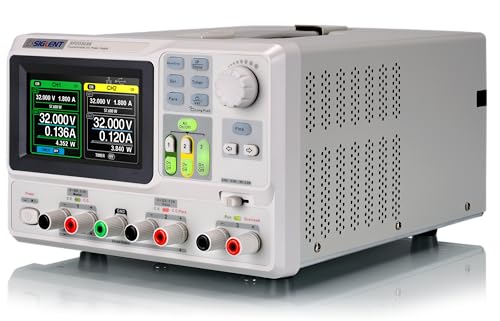
- Two isolated 32V/3.2A outputs
- Selectable 2.5V, 3.3V, or 5V channel
- Series, parallel, timing, and graph functions
Best For: Multi-rail electronics development and bench work
Best Value High-Current Pick
Kiprim DC620S 60V/20A Programmable Supply
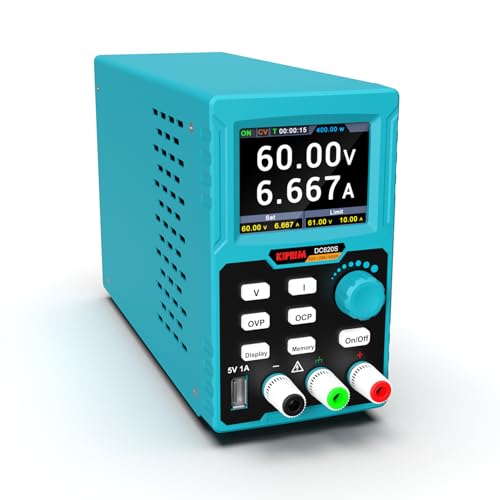
- 0–60V and 0–20A output, rated at 400W
- Four presets and 10-point waveform editing
- USB charging, PC control, and 12-month warranty
Best For: High-current workshop and lab applications
Precision Control Pick

- Digit-selecting encoder for fine adjustment
- Output enable/disable and OCP protection
- Four-digit display plus 18W USB charging
Best For: Hands-on electronics repair and prototyping
Most Versatile Programmable Pick

- Stores four custom output settings
- Edits 10-point voltage/current waveforms
- Combines supply and multimeter functions
Best For: Multi-function electronics benches and waveform testing
Battery-Charging Pick

- Intelligent charging stops when the battery is full
- Dual USB-A and USB-C 20W ports
- Compact 32V, 10A supply with encoder controls
Best For: Battery work, development boards, and space-conscious benches
Best Programmable Precision Pick

- 0–30V and 0–10A regulated output
- 10-point waveform programming with four memories
- Color LCD, PC control, and multiple protections
Best For: Waveform programming and repeatable bench testing
Best Compact Programmable Lab Supply

- 0–30V, 0–10A, and 300W output
- Four memories plus timed waveform editing
- Compact body with TFT display and PC software
Best For: Portable, space-saving programmable bench work
Best Simple Adjustable Bench Supply

- 0–30V and 0–10A adjustable output
- Four-digit V/A/W display with fine resolution
- Compact design with automatic CV/CC modes
Best For: Everyday electronics testing and hobby projects
Best High-Power Compact Pick – OWON SPE8205 80V/20A Programmable Supply
The OWON SPE8205 is a strong option for shoppers comparing programmable bench power supplies with high output capacity in a compact enclosure. It delivers up to 80V, 20A, and 500W within its constant-power design, while its display and programmable output functions support repeatable bench testing.
Best For: Users who need high voltage and current capacity, waveform or timed output editing, and PC control in a lightweight bench supply.
Pros:
- Up to 80V, 20A, and 500W output capacity.
- Supports four memory shortcuts, waveform editing, and timing output for up to 10 groups.
- 2.8-inch display shows set and actual voltage, current, power, runtime, and channel status.
- Includes current-limit, thermal, overvoltage, short-circuit, and overpower protection.
Cons:
- The display is smaller than the 4.3-inch screen on some competing models.
- Its rated power means voltage and current cannot necessarily reach their maximums simultaneously.
- The supplied warranty is listed as one month.
Choose the SPE8205 when compact size and high output range matter more than multiple isolated channels. Its USB interfaces and programmable functions make it especially practical for recurring tests and workshop use.
Best Multi-Channel Lab Choice – UNI-T UDP3305S-E Four-Channel Supply
The UNI-T UDP3305S-E stands out among programmable bench power supplies for its four-channel layout and extensive test automation features. It combines 328W of total power with 10mV/1mA resolution, built-in series and parallel operation for its main channels, and several remote-control interfaces.
Best For: Laboratories and engineering benches that need multiple outputs, automated test sequences, and USB, RS232, LAN, or digital I/O connectivity.
Pros:
- Four channels: two 0–30V/5A channels, one 0–6V/3A channel, and a 5V/2A channel.
- List and delay functions support up to 2,048 data sets and 99,999 cycles.
- CH1 and CH2 can be connected in series or parallel internally.
- 4.3-inch display shows set values, actual output, and protection values in real time.
Cons:
- At 12.5 kg, it is substantially heavier than compact single-channel supplies.
- Its maximum listed output is 328W, below some higher-power single-output alternatives.
- The feature set may be more than needed for straightforward manual power testing.
The UDP3305S-E is the most automation-oriented choice in this group. Its channel flexibility and large test-sequence capacity make it a good fit for development, aging, and cycle-testing workflows.
Best Triple-Output Linear Pick – Siglent SPD3303X-E Triple Output Supply
The Siglent SPD3303X-E is a practical choice among programmable bench power supplies when you want three controlled outputs and linear power-supply design. It provides two isolated 32V/3.2A outputs plus a selectable fixed-output channel, with independent, series, parallel, and timing modes.
Best For: Electronics benches that need multiple isolated rails, flexible series or parallel combinations, and a dependable linear supply architecture.
Pros:
- Two independent, controlled, and isolated outputs rated at 32V/3.2A each.
- Third output supports 2.5V, 3.3V, or 5V at 3.2A.
- Offers independent, series, parallel, and timing output modes.
- Includes trending graphs and a three-year warranty.
Cons:
- Total output power is limited to 220W.
- The third channel is selectable at fixed low-voltage levels rather than continuously adjustable.
- Its 17.6-pound weight makes it less portable than compact supplies.
The SPD3303X-E is well suited to digital and analog projects requiring several rails at once. It is less appropriate if your priority is maximum voltage, current, or total wattage from a single output.
Best Value High-Current Pick – Kiprim DC620S 60V/20A Programmable Supply
The Kiprim DC620S offers a high-current alternative for shoppers evaluating programmable bench power supplies on a 110V input. Its 0–60V, 0–20A, 400W rating is paired with a color display, four memory presets, editable waveform points, USB connectivity, and a 12-month warranty.
Best For: Workshops and labs that need programmable 60V/20A output, quick preset recall, and software control without moving to a multi-channel instrument.
Pros:
- Provides 0–60V and 0–20A output with 10mV voltage and 1mA current resolution.
- Stores four channel parameter sets and supports 10 editable waveform points.
- Front 5V/1A USB port supports charging, while the rear port supports upgrades and PC control.
- Includes overvoltage, overcurrent, and overheat protection with intelligent fan cooling.
Cons:
- It cannot deliver 60V and 20A simultaneously because of the 400W power limit.
- It uses a 110V input according to the supplied specifications.
- The listed protection threshold and operating details may require careful setup for sensitive devices.
The DC620S balances substantial output capability with useful programming features and a longer stated warranty than the OWON model. It is a compelling single-channel choice for users who can work within its 400W limit and 110V input.
Precision Control Pick – NANKADF 30V 10A Bench Supply
For straightforward programmable bench power supplies work, the NANKADF 30V 10A model emphasizes precise manual setting and clear output control. Its encoder lets you select individual digits, while the four-digit display shows voltage and current readings with fine resolution.
Best For: Electronics repair, prototyping, and users who want accurate front-panel adjustment with basic safety features.
Pros:
- Encoder control supports 0.01V and 0.001A display resolution.
- Output enable/disable button helps prevent accidental power delivery.
- Includes OCP, constant-voltage and constant-current modes, and an 18W USB charging port.
Cons:
- It is a manually adjusted supply rather than a memory- or waveform-oriented programmable model.
- The supplied notes do not list computer-control connectivity.
This is a practical choice when precise knob-based adjustment matters more than advanced sequencing. The output button, OCP function, and readable display add useful day-to-day safeguards.
Most Versatile Programmable Pick – Kiprim DC310Pro 2-in-1
The Kiprim DC310Pro stands out among programmable bench power supplies by combining a 0–30V, 0–10A supply with a built-in multimeter. It also adds four saved settings and editable waveform sequences, making it suitable for projects that need more than basic fixed output.
Best For: Electronics workbenches where programmable output, measurement, and reduced instrument clutter are priorities.
Pros:
- Stores four custom settings for quick recall.
- Supports editable 10-point waveform output sequences.
- Built-in multimeter measures voltage, current, resistance, continuity, capacitance, and more.
- Provides OVP, OCP, a color LCD, and a 5V/1A USB charging output.
Cons:
- The added multimeter and programming features may be unnecessary for simple bench-supply tasks.
- Its plastic/polycarbonate enclosure may not suit users seeking a metal chassis.
Choose this model when flexibility is the priority. Memory presets, waveform editing, and integrated measurements give it a broader role than a conventional adjustable supply, although the extra functions can add complexity.
Battery-Charging Pick – Jesverty SPS-3010C 32V 10A
The Jesverty SPS-3010C is a compact option for programmable bench power supplies users who also charge batteries or power development boards. Coarse and fine encoder controls simplify setting voltage and current, while the dedicated charging mode can stop automatically when a battery is full.
Best For: Compact workbenches, battery charging, Arduino or Raspberry Pi projects, and repair tasks.
Pros:
- Coarse/fine encoders provide 0.01V and 0.001A setting resolution.
- Intelligent charging includes reverse-connection protection and automatic full-charge stopping.
- Offers USB-A and USB-C 20W quick-charge ports.
- Includes output control, OCP, selectable 115V/230V input, and temperature-regulated cooling.
Cons:
- The supplied notes do not mention saved presets or waveform programming.
- Its 2.5-pound plastic/polycarbonate construction may feel less substantial than larger bench units.
This model is especially appealing if charging and compact size are as important as adjustable DC output. Its dedicated CHG function and dual fast-charge ports add convenience for mixed electronics work.
Best Programmable Precision Pick – Kiprim DC310S
The Kiprim DC310S is a practical choice for programmable bench power supplies when you want 0–30V, 0–10A output plus detailed monitoring. Its color LCD, waveform editing, preset memory, PC connectivity, and multiple protections make it suitable for repeatable bench testing and development work.
Best For: Users who need waveform programming, PC control, and precise on-screen measurements.
Pros:
- Stores four parameter sets and supports 10-point waveform editing.
- 2.8-inch color LCD displays voltage, current, power, runtime, and channel status.
- Offers overvoltage, overcurrent, overheat, and fan-assisted cooling features.
- Includes rear PC/firmware USB connectivity and a front 5V/1A USB port.
Cons:
- Its 8.9-inch depth takes more bench space than some compact alternatives.
- Operation is limited to a single 0–30V, 0–10A output range.
Choose the DC310S if programming flexibility and a clear color display matter more than having the smallest enclosure. The included cable, fuse, power cord, and software-oriented connectivity also make it a well-equipped starting point.
Best Compact Programmable Lab Supply – OWON SPE3103
The OWON SPE3103 is a compact option among programmable bench power supplies, combining 0–30V, 0–10A output with a 2.8-inch TFT display and PC software support. It provides memory presets, timed waveform output, and protective functions while taking up relatively little space.
Best For: Space-conscious users who want programmable output and PC communication in a lightweight bench unit.
Pros:
- Provides four memory shortcuts and editable 10-group timed waveform output.
- Displays set and actual voltage/current, power, execution time, and output status.
- Includes current limiting with automatic constant-current operation.
- Compact 3.2 × 8.9 × 5.6-inch design weighs about 3.3 pounds.
Cons:
- The supplied specifications identify a single output channel.
- Its programmable output range is 0–30V and 0–10A, rather than a higher-voltage range.
The SPE3103 stands out when bench space and portability are priorities. It retains useful programming and monitoring features, making it a balanced fit for electronics work that does not require multiple channels.
Best Simple Adjustable Bench Supply – Jesverty SPS-3010
The Jesverty SPS-3010 is a straightforward option for programmable bench power supplies if your priority is accurate adjustment and live output monitoring rather than waveform sequencing. Its 0–30V, 0–10A range, coarse/fine control approach, and automatic CV/CC operation suit general electronics testing.
Best For: Hobbyists and technicians who need a compact, adjustable supply for everyday voltage and current testing.
Pros:
- Bright four-digit display shows real-time voltage, current, and power.
- Offers 0.01V, 0.001A, and 0.1W display resolution.
- Automatically switches between constant-voltage and constant-current modes.
- Compact 7.1 × 3.35 × 6.1-inch body weighs about 2.5 pounds.
Cons:
- The supplied notes do not list PC control, memory presets, or waveform programming.
- Included test leads are described as giveaway leads and may not suit sustained high-current use.
- The display uses red LED technology rather than a color LCD.
The SPS-3010 is a sensible choice for routine bench work where compact size, simple controls, and readable measurements are more important than advanced programming. Plan to use higher-capacity test leads for demanding high-current projects.
How We Picked the Best Programmable Bench Power Supplies
We focused on supplies that offer adjustable DC output, useful voltage and current ranges, clear displays, and practical control features. We also considered output power, channel count, adjustment resolution, protection systems, remote-control potential, and day-to-day usability. Because requirements vary widely, this list includes laboratory-style linear supplies, higher-power programmable models, and more affordable switching units.
Specifications can vary by operating mode, input conditions, and channel configuration. Before ordering, confirm the manufacturer’s limits for continuous output, combined channel power, and included accessories.
Quick Comparison
- For multi-rail testing: Choose a four-channel or triple-output laboratory supply.
- For higher-power projects: Look for models rated around 300W to 500W with the voltage and current range your load requires.
- For compact electronics benches: A 0–30V or 0–32V, 0–10A supply covers many development and repair tasks.
- For occasional charging and testing: USB, USB-C, and intelligent charging modes can add useful convenience.
- For repeatable test sequences: Prioritize programmable presets, output control, and computer connectivity.
Key Buying Factors for Programmable Bench Power Supplies
Voltage, Current, and Total Power
Make sure the maximum voltage and current meet your project’s needs, then calculate total wattage. A supply rated for 30V at 10A may not deliver both limits simultaneously, so check its power rating and operating specifications.
Resolution, Regulation, and Noise
Finer voltage and current resolution helps with sensitive circuits and repeatable experiments. Linear supplies generally appeal to users who prioritize low noise, while switching supplies can provide higher power in a smaller, lighter package. Regulation and ripple specifications matter more than display digits alone.
Channels and Tracking
Multiple isolated outputs are useful for analog and digital rails, dual-rail circuits, and simultaneous testing. Check whether channels can be connected in series or parallel and whether tracking controls are available.
Programming and Controls
Look for presets, output-enable controls, programmable sequences, remote sensing, or PC interfaces if you need automated testing. An encoder and clearly separated voltage and current controls make manual adjustments faster and safer.
Protection and Usability
Overvoltage, overcurrent, overtemperature, and short-circuit protection help protect both the supply and the device under test. A readable display, quiet cooling, dependable terminals, and a stable enclosure are important for daily bench work.
Who Should Buy Which Programmable Bench Power Supplies?
Students, hobbyists, and repair users will usually be well served by a straightforward 0–30V or 0–32V, 0–10A model with a clear display and basic protection. Embedded developers and makers should consider programmable presets, USB connectivity, and enough output power for motors, boards, and peripherals.
Professional engineers and laboratories may benefit from multi-channel supplies, finer resolution, lower noise, remote sensing, and computer control. Users testing power-hungry equipment should choose a higher-wattage unit and verify thermal performance, input requirements, and continuous-output limits before purchase.