The right bench power supply gives you stable, adjustable power for testing circuits, repairing equipment, charging batteries, and developing prototypes. The models in this roundup range from compact single-output units to programmable triple-output supplies.
Use the comparison and buying advice below to match voltage range, current capacity, regulation, connectivity, and control features to your workbench.
Best 10 Bench Power Supplies Picks for 2026
Compact High-Current Pick

- 0–32V, 0–10A adjustable output
- Coarse/fine encoder controls and output switch
- USB-A and USB-C 20W charging
Best For: DIY electronics and repair work needing high current in a compact supply
Triple-Output Linear Choice
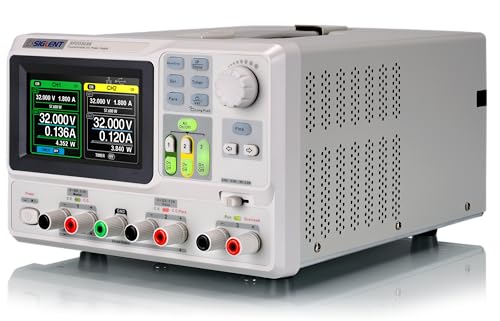
- Three isolated controlled outputs
- Independent, series, and parallel modes
- 220W linear supply with timing and trending
Best For: Multi-rail laboratory and development benches
Value 10A Workbench Pick

- 0–30V and 0–10A adjustable output
- USB and 5V/3.6A Type-C charging
- Short-circuit alarm and multiple protections
Best For: General electronics repair and DIY work
Professional Programmable Pick
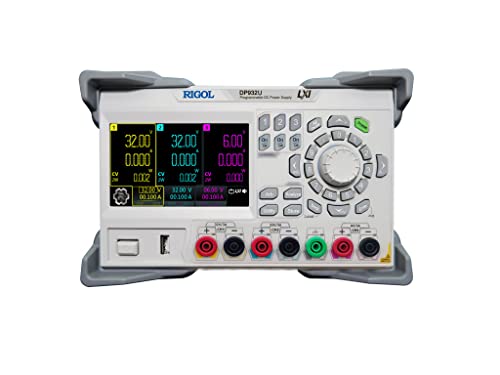
- Three isolated linear outputs, 210W total
- Series/parallel operation on CH1 and CH2
- Touchscreen, USB/LAN, logging, and sequencing
Best For: Laboratory, education, validation, and automated testing
Precision Adjuster
HANGELL 30V 10A Variable Bench Supply

- 0–30V and 0–10A adjustable output
- Coarse/fine encoder control with 4-digit display
- USB and Type-C charging plus protection features
Best For: Precise electronics testing, DIY work, and lab use
High-Current Converter
Pyramid 12A Linear-Regulated Bench Supply

- Regulated 12V and 13.8V DC output
- 12A continuous, 14A surge capability
- Short-circuit protection and built-in cooling fan
Best For: 12V communications gear and fixed-output testing
Smart Charging Pick

- 0–32V and 0–10A adjustable output
- Intelligent battery charging with automatic stop
- 20W USB-A and USB-C quick-charge ports
Best For: Compact maker benches, repairs, and battery charging
Compact Precision Pick
NICE-POWER 30V 10A Bench Supply

- 30V/10A output with fine adjustment resolution
- 4-digit display shows voltage, current, and power
- Output switch, USB charging, and multiple protections
Best For: High-current electronics testing in a compact workspace
Versatile Adjustment Pick

- 0-60V/0-5A adjustable output
- Coarse and fine encoder controls
- 20W USB-A and USB-C charging
Best For: General electronics work requiring flexible voltage range
Battery Charging Pick

- 0-60V/0-5A adjustable output
- Automatic intelligent battery charging mode
- Reverse protection and 20W USB charging
Best For: Electronics work that includes safer battery charging
Compact High-Current Pick – Jesverty SPS-3010V
For shoppers comparing bench power supplies for electronics work, the Jesverty SPS-3010V combines a 0–32V, 0–10A output with a compact footprint. Its coarse and fine encoder controls, four-digit display, and separate output switch are practical for projects that require frequent adjustments.
Best For: DIY electronics, repair work, Arduino or Raspberry Pi projects, and users who need up to 10A in a space-saving unit.
Pros:
- Provides adjustable 0–32V and 0–10A output with 0.01V/0.001A setting resolution.
- Coarse and fine encoder knobs make voltage and current adjustments more efficient.
- Includes USB-A and USB-C ports with 20W quick charging, plus a convenient output ON/OFF button.
- Compact 7.1 x 3.6 x 6.2-inch design weighs approximately 2.5 pounds.
Cons:
- Included test leads are described as giveaway accessories and may not suit long-term high-current use.
- Its switching design may be less appropriate than a low-ripple linear supply for sensitive precision work.
The SPS-3010V is a versatile, portable option when output current, fast control, and bench space matter more than advanced multi-channel functionality.
Triple-Output Linear Choice – Siglent SPD3303X-E
The Siglent SPD3303X-E is one of the more capable bench power supplies for setups that need multiple isolated outputs. It offers two adjustable 32V/3.2A channels plus a fixed-selectable 2.5V, 3.3V, or 5V channel, with independent, series, and parallel operating modes.
Best For: Benches that power several circuits at once, including laboratory, development, and testing environments.
Pros:
- Provides three independent, controlled, and isolated outputs.
- Supports independent, series, and parallel output modes.
- Offers 220W total output power and a linear power-supply design.
- Includes a timing output function and trending graphs.
Cons:
- At 17.6 pounds and 16 x 14 x 11 inches, it is substantially less portable than compact single-output models.
- The main adjustable channels are rated at 3.2A, rather than the 10A available from some single-output supplies.
Choose the SPD3303X-E when multi-rail flexibility and isolated linear outputs are more valuable than a small footprint or very high single-channel current.
Value 10A Workbench Pick – WANPTEK POWER DPS3010U
The WANPTEK POWER DPS3010U is a practical choice among bench power supplies for users who want adjustable 0–30V, 0–10A output without a large enclosure. It adds coarse and fine coding knobs, a four-digit display, USB and Type-C charging, and automatic 110V/220V input detection.
Best For: Electronics repair, DIY projects, communications-equipment maintenance, and teaching or research benches needing a straightforward high-current supply.
Pros:
- Delivers adjustable 0–30V and 0–10A output with a 300W rating.
- Coarse and fine encoder controls support faster, more precise setting changes.
- Includes USB and Type-C charging, with the Type-C port rated at 5V/3.6A.
- Features short-circuit alarm, OCP, overheating, leakage, voltage, and power protection.
Cons:
- It is a single-output switching supply, so it lacks the multi-channel flexibility of the Siglent and Rigol models.
- The supplied details list a one-year warranty.
This model offers a strong feature-to-size balance for general-purpose bench work, especially when 10A output and built-in protection are priorities.
Professional Programmable Pick – Rigol DP932U
The Rigol DP932U is a professional-oriented bench power supply for users who need three isolated linear channels, remote connectivity, and repeatable test functions. It combines two 32V/3A outputs with a 6V/3A channel and supports series or parallel operation between CH1 and CH2.
Best For: Laboratory development, education, validation, automated testing, and repair work where low ripple and programmable sequences are important.
Pros:
- Provides three independently controlled, isolated outputs totaling 210W.
- CH1 and CH2 support series operation up to 64V or parallel operation up to 6A.
- Offers low ripple and noise below 350 µVrms/2 mVpp with transient response under 50 µs.
- Includes a 4.3-inch color touchscreen, USB, LAN, data logging, protections, and timed output functions.
Cons:
- Its listed 30-pound weight and 23 x 15 x 12-inch dimensions make it a substantial bench instrument.
- Maximum current is 3A per channel in standard operation, or 6A using CH1 and CH2 in parallel.
- Some sequence-output capabilities require optional upgrades.
The DP932U is best suited to serious bench environments where programmable control, low ripple, and automation features justify the larger and heavier chassis.
Precision Adjuster – HANGELL 30V 10A Variable Bench Supply
For electronics work that calls for precise, repeatable adjustments, this HANGELL unit is one of the more versatile bench power supplies in the group. Its encoder control, fine resolution, output switch, and multiple protection features make it practical for lab testing, DIY projects, and general bench use.
Best For: Users who want adjustable 0–30V, 0–10A output with detailed digital control and USB charging ports.
Pros:
- Encoder knob supports coarse and fine adjustments with 0.01V and 0.001A resolution.
- Output switch lets you adjust settings while output is off, helping protect connected equipment.
- Includes overvoltage, overcurrent, overtemperature, overload, and short-circuit protection.
- Offers USB and Type-C quick-charge ports rated at 18W.
Cons:
- Its 3.5 x 5.6 x 7.4-inch benchtop footprint may be larger than compact desktop units.
- The supplied notes do not specify included USB cables or additional accessories beyond the listed power and output cables.
The HANGELL stands out when control precision and safety features matter more than minimal size. Its 300W capacity and clear four-digit display make it a capable all-purpose choice for adjustable bench work.
High-Current Converter – Pyramid 12A Linear-Regulated Bench Supply
This Pyramid model takes a simpler, fixed-output approach than many adjustable bench power supplies. It converts household AC to regulated 12V or 13.8V DC and provides high current for radios, scanners, phones, and other compatible equipment.
Best For: Users who need a straightforward 12V-class AC-to-DC source for communications equipment and component testing.
Pros:
- Provides regulated 12V DC output, with a listed 13.8V output option and 12A continuous current.
- Screw-type terminals support hardwired connections across a range of devices and components.
- Built-in overload and short-circuit protection, plus fuse protection with auto reset.
- Cabinet heatsink and cooling fan help manage heat during operation.
Cons:
- It is not a variable-voltage supply, limiting flexibility for projects requiring adjustable output.
- The 4kg chassis is substantially heavier than compact switching-style bench supplies.
- Cooling fan operation may be less appealing for users seeking silent bench equipment.
The Pyramid is best viewed as a dependable fixed-voltage converter rather than a precision laboratory supply. Choose it when 12V-class output, high current, and simple screw-terminal connectivity fit your setup.
Smart Charging Pick – Jesverty 32V 10A SPS-3010C
Among these bench power supplies, the Jesverty SPS-3010C is especially feature-rich for charging and electronics projects. It combines 0–32V, 0–10A adjustment with encoder controls, USB fast charging, and an intelligent battery-charging mode in a relatively compact enclosure.
Best For: Makers, repair users, and electronics students who want adjustable output alongside battery charging and USB-C convenience.
Pros:
- Coarse and fine encoder controls provide 0.01V and 0.001A setting resolution.
- Intelligent charging mode displays charging power and stops automatically when the battery is full.
- USB-A and USB-C ports support 20W quick charging for compatible devices and modules.
- Includes output control, selectable 115V/230V input, overcurrent protection, and a temperature-regulated fan.
Cons:
- The enclosure uses plastic and polycarbonate materials rather than a fully metal case.
- The listed USB output wattage is 20W, so it is intended for charging and powering smaller devices rather than high-power loads.
The SPS-3010C is a strong choice for a compact, multifunction workbench setup. Its battery mode and dual charging ports add convenience beyond standard adjustable output, while the 2.5-pound weight helps conserve bench space.
Compact Precision Pick – NICE-POWER 30V 10A Bench Supply
For shoppers comparing bench power supplies for electronics work, the NICE-POWER 30V 10A model offers a clear, practical control setup. Its 4-digit display shows voltage, current, and power, while the separate output switch lets you adjust settings without applying power to the load.
Best For: Electronics repair, DIY projects, lab work, and users who want high current capacity in a compact unit.
Pros:
- 30V/10A adjustable output with 0.01V and 0.001A resolution.
- Bright 4-digit LED readout displays voltage, current, and power in real time.
- Dedicated output on/off control helps reduce accidental power application.
- Includes a 5V/2A USB port and temperature-controlled fan.
Cons:
- Designed for 110V input only; 220V input is not available.
- The included USB port is limited to 5V/2A charging.
This is a capable choice when you need more current than many entry-level bench supplies provide without giving up portability. Its safety protections and output switch add useful convenience for repeated testing and repair work.
Versatile Adjustment Pick – Jesverty SPS-6005V 60V 5A
The Jesverty SPS-6005V is one of the more versatile bench power supplies for projects that span low-voltage electronics and higher-voltage testing. Coarse and fine encoder controls make setup easier, while selectable 115V/230V input and dual 20W USB charging add flexibility.
Best For: Laboratories, educational work, repairs, manufacturing tests, Arduino or Raspberry Pi projects, and general electronics DIY.
Pros:
- Adjustable 0-60V and 0-5A output with 0.01V/0.001A setting resolution.
- Separate coarse and fine encoder knobs simplify voltage and current adjustments.
- USB-A and USB-C ports support 20W quick charging.
- Selectable AC115V/230V input, output control, over-current protection, and temperature-regulated cooling.
Cons:
- The supplied test leads are described as giveaways and may not suit long-term high-current use.
- Its plastic enclosure may be less substantial than a metal-cased laboratory supply.
Choose this model if broad voltage range and convenient controls matter more than specialized battery charging. Its compact 2.5-pound design also makes it practical for crowded benches or portable work areas.
Battery Charging Pick – Jesverty SPS-6005C 60V 5A
Among bench power supplies, the Jesverty SPS-6005C stands out for users who also charge batteries. It combines 0-60V/0-5A adjustable output with a dedicated intelligent charging mode that can stop automatically when the battery is full.
Best For: Electronics benches where battery charging, repair work, and adjustable power delivery are all part of the workflow.
Pros:
- 0-60V and 0-5A adjustable output with 0.01V/0.001A setting resolution.
- Intelligent charging mode displays charging power and automatically stops at full charge.
- Reverse-connection protection supports safer battery charging.
- Includes 20W USB-A and USB-C quick-charge ports plus selectable 115V/230V input.
Cons:
- It is a switching supply, so it may not suit users specifically seeking a linear bench supply.
- The compact plastic enclosure prioritizes portability over heavy-duty construction.
The SPS-6005C is the better fit than the closely related SPS-6005V when controlled battery charging is a priority. For ordinary voltage and current testing, its encoder controls and output switch remain useful as well.
How We Picked These Bench Power Supplies
We selected models across the most useful categories for home workshops, electronics repair, education, and professional bench work. The lineup includes adjustable switching supplies, low-ripple linear units, higher-voltage options, compact 12V supplies, and programmable triple-output designs.
Our evaluation criteria include output range, maximum current, control precision, display and adjustment usability, output protection, charging features, connectivity, and suitability for continuous bench use. Product specifications should always be confirmed before purchase, particularly for ripple, accuracy, cooling, and remote-control functions.
Quick Comparison
- General-purpose 0–30V or 0–32V units: A practical choice for most hobby electronics, Arduino projects, repairs, and prototyping.
- 0–60V models: Better for circuits, motors, and equipment that require more voltage, although their maximum current is typically lower.
- Triple-output supplies: Ideal when a project needs multiple rails, such as positive, negative, and logic voltages.
- Linear supplies: Preferable for sensitive analog, audio, measurement, and low-noise applications.
- USB and Type-C outputs: Convenient for charging devices or powering accessories without using the primary adjustable output.
Key Buying Factors for Bench Power Supplies
Voltage and Current Range
Choose a supply that comfortably exceeds your project’s normal requirements. A 0–30V, 0–32V, or 0–60V range covers many electronics tasks, while 10A models provide useful headroom for motors, lighting, and power circuits. Remember that maximum voltage and current may not be available simultaneously because of the unit’s wattage limit.
Switching Versus Linear Regulation
Switching supplies are generally lighter, cooler, and more efficient. Linear supplies usually offer lower noise and ripple but can be larger and less efficient. For digital projects and general repair, switching regulation is often sufficient; for sensitive analog or RF work, prioritize verified low-ripple performance.
Controls, Protection, and Connectivity
Coarse and fine adjustment controls make it easier to set precise values. Look for clear displays, an output-enable switch, constant-voltage and constant-current modes, overvoltage and overcurrent protection, and thermal protection. USB, LAN, or other remote interfaces matter most when you need automated testing or repeatable lab procedures.
Who Should Buy Which Bench Power Supplies?
Hobbyists and students should start with a straightforward 0–30V or 0–32V adjustable model. Repair technicians may benefit from 10A capacity, quick adjustment controls, and USB or Type-C convenience. Audio, analog, and measurement users should prioritize a linear, low-ripple supply. Engineers building multi-rail circuits should choose a programmable triple-output model such as the Siglent or Rigol option. High-voltage project users should consider a 0–60V supply, while checking whether its 5A limit meets their load requirements.