A bench power supply with USB can power circuits, test equipment, and charge compatible devices from one compact workstation unit. The right model combines precise DC adjustment with convenient USB-A or USB-C output.
We selected 10 options across common 0–30V, 0–32V, and 0–60V ranges, emphasizing useful controls, readable displays, charging features, and protection functions for repair benches, hobby projects, and labs.
Best 10 Bench Power Supplies with USB Picks for 2026
Best Compact 32V Power Supply

- 0–32V and 0–10A adjustable output
- USB-A and USB-C 20W quick charging
- Encoder controls and output switch
Best For: Compact electronics benches and DIY projects
Best for Battery Charging

- Intelligent charging stops at full battery
- 18W USB charging interface
- OCP alarm and broad safety protections
Best For: Battery charging and repair benches
Best for Preset Workflows
WANPTEK 32V 10A USB Power Supply

- Three memory storage keys
- USB-A and USB-C fast-charge ports
- Short-circuit alarm and output control
Best For: Repeatable repair and electronics workflows
Best Display Controls
NANKADF 30V 10A USB Bench Supply

- 4-digit display with fine resolution
- Digit-selecting encoder adjustment
- 18W USB fast charging and output control
Best For: Precise testing and repair work
Compact USB Bench Pick

- 0–30V, 0–10A adjustable output
- 4-digit V/A/W display with fine resolution
- 5V/2A USB port and compact 2.4-lb design
Best For: Space-conscious electronics benches and hobby testing
Fast-Charging USB Choice
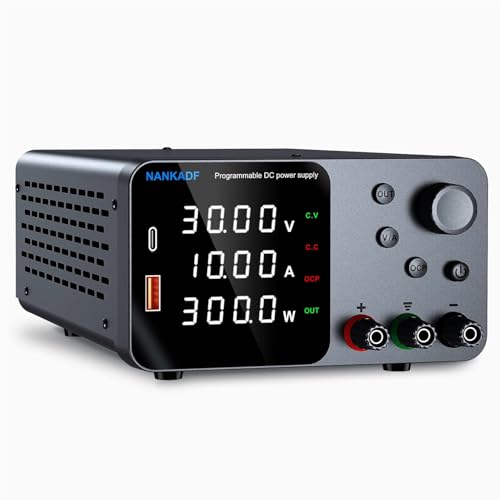
- 0–30V, 0–10A output with encoder control
- USB-A and USB-C ports up to 18W QC each
- Output switch, memory, and multi-layer protection
Best For: Repair benches and projects needing USB-A/C charging
Simple USB Bench Supply

- 0–30V, 0–10A adjustable switching output
- 4-digit real-time V/A/W display
- 5V/2A USB port and dedicated output switch
Best For: General electronics testing on a 110V workbench
Best Overall Value

- 0–30V, 0–10A adjustable output
- USB-A and USB-C, 5V/3.6A charging
- Automatic 110V/220V input detection
Best For: General repair benches and DIY electronics
Best Heavy-Duty Pick

- 0–32V and 0–10A adjustable output
- USB-A and USB-C support 20W charging
- Automatic battery-charge stop function
Best For: Battery maintenance and compact electronics benches
Best High-Voltage Option

- 0–60V adjustable output range
- USB-A and USB-C support 20W charging
- Output switch for connected-load adjustments
Best For: Higher-voltage testing and electronics development
Best Compact 32V Power Supply – Jesverty SPS-3010V with USB-C
For shoppers comparing bench power supplies with USB, the Jesverty SPS-3010V combines a 0–32V, 0–10A adjustable output with USB-A and USB-C 20W quick-charge ports. Its encoder controls, output switch, and compact enclosure make it practical for electronics work where bench space matters.
Best For: Arduino, Raspberry Pi, repair, laboratory, educational, and general DIY projects requiring up to 32V and 10A.
Pros:
- Coarse and fine encoder controls support 0.01V and 0.001A setting resolution.
- USB-A and USB-C ports both support 20W quick charging.
- Output ON/OFF button lets you adjust settings without removing the load.
- Compact 7.1 x 3.6 x 6.2-inch design weighs approximately 2.5 pounds.
Cons:
- Included test leads are described as giveaway leads and may not suit sustained high-current use.
- AC input settings and power-cord configuration vary by destination.
This is a well-equipped option if USB charging, fine adjustment, and a small footprint are priorities. Its 320W maximum output and selectable 115V/230V input add flexibility, while the OCP and temperature-regulated cooling fan provide useful protection features.
Best for Battery Charging – Kungber 30V 10A Bench Supply
The Kungber SPS3010B is one of the bench power supplies with USB suited to users who also charge batteries. It provides a 0–30V, 0–10A regulated output, an 18W USB port, and an intelligent charging mode designed to stop charging when a battery is full.
Best For: Battery charging, repair work, laboratory and school projects, plating, lamp testing, aging tests, and home DIY.
Pros:
- Intelligent charging mode displays charging power and stops when the battery is full.
- OCP detection can alarm and stop output during short circuits or overcurrent conditions.
- 18W USB interface supports quicker charging for compatible devices.
- Measures 7.59 x 3.35 x 6.1 inches and weighs less than 2.3 pounds.
Cons:
- Offers a USB interface rather than the listed USB-A and USB-C combination found on some alternatives.
- Maximum output voltage is 30V, slightly below 32V models in this roundup.
The Kungber stands out for charging-focused features and multiple safety protections, including thermal, overload, leakage, grounding, and short-circuit protection. Its compact size also makes it convenient for smaller work areas.
Best for Preset Workflows – WANPTEK 32V 10A USB Power Supply
The WANPTEK EPS3210 is a useful choice among bench power supplies with USB when you regularly repeat the same voltage and current settings. Along with 0–32V and 0–10A adjustment, it offers three memory presets, USB-A and USB-C fast charging, and an output button for safer setup changes.
Best For: Electronics repair and projects that reuse several common voltage and current combinations.
Pros:
- Three memory keys store frequently used voltage and current combinations.
- Encoder control allows digit selection and precise value adjustment.
- USB-A and USB-C ports provide charging flexibility.
- Short-circuit detection stops output and sounds an alarm.
Cons:
- The supplied notes do not specify the USB charging wattage.
- Memory presets may be less useful for users who rarely repeat settings.
Its strongest advantage is workflow efficiency: saved presets reduce repeated setup, while the output button helps prevent applying power before settings are ready. The compact 320W unit is a practical fit for repair and general bench use.
Best Display Controls – NANKADF 30V 10A USB Bench Supply
For buyers seeking bench power supplies with USB and straightforward digital control, the NANKADF 30V 10A model offers a precision encoder, output enable/disable button, 4-digit LED display, and an 18W fast-charging port. It is designed for accurately setting and monitoring voltage and current during electronics work.
Best For: Users who want fine digital adjustment, visible operating status, and USB charging for repair devices or mobile equipment.
Pros:
- Encoder lets you select individual digits for precise voltage and current adjustment.
- 4-digit display shows readings to 0.01V and 0.001A.
- Output button helps prevent accidental power application to the load.
- 18W USB fast-charging port adds convenience at the bench.
Cons:
- Maximum output is 30V rather than 32V.
- The supplied dimensions listing appears inconsistent, so verify the physical size before purchase.
This model prioritizes clear feedback and hands-on control. Its constant-voltage and constant-current modes, adjustable display brightness, and overcurrent protection make it suitable for routine testing, provided its 30V ceiling meets your projects’ requirements.
Compact USB Bench Pick – Jesverty SPS-3010
The Jesverty SPS-3010 is a compact choice for shoppers comparing bench power supplies with USB. It provides adjustable 0–30V and 0–10A output, a 4-digit readout for voltage, current, and power, plus a 5V/2A USB port for charging compatible devices.
Best For: Space-conscious electronics benches, hobby projects, and general-purpose testing.
Pros:
- Displays voltage, current, and power in real time with resolutions up to 0.01V, 0.001A, and 0.1W.
- Automatically switches between constant-voltage and constant-current operation.
- Compact, lightweight design with short-circuit, overload, and temperature-related protection features.
- Includes a convenient 5V/2A USB port.
Cons:
- The included test leads are described as giveaways and may not suit long-term high-current use.
- The USB port is limited to 5V/2A rather than USB-C fast charging.
This model emphasizes portability and straightforward control. Its USB output is useful for basic charging, while the adjustable DC output and clear metering cover common bench-testing needs.
Fast-Charging USB Choice – NANKADF 30V 10A
The NANKADF 30V 10A supply stands out among bench power supplies with USB because it combines adjustable bench output with USB-A and USB-C charging. Its encoder control, output-enable button, and automatic CV/CC switching are practical features for repair work and circuit debugging.
Best For: Electronics repair, prototyping, school labs, and automotive diagnostics where USB fast charging is useful.
Pros:
- Offers 0–30V and 0–10A output with 0.01V and 0.001A adjustment resolution.
- Includes separate output enable/disable control and remembers the last voltage and current settings.
- Provides USB-A and USB-C ports, each rated up to 18W QC fast charging.
- Includes over-voltage, over-current, over-temperature, and short-circuit protection with an alarm.
Cons:
- Its larger feature set may be more than needed for simple voltage-supply tasks.
- The supplied notes do not specify the USB charging protocols beyond the stated QC capability.
Choose this model when USB charging convenience is a priority rather than an afterthought. The encoder, output switch, memory, and safety alerts also make it well suited to repetitive repair and testing workflows.
Simple USB Bench Supply – NICE-POWER 30V 10A
The NICE-POWER 30V 10A unit is a practical option for shoppers seeking bench power supplies with USB and straightforward controls. It combines adjustable DC output, a 4-digit V/A/W display, an output switch, and a 5V/2A USB charging port in a compact vertical enclosure.
Best For: General electronics work, lab-style testing, and users who want separate output control.
Pros:
- Provides adjustable 0–30V and 0–10A output with 0.01V and 0.001A resolution.
- Displays voltage, current, and calculated power in real time.
- Output switch allows settings to be adjusted without applying power to the load.
- Includes 5V/2A USB charging, protection features, and temperature-controlled cooling.
Cons:
- Uses a 5V/2A USB port rather than USB-C or higher-wattage fast charging.
- The supplied notes specify 110V input only, with 220V input unavailable.
This is a sensible middle-ground choice for everyday bench work. The output switch improves convenience and safety during setup, while the USB port handles basic charging without requiring a separate charger.
Best Overall Value – 30V 10A Supply with USB-C
For shoppers comparing bench power supplies with usb connectivity, the WANPTEK POWER DPS3010U combines a 0–30V, 0–10A adjustable output with USB-A and USB-C charging ports. Its coarse and fine encoder controls, four-digit display, and automatic 110V/220V input detection make it a practical choice for repair benches and electronics projects.
Best For: General electronics repair, DIY work, teaching, and users who want USB-C charging alongside a conventional bench supply.
Pros:
- Adjustable 0–30V and 0–10A output with separate coarse and fine controls.
- USB and Type-C ports provide 5V/3.6A charging output.
- Includes short-circuit alerting, overcurrent, overheating, leakage, and overload protection.
- Automatic detection supports 110V and 220V ±10% AC input.
Cons:
- USB charging output is specified at 5V/3.6A rather than the higher 20W quick-charge rating offered by the Jesverty models.
- Its 0–30V range may be limiting for projects requiring higher voltage.
The DPS3010U is a well-rounded option when adjustable bench power and basic device charging are both priorities. Its broad protection features and dual encoder controls add convenience for frequent testing and repair work.
Best Heavy-Duty Pick – 32V 10A Supply with 20W USB
The Jesverty SPS-3010C is a strong candidate among bench power supplies with usb ports, offering 0–32V and 0–10A output plus USB-A and USB-C 20W quick charging. Its dedicated intelligent charging mode can stop automatically when a battery is full, adding a useful feature for maintenance and electronics work.
Best For: Battery charging, Arduino and Raspberry Pi projects, compact workbenches, and users who want an output switch.
Pros:
- Coarse and fine encoder knobs provide 0.01V/0.001A setting resolution.
- USB-A and USB-C ports both support 20W quick charging.
- Intelligent battery charging displays charging power and stops when the battery is full.
- Compact 7.1 × 3.6 × 6.2-inch design weighs approximately 2.5 pounds.
Cons:
- The enclosure is made from plastic and polycarbonate rather than a metal housing.
- Its maximum output voltage is 32V, so it is less suitable for higher-voltage projects.
Choose the SPS-3010C if battery charging and fast USB device charging matter as much as adjustable output. The output control and compact footprint are especially convenient when loads remain connected during setup changes.
Best High-Voltage Option – 60V 5A Supply with USB-C
For projects that need more voltage headroom, the Jesverty SPS-6005V extends adjustable output to 0–60V while retaining USB-A and USB-C 20W quick-charge ports. This bench power supply with usb connectivity also includes encoder adjustment, an output on/off button, and a four-digit LED display.
Best For: Higher-voltage electronics testing, laboratory work, manufacturing checks, anodizing, and repair projects requiring up to 60V.
Pros:
- 0–60V adjustable range accommodates higher-voltage projects than the other listed models.
- USB-A and USB-C ports support 20W quick charging.
- Output ON/OFF control lets users adjust settings without removing the load.
- Temperature-regulated cooling fan and overcurrent protection support regular bench use.
Cons:
- Maximum output current is 5A, lower than the 10A models in this roundup.
- The supplied test leads are described as giveaways; higher-capacity leads are recommended for sustained high-current use.
- It lacks the SPS-3010C’s listed intelligent battery-charging mode.
The SPS-6005V is the best fit when voltage range is the deciding factor. Its 5A limit makes it less appropriate for high-current loads, but the 60V ceiling and USB quick-charge ports broaden its usefulness for testing and development.
How We Picked These Bench Power Supplies with USB
We compared the selected models by their voltage and current ranges, adjustment controls, USB charging capability, display design, output switching, and stated protection features. Models with encoder-based coarse and fine adjustment can make setup faster, while memory storage and intelligent charging modes may improve repeatability. Because specifications vary by seller and configuration, confirm the current listing before purchase, especially USB wattage, connector type, and protection ratings.
Quick Comparison
| Feature | What to look for | Why it matters |
|---|---|---|
| DC output range | Typically 0–30V or 0–32V; some reach 60V | Determines the projects and devices you can test |
| Current capacity | Up to 10A on many models | Provides headroom for motors, lighting, and power-hungry circuits |
| USB output | USB-A, USB-C, or both; check wattage | Supports charging and convenient accessory power |
| Controls | Encoder, coarse/fine adjustment, output switch | Improves precision and reduces accidental energizing |
| Protection | Over-current and over-voltage protection | Helps protect the supply and connected equipment |
Key Buying Factors for Bench Power Supplies with USB
Voltage, Current, and Regulation
Choose a range that exceeds your normal requirements without compromising control at low settings. A 30V or 32V, 10A supply suits most hobby electronics and repair tasks. A 60V model is more appropriate for higher-voltage development, but its lower 5A maximum may limit current-heavy work.
USB Charging Performance
USB ports are not interchangeable. Review whether the unit includes USB-A, USB-C, or both, and check the advertised output such as 5V/2A, 18W, or 20W. Fast-charge support may depend on the connected device and charging protocol. Treat the USB output as a convenience feature unless the manufacturer clearly documents its operating limits.
Usability and Safety
A bright four-digit display, encoder adjustment, memory presets, and an output enable button can make daily testing easier. Look for over-current protection, short-circuit response, cooling design, and a clearly stated operating manual. Also check terminal style, fan noise, physical size, and input-voltage compatibility.
Who Should Buy Which Bench Power Supplies with USB?
- For general electronics benches: Choose a 0–30V or 0–32V, 10A model with encoder control, a readable display, and an output switch.
- For frequent device charging: Prioritize USB-A and USB-C ports with documented 18W or 20W output, while verifying charging compatibility.
- For repeatable testing: Select a model with memory storage, fine adjustment, and dependable output enable/disable control.
- For higher-voltage projects: Consider the 0–60V option, but confirm that its 5A limit meets your load requirements.
- For beginners: Favor straightforward controls, clear protection indicators, and a well-documented interface over the highest headline output.