The best compact audio mixers give you practical control over multiple sound sources without taking over your desk. They can simplify podcasting, home recording, live playback, DJ setups, and streaming.
This roundup compares 10 options ranging from straightforward analog mixers to models with USB connectivity, Bluetooth, phantom power, onboard effects, and podcast-focused controls.
Best 10 Compact Audio Mixers Picks for 2026
Effects-Ready Compact Mixer

- Six inputs with two microphone preamps
- Four dedicated stereo line channels
- Built-in digital effects
Best For: Small live vocal and instrument setups
Ultra-Compact Line Mixer
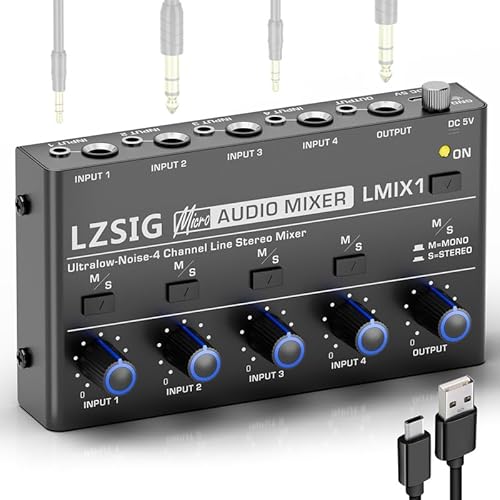
- Mixes four sources into one output
- 3.5mm and 6.35mm input support
- Mono/stereo switching
Best For: Desktop sub-mixing and basic audio routing
Analog Control Compact Mixer

- Six analog channels with D-PRE preamps
- Three-band EQ and high-pass filters
- One-knob compressors and rugged chassis
Best For: Small performances, lectures, and analog recording
Feature-Packed Compact Mixer
6-Channel Bluetooth Sound Board

- Four XLR inputs with 48V phantom power
- Bluetooth and USB playback functions
- 16 DSP effects with three-band EQ
Best For: Karaoke, streaming, and small live performances
Best Compact Analog Mixer

- 5-channel compact analog design
- Phantom power and 2-band EQ
- RCA playback and recording connections
Best For: Small desktop and basic live sound setups
Best for USB Streaming

- Eight-input analog mixer
- Stereo USB audio interface
- Mixes PC and gaming audio for streams
Best For: Streaming, podcasting, and computer-based recording
Best for Comfort
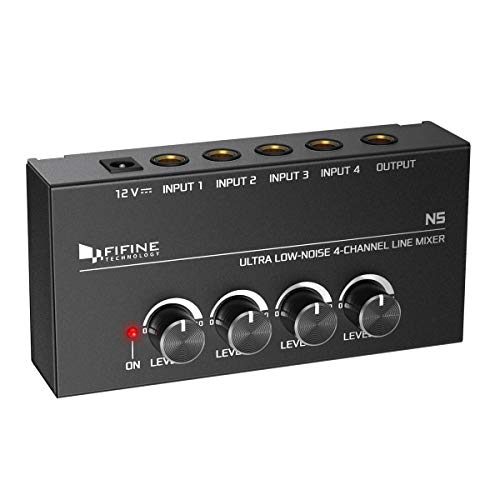
- Four-channel stereo or mono operation
- Independent volume controls
- Metal enclosure with low-noise performance
Best For: Keyboard rigs, monitoring, and simple line-level submixing
Versatile Value Mixer
Compact Bluetooth 4-Channel Mixer
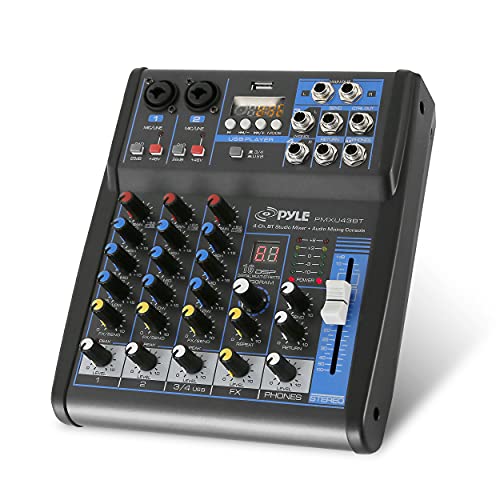
- Bluetooth, USB, flash drive, and MP3 support
- 48V phantom power and 3-band EQ
- Steel chassis with sealed rotary controls
Best For: Small performances, karaoke, and basic home recording
Podcasting Pick
Compact 4-Channel Mixer with 99 DSP Effects

- 99 DSP effects with reverb and delay
- PAD and 80Hz high-pass filter
- USB recording plus Bluetooth 5.0
Best For: Podcasting, streaming, and home-studio recording
Flexible Mini Console

- Three XLR inputs with 48V phantom power
- RCA and 6.35mm stereo connections
- USB playback, recording, and headphone monitoring
Best For: Portable podcasts, streams, and small active-speaker setups
Effects-Ready Compact Mixer – Yamaha MG06X
The Yamaha MG06X is a practical choice among compact audio mixers when you need six inputs, two microphone preamps, dedicated stereo line channels, and built-in digital effects in a small corded mixer.
Best For: Small live setups, vocal performances, and users who want onboard effects without a large console.
Pros:
- Six-channel layout with two microphone preamps and four dedicated stereo line channels.
- Built-in digital effects add flexibility for live sound and vocal applications.
- Compact 5.9-by-7.9-by-2.4-inch design with XLR output connectivity.
Cons:
- Uses corded electric power rather than a portable battery setup.
- The supplied specifications do not identify a USB recording interface function.
The MG06X is a focused option for buyers who value Yamaha’s compact format and integrated effects. Its six-input design suits straightforward mixes, while the small footprint helps conserve desk or equipment-bag space.
Ultra-Compact Line Mixer – LZSIG 4-Channel Mini Mixer
The LZSIG Mini Audio Mixer is one of the most compact audio mixers for combining several line-level sources into one output. Its four-channel design supports 3.5mm and 6.35mm connections and can switch between mono and stereo operation.
Best For: Sub-mixing electronic drums, keyboards, guitars, computers, CD players, or gaming consoles.
Pros:
- Combines up to four audio sources into a single stereo or mono output.
- Supports both 1/8-inch and 1/4-inch TS/TRS cables without requiring adapters.
- Small 3.14-by-5.39-by-1.77-inch enclosure with an ultra-low-noise design.
Cons:
- Power adapter is sold separately.
- Designed for line mixing rather than microphone preamp control or onboard effects.
This LZSIG model makes sense when the main goal is simple audio routing in a very small package. The mono/stereo switch and mixed connector support provide useful flexibility for desktop, practice-room, and gaming configurations.
Analog Control Compact Mixer – Yamaha MG06
The Yamaha MG06 is a straightforward choice among compact audio mixers for users who want six analog channels, studio-grade D-PRE microphone preamps, and hands-on EQ and compression controls without USB connectivity.
Best For: Recording, lectures, and small performances requiring durable analog mixing and XLR outputs.
Pros:
- Six-channel analog configuration with D-PRE preamps and XLR inputs.
- Three-band EQ and high-pass filters help shape and clean up signals.
- One-knob compressors provide simple control for guitars, bass, vocals, and drums.
- Rugged, impact-resistant powder-coated metal chassis.
Cons:
- No USB connectivity, according to the supplied specifications.
- Larger and heavier than the smaller MG06X, at about two pounds.
The MG06 favors dependable analog operation and accessible controls over computer integration. It is a sensible fit for buyers who want a compact but sturdy mixer for live or installed applications and do not need a USB interface.
Feature-Packed Compact Mixer – 6-Channel Bluetooth Sound Board
This six-channel sound board expands the typical compact audio mixers feature set with Bluetooth streaming, USB playback, 48V phantom power, a three-band EQ, and 16 DSP effects. It is aimed at karaoke, live performance, streaming, and recording setups that need several connection options.
Best For: Karaoke, small live gigs, streaming, and setups combining microphones, instruments, USB media, and Bluetooth playback.
Pros:
- Four XLR inputs support microphones, including condenser microphones with 48V phantom power.
- Bluetooth and USB functions support wireless streaming and USB-stick or MP3 playback.
- Three-band EQ and 16 built-in DSP effects provide extensive onboard adjustment.
Cons:
- At 11.61 by 13.77 by 11.61 inches and 2.3 kg, it is less compact than several alternatives here.
- Manufacturer warranty is listed as 90 days from purchase.
- The supplied notes describe a traditional analog mixer, so computer compatibility should not be assumed beyond the stated USB functions.
This mixer is best when connectivity and onboard features matter more than the smallest footprint. Its phantom-powered XLR inputs, wireless playback, USB functions, and effects make it versatile, though buyers should account for its larger size and shorter listed warranty.
Best Compact Analog Mixer – Mackie Mix5
The Mackie Mix5 is a straightforward choice among compact audio mixers when you need a small, corded analog unit for basic live sound, playback, or recording. It combines one mic/line input, two stereo line inputs, RCA connectivity, and main left/right outputs in a lightweight chassis.
Best For: Small desktop setups, simple vocal-and-playback rigs, and users who want phantom power for a studio condenser microphone.
Pros:
- Compact 5-channel design with high-headroom, low-noise performance.
- Includes phantom power for studio condenser microphones.
- Provides 2-band EQ for practical tone shaping.
- Dedicated stereo RCA inputs and outputs support playback or recording.
Cons:
- Only one mic/line input is available.
- Its corded-electric design is less convenient for portable, battery-free use.
- It does not include a listed USB interface.
The Mix5 focuses on essential analog mixing rather than extensive routing or computer connectivity. Its small footprint and simple controls make it a sensible fit for compact setups that prioritize dependable basic connections.
Best for USB Streaming – Behringer XENYX 802S
Behringer XENYX 802S Premium Analog 8-Input Mixer with USB Streaming Interface
Check Price On AmazonThe Behringer XENYX 802S stands out among compact audio mixers for streaming-focused setups that need both analog mixing and computer connectivity. Its eight-input layout, stereo USB audio interface, and PC or gaming sound integration make it suited to podcasting, recording, and live streaming workflows.
Best For: Streamers, podcasters, and creators mixing computer or gaming audio with analog sources.
Pros:
- Eight-input configuration offers more source capacity than smaller mixers.
- Stereo USB interface connects to a computer or mobile device.
- Supports direct mixing of PC or gaming sounds into the streaming output.
- Analog mixing and equalization provide hands-on control.
Cons:
- Its listed dimensions are substantially larger than ultra-mini mixers.
- It requires corded power.
- The supplied notes do not specify onboard effects or advanced digital processing.
Choose the XENYX 802S when USB streaming capability matters as much as analog control. It offers a practical bridge between traditional mixer operation and computer-based audio production.
Best for Comfort – FIFINE N5
The FIFINE N5 is one of the most compact audio mixers for combining four line-level sources into a stereo or mono output. Its metal enclosure, independent channel volume controls, and low-noise operation make it useful for keyboard rigs, small-stage setups, monitoring, and simple submixing.
Best For: Keyboard players, small rigs, and users mixing several line-level instruments into one output.
Pros:
- Very small 4-channel design fits easily on a desktop or keyboard.
- Independent volume controls simplify quick level adjustments.
- Heavy-duty metal enclosure supports everyday handling.
- Can operate in stereo or mix four mono inputs to one mono output, depending on cabling.
Cons:
- It is designed for line-level sources rather than dedicated mic preamp use.
- TRS/TS cables are not included.
- Correct cable type is required for stereo or mono operation.
The N5 is best viewed as a compact line mixer rather than a full-featured console. Its minimal controls and tiny footprint are advantageous when the goal is simply to combine multiple instruments or monitor sources without a complicated setup.
Versatile Value Mixer – Compact Bluetooth 4-Channel Mixer
The Pyle PMXU43BT is a practical choice when shopping for compact audio mixers with Bluetooth playback, USB connectivity, and inputs for microphones or stereo sources. Its steel chassis, 3-band channel EQ, and 48V phantom power make it suitable for small performances, karaoke, and basic recording setups.
Best For: Small live performances, karaoke, home studios, and users who want Bluetooth and USB playback in one compact mixer.
Pros:
- Bluetooth, USB, flash drive, and MP3 compatibility support flexible playback and recording.
- Four channels include XLR and unbalanced 1/4-inch inputs.
- Provides 48V phantom power, 3-band EQ, LED peak indication, and built-in DSP effects.
- Rugged steel chassis and sealed rotary controls help resist dust and grime.
Cons:
- The listed USB and MP3 features may be more than needed for a simple analog setup.
- Its 2.9-pound chassis is compact, but not the lightest option in this group.
Choose this model if you want a broadly equipped four-channel mixer with wireless streaming and conventional mic and line inputs. It offers a strong feature set for small-scale audio work without requiring a larger console.
Podcasting Pick – Compact 4-Channel Mixer with 99 DSP Effects
This compact audio mixer is aimed at podcasting, recording, and live streaming, with two XLR microphone inputs, stereo line inputs, USB connectivity, and Bluetooth 5.0. Its PAD switch and 80Hz high-pass filter add useful control when managing loud sources or low-frequency rumble.
Best For: Podcasters, home-studio users, and streamers who want onboard effects and direct USB recording in a small console.
Pros:
- Offers 99 selectable DSP effects, including reverb and delay.
- 48V phantom power supports condenser microphones.
- PAD and 80Hz high-pass filter help manage distortion and unwanted low-end noise.
- USB recording, playback, OTG support, and Bluetooth 5.0 suit computer and mobile workflows.
Cons:
- Only two XLR microphone inputs are specified, which may limit larger microphone setups.
- Bluetooth streaming is listed for use within 15 feet.
For content creators, the combination of effects, signal-management controls, and USB recording makes this a focused option. It is especially appealing when a small footprint matters more than having a large number of microphone channels.
Flexible Mini Console – 5-Channel USB Bluetooth Mixer
The BOMGE BM-05 is a lightweight option among compact audio mixers, combining three XLR inputs with stereo line connections, USB playback and recording, Bluetooth, and headphone monitoring. It also includes 48V phantom power, 2-band EQ, echo, and delay for small live, podcast, and streaming applications.
Best For: Lightweight mobile setups, small shows, podcasts, live streams, and users who need several input formats.
Pros:
- Three XLR inputs include 48V phantom power for condenser microphones.
- Supports RCA and 6.35mm stereo connections for devices such as keyboards, computers, and CD players.
- USB-A playback and recording, USB-B computer connection, Bluetooth, and headphone monitoring expand its utility.
- At 0.78 kg, it is relatively easy to transport.
Cons:
- Bluetooth, USB, and 4/5-channel functions cannot be used simultaneously.
- The listed Bluetooth working range is only 1.5 feet.
- It is intended for active speakers or powered systems rather than passive speaker connections.
This model stands out for its varied input and output options in a portable format. Before buying, account for its connection limitations and very short stated Bluetooth range, particularly if you plan to switch between multiple digital functions during a session.
How We Picked These Compact Audio Mixers
We focused on mixers that balance useful connectivity, manageable size, everyday controls, and value. The selection includes simple analog models for basic source mixing, USB-equipped options for computer recording or streaming, and feature-rich consoles with Bluetooth, DSP effects, echo, or phantom power.
We also considered channel count, input flexibility, stereo playback support, portability, and the needs of different users. A compact mixer is only useful when its connections and controls match your equipment, so shoppers should verify the input types and intended workflow before buying.
Quick Comparison
| Best For | Look For | Most Relevant Features |
|---|---|---|
| Basic mixing | Simple analog layout | Independent level controls and main output |
| Podcasting and streaming | USB or computer connectivity | USB interface, microphone inputs, monitoring |
| Recording microphones | Phantom power | 48V support and XLR inputs |
| Music playback | Stereo inputs and wireless support | Bluetooth, USB, or media playback |
| Live effects | Built-in DSP or reverb | Effects controls and dependable output routing |
Key Buying Factors for Compact Audio Mixers
Inputs and Channel Count
Count every source you plan to connect at the same time, including microphones, instruments, phones, computers, and playback devices. Remember that a stereo input may use two channels, while advertised channel counts do not always indicate how many microphone preamps are included.
USB, Bluetooth, and Recording Support
USB is valuable when you want to send a mixed signal to a computer for recording, streaming, or calls. Bluetooth and built-in media players are convenient for background music, but they are not substitutes for a dedicated recording interface when you need multitrack control or low-latency monitoring.
Phantom Power and Microphone Compatibility
Condenser microphones commonly require 48V phantom power, while dynamic microphones generally do not. If you plan to use studio microphones, confirm that phantom power is available on the appropriate input and that the mixer provides the gain and connectors your microphone needs.
Effects, Noise, and Monitoring
Reverb, echo, and DSP effects can be useful for live vocals, karaoke, and casual streaming, but extra features should not outweigh clean gain control and reliable monitoring. Look for a headphone output, clear level meters when available, and independent controls that make it easy to prevent clipping.
Who Should Buy Which Compact Audio Mixers?
Choose a basic analog mixer if you need dependable level control for a few sources and do not need computer integration. Pick a USB model for podcasting, streaming, or simple home recording. A mixer with phantom power is the better choice for condenser microphones, while Bluetooth and media playback features suit presenters, DJs, and casual entertainment setups.
If you frequently perform live or want vocal shaping without additional equipment, prioritize built-in effects. For a portable desk setup, compare the actual dimensions, power requirements, and connector layout—not just the channel count. The right compact audio mixer is the one that leaves enough input capacity for your current setup while matching how you record, monitor, and share audio.