Choosing the right audio mixer can simplify everything from podcast production and home recording to DJ sets and small live performances. Built-in effects add reverb, delay, and other processing without requiring separate hardware.
We compared 10 compact and versatile models across channel count, connectivity, effects, phantom power, recording features, and ease of use so you can match your setup and budget with confidence.
Best 10 Audio Mixer with Built in Effects Picks for 2026
Studio-Ready Control

- 10 inputs with USB and SPX digital effects
- D-PRE preamps, EQ, filters, and one-knob compression
- Rugged metal chassis for demanding use
Best For: Small live, rehearsal, and home-recording setups
Connected Value

- Eight channels with Bluetooth and USB MP3 playback
- 16-bit DSP effects and +48V phantom power
- Compact steel chassis with three-band EQ
Best For: DJs, karaoke, and casual live entertainment
Compact Effects Mixer

- Six-channel design with two microphone preamps
- Four stereo line channels, EQ, and digital effects
- Lightweight 900-gram construction
Best For: Solo performers and small rehearsal setups
Feature-Packed Entertainment Hub

- Eight channels with reverb and 48V phantom power
- Bluetooth 5.0, USB playback, and USB recording
- LED display and ultra-thin 1.57-inch design
Best For: Karaoke, family KTV, events, and casual live music
Best Compact Analog Mixer

- 12 channels with four mic/line inputs
- 12 built-in reverb, chorus, and delay effects
- RCA playback and recording connections
Best For: Small live setups, rehearsals, and analog home mixing
Best Bluetooth Mixer
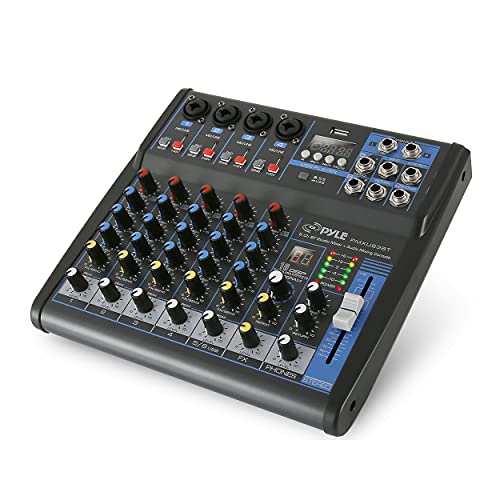
- Six-channel design with 16-bit DSP effects
- Bluetooth, USB, flash-reader, and MP3 support
- 48V phantom power and three-band channel EQ
Best For: Karaoke, DJs, live gigs, and wireless playback
Best Podcast Mixer

- 99 selectable DSP effects with reverb and delay
- 48V phantom power plus PAD and high-pass filter
- USB recording and Bluetooth 5.0 streaming
Best For: Podcasting, home recording, and live streaming
Versatile Effects Mixer
Pyle PMX466 6-Channel DJ Mixer

- 16 preset digital effects
- Four XLR mic/line inputs
- USB, Bluetooth, and MP3 playback
Best For: DJs and performers needing flexible inputs and quick effects
Streaming-Ready Effects Mixer
6-Channel Bluetooth Audio Mixer

- 16 DSP reverb and delay effects
- Four XLR inputs with 48V phantom power
- Bluetooth and USB playback
Best For: Karaoke, streaming, and small live performances
Eight-Channel Production Mixer

- Eight-channel input layout
- 16 DSP effects and three-band EQ
- USB, Bluetooth, and headphone output
Best For: Events, recording, streaming, and larger microphone setups
Studio-Ready Control – Yamaha MG10XU
The Yamaha MG10XU is a strong choice if you want an audio mixer with built in effects for rehearsals, live sound, or home recording. It combines 10 inputs, USB connectivity, SPX digital effects, studio-grade D-PRE preamps, and practical channel processing in a rugged metal chassis.
Best For: Musicians and small production setups that need flexible inputs, USB connectivity, and more detailed control over vocals and instruments.
Pros:
- 10-channel layout with USB connectivity and SPX digital effects
- D-PRE preamps, three-band EQ, and high-pass filters support cleaner mixes
- One-knob compressors simplify control of guitars, bass, snare, and vocals
- Rugged, impact-resistant powder-coated metal chassis
Cons:
- Its 7.7-pound build and corded power make it less portable than smaller mixers
- The feature set may be more than needed for very simple setups
The MG10XU is the most versatile option here for users who want built-in effects without giving up useful mixing tools. Its USB connection and input processing make it especially practical for hybrid live and recording workflows.
Connected Value – Pyle PMXU83BT
The Pyle PMXU83BT is an approachable audio mixer with built in effects for DJs, karaoke, live gigs, and casual performance systems. Its eight-channel design adds Bluetooth streaming, USB MP3 playback, DSP effects, phantom power, and straightforward controls in a compact steel chassis.
Best For: DJs, karaoke hosts, and performers who want wireless playback and basic channel control at a value-focused price.
Pros:
- Bluetooth supports wireless streaming from a smartphone
- Eight channels include XLR and unbalanced quarter-inch inputs
- Features 16-bit DSP, USB-A MP3 playback, and +48V phantom power
- Three-band EQ and LED peak indicators are provided on all channels
Cons:
- The supplied notes do not specify particular DSP effect types
- Its 4-pound chassis is compact but may not suit larger input requirements
- No warranty is listed in the supplied details
With Bluetooth and USB playback built in, the PMXU83BT is convenient for entertainment-focused setups. It offers useful connectivity and basic effects, though users seeking more detailed processing may prefer the Yamaha MG models.
Compact Effects Mixer – Yamaha MG06X
The Yamaha MG06X is a compact audio mixer with built in effects designed for smaller setups. It provides six channels, two microphone preamps, four dedicated stereo line channels, EQ, and digital effects while keeping the unit lightweight and easy to place on a small desk or performance table.
Best For: Solo performers, compact rehearsal rigs, and users who need essential mixing and effects without a larger console.
Pros:
- Compact six-channel configuration with two microphone preamps
- Four dedicated stereo line channels support multiple playback sources
- Built-in digital effects and EQ add basic mix shaping
- Lightweight 900-gram design is easy to transport
Cons:
- Fewer inputs than the other eight- and 10-channel options
- The supplied notes do not identify the specific digital effects
- Its compact layout may be limiting for larger ensembles
The MG06X is a sensible pick when portability and simplicity matter more than channel count. It keeps the core features useful for small performances while adding Yamaha’s built-in digital effects.
Feature-Packed Entertainment Hub – FULUODE CT-80S
The FULUODE CT-80S is an audio mixer with built in effects aimed at karaoke, live music, conferences, and home entertainment. This eight-channel model includes reverb, MP3/USB input, Bluetooth 5.0, USB recording, a large LED display, and 48V phantom power for wired, wireless, and condenser microphone setups.
Best For: Karaoke systems, family KTV, campus events, and users who want playback, recording, Bluetooth, and reverb in one console.
Pros:
- Eight-channel mixer includes reverb and three-band channel controls
- Bluetooth 5.0, MP3/USB input, USB recording, and LED song display add convenience
- Supports wired, wireless, and capacitive microphones and instruments
- Ultra-thin 1.57-inch design with 48V phantom power
Cons:
- The supplied details specify a 110V American plug, so buyers elsewhere should check compatibility
- At 3.3 kg, it is heavier than the compact Yamaha MG06X
- The notes do not provide detailed specifications for the reverb or recording functions
The CT-80S prioritizes convenience and entertainment features over a minimal control surface. Its wireless playback, USB functions, display, and reverb make it particularly appealing for karaoke and event-focused setups.
Best Compact Analog Mixer – Mackie Mix12FX
The Mackie Mix12FX is a practical audio mixer with built in effects for small live setups, rehearsals, playback, and basic recording. Its 12-channel layout, four mic/line inputs, four stereo line inputs, phantom power, and 12 onboard effects provide useful flexibility without a large footprint.
Best For: Small bands, rehearsals, live presentations, and home setups needing straightforward analog mixing with integrated effects.
Pros:
- 12 channels with four mic/line inputs and four stereo line inputs.
- Includes 12 integrated reverbs, choruses, and delays.
- Offers three-band EQ, a 75 Hz low-cut filter, phantom power, and overload indication.
- Dedicated RCA inputs and outputs support playback or recording.
Cons:
- Uses wired analog connectivity rather than Bluetooth or USB.
- Its compact control set may be less suitable for complex digital routing.
The Mix12FX stands out when you want more channels and familiar analog controls in a compact format. It is a strong fit for users who value Mackie’s stated high-headroom, low-noise design and a useful selection of built-in effects.
Best Bluetooth Mixer – Pyle PMXU63BT
The Pyle PMXU63BT is an audio mixer with built in effects aimed at DJs, karaoke users, live performers, and compact studio setups. It combines six channels with Bluetooth streaming, USB and flash-drive support, a built-in MP3 player, 48V phantom power, and 16-bit DSP effects.
Best For: DJs, karaoke, live gigs, and users who want wireless playback alongside microphone and stereo line inputs.
Pros:
- Bluetooth supports wireless streaming from compatible phones and tablets.
- USB, flash-reader, and MP3 functions support playback and mixing with external devices.
- Provides 48V phantom power, LED peak indication, and three-band EQ on channels.
- Sealed rotary controls and a steel chassis are suited to regular performance use.
Cons:
- Six channels provide less input capacity than larger mixers.
- The supplied notes do not specify the number or types of individual DSP effects.
The PMXU63BT is a versatile choice when convenient music playback matters as much as traditional mixing. Its wireless and USB features make it especially practical for mobile performances, karaoke, and casual recording workflows.
Best Podcast Mixer – Compact 4-Channel DSP Console
This compact audio mixer with built in effects is designed for podcasting, recording, and live streaming. It provides four inputs, 99 selectable DSP effects, 48V phantom power, USB recording, Bluetooth 5.0 streaming, and signal-cleanup tools including a -26 dB PAD and 80 Hz high-pass filter.
Best For: Podcasters, home-studio users, and streamers who need vocal effects, USB recording, and a small desktop mixer.
Pros:
- Offers 99 selectable DSP effects, including reverb and delay.
- Supports condenser microphones through 48V phantom power.
- Includes a -26 dB PAD, 80 Hz high-pass filter, and three-band EQ on each channel.
- Combines USB recording and playback with Bluetooth 5.0 streaming and OTG support.
Cons:
- Four channels offer less expansion room than larger mixing consoles.
- Bluetooth streaming is specified for a range of up to 15 feet.
- The supplied notes do not identify the individual 99 effect presets.
The console is a focused option for voice-centered workflows where effects and direct computer or mobile connectivity are priorities. Its compact dimensions and input-protection features make it convenient for a desktop podcast or streaming station.
Versatile Effects Mixer – Pyle PMX466 6-Channel DJ Mixer
The Pyle PMX466 is a practical audio mixer with built in effects for DJs, small live setups, karaoke, and home recording. It combines six channels, four XLR mic/line inputs, USB connectivity, Bluetooth DJ functionality, and 16 preset digital effects in a compact metal chassis.
Best For: DJs and performers who want multiple inputs plus selectable effects and MP3 playback.
Pros:
- Includes 16 preset digital effects.
- Offers four XLR mic/line inputs across six channels.
- Provides USB connectivity, Bluetooth functionality, and an MP3 player.
- Uses a rugged metal chassis with a compact footprint.
Cons:
- The effects are preset rather than described as fully customizable.
- The supplied notes do not specify a warranty.
Choose this model if you value straightforward connectivity and ready-made effects in a portable mixer. Its six-channel layout and built-in playback features make it flexible, while the limited warranty information may warrant checking the seller’s coverage before purchase.
Streaming-Ready Effects Mixer – 6-Channel Bluetooth Audio Mixer
This six-channel audio mixer with built in effects suits karaoke, live performance, streaming, and basic recording. It offers four XLR inputs with switchable 48V phantom power, Bluetooth and USB playback, three-band EQ controls, and a 16-effect DSP processor.
Best For: Karaoke hosts, small live setups, and streamers who need wireless playback and reverb or delay.
Pros:
- Includes 16 built-in DSP effects, including delay or reverb options.
- Four XLR inputs support condenser and dynamic microphones with 48V phantom power.
- Bluetooth and USB functions support music playback and mixing.
- Provides three-band EQ and independent channel controls.
Cons:
- The manufacturer describes it as a traditional analog mixer, so operation may require setup familiarity.
- The listed manufacturer warranty is 90 days.
- The supplied dimensions are relatively large for a compact mixer.
This model is a strong feature-focused choice when microphone inputs, wireless playback, and vocal effects matter more than advanced digital workflow. Confirm the controls and signal routing meet your needs, especially if you are new to analog mixers.
Eight-Channel Production Mixer – CT-08 USB DSP Audio Mixer
The CT-08 expands the audio mixer with built in effects format to eight channels, making it a useful option for larger microphone setups, karaoke, conferences, and studio recording. It combines 16 DSP effects, 48V phantom power, three-band EQ, USB and Bluetooth connections, and headphone monitoring.
Best For: Users who need eight inputs and broad connectivity for events, recording, streaming, or karaoke.
Pros:
- Provides eight channels with XLR microphone and balanced line inputs.
- Includes a 16DSP sound processor and three-band EQ controls.
- Supports 48V phantom power for condenser microphones.
- Offers USB, Bluetooth, headphone, RCA, TRS, and XLR connectivity.
Cons:
- At 3.7 kg, it is heavier than the other listed mixers.
- The supplied notes do not detail individual effect types or editing controls.
- Its larger channel count may be more than needed for simple two-microphone setups.
The CT-08 stands out when you need more input capacity and connection options without giving up built-in effects. Its headphone output and USB support are useful for monitoring and recording, while the one-year warranty adds defined coverage.
How We Picked the Best Audio Mixer with Built in Effects
We focused on the features that have the greatest effect on everyday usability: input count, microphone and line connectivity, built-in DSP effects, phantom power, USB recording, Bluetooth or media playback, control layout, and portability. We also considered whether each mixer is better suited to speech, music, DJ use, rehearsal, or small live applications.
Because specifications vary widely among compact mixers, confirm the exact input configuration, USB functionality, power requirements, and included accessories before buying. Some models advertise many channels while counting stereo inputs, media channels, or USB playback separately.
Quick Comparison
| Best For | Look For |
|---|---|
| Home recording | USB interface functionality, clean preamps, and phantom power |
| Podcasts and streaming | Simple controls, multiple microphone inputs, and reliable monitoring |
| DJ and party setups | Bluetooth, USB or MP3 playback, and fast-access effects |
| Live music | Enough mic channels, robust construction, and usable reverb |
| Small rehearsals | Flexible inputs, headphone monitoring, and straightforward level control |
Key Buying Factors for an Audio Mixer with Built-In Effects
Channel Count and Input Types
Count the microphones, instruments, playback devices, and stereo sources you will connect at the same time. XLR inputs are important for microphones, while combination XLR/TRS inputs offer more flexibility. Leave spare capacity if your setup may grow.
Effects and DSP Control
Built-in effects are useful for vocal reverb, announcements, streaming, and live performance. Check whether effects are available globally or can be assigned independently to channels. More presets do not automatically mean better sound; accessible controls and clean processing matter more.
Phantom Power and Recording
48V phantom power is necessary for many condenser microphones, but it should be used carefully with equipment that does not support it. If you plan to record into a computer, verify that the USB connection functions as an audio interface rather than only as a playback port.
Playback and Wireless Features
Bluetooth, USB media playback, and built-in MP3 players can make background music and break music convenient. These features are helpful, but they should not replace checking the mixer’s analog inputs, output quality, and monitoring options.
Size, Layout, and Monitoring
A compact mixer saves desk or stage space, while a larger control surface may be easier to operate during a busy performance. Look for clear metering, headphone output, main and monitor outputs, and controls that are easy to reach without accidental adjustments.
Who Should Buy Which Audio Mixer with Built in Effects?
Choose a Yamaha MG10XU or Mackie Mix12FX when dependable controls, musical inputs, and live-sound flexibility are priorities. Smaller Yamaha MG06X models suit minimalist setups that need quality effects without extra channels.
Pyle and similar feature-rich mixers are a practical fit for DJs, casual performers, karaoke, and users who value Bluetooth, USB playback, and multiple DSP presets. The compact podcast-focused models make more sense for creators who need several microphone inputs, voice effects, and a small home-studio footprint.
For recording-focused buyers, prioritize genuine USB interface support, low-noise preamps, phantom power, and monitoring over the largest effects list. For occasional use, choose the simplest mixer that has enough inputs today plus a little room for future equipment.