The best network audio player for audiophiles can bring streaming services, local libraries, and high-resolution playback to a serious stereo system without forcing you to replace every component.
These 10 selections range from compact, affordable streamers to premium transports, DACs, preamps, and multiroom-ready solutions. The right choice depends on your system, sources, outputs, and listening priorities.
Best 10 Network Audio Player for Audiophiles Picks for 2026
Best Feature-Rich Streamer

- DSD512 and broad high-resolution format support
- 6-inch touchscreen plus mobile app control
- RCA, XLR, HDMI ARC, and trigger connectivity
Best For: All-in-one streaming, decoding, and local-library management
Best Network Receiver
Yamaha R-N600A Network Receiver

- Built-in ESS SABRE DAC and network playback
- Native DSD 11.2 MHz and PCM up to 384 kHz
- Includes phono and optical TV inputs
Best For: Stereo systems needing streaming and built-in receiver functionality
Best Digital Transport
Eversolo T8 Music Streamer Transport

- Multiple isolated digital outputs, including AES/EBU and USB
- Dual femtosecond clocks for source-level timing control
- Supports DSD512 Native and PCM up to 768 kHz/32-bit
Best For: External-DAC systems requiring a high-spec digital transport
Best All-in-One Connectivity
WiiM Ultra Hi-Res Music Streamer
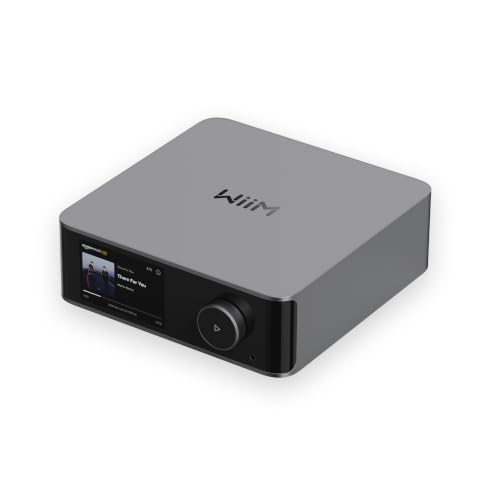
- ESS DAC, touchscreen, and Wi-Fi 6
- HDMI ARC, phono, headphone, and subwoofer connections
- Supports major streaming, multiroom, and room-correction features
Best For: Flexible two-channel or 2.1 systems with multiple source types
Whole-Home Choice

- Four independent Wi-Fi streaming zones
- AirPlay and major streaming service support
- Installation-friendly outputs and 12V triggers
Best For: Custom whole-home audio systems
Reference-System Pick
Eversolo DMP-A10 Network Streamer

- All-in-one streamer, DAC, and preamp
- OCXO clock and isolation features
- Ethernet, HDMI, and SFP fiber connectivity
Best For: Premium, feature-rich digital audio systems
Easy Stereo Upgrade

- Up to 24-bit/192 kHz high-resolution output
- Spotify, TIDAL, AirPlay 2, and Google Cast
- Wide connectivity for existing stereo systems
Best For: Adding modern streaming to a traditional stereo
Editor's Choice
Eversolo DMP-A6 Master Edition

- DSD512 and broad high-resolution format support
- Built-in DAC with XLR and RCA outputs
- 6-inch touchscreen and extensive connectivity
Best For: Audiophiles seeking a flexible streamer-DAC hub
Storage Powerhouse

- All-in-one streamer, DAC, preamp, and DAP
- 4X ESS9039Q2M DACs with DSD512 support
- 64GB storage plus SSD and NAS expansion
Best For: Large local music libraries and advanced digital systems
Living-Room Favorite

- ESS SABRE32 Reference DAC for hi-fi playback
- HDMI eARC for TV and home entertainment systems
- Built-in streaming services, AirPlay 2, and Chromecast
Best For: Flexible hi-fi and living-room streaming setups
Best Feature-Rich Streamer – EVERSOLO DMP-A6 Gen 2
The EVERSOLO DMP-A6 Gen 2 is a versatile network audio player for audiophiles who want high-resolution streaming, local-library organization, and flexible digital and analog connections. Its large touchscreen, dedicated app, HDMI ARC, and broad format support make it suitable for a serious two-channel system or a streamlined home theater setup.
Best For: Audiophiles seeking an all-in-one streamer and DAC with extensive format, service, and connectivity support.
Pros:
- Supports DSD512, multichannel DSD, MQA, and high-resolution PCM formats.
- Includes TIDAL, Qobuz, Roon Ready, Spotify Connect Lossless, and DLNA support.
- Offers a 6-inch touchscreen, mobile app control, HDMI ARC, trigger functionality, RCA, and XLR outputs.
Cons:
- Its extensive feature set may be more than a basic streaming setup requires.
- Some supported services and third-party apps may require separate account access.
The DMP-A6 Gen 2 stands out when you want one component to manage streaming, local files, decoding, and system integration. Its separate RCA and XLR outputs also give it flexibility when connecting active speakers or a power amplifier.
Best Network Receiver – Yamaha R-N600A Network Receiver
The Yamaha R-N600A combines network streaming with an integrated receiver, DAC, and phono stage. For shoppers comparing a network audio player for audiophiles, it is a practical choice when you want streaming and traditional source connections in one black, full-size component.
Best For: Listeners who want network playback, vinyl support, and a built-in receiver rather than a standalone streamer.
Pros:
- Uses an ESS SABRE ES9010K2M Ultra DAC.
- Supports native DSD 11.2 MHz and PCM playback up to 384 kHz through its USB and network capabilities.
- Includes a dedicated phono input and optical input for connecting a turntable and TV.
Cons:
- It is a receiver, so it may be less suitable for systems that already have a separate amplifier.
- The supplied notes identify Spotify as the supported streaming service without detailing a broader service list.
The R-N600A makes the most sense for a conventional stereo system that needs amplification alongside digital streaming. Its phono input and TV-friendly optical connection broaden its usefulness beyond music services alone.
Best Digital Transport – Eversolo T8 Music Streamer Transport
The Eversolo T8 is a network audio player for audiophiles built primarily as a digital transport. It focuses on clean signal delivery to an external DAC, with isolated outputs, dual femtosecond clocks, Wi-Fi 6, and support for TIDAL, Qobuz, Roon Ready, and other major streaming protocols.
Best For: Digital-focused systems using an external DAC and listeners who prioritize clocking, isolation, and multiple digital outputs.
Pros:
- Provides IIS, coaxial, AES/EBU, USB Audio, and optical outputs.
- Uses dual femtosecond clocks and electrically isolated audio outputs to help limit clock and ground-loop noise.
- Supports DSD512 Native and PCM up to 768 kHz/32-bit through IIS and USB Audio.
- Includes a touchscreen, remote, mobile-app control, room calibration, and parametric EQ.
Cons:
- It is a transport, so an external DAC is needed for a complete playback chain.
- SFP modules are sold separately and must be compatible with the selected network switch.
The T8 is a specialized pick for a separates-based system rather than a simple plug-and-play streamer. Its output variety and isolation features are particularly useful when matching it with different DACs and digital interfaces.
Best All-in-One Connectivity – WiiM Ultra Hi-Res Music Streamer
The WiiM Ultra is a flexible network audio player for audiophiles who want streaming, a touchscreen, room correction, and broad analog and digital connectivity in a compact component. Its ESS DAC, HDMI ARC, phono input, headphone output, and subwoofer connection make it easy to adapt to different home audio systems.
Best For: Users building a flexible two-channel or 2.1 system with streaming, TV audio, vinyl, and app-based multiroom control.
Pros:
- Combines an ESS ES9038 Q2M DAC with a 3.5-inch touchscreen and Wi-Fi 6.
- Offers HDMI ARC, phono, RCA, optical, coaxial, USB, headphone, and subwoofer connections.
- Supports Spotify Connect, TIDAL Connect, Qobuz Connect, Roon Ready, DLNA, NAS, and multiroom playback.
- Includes room correction and independent EQ settings.
Cons:
- It is incompatible with AirPlay and cannot function as an AirPlay receiver.
- Its maximum listed streaming resolution is 24-bit/192 kHz.
The WiiM Ultra is a strong practical choice when system flexibility matters as much as streaming quality. It can serve as the hub for a powered-speaker, amplifier, headphone, TV, vinyl, or subwoofer setup without requiring many separate source components.
Whole-Home Choice – OSD Audio SRT4 GEN2
For shoppers seeking a network audio player for audiophiles across multiple rooms, the OSD Audio SRT4 GEN2 is built around distributed listening rather than a single stereo setup. Its four independent Wi-Fi streamers can play different sources in separate zones or synchronize playback throughout the home.
Best For: Whole-home audio installations using existing amplifiers, speakers, and custom-control equipment.
Pros:
- Four independent streamers support separate or synchronized zone playback.
- Works with iOS and Android control through the OSD Player App.
- Supports services including Spotify, Amazon Music, Tidal, Napster, internet radio, and AirPlay.
- Offers RCA, coaxial, optical, USB audio, and 12V trigger connectivity per zone.
Cons:
- Its multi-zone design is more specialized than a simple single-room streamer.
- Requires existing amplification and speakers for a complete audio system.
The SRT4 GEN2 makes the most sense when flexible multi-room control is the priority. Its four-zone architecture, 24-bit audiophile-level sound claim, and installation-friendly connections make it a practical hub for a distributed audio system.
Reference-System Pick – Eversolo DMP-A10 Network Streamer
The Eversolo DMP-A10 is aimed at listeners who want a network audio player for audiophiles with streaming, local playback, DAC functionality, and preamp control in one component. Its high-end architecture, large touchscreen, and extensive wired connectivity suit advanced home audio systems.
Best For: Enthusiasts building a premium digital source and balanced preamp-centered listening system.
Pros:
- Combines a network streamer, DAC, digital music player, and preamp.
- Includes an OCXO clock system plus electrical and USB isolation features.
- Provides Ethernet, HDMI, SFP fiber, and multi-format connectivity.
- Offers a 6.5-inch LCD touchscreen and digital room correction.
Cons:
- Its 12.46 kg chassis and advanced feature set may be excessive for basic systems.
- The supplied notes do not specify individual streaming services or supported audio formats.
The DMP-A10 is designed as a central music component rather than a minimalist network adapter. It is particularly compelling for systems that can take advantage of its isolation, clocking, room-correction, DDC, and balanced preamp capabilities.
Easy Stereo Upgrade – WiiM Pro Plus Music Streamer
The WiiM Pro Plus is a compact way to add network playback to an existing stereo, making it a practical network audio player for audiophiles who want high-resolution streaming without replacing their amplifier. It supports up to 24-bit/192 kHz output, direct app connections, and several multi-room platforms.
Best For: Upgrading an existing stereo with high-resolution streaming, app control, and multi-room compatibility.
Pros:
- Supports up to 24-bit/192 kHz playback with gapless output.
- Works with Spotify Connect, TIDAL Connect, Amazon Music, AirPlay 2, and Google Cast.
- Offers optical, coaxial, RCA, Ethernet, Wi-Fi, and Bluetooth connectivity.
- Roon Ready, NAS, DLNA, and home media server support add source flexibility.
Cons:
- It can receive AirPlay streams but cannot transmit AirPlay to other AirPlay devices.
- High-resolution availability depends on the music service or library source.
The WiiM Pro Plus is a strong value-oriented bridge between modern streaming and traditional hi-fi equipment. Its broad platform support and digital outputs make it easy to integrate, while the AirPlay receiver limitation is worth noting for multi-room buyers.
Editor's Choice – Eversolo DMP-A6 Master Edition
The Eversolo DMP-A6 Master Edition is a versatile network audio player for audiophiles who want high-resolution playback, an integrated DAC, and extensive system connectivity. Its large touchscreen, EOS Audio Engine, and support for formats including DSD512 make it suitable for both local libraries and streaming-focused setups.
Best For: Audiophiles wanting a feature-rich streamer with a built-in DAC, touchscreen control, and flexible digital and analog connections.
Pros:
- Supports high-resolution formats up to DSD512, along with FLAC, WAV, APE, and MQA.
- EOS Audio Engine can bypass Android SRC restrictions for direct audio output from supported third-party apps.
- Offers HDMI, USB, optical, coaxial, Bluetooth, XLR, and RCA connectivity.
- Large 6-inch 1080p touchscreen provides direct access to settings, music libraries, and apps.
Cons:
- Its broad feature set may be more than needed for a simple streaming-only system.
- The unit weighs approximately 5.5 kg, so it is not especially lightweight.
With Roon Ready support, TIDAL Connect, app control, and both balanced and unbalanced outputs, the DMP-A6 Master Edition is a strong all-in-one source component. It is especially appealing when you want to connect directly to active speakers or a power amplifier without adding a separate DAC.
Storage Powerhouse – Kaiboer DMP-K7 Plus
The Kaiboer DMP-K7 Plus is a network audio player for audiophiles who want streaming, DAC, preamp, and digital-library functions in one component. Its 4X ESS9039Q2M DAC design, large internal storage capacity, NAS support, and optional SSD expansion make it particularly suited to substantial local collections.
Best For: Dedicated listeners building a high-resolution music library with NAS, internal storage, CD ripping, and preamp functionality.
Pros:
- Combines a music streamer, DAP, DAC, and preamp in one unit.
- Supports up to 768kHz/32-bit audio and DSD512, with four ESS9039Q2M DACs.
- Includes 8GB DDR4 memory, 64GB eMMC storage, M.2 NVMe support, and USB storage support up to 16TB.
- Can connect to an external USB CD drive for playback and lossless CD ripping.
Cons:
- Bluetooth is not supported.
- The feature-rich storage and library-management system may be excessive for users who mainly stream from a phone.
Dual femtosecond clocks and the Pure OS Audio Engine are designed for precise, direct playback, while NFS, SMB, WebDAV, and cloud support broaden its library options. The DMP-K7 Plus is a compelling choice for a more self-contained digital audio system, provided Bluetooth is not a requirement.
Living-Room Favorite – Cambridge Audio CXN100 SE
The Cambridge Audio CXN100 SE is a polished network audio player for audiophiles who want straightforward access to major streaming services and broad wireless connectivity. Its ESS ES9028Q2M SABRE32 Reference DAC, HDMI eARC, and StreamMagic Gen 4 platform make it a practical bridge between a hi-fi system and a home entertainment setup.
Best For: Hi-fi listeners who want dependable streaming, TV integration, multi-room compatibility, and simple app-based control.
Pros:
- Uses an ESS ES9028Q2M SABRE32 Reference DAC for high-resolution stereo playback.
- Includes Spotify Connect, TIDAL Connect, Qobuz Connect, and Deezer.
- HDMI eARC adds high-resolution TV audio to the music system.
- Supports Chromecast built-in, AirPlay 2, Bluetooth aptX HD, Roon Ready, USB, coaxial, and TOSLINK connections.
Cons:
- It is a network player rather than an all-in-one amplifier or speaker system.
- The supplied information does not specify a current software-update schedule.
With a large high-resolution color display and StreamMagic app control, the CXN100 SE emphasizes accessible operation without giving up useful hi-fi connectivity. HDMI eARC and multi-room support make it especially adaptable for listeners combining music streaming with television and whole-home audio.
How We Picked the Best Network Audio Player for Audiophiles
We focused on features that matter in real hi-fi systems: streaming-service support, resolution capability, digital and analog connectivity, app usability, DAC implementation, system flexibility, and value. The lineup includes dedicated transports, all-in-one streamers with built-in DACs, network receivers, and zone-oriented products so you can match the component to your setup.
We also considered upgrade paths. Some models are designed to feed an existing DAC or amplifier, while others can serve as the control center for a complete system. Compatibility with services such as Qobuz, Tidal, Spotify Connect, AirPlay 2, Chromecast, and manufacturer-specific platforms can be just as important as headline specifications.
Quick Comparison
- Best for a complete high-end front end: Choose a model with a built-in DAC, preamp functionality, and extensive digital outputs.
- Best for upgrading an existing stereo: A compact streamer with reliable app control and line-level or digital output may be all you need.
- Best for a separate DAC: Select a transport with clean digital output and strong clocking or isolation features.
- Best for vinyl and streaming together: A network receiver with phono input can simplify the entire system.
- Best for distributed audio: Look for multi-zone control, trigger connections, and support for multiple rooms.
Key Buying Factors for a Network Audio Player for Audiophiles
DAC and Output Options
If the player will connect directly to an amplifier, prioritize its DAC quality, analog output stage, volume control, and balanced connections. If you already own a preferred DAC, focus instead on dependable digital outputs, format support, and low-noise operation.
Streaming and Library Support
Check that the player supports your preferred services and playback methods. Qobuz and Tidal are useful for high-resolution catalogs, while Spotify Connect, AirPlay 2, Chromecast, and network-share support improve everyday convenience. Confirm whether the device handles your preferred DSD, FLAC, WAV, or other file formats.
Connectivity and System Fit
Review Wi-Fi and Ethernet options, USB inputs, coaxial and optical outputs, HDMI or television connectivity where relevant, and any phono or line inputs. A feature-rich player is not necessarily the best choice if your amplifier lacks the required connection.
Software and Controls
A responsive app, clear display, physical remote, and stable firmware can make a larger difference than a small specification advantage. Consider how easily you can browse favorites, manage local files, switch inputs, and control playback from different rooms.
Who Should Buy Which Network Audio Player for Audiophiles?
Choose an affordable compact streamer if you want to add modern streaming to an existing receiver or integrated amplifier. Choose a streamer with a built-in DAC or preamp if you are assembling a minimalist system or want fewer boxes. Choose a premium transport when you already have a high-quality DAC and want a refined digital source. Choose a network receiver if you need amplification, phono playback, and streaming in one chassis. Finally, choose a multi-zone model for whole-home audio rather than a dedicated two-channel listening system.