The best network audio players with headphone output combine convenient streaming with a direct path to private, high-quality listening. They can simplify a desktop setup, add modern services to an existing amplifier, or serve as the digital hub of a serious hi-fi system.
This roundup includes compact budget streamers, touchscreen models, dedicated headphone-focused components, and feature-rich network transports. The right choice depends on your headphones, source components, room system, and preferred streaming services.
Best 10 Network Audio Players with Headphone Output Picks for 2026
Most Versatile
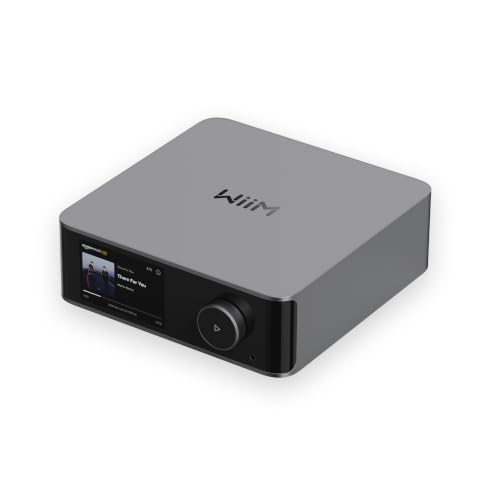
- ESS DAC and up to 24-bit/192 kHz playback
- Dedicated headphone output plus HDMI ARC and phono
- Touchscreen, Wi-Fi 6, Bluetooth 5.3, and multiroom support
Best For: Flexible headphone-and-speaker systems with multiple sources
Best Headphone Focus
Naim Uniti Atom Headphone Edition

- Headphone-optimised streaming system
- Balanced XLR, 4.4mm, and 6.35mm outputs
- Works as a streaming pre-amplifier too
Best For: Dedicated headphone listening with future system expansion
Best Audiophile Connectivity

- Dual-mono ESS DAC design with THX AAA headphone amp
- 1/4-inch headphone jacks, balanced XLR, and HDMI eARC
- BluOS multiroom, AirPlay 2, and optional Dirac Live
Best For: High-end headphone, stereo, and home-theater systems
Best HDMI Integration

- ESS Sabre ES9028Q2M DAC
- HDMI eARC plus USB, optical, coaxial, and Ethernet
- Balanced XLR output and Bluetooth 5 aptX HD
Best For: TV-connected stereo systems with varied digital sources
Best All-in-One Control Hub

- Combines streamer, DAC, DAP, and preamp functions
- Supports major streaming services and high-resolution playback
- Extensive touchscreen, app, digital, and analog connectivity
Best For: Audiophiles wanting a versatile digital front end
Best Hi-Fi Streaming Experience

- SABRE32 Reference DAC supports high-resolution playback
- Built-in Spotify, TIDAL, Qobuz, Deezer, Chromecast, and AirPlay 2
- HDMI eARC and broad inputs simplify system integration
Best For: Hi-fi systems needing streaming and TV connectivity
Best Compact Stereo Upgrade

- Streams up to 24-bit/192 kHz with gapless playback
- Supports AirPlay 2, Google Cast, Spotify, TIDAL, and Qobuz
- Compact design with RCA, optical, coaxial, Ethernet, Wi-Fi, and Bluetooth
Best For: Upgrading an existing stereo with flexible streaming
High-End Digital Transport

- Electrically isolated digital outputs and dual femtosecond clocks
- Streams TIDAL, Qobuz, Spotify Connect Lossless, and Roon
- Requires an external DAC and headphone amplifier
Best For: Audiophiles building a separate DAC-based streaming system
Best Heavy-Duty Pick
WiiM Mini Wi-Fi Music Streamer

- Streams up to 192kHz/24-bit audio
- Supports AirPlay 2, Spotify Connect, and TIDAL Connect
- Needs a separate headphone-capable DAC or amplifier
Best For: Adding network streaming to an existing stereo or headphone setup
Direct Headphone Streaming
Surfans F20 Pro HiFi Music Player

- Includes 3.5mm and 4.4mm balanced headphone outputs
- Offers up to 500mW at 32 ohms through 4.4mm output
- Streams Spotify and TIDAL over dual-band Wi-Fi
Best For: Portable headphone listening with powerful wired output
Most Versatile – WiiM Ultra
The WiiM Ultra is a flexible choice among network audio players with headphone output, combining app-based streaming, a touchscreen, and extensive connections. Its ESS DAC, Wi-Fi 6, Bluetooth 5.3, and support for up to 24-bit/192 kHz playback make it suitable for both digital and analog-focused systems.
Best For: Listeners who want one network player for headphones, speakers, TV audio, phono, and multiroom streaming.
Pros:
- Dedicated headphone output alongside RCA, optical, coaxial, USB, and HDMI ARC connections
- ESS ES9038 Q2M DAC with support for high-resolution playback up to 24-bit/192 kHz
- 3.5-inch touchscreen, WiiM Home App control, and broad streaming support
- Subwoofer output, room correction, and independent EQ settings add system flexibility
Cons:
- It is not compatible with AirPlay or usable as an AirPlay receiver
- Its many connection and configuration options may be more than a simple setup requires
The WiiM Ultra stands out for connectivity and system-building potential. It is especially compelling if you want headphone listening without giving up TV integration, vinyl input, multiroom features, or detailed app control.
Best Headphone Focus – Naim Uniti Atom Headphone Edition
The Naim Uniti Atom Headphone Edition is purpose-built for listeners comparing network audio players with headphone output. It functions as a complete streaming system for headphones while also working as a streaming pre-amplifier for active speakers or a separate power amplifier.
Best For: Dedicated headphone listeners who want premium balanced and single-ended connection options in a compact streaming system.
Pros:
- Headphone-optimised design with balanced 4-pin XLR and 4.4mm Pentaconn outputs
- Also includes a 6.35mm headphone connection for broad headphone compatibility
- Supports Qobuz, TIDAL, Spotify, internet radio, AirPlay 2, Chromecast, and Roon Ready operation
- Can serve as a streaming pre-amplifier for active speakers or a separate power amp
Cons:
- Its headphone-first design may be unnecessary for buyers mainly building a speaker system
- Connectivity is centered on Ethernet rather than built-in Wi-Fi in the supplied specifications
The Uniti Atom Headphone Edition is the specialist option here. Its output variety and headphone-focused architecture make it a strong fit for serious personal listening, while pre-amplifier functionality leaves room to expand into a larger system.
Best Audiophile Connectivity – Bluesound NODE ICON
The Bluesound NODE ICON pairs network streaming with a dual-mono DAC design and a THX AAA headphone amplifier. For shoppers seeking network audio players with headphone output, it adds full-size 1/4-inch headphone jacks, a color display, balanced XLR outputs, HDMI eARC, and BluOS multiroom support.
Best For: Audiophile systems that need high-quality headphone listening, balanced outputs, TV integration, and multiroom control.
Pros:
- Dual ESS ES9039Q2M DACs and THX AAA headphone amplification
- Full-size 1/4-inch headphone jacks and balanced XLR outputs
- 5-inch color display, HDMI eARC, AirPlay 2, Bluetooth, and BluOS multiroom support
- Dirac Live upgrade option can address room-acoustic problems with additional equipment
Cons:
- Dirac Live requires an upgrade, and a calibration microphone is purchased separately
- The feature-rich design may be excessive for basic headphone streaming
The NODE ICON is a strong all-rounder for a high-end digital setup. Its headphone amplifier, balanced connectivity, and home-theater and multiroom features make it particularly useful when one streamer must serve several listening roles.
Best HDMI Integration – Cambridge Audio EXN100
The Cambridge Audio EXN100 is a network audio player with headphone output aimed at systems that prioritize clean signal conversion and broad source connectivity. Its ESS Sabre ES9028Q2M DAC, Ethernet networking, Bluetooth 5 with aptX HD, and HDMI eARC input support both traditional hi-fi and home-cinema setups.
Best For: Stereo listeners who want a network player with HDMI eARC, balanced output, and multiple digital inputs.
Pros:
- ESS Sabre ES9028Q2M DAC for digital-to-analog conversion
- HDMI eARC input simplifies integration with a compatible TV or home-cinema system
- Includes USB, optical, coaxial, and Ethernet connectivity
- Bluetooth 5 with aptX HD supports higher-quality wireless playback
Cons:
- The supplied notes do not specify the headphone connector or detailed headphone-amplifier design
- Streaming services and control-platform support are not detailed in the supplied specifications
The EXN100 is best considered a connectivity-focused network player. It makes the most sense when HDMI eARC and balanced XLR output matter, but buyers should verify the exact headphone-output details before choosing it primarily for headphone use.
Best All-in-One Control Hub – EVERSOLO DMP-A8
The EVERSOLO DMP-A8 is a feature-rich choice for shoppers seeking network audio players with headphone output, particularly if they also want streaming, local playback, DAC functionality, and preamp control in one component. Its large touchscreen and mobile app provide flexible control, while broad digital and analog connectivity suits more advanced systems.
Best For: Audiophiles building a versatile, high-resolution digital front end with preamp features.
Pros:
- Combines a music streamer, digital audio player, DAC, and preamp in one unit.
- Supports services including Amazon Music, TIDAL, Qobuz, Spotify Connect Lossless, and DLNA.
- Offers extensive connectivity, including HDMI ARC, coaxial, optical, USB-B, RCA, and XLR connections.
- Includes a 6-inch color touchscreen, mobile app control, parametric EQ, and room-correction features.
Cons:
- Its broad feature set and larger chassis may be more than needed for a simple streaming setup.
- The supplied notes do not specify a dedicated headphone-output connection.
The DMP-A8 stands out when system flexibility matters more than simplicity. Its streaming, conversion, storage, display, and preamp capabilities make it a strong centerpiece, but shoppers specifically prioritizing a confirmed headphone jack should verify the connection details before buying.
Best Hi-Fi Streaming Experience – Cambridge Audio CXN100 SE
The Cambridge Audio CXN100 SE is a polished option among network audio players with headphone output, pairing a SABRE32 Reference DAC with Wi-Fi streaming, app control, and broad wireless compatibility. It is designed to integrate cleanly into a modern stereo or home entertainment system rather than serve as a basic Bluetooth receiver.
Best For: Hi-fi listeners who want a refined network streamer with TV integration and a high-resolution display.
Pros:
- Uses an ESS ES9028Q2M SABRE32 Reference DAC for high-resolution digital playback.
- Includes Spotify Connect, TIDAL Connect, Qobuz Connect, Deezer, Chromecast built-in, and AirPlay 2.
- HDMI eARC adds a practical way to integrate TV audio with a stereo system.
- Offers USB audio, coaxial, TOSLINK, Bluetooth aptX HD, Roon Ready support, and multi-room compatibility.
Cons:
- The supplied details do not clearly identify a dedicated headphone-output jack.
- Its feature set is more appropriate for a full hi-fi system than a minimal desktop setup.
The CXN100 SE is compelling for listeners who value streamlined control, wide platform support, and home-theater integration. Because the notes list headphone compatibility but do not confirm a physical headphone output, verify the output configuration if private listening is essential.
Best Compact Stereo Upgrade – WiiM Pro Music Streamer
The WiiM Pro is a compact, practical pick for shoppers comparing network audio players with headphone output and looking to add modern streaming to an existing stereo. It supports high-resolution playback, direct streaming from popular apps, multiroom platforms, and several digital and analog connections in a small package.
Best For: Existing stereo owners who want affordable streaming, multiroom support, and high-resolution output.
Pros:
- Supports up to 24-bit/192 kHz playback on digital and analog outputs with gapless playback.
- Works with AirPlay 2, Google Cast, Spotify Connect, TIDAL Connect, Qobuz Connect, Alexa, and Roon Ready systems.
- Provides RCA, optical, coaxial, Ethernet, Wi-Fi, and Bluetooth connectivity.
- Supports multiroom playback through AirPlay 2, Google Home, Alexa, and multiple WiiM devices.
Cons:
- AirPlay functionality is receiver-only and cannot transmit to other AirPlay-enabled devices.
- The supplied notes do not confirm a dedicated headphone-output jack.
- It is a streamer for an existing audio system, not a complete amplifier or speaker solution.
The WiiM Pro makes sense when the goal is to modernize an existing stereo without adding a large component. It offers impressive platform coverage and high-resolution output for its compact format, but buyers specifically seeking a built-in headphone connection should confirm that feature before purchase.
High-End Digital Transport – Eversolo T8 Music Streamer
The Eversolo T8 is a premium network audio player for listeners building a separate DAC-based system. It focuses on low-jitter, electrically isolated digital output, with support for TIDAL, Qobuz, Spotify Connect Lossless, Roon Ready, and Qobuz Connect. Its IIS, coaxial, AES/EBU, USB Audio, and optical connections provide broad integration options, but it does not offer a built-in headphone output.
Best For: Audiophiles who want a highly configurable streaming transport for an external DAC, amplifier, or headphone system.
Pros:
- Supports high-resolution playback up to DSD512 Native and PCM 768kHz/32-bit through IIS and USB Audio.
- Dual femtosecond clocks and electrical isolation are designed to reduce jitter and ground-loop noise.
- Offers extensive control options, Wi-Fi 6, a touchscreen, remote, and mobile-app support.
- Includes room calibration and a 10-band parametric EQ for system tuning.
Cons:
- No built-in headphone output; a separate DAC and headphone amplifier are required.
- SFP modules are sold separately and SFP+ is not supported.
- Its extensive features and outputs may be more than a simple stereo setup needs.
The T8 is best viewed as a reference-oriented digital source rather than an all-in-one headphone streamer. Choose it when output flexibility, isolation, and advanced system matching matter more than direct headphone connectivity.
Best Heavy-Duty Pick – WiiM Mini Wi-Fi Music Streamer
The WiiM Mini is an affordable network audio player for adding streaming to an existing stereo, DAC, or amplifier. It supports AirPlay 2 reception, Spotify Connect, TIDAL Connect, Amazon Music Cast, DLNA, and NAS playback, with analog and optical outputs. It is not a headphone player by itself, so headphone listeners will need to connect a compatible amplifier or DAC with a headphone jack.
Best For: Users who want a small, app-controlled streamer for an existing stereo or headphone amplifier.
Pros:
- Delivers up to 192kHz/24-bit audio through its analog and digital outputs without resampling.
- Supports AirPlay 2, Spotify Connect, TIDAL Connect, Alexa Cast, DLNA, and NAS playback.
- Can join multiroom groups with AirPlay 2, Alexa, or other WiiM devices.
- Compact design and USB-C power make it easy to add to an existing setup.
Cons:
- It receives AirPlay but cannot transmit AirPlay to other devices.
- No Google Cast support.
- No dedicated headphone output.
The WiiM Mini makes sense when you already have a headphone amplifier, DAC, or stereo receiver and want inexpensive network access. For direct headphone use, confirm that your downstream equipment provides the required headphone connection.
Direct Headphone Streaming – Surfans F20 Pro HiFi Music Player
The Surfans F20 Pro is the most direct fit for shoppers seeking network audio players with headphone output. This portable Android-based music player combines dual ESS9018K2M DACs, Wi-Fi streaming for Spotify and TIDAL, Bluetooth LDAC, and both 3.5mm and balanced 4.4mm headphone outputs. Its 4.4mm connection provides up to 500mW at 32 ohms for demanding headphones, while expandable storage supports offline music libraries.
Best For: Headphone listeners who want a portable Wi-Fi player with strong wired output and expandable local storage.
Pros:
- Provides both 3.5mm and 4.4mm balanced headphone outputs.
- 4.4mm output delivers up to 500mW at 32 ohms for full-size headphones.
- Supports DSD512, up to 192kHz/24-bit PCM, Spotify, TIDAL, and Bluetooth LDAC.
- Includes 32GB storage and supports microSD expansion up to 1TB.
Cons:
- Its 2.73-inch display and portable form factor may feel limited for extensive browsing.
- Only 32GB of built-in storage is provided before microSD expansion.
- Portable-player controls and Android software may be less convenient than a dedicated home streamer.
Unlike the other products here, the F20 Pro is designed to drive headphones directly, making it the strongest match for this keyword. It is particularly appealing if you want streaming, local files, balanced output, and portability in one device.
How We Picked These Network Audio Players with Headphone Output
We focused on the features that matter in everyday network audio use: reliable Wi-Fi or wired networking, support for popular services such as Spotify Connect, TIDAL, and Qobuz, useful digital and analog outputs, high-resolution format compatibility, and a practical headphone connection. We also considered whether each model is best suited to a desktop, headphone-only system, or full stereo setup.
Because these products span several price classes, the comparison emphasizes overall capability and use case rather than treating the most expensive model as automatically superior. App quality, connectivity, upgrade potential, and ease of integration are equally important.
Quick Comparison
| Best For | Look For | Typical Strength |
|---|---|---|
| Affordable stereo upgrade | Compact size and simple outputs | Easy access to modern streaming |
| Headphone-first listening | Dedicated headphone amp and balanced output | Private listening without extra hardware |
| Full hi-fi system | Strong DAC, preamp features, and varied inputs | Central control for multiple sources |
| Digital transport | Clean digital outputs and clocking | Pairing with an external DAC |
Key Buying Factors for Network Audio Players with Headphone Output
Headphone Amplification and Connections
Check the output type before buying. A standard 6.35mm or 3.5mm jack is convenient for common headphones, while a 4.4mm balanced output can suit compatible headphones and may provide more power. Impedance and sensitivity matter more than headline wattage, especially with demanding planar headphones.
Streaming and Network Support
Confirm that the player supports your preferred services and control methods. Native app support, Spotify Connect, TIDAL Connect, AirPlay 2, Chromecast, and Roon compatibility can make a significant difference. Ethernet is useful for a fixed system, while dual-band Wi-Fi offers easier placement.
Outputs, Inputs, and System Matching
Choose a streamer with the connections your system actually needs. Analog outputs can connect directly to an amplifier, while coaxial, optical, USB, or I2S outputs let an external DAC handle conversion. HDMI ARC is valuable if you want to include a television.
DAC and Format Support
Higher sample-rate and DSD support can be useful, but they should not outweigh usability or amplifier quality. Look for a well-implemented DAC, adjustable volume where appropriate, and support for the files and services you use rather than choosing solely by maximum specifications.
Who Should Buy Which Network Audio Players with Headphone Output?
Choose a compact WiiM-style streamer if you want an inexpensive way to add wireless streaming to an existing stereo. A touchscreen model is better for listeners who prefer on-device browsing and visible album information. Dedicated headphone-oriented options suit anyone who wants to connect demanding headphones without adding a separate amplifier.
For a premium two-channel system, consider a model with a stronger DAC, preamp functionality, extensive inputs, and a polished control interface. Choose a transport when you already own a preferred DAC and want the cleanest, most flexible digital front end. Before buying, verify connector compatibility, app support, and whether the player’s headphone output is intended for casual listening or serious headphone amplification.