Timecode can turn a multi-device production into a much faster, cleaner editing workflow. The best field recorder with timecode combines dependable synchronization with the input flexibility, recording format, and portability your shoot requires.
We compared compact handheld units, camera-mounted recorders, multitrack production systems, and wearable options to help you choose the right balance of audio quality, timecode support, controls, and runtime.
Best 10 Field Recorder with Timecode Picks for 2026
Best Compact Timecode Recorder

- Built-in timecode generation and sync
- 32-bit float, no-clip recording
- Dual XLR/TRS inputs in a compact body
Best For: Videographers needing integrated timecode in a small recorder
Best Versatile Handheld Recorder

- 32-bit float recording for clip-free capture
- Built-in stereo mics and two XLR/TRS inputs
- USB-C audio plus SD-card backup
Best For: General recording, podcasts, music, and video audio
Best Lavalier Timecode Recorder

- Included lavalier microphone for personal audio
- LTC Jam Sync added through firmware V2.0
- 32-bit float recording and 512GB microSDXC support
Best For: Wearable dialogue capture and multi-recorder video shoots
Best Professional Multitrack Recorder

- Timecode I/O for frame-accurate sync
- Six XLR inputs and up to 14 tracks
- 32-bit float recording with dual A/D converters
Best For: Professional location sound and multi-microphone video production
Best Pocket Pick

- 32-bit float WAV recording
- Timecode-compatible standalone recorder
- Up to 30 hours on two AA batteries
Best For: Portable interviews, video rigs, and run-and-gun production
Best Professional Multitrack
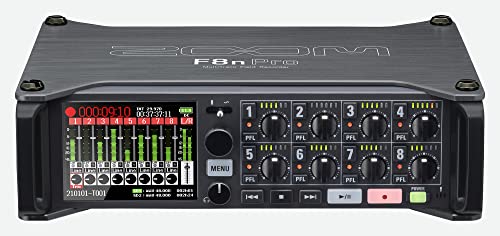
- Eight inputs and 10-track recording
- 0.2 ppm timecode accuracy
- Dual SD slots for redundant recording
Best For: Film crews and complex location-sound setups
Best Compact XLR Bundle

- Two locking XLR inputs
- Includes dedicated TCA-1 adapter
- 32-bit float recording with phantom power
Best For: Small crews and two-channel audio-for-video work
Best Wearable Pick

- 32-bit float recording in a 35 g wearable unit
- IP67 dust and water protection
- Timecode sync for up to 10 units
Best For: Discreet mobile video and interview recording
Best Multichannel Pick

- Four XLR/TRS inputs with Ultra HDDA preamps
- Six-track recording to SDXC
- Timecode, HDMI sync, and 192 kHz support
Best For: Multimicrophone camera rigs and production crews
Best Lightweight Stereo Option
Instamic Pro Plus C Mono/Stereo

- 18 g wearable recorder with 32-bit float audio
- Bluetooth connectivity and 16GB memory
- IP67 protection with timecode compatibility
Best For: Portable mono or stereo audio for action cameras and phones
Best Compact Timecode Recorder – TASCAM FR-AV2
The TASCAM FR-AV2 is a strong choice if you need a compact field recorder with timecode for video production. It combines 32-bit float recording, dual XLR/TRS inputs, and built-in timecode generation, helping simplify setup and reduce the risk of clipped recordings.
Best For: Videographers who want built-in timecode and flexible professional inputs in a small recorder.
Pros:
- Built-in timecode IN/OUT and high-accuracy TCXO generation and sync
- 32-bit float recording with dual ADCs for no-clip capture
- Two XLR/TRS combo inputs plus a 3.5 mm input
- Compact 9.5-ounce design
Cons:
- Bluetooth monitoring requires the optional AK-BT2 adapter
- Uses three AA batteries
For filmmakers who want timecode without adding a separate timecode device, the FR-AV2 offers an efficient, travel-friendly setup with recording rates up to 192 kHz.
Best Versatile Handheld Recorder – Zoom H4 Essential
The Zoom H4 Essential is a practical handheld field recorder for creators who need built-in microphones, external inputs, and 32-bit float recording. While its supplied notes do not list dedicated timecode hardware, it can fit video audio, interviews, podcasts, and live recording workflows.
Best For: Musicians, podcasters, and filmmakers seeking an accessible handheld recorder with flexible connectivity.
Pros:
- 32-bit float recording helps avoid distorted takes
- Built-in stereo microphones and two XLR/TRS inputs
- Four-track recording for larger projects
- USB-C recording or streaming with simultaneous SD-card backup
Cons:
- Supplied information does not identify timecode input, output, or generation
- Requires two AA batteries
The H4 Essential is better suited to general-purpose recording than timecode-centered production, but its combination of 32-bit float capture, four tracks, and USB connectivity makes it adaptable for many creative setups.
Best Lavalier Timecode Recorder – TASCAM DR-10L Pro
The TASCAM DR-10L Pro is a discreet personal field recorder with timecode support, making it useful when each performer needs an independent lavalier track. Its included microphone and 32-bit float recording simplify dialogue capture, while the V2.0 firmware adds LTC Jam Sync for multi-device workflows.
Best For: Filmmakers and content creators recording personal dialogue for interviews, events, and video shoots.
Pros:
- Includes a matched TM-10L clip-on lavalier microphone
- 32-bit float recording captures quiet and loud speech without clipping
- LTC Jam Sync supports seamless timecode synchronization
- Supports up to 512GB microSDXC cards and control of up to five units
Cons:
- Timecode wireless functions require the optional AK-BT1 adapter
- Not compatible with the AK-BT2 adapter
- Mono lavalier operation is designed for personal recording rather than multi-input mixing
Choose the DR-10L Pro when small, wearable dialogue recorders are more important than multiple inputs. Its LTC Jam Sync update makes it a particularly useful option for coordinated multi-recorder productions.
Best Professional Multitrack Recorder – Zoom F6
The Zoom F6 is a professional field recorder with timecode for productions that need multiple microphones and frame-accurate synchronization. Six XLR inputs, up to 14 tracks, and 32-bit float recording give location crews substantial flexibility for dialogue, music, and broadcast work.
Best For: Filmmakers and location sound teams managing several microphones in professional video workflows.
Pros:
- Timecode I/O provides frame-accurate audio-video synchronization
- Six XLR inputs support simultaneous multi-microphone recording
- 32-bit float recording with dual A/D converters reduces clipping concerns
- Works as a standalone recorder or USB audio interface
Cons:
- At 2.4 pounds, it is heavier than compact handheld options
- Requires four AA batteries for portable operation
- Its professional feature set may be more than basic recording needs require
For demanding location work, the F6 stands out through its combination of timecode I/O, six XLR inputs, and high track capacity. Its rugged portable design and multiple power options further support field production.
Best Pocket Pick – Deity PR-2 Pocket Recorder
If you need a field recorder with timecode that stays compact and flexible, the Deity PR-2 is designed for mobile production. It records 24-bit or 32-bit float WAV audio through a locking 3.5mm stereo mic/line input, and the package includes a W.Lav Pro lavalier microphone.
Best For: Videographers, journalists, and filmmakers who need a pocket-sized recorder with wireless control and timecode capability.
Pros:
- 32-bit float recording helps accommodate changing input levels.
- Compatible with Deity timecode products and can work as a standalone timecoder.
- Up to 30 hours of battery life from two AA batteries.
- Bluetooth control and monitoring through the Sidus Audio App.
Cons:
- The single 3.5mm input is less suitable for multi-microphone setups.
- Timecode features may be most useful within a compatible Deity workflow.
The PR-2 is a strong choice when portability matters more than channel count. Its included lavalier, app control, and 32-bit float support make it especially practical for interviews and compact camera rigs.
Best Professional Multitrack – Zoom F8n Pro Field Recorder
The Zoom F8n Pro is a field recorder with timecode built for larger film and location-sound workflows. It combines eight inputs, 10-track recording, 32-bit float capture, accurate 0.2 ppm timecode, and dual SD card slots for redundant recording.
Best For: Professional film crews and field recordists who need multiple inputs, extensive track capacity, and reliable synchronization.
Pros:
- Eight-channel, 10-track recording supports complex production setups.
- 32-bit float recording and dual A/D converters help prevent clipping.
- Timecode accuracy is specified down to 0.2 ppm.
- Dual SD slots support redundant recording, while USB operation provides an 8-in/4-out interface.
Cons:
- At 1.8 kg, it is substantially less portable than pocket recorders.
- Its listed battery life is about 8.5 hours.
- The larger feature set may be excessive for simple two-channel recording.
For productions with several microphones and cameras, the F8n Pro offers the most capable routing and recording setup in this group. Its dual-card redundancy and precise timecode make it a particularly production-oriented option.
Best Compact XLR Bundle – Zoom F3 with TCA-1 Timecode
This Zoom F3 bundle pairs a compact two-channel recorder with the TCA-1 timecode adapter, creating a practical field recorder with timecode for smaller audio-for-video setups. The F3 records 32-bit float WAV files through two locking XLR inputs and supports phantom power for compatible microphones.
Best For: Solo filmmakers, small crews, and production users who need two XLR channels with an included timecode connection.
Pros:
- Includes the TCA-1 adapter for 3.5mm TRS timecode input and output.
- Two locking XLR inputs support mic/line signals and 24/48V phantom power.
- 32-bit float recording and dual A/D converters suit changing sound levels.
- Runs on AA batteries, USB power, or the AD-17 AC adapter.
Cons:
- Two channels provide less capacity than the Zoom F8n Pro.
- The TCA-1 requires compatible firmware and connects through the F3 Remote connector.
The F3 plus TCA-1 is a focused solution for productions that need professional XLR inputs without a larger multitrack recorder. It offers a useful balance of portability, 32-bit float capture, and camera-sync connectivity.
Best Wearable Pick – Instamic Pro Plus C Mono
If you need a field recorder with timecode for discreet interviews, performances, or run-and-gun video, the Instamic Pro Plus C Mono combines a tiny wearable design with 32-bit float recording. Its built-in microphones, 16GB storage, and compatibility with phones, action cameras, Atomos, and Tentacle Sync make it easy to add time-synced audio to compact production setups.
Best For: Wearable, single-channel recording for mobile video, interviews, and outdoor shoots.
Pros:
- 32-bit float audio helps preserve recordings across changing sound levels.
- Extremely light 35 g design can stay discreet on camera.
- IP67-rated construction helps protect against dust and water.
- Can sync and control up to 10 units through the companion app.
Cons:
- Mono operation is less flexible than a multichannel recorder.
- Built-in omnidirectional microphones may capture surrounding sound.
This is a practical choice when portability and discreet placement matter more than XLR connectivity. Its timecode support and wireless pairing make it particularly useful for lightweight video workflows.
Best Multichannel Pick – TASCAM FR-AV4
For productions that need a field recorder with timecode and multiple professional inputs, the TASCAM FR-AV4 offers four XLR/TRS channels, a built-in mixer, and 32-bit float recording. It records four input tracks plus a stereo mix to SDXC while supporting HDMI synchronization and high-resolution recording up to 192 kHz.
Best For: Camera rigs and video crews recording several microphones or line sources at once.
Pros:
- Four XLR/TRS combo inputs support microphones and line sources.
- 32-bit float recording and dual A/D converters provide broad level coverage.
- Records six tracks, including four inputs and a stereo mix.
- Includes timecode generation, HDMI sync, and USB timecode output.
Cons:
- Some wireless and app features require the optional AK-BT2 accessory.
- Its camera-rig feature set is more involved than a simple wearable recorder.
The FR-AV4 is the strongest fit here for structured production audio. Choose it when multiple wired inputs, mixing, SDXC recording, and extensive camera synchronization are more important than minimal size.
Best Lightweight Stereo Option – Instamic Pro Plus C Mono/Stereo
The Instamic Pro Plus C Mono/Stereo is a compact field recorder with timecode for creators who want portable, wireless audio without adding a visible recorder to the setup. It offers 32-bit float capture, built-in MEMS microphones, Bluetooth connectivity, 16GB storage, and IP67 protection for mobile video work.
Best For: Lightweight mono or stereo wearable recording with phones and action cameras.
Pros:
- Supports clip-resistant 32-bit float recording.
- Mono/stereo model provides more channel flexibility than the mono version.
- Weighs just 18 g and is designed for discreet placement.
- Works with Atomos and Tentacle Sync workflows and can sync up to 10 units.
Cons:
- It uses built-in microphones rather than XLR or TRS inputs.
- Battery-powered wireless operation may be less suitable for extended multichannel sessions.
Compared with a conventional field recorder, this Instamic model prioritizes size, convenience, and camera-friendly placement. It is a good match for creators who want timecode-enabled audio that can disappear into a compact production kit.
How We Picked the Best Field Recorder with Timecode Options
We focused on recorders that offer built-in timecode generation, LTC support, or an included timecode solution rather than relying only on manual syncing. We also considered input count, connector types, 32-bit float availability, recording media, camera integration, size, and the demands of each intended workflow.
Because a compact lavalier recorder serves a different buyer than an eight-input production mixer, the list includes several form factors instead of ranking every model by the same standard. The goal is to match useful features to real production needs.
Quick Comparison
| Best For | What to Prioritize | Recommended Type |
|---|---|---|
| Solo filmmakers | Small size, simple sync, flexible gain handling | Compact 32-bit float recorder |
| Camera rigs | Multiple XLR/TRS inputs and camera connectivity | Camera-mounted field mixer |
| Large productions | Input count, track capacity, routing, and timecode reliability | Professional multitrack recorder |
| Interviews and lavaliers | Wearability, microphone compatibility, and long runtime | Body-worn or lavalier recorder |
| Musicians and creators | Fast setup, stereo recording, and portable controls | Handheld recorder with sync support |
Key Buying Factors for a Field Recorder with Timecode
Timecode Compatibility
Check whether the recorder generates timecode internally, accepts LTC, or needs a separate timecode accessory. Confirm the format and workflow used by your camera, wireless system, and editing software. A compatible connector and matching frame rate matter as much as the presence of a timecode label.
Inputs and Signal Handling
Two inputs may be enough for interviews, ambient sound, or a small camera package. Productions with several microphones need four or more XLR/TRS inputs, independent gain control, and practical routing. 32-bit float recording can provide extra protection against unexpected level changes, but it does not replace good microphone placement or clean cabling.
Camera and Production Integration
For a camera rig, look for mounting options, camera-return or line outputs, HDMI or other sync support, headphone monitoring, and easy access to controls. A larger multitrack recorder may be the better choice when you need isolated tracks, more sophisticated routing, or a dedicated sound operator.
Portability, Power, and Storage
Weight, battery life, media capacity, and weather exposure can determine whether a recorder works in the field. Verify the supported microSD or SD capacity, power options, and whether the unit can run while connected to external power. Wearable models should also be judged by clip security and cable strain relief.
Who Should Buy Which Field Recorder with Timecode?
Choose a compact two-channel model if you shoot alone and want dependable sync without carrying a full audio bag. A camera-mounted four-channel recorder is a stronger fit for small crews that need several XLR/TRS sources close to the camera. Select a multitrack recorder when the production includes multiple microphones, separate tracks, or more involved routing.
For interviews, documentary work, and performers wearing microphones, a dedicated lavalier or wearable recorder keeps the setup discreet and mobile. Musicians, podcasters, and occasional filmmakers may prefer a handheld recorder that starts quickly and handles stereo sources with minimal configuration. Before buying, confirm the exact timecode connection, microphone power requirements, included accessories, and the recording workflow used by your editing team.