As a PC enthusiast, you know the importance of a reliable power supply. A quality PSU tester can help you monitor voltage levels and prevent potential hardware issues. With so many options available, it’s essential to choose a model that fits your needs. From user-friendly designs to advanced features, the right tester can make all the difference. Let’s explore the top 10 PSU testers that can keep your power supply in check.
Computer PC Power Supply Tester with LCD Screen
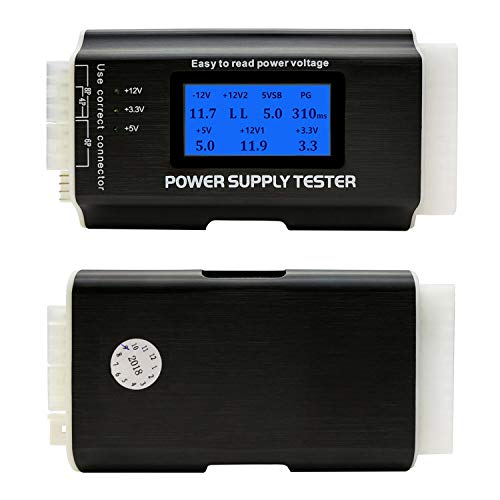
If you’re a PC enthusiast looking to confirm your power supply is functioning correctly, the Computer PC Power Supply Tester with LCD Screen is an essential tool for you. This lightweight device supports various connectors, including 20-pin and 24-pin ATX, SATA, and IDE. Its durable aluminum alloy enclosure guarantees protection while you test. The 1.8” LCD screen displays accurate output voltages, helping you monitor performance easily. Plus, the built-in beep alarm alerts you if values fall outside normal ranges. With this tester, you can confidently check your power supply’s reliability and keep your system running smoothly.
Best For: PC enthusiasts and technicians who need a reliable tool to test and monitor power supply performance.
Pros:
- Supports a wide range of connectors, making it versatile for different power supplies.
- Lightweight and portable design, easy to carry for on-the-go testing.
- LCD screen provides clear voltage readings, enhancing user experience and accuracy.
Cons:
- Does not support PCI-e 8-pin connectors, limiting compatibility with some high-end power supplies.
- The protective film on the screen may need to be removed for optimal visibility.
- Beep alarm may be disruptive in quiet environments when testing.
Thermaltake Dr. Power III ATX Power Supply Tester
For PC enthusiasts seeking reliability and precision, the Thermaltake Dr. Power III ATX Power Supply Tester is a must-have. This compact device supports ATX12V v3.1 and accurately detects voltage outputs of +12V, +5V, and +3.3V. Its real-time LCD display gives instant feedback, ensuring you know your power supply’s performance at a glance. Weighing just 0.33 pounds, it’s portable and easy to use. With a built-in diagnostic system, you can proactively maintain your setup. Rated 4.8 out of 5 stars, it’s a trusted choice among users. Don’t compromise your system—keep your power supply in check with this reliable tester.
Best For: PC enthusiasts and professionals who require precise monitoring and assessment of power supply performance.
Pros:
- Real-time voltage display allows for instant feedback on power supply performance.
- Compact and lightweight design makes it portable and easy to use.
- Built-in diagnostic system aids in proactive maintenance of power supplies.
Cons:
- Limited to ATX12V v3.1 compatibility, which may not cover all power supply types.
- Does not include advanced features like load testing or stress testing.
- Requires manual checking; may not be suitable for automated testing setups.
Kingwin Digital Power Supply Tester with LCD Screen

The Kingwin Digital Power Supply Tester with LCD Screen stands out as an essential tool for PC enthusiasts and builders who demand accuracy and efficiency in diagnosing power supply issues. It efficiently tests various PSUs, providing accurate voltage readouts for +12V, +5V, and +3.3V. With its clear LCD display, you can monitor voltage in real-time, making diagnostics straightforward. Its plug-and-play design guarantees that both beginners and professionals can use it easily. Lightweight and compact, it’s portable for on-the-go use. Plus, built-in safeguards protect against short circuits, guaranteeing long-term reliability for your power supply needs.
Best For: The Kingwin Digital Power Supply Tester is best for PC builders, repair technicians, and enthusiasts who require precise and efficient power supply diagnostics.
Pros:
- Accurate voltage readouts for +12V, +5V, and +3.3V, ensuring reliable testing results.
- User-friendly design with a clear LCD display and plug-and-play functionality for easy use.
- Portable and compact construction allows for convenient storage and on-the-go testing.
Cons:
- Limited to testing specific power supply types (ATX, ITX, IDE, HDD, SATA, and BTX), which may not cover all models.
- The reliance on battery power may require replacements for prolonged use.
- Some users may find the lightweight design less durable compared to heavier testers.
1Pcs LCD Computer Power Supply Tester for ATX BTX ITX TFX SATA

PC builders and enthusiasts will find the LCD Computer Power Supply Tester indispensable for diagnosing power supply issues. This compact device easily connects to various power supply types, including ATX, BTX, ITX, and TFX, allowing you to measure critical output voltages like 3.3V, +5V, and +12V. The intuitive LCD screen displays voltage and PG values, flashing warnings for any abnormal readings. With a built-in buzzer for alerts and an aesthetic design, this tester offers a complete analysis interface. It’s perfect for quickly identifying and resolving potential power problems in your setup, ensuring your system runs smoothly.
Best For: PC builders and enthusiasts looking for an efficient tool to diagnose power supply issues in their systems.
Pros:
- Compact design makes it easy to use and store.
- Intuitive LCD display provides clear voltage readings and alerts.
- Supports multiple power supply types and connectors for versatile use.
Cons:
- May not cover all specific power supply issues beyond voltage readings.
- Limited functionality for advanced diagnostics compared to professional tools.
- Requires manual connection to power supply which may be inconvenient for some users.
20+4 Pin LCD Computer Power Supply Tester for SATA IDE HDD ATX ITX Connectors
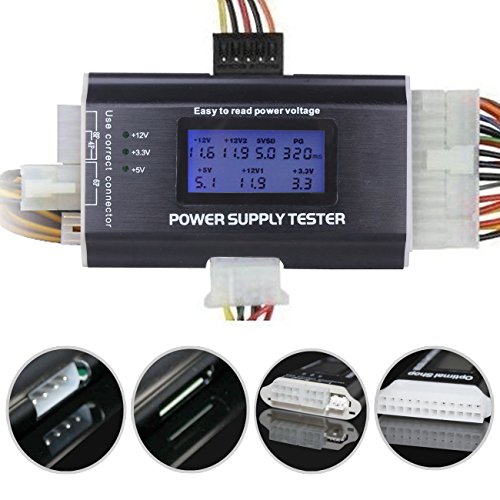
Designed with versatility in mind, the 4 Pin LCD Computer Power Supply Tester is perfect for tech-savvy enthusiasts who demand reliability in their components. This 20+4 pin tester supports various connectors, including SATA, IDE, and PCI-e, providing 8-in-1 functionality. Its aluminum alloy shell guarantees durability while maintaining lightweight properties. The 1.8-inch LCD screen displays voltage readings clearly, and a buzzer alarm alerts you to any power supply issues. With easy testing capabilities, you can quickly verify your power supply’s performance, confirming your computer runs smoothly and efficiently. Don’t compromise on quality; keep your system in check with this essential tool.
Best For: Tech enthusiasts and computer builders who need a reliable and efficient way to test power supply connectors.
Pros:
- 8-in-1 functionality allows testing of multiple connector types, enhancing versatility.
- Lightweight aluminum alloy shell ensures durability and portability.
- 1.8-inch LCD screen provides clear voltage readings, making it easy to monitor power supply performance.
Cons:
- Limited to testing power supply connectors, may not cover other components.
- The buzzer alarm may be too loud for some users in quiet environments.
- Requires a compatible power supply to function, which might limit its usability in certain situations.
PC Computer PSU and Motherboard Tester Tool Diagnostic Analyzer Starter Kit

For tech-savvy users who want to diagnose power supply issues efficiently, the PC Computer PSU and Motherboard Tester Tool Diagnostic Analyzer Starter Kit is an essential tool. This compact kit includes a large PCI test board, a small laptop test board, a BIOS speaker for beep codes, and a motherboard power switch cable, all neatly stored in a portable case. Weighing just 7 ounces, it’s easy to carry. With four digital LEDs and eight additional indicators, you can quickly identify common problems like no power or no boot. Plus, enjoy free lifetime customer service support for peace of mind.
Best For: Tech-savvy users and PC builders looking to diagnose power supply and motherboard issues efficiently.
Pros:
- Compact and portable design makes it easy to carry and store.
- Includes multiple diagnostic tools like a BIOS speaker and various test boards for versatility.
- Free lifetime customer service support ensures assistance when needed.
Cons:
- Not compatible with PCIe slots, limiting its use with newer systems.
- May require careful matching of PSU connector pins for accurate functionality.
- The kit may be overwhelming for beginners unfamiliar with PC diagnostics.
SDTC Tech 24-Pin ATX Power Supply Jumper Bridge Tool

If you’re a DIY enthusiast looking to streamline your PC builds or troubleshoot hardware, the SDTC Tech 24-Pin ATX Power Supply Jumper Bridge Tool is a must-have. This handy device lets your power supply unit (PSU) power on without needing a motherboard connection, making it perfect for testing and assembling components. Compatible with both 20 and 24-pin connectors, you can easily check lights, fans, hard drives, or even your PSU itself. With a robust 18AWG cable, it promises reliability during frequent use. Rated 4.7 out of 5 stars by users, it’s a top choice for any PC builder.
Best For: DIY enthusiasts and PC builders looking to test and assemble components efficiently without a motherboard connection.
Pros:
- Versatile Compatibility: Works with both 20 and 24-pin connectors for a wide range of power supply units.
- Reliable Construction: Features a robust 18AWG cable that ensures durability and reliability during frequent use.
- High User Rating: Enjoys a strong rating of 4.7 out of 5 stars from over 400 reviews, indicating customer satisfaction.
Cons:
- Limited Functionality: Primarily designed for testing and assembly, may not be necessary for all users.
- Requires Manual Operation: Users must manually connect the jumper, which may not be as convenient as integrated solutions.
- No Advanced Features: Lacks additional functionalities that some more complex testing tools may offer.
Computer PC Power Supply Tester with LCD Display

The Computer PC Power Supply Tester with LCD Display is an essential tool for computer enthusiasts and repair technicians who need accurate and efficient diagnostics for power supply units. This compact device inspects ATX, BTX, ITX, and TFX power supplies with a user-friendly design. Its intelligent LCD screen shows real-time voltage readings and triggers alarms for any abnormal parameters. Weighing just 0.08 kilograms, it’s easy to carry around. Supporting various connectors, it guarantees precise voltage measurements, enhancing your power supply assessments. Rated 4.5 out of 5 stars by users, it’s a reliable choice for maintaining peak power performance.
Best For: The Computer PC Power Supply Tester with LCD Display is best for computer enthusiasts and repair technicians seeking a reliable tool for diagnosing power supply units.
Pros:
- Intelligent LCD Screen provides real-time voltage readings and alerts for abnormal parameters, enhancing diagnostic efficiency.
- Lightweight and Portable design makes it easy to carry for on-the-go diagnostics or routine maintenance.
- Comprehensive Compatibility with multiple connector types ensures versatility for various power supply units.
Cons:
- Limited to Power Supply Testing only; does not offer additional features for other computer component diagnostics.
- Corded Electric Power Source may limit usability in areas without easy access to an outlet.
- Warranty Information is not readily available, which may concern some potential buyers.
axGear Power Supply Tester for PC Computer

PC enthusiasts seeking a reliable tool for testing power supplies will find the axGear Power Supply Tester an invaluable addition to their toolkit. This compact device supports ATX, BTX, and ITX power supplies, providing quick voltage checks for +12V, -12V, +5V, and more. With a clear LCD display, it signals normal operation through a beep, while a long buzzer warns of issues. Weighing just 3.1 oz, it’s lightweight and easy to use. Plus, it doesn’t require batteries, making it convenient for any setup. With a solid 4.5-star rating, it’s a trusted choice for serious PC builders.
Best For: PC enthusiasts and builders looking for a reliable and efficient tool to test power supplies quickly and accurately.
Pros:
- Compact and lightweight design, making it easy to transport and use.
- Clear LCD display with audible alerts for normal and abnormal voltage readings.
- Supports a variety of power supply types (ATX, BTX, ITX) and multiple voltage tests.
Cons:
- May not provide in-depth diagnostics for advanced users.
- Limited to voltage testing; does not measure other power supply characteristics.
- Requires connection to power supply, which may not be convenient for all setups.
Byi Plug PC Power Supply Diagnostic Tester

For those passionate about building or upgrading their computers, the Byi Plug PC Power Supply Diagnostic Tester stands out with its precise LCD display, offering voltage accuracy within +/-0.01V. This compact tool measures essential voltages, including +3.3V, +5V, and +12V, so you can easily monitor your power supply’s performance. With support for multiple interfaces like 20Pin, 24Pin, and PCI-E connectors, it’s versatile enough for various setups. An automatic error alarm lets you know if something’s off, ensuring you catch issues early. Weighing only 3.34 ounces, it’s convenient for quick diagnostics, making it a must-have for enthusiasts.
Best For: Computer enthusiasts and builders looking for an accurate and convenient tool to diagnose power supply performance.
Pros:
- Compact design makes it easy to use and store.
- LCD display offers precise voltage readings with high accuracy.
- Supports a variety of connectors, enhancing its versatility for different setups.
Cons:
- Some users may experience issues with the +3.3V light on the SATA interface not illuminating.
- Limited information on warranty may be a concern for some buyers.
- Requires proper connection and understanding of power supply functions for effective use.
Factors to Consider When Choosing a PSU Tester for PC
When choosing a PSU tester for your PC, you’ll want to take into account several key factors. Look for voltage measurement accuracy and connector compatibility to guarantee it meets your needs. Additionally, a user-friendly design and solid build quality can make your testing experience more efficient and reliable.
Voltage Measurement Accuracy
Choosing a PSU tester hinges on voltage measurement accuracy, as even minor discrepancies can lead to significant issues in your computer system. Look for testers that offer precision as high as +/-0.01V, ensuring reliable assessments of your power supply outputs. It’s crucial to have a tester that displays multiple voltage readings, including +3.3V, +5V, +12V, -12V, and +5V standby (SB), as these are critical for diagnosing power supply health. An accurate LCD display can provide real-time feedback on voltage fluctuations, allowing you to spot problems quickly. Additionally, testers with built-in alarm systems will alert you to abnormal voltage readings, enhancing safety and efficiency during troubleshooting. Consistent, precise readings are imperative for protecting your hardware and maintaining system stability.
Connector Compatibility
While selecting a PSU tester, it’s vital to take into account connector compatibility, as not all testers support the same types of connections. Verify the tester covers the specific connectors in your power supply, like ATX, BTX, ITX, and SATA. Pay special attention to both 20-pin and 24-pin ATX connectors, which are common in modern power supplies. Additionally, look for compatibility with PCI-e, IDE, floppy drive, and EPS connectors to test all your components effectively. It’s also important to confirm the tester can handle various voltage outputs, such as +3.3V, +5V, +12V, and -12V. Finally, opt for testers with clear indicator lights or LCD displays to easily monitor voltage readings and spot potential issues.
User-Friendly Design
Selecting a PSU tester goes beyond just connector compatibility; the design of the tester plays a significant role in its overall usability. Look for a tester with a clear, intuitive display, like an LCD screen, that shows real-time voltage readings for easy monitoring. A lightweight and compact design enhances portability, making it convenient whether you’re a professional technician or an everyday user. Opt for a model with simple plug-and-play functionality, which allows for quick setup regardless of your technical expertise. Ergonomic designs improve handling comfort, especially during long testing sessions. All these features contribute to a user-friendly experience, making it easier for you to verify your power supply is operating correctly.
Alarm and Notification Features
One key factor to contemplate when evaluating PSU testers is the presence of alarm and notification features, which can greatly enhance your troubleshooting experience. These alarms are designed to alert you to abnormal voltage levels, allowing for timely detection of potential power supply issues. Many testers come with built-in buzzers that sound off when voltage readings exceed normal thresholds, giving you immediate feedback. Additionally, some models incorporate visual notifications like flashing parameters on an LCD screen, indicating errors or faults in real-time. Advanced testers may even include specific alarms for various power output signals, such as +3.3V, +5V, and +12V, improving diagnostic accuracy and maintenance efficiency while reducing the risk of hardware damage.
Build Quality and Durability
When troubleshooting power supply issues, the effectiveness of your PSU tester relies not only on its features but also on its build quality and durability. Look for testers made from high-quality materials like aluminum alloy, which offer excellent thermal conductivity and corrosion resistance. A lightweight, portable design makes it easier to carry and use in different environments without sacrificing strength. Features such as a protective film on the display screen can indicate a focus on durability and user convenience. Additionally, choose testers with robust enclosures that can handle regular use and potential drops. While lighter models are convenient for transport, they should still maintain solid build quality to guarantee long-lasting reliability during your testing sessions.