Wireless infrared repeaters make it easier to control hidden or distant AV equipment without pointing your remote directly at each component. They are especially useful for enclosed cabinets, wall-mounted TVs, and multi-device home theaters.
This roundup compares 10 wireless infrared repeaters by compatibility, range, installation style, device capacity, and everyday convenience, helping you choose a setup that fits your room and equipment.
Best 10 Wireless Infrared Repeaters Picks for 2026
Comprehensive Wired Control

- Controls up to 10 devices, expandable to 12
- Broad compatibility with IR home theater equipment
- Includes five dual emitters and a distribution block
Best For: Multi-component home theaters with concealed equipment
Long-Range Wireless Control

- Designed for through-wall and multi-zone control
- 433MHz transmission with wide-angle reception
- Configured to control up to four IR devices
Best For: Large homes and multi-room installations
Simple TV Setup
Cable Matters IR Extender Cable

- 6-foot USB-powered IR extension cable
- LED confirms signal transmission
- Adhesive-backed cables simplify installation
Best For: Single concealed A/V source behind a wall-mounted TV
Extended Wireless Reach

- Wireless range rated up to 200 meters
- Supports up to 10 compatible IR devices
- Includes flexible mounting and emitter accessories
Best For: Large or multi-zone IR entertainment setups
Best Compact Pick

- USB-powered receiver and transmitter kit
- Works with many hidden AV components
- Rated for remote control up to 22 feet
Best For: Simple TV-cabinet and media-center installations
Best Long-Range Pick
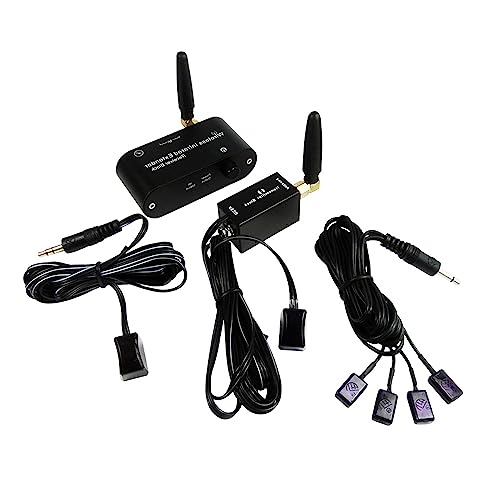
- 433 MHz wireless through-wall transmission
- Supports multi-room and multi-floor control
- Quad-eye design for multiple IR devices
Best For: Large or expandable home theater systems
Best Multi-Device Pick

- Controls up to 10 devices, expandable to 12
- Includes five IR emitters and a console box
- Supports a broad 20–60 kHz frequency range
Best For: Crowded AV cabinets with multiple hidden components
Best with Extra Features

- Advertised 700-foot emitter-to-receiver range
- Supports 20–60 kHz IR devices
- LED signal indicator and 12-month warranty
Best For: Concealed media cabinets and long-distance IR control
Best Multi-Device System
Four-Device Wireless IR Extender

- Designed to control up to four IR devices
- Supports expandable multi-zone configurations
- Advertised 50 m indoor and 200 m outdoor range
Best For: Large homes and multi-room infrared setups
Best Cabinet Setup

- Advertised 500-foot 433 MHz wireless range
- Two channels help separate nearby devices
- Includes cables, power adapters, pads, and manual
Best For: Cabinet-based home theater and multi-device media centers
Comprehensive Wired Control – Multi-Device IR Repeater Kit
This wireless infrared repeaters roundup includes options for different home theater layouts, and this kit is designed for centralized control of hidden equipment. It supports up to 10 devices, with expansion to 12, using the included distribution block, receiver, and emitters.
Best For: Home theater systems with several IR-controlled components stored in cabinets or behind doors.
Pros:
- Controls up to 10 devices and can expand to 12.
- Works with a broad range of IR electronics, including receivers, cable boxes, DVD players, and Blu-ray players.
- Includes five 10-foot dual IR emitters and a 5-foot receiver cable.
- Provides real-time transmission and CFL-friendly operation.
Cons:
- Plasma displays may cause interference and require receiver placement away from the screen.
- Multiple receivers need at least 6 meters of separation to help avoid interference.
This is a practical choice when you need broad device support and multiple wired emitters. Installation requires attention to receiver placement, especially in rooms with plasma displays or multiple receivers.
Long-Range Wireless Control – 433MHz IR Blaster Repeater
For shoppers comparing wireless infrared repeaters, the SPENFiLY WL-T1-E4 emphasizes long-distance, through-wall control. Its 433MHz wireless link is designed for multiple zones and supports control of up to four IR devices with the supplied setup.
Best For: Large homes, multi-floor spaces, offices, or installations where IR devices are located in separate rooms.
Pros:
- Supports wireless control across rooms and through walls.
- Offers claimed outdoor range over 500 meters and through-two-wall range over 200 meters.
- Uses a 180-degree wide-angle reception design with anti-interference features.
- Package includes receiving and transmitting hosts, power adapters, USB cables, and a receiver and transmitter.
Cons:
- The IR transmitter range is listed as less than 1 meter.
- This model is specified for controlling four devices, rather than the larger capacities of some wired kits.
- Warranty coverage is listed as six months.
The WL-T1-E4 stands out when distance and cross-room communication matter most. Confirm the number and placement of your IR devices before choosing this four-device configuration.
Simple TV Setup – Cable Matters IR Extender Cable
Among wireless infrared repeaters and related IR extenders, this Cable Matters kit is a straightforward wired option for a wall-mounted TV or concealed source. The 6-foot USB-powered cable relays remote commands to a Blu-ray player, set-top box, receiver, or other IR-controlled device.
Best For: Single-device home theater setups that need a compact, easy-to-install IR extension.
Pros:
- Uses a 6-foot Y-cable and 5V USB power.
- Blue receiver LED indicates signal transmission.
- Adhesive backing helps secure the receiver and transmitter cables.
- Supports up to a 15-foot IR signal range and a 30-degree receiver angle.
Cons:
- Requires a separate 5V USB wall charger because a TV USB port may not provide power when the TV is off.
- Works with IR devices, not RF signal devices.
- Wi-Fi routers and CFL bulbs may cause interference.
This is a good fit for a simple, low-profile installation rather than a multi-device distribution system. Its USB power requirement and IR-only compatibility are the main points to verify before purchase.
Extended Wireless Reach – Sewell BlastIR Pro Repeater
The Sewell BlastIR Wireless Pro is a strong contender among wireless infrared repeaters for separated equipment zones. It uses a wireless link rated up to 200 meters under stated conditions and supports control of up to 10 compatible IR devices.
Best For: Larger homes or multi-zone entertainment systems where equipment is far from the remote-control position.
Pros:
- Wireless distance is listed at up to 200 meters, or 650 feet, depending on obstacles.
- Supports up to 10 devices and offers multi-zone control.
- Includes USB and AC power cables, emitter cables, mounting adhesive, and rubber feet.
- Optional receiver and emitter cables can improve directional reception and device placement.
Cons:
- The IR receiver distance is listed as 7 meters, and the main receiver is directional.
- Works only with IR devices, not RF-controlled equipment.
- Notes list incompatibility with Yamaha HTR 6140, Arris DCX 3520E-M, and OSD ATM-7 Speaker Selector.
The BlastIR Pro combines long wireless reach with support for a sizable group of devices. Check compatibility and plan receiver orientation carefully, especially if the remote will be used from varying angles.
Best Compact Pick – USB IR Extender Kit
This compact option is a practical starting point for wireless infrared repeaters when you want to control a hidden cable box, DVD player, Blu-ray player, or other AV component from up to 22 feet. Its receiver-and-transmitter setup uses USB power and is designed for straightforward TV-cabinet installation.
Best For: Small entertainment centers and users who need a simple way to operate one hidden IR-controlled device.
Pros:
- Complete kit includes an infrared receiver and transmitter.
- USB-powered design suits many TV cabinets and media centers.
- Compatible with a broad range of IR-controlled home theater equipment.
- Simple placement-based installation with a stated range of up to 22 feet.
Cons:
- Designed for IR devices, so it will not suit equipment using another remote technology.
- The supplied notes do not indicate multi-device expansion.
Choose this Qavrulino kit if you value uncomplicated setup and a tidy entertainment area more than long-distance or multi-room control.
Best Long-Range Pick – WL-E4 Quad-Eye IR Repeater
For demanding wireless infrared repeaters setups, the SPENFiLY WL-E4 emphasizes distance and through-wall control. Its 433 MHz wireless link is specified for more than 50 meters indoors and more than 200 meters outdoors, while the quad-eye design supports control of multiple infrared devices.
Best For: Multi-room, multi-floor, or larger home theater installations that need long-distance IR transmission.
Pros:
- Long-range 433 MHz transmission supports through-wall and multi-floor control.
- Quad-eye IR emitter design is suited to multiple infrared devices.
- 130-degree reception angle and external antenna are designed for stable signal pickup.
- Package includes receiving and transmitting hosts, cables, power adapters, and a manual.
Cons:
- Its more extensive hardware may be excessive for a single nearby cabinet.
- The listing specifies infrared compatibility, so non-IR equipment is not covered.
This is the strongest fit when range and expansion matter most. Consider it for distributed AV control rather than a basic single-cabinet installation.
Best Multi-Device Pick – 10-Device IR Repeater System
This Herfair system is a capable choice among wireless infrared repeaters when several AV components must remain concealed. The console box includes five IR emitters and can control up to 10 devices, with expansion to 12, while supporting a broad 20–60 kHz frequency range.
Best For: Media consoles or cabinets containing multiple receivers, players, cable boxes, and other IR-controlled components.
Pros:
- Controls up to 10 devices and is expandable to 12.
- Includes five IR emitters, an IR receiver, console box, and 12V power adapter.
- Broad frequency range is designed for compatibility with many AV appliances.
- Plug-and-play operation provides real-time transmission with status indicators.
Cons:
- With a listed range of 8 meters, it is less suited to especially long-distance installations.
- Multiple receiver placement requires at least 20 feet of separation to help avoid interference.
- The system uses a wired emitter arrangement around the concealed components.
Pick this model when device count is the priority. Its included emitters and expandable capacity make it more practical for a busy AV cabinet than a minimalist repeater kit.
Best with Extra Features – 700-Foot Wireless IR Repeater
If you need wireless infrared repeaters for an entertainment cabinet, wardrobe, or other concealed setup, this Fourair kit emphasizes long-distance transmission and broad compatibility. It supports 20–60 kHz infrared devices, including DVD players, cable or satellite boxes, and audio systems, but it will not control Bluetooth, Wi-Fi, or app-controlled equipment.
Best For: Homes, offices, hotels, and media cabinets where IR components need to stay hidden while the remote is used from a distance.
Pros:
- Advertised 700-foot range between the infrared emitter and receiver.
- Supports mainstream IR equipment across the 20–60 kHz range.
- LED indicator provides a quick signal-reception check.
- Includes a 12-month warranty and real-time signal transmission.
Cons:
- Compatibility must be verified because Bluetooth, Wi-Fi, and app-controlled devices are unsupported.
- The extension cables need to be positioned in line of sight of the source IR sensor, ideally within 2 inches.
This is a strong option when maximum stated range and broad traditional IR compatibility matter most. Check your equipment’s remote technology and IR receiver placement before ordering.
Best Multi-Device System – Four-Device Wireless IR Extender
For buyers comparing wireless infrared repeaters for several rooms or appliances, the SPENFiLY OWM-Series focuses on multi-zone control and system expansion. Its 36–56 kHz transmission is designed for standard IR devices, with advertised coverage of more than 50 meters indoors and more than 200 meters outdoors.
Best For: Large homes, offices, home theaters, and installations that need synchronized control of multiple infrared devices across rooms or floors.
Pros:
- Model is specified for control of up to four devices.
- Supports multi-point expansion with additional transmitters or receivers.
- Advertised range exceeds 50 meters indoors and 200 meters outdoors.
- Kit includes receiving and transmitting hosts, receivers, transmitters, two power supplies, and a manual.
Cons:
- Only compatible with infrared devices, not non-IR control systems.
- The multi-zone setup may require more installation planning than a simple one-device extender.
This model stands out for scalable, multi-appliance installations rather than a basic single-cabinet connection. It is worth considering if you expect to expand the system or control equipment in separate areas.
Best Cabinet Setup – 2CH 500-Foot IRBlast Repeater
This 2CH IRBlast is a practical wireless infrared repeater for controlling cable boxes, Blu-ray or DVD players, receivers, and other IR equipment hidden inside a cabinet. It uses a 433 MHz wireless link with an advertised 500-foot range and includes channel switches to help separate multiple nearby setups.
Best For: Home theater cabinets and multi-device media centers where line-of-sight problems and cross-control between adjacent components are concerns.
Pros:
- Advertised 500-foot wireless range, with up to 984 feet in open air.
- Two adjustable channels help prevent accidental control of nearby devices.
- Includes two IR extension cables, AC and USB power adapters, adhesive pads, and a manual.
- LED flashes when an IR signal is received, simplifying troubleshooting.
Cons:
- Works only with IR remotes; RF, Bluetooth, Wi-Fi, and app-controlled devices are not supported.
- The receiver’s stated remote-capture angle is 45 degrees.
Choose this kit if channel selection and a complete installation package are more useful than support for newer network-controlled devices. Confirm that your remote is infrared before purchase.
How We Picked the Best Wireless Infrared Repeaters
We focused on the features that matter most in real installations: reliable infrared signal transmission, stated wireless range, compatibility with common remotes and AV equipment, installation simplicity, and the number of devices each system can control. We also considered whether a kit uses a single emitter, multiple emitters, or a quad-eye design for directing signals to several components.
Because performance depends on wall construction, cabinet materials, placement, and remote-control protocols, published range figures should be treated as maximums rather than guarantees. A strong wireless connection is helpful, but correct receiver and emitter placement remains essential.
Quick Comparison
| Best For | What to Look For |
|---|---|
| One hidden component | Compact repeater with a focused emitter |
| Several AV devices | Multiple emitters or a quad-eye output |
| Long-distance installations | A clearly specified wireless range and flexible placement |
| Simple wired expansion | Long IR cable and straightforward emitter connection |
| Home theater cabinets | Low-profile sensors and discreet adhesive mounting |
Key Buying Factors for Wireless Infrared Repeaters
Compatibility
Most infrared repeaters work with standard IR remotes used by televisions, receivers, streaming boxes, Blu-ray players, cable boxes, and similar equipment. They generally will not control Bluetooth- or radio-frequency-only devices. Confirm that your remote and components use infrared before buying.
Range and Placement
Check both the receiver’s remote-control pickup range and the transmitter’s wireless range. Place the receiver where the remote is normally used, then position the emitter directly over the target device’s IR sensor. Avoid enclosing the receiver behind dense furniture or placing emitters where they can be knocked loose.
Device Capacity
A single-emitter kit may be enough for a television or one concealed component. Multi-emitter and quad-eye systems are better for receivers, consoles, disc players, streaming devices, and cable boxes installed in the same cabinet. Count your components before choosing.
Installation and Power
Look for included cables, adhesive mounts, power adapters, and clearly labeled transmitter and receiver units. Wireless systems reduce signal cabling between rooms, but both ends may still need nearby power. Measure cable lengths when the equipment is spread across a wide cabinet.
Who Should Buy Which Wireless Infrared Repeaters?
Choose a compact single-device extender if you only need to operate one hidden component. A multi-emitter kit is a better fit for a conventional home theater with several devices behind a cabinet door. For larger rooms or equipment located farther from the seating area, prioritize a model with a clearly stated long wireless range, while remembering that walls and interference can reduce actual performance.
If you want the simplest installation and do not need a wireless link, a wired IR extension cable can be practical and economical. Buyers managing professional or unusually complex systems should favor established brands, replaceable emitters, documented compatibility, and responsive support over headline range alone.