Infrared repeaters let you control hidden or enclosed entertainment equipment without pointing your remote directly at each device. They can simplify cabinet installations, improve access to components, and reduce the need to expose receivers.
This roundup compares 10 infrared repeaters for home use, including wired and wireless kits, long-range options, and systems designed to control multiple devices. The right choice depends on compatibility, installation distance, receiver placement, and how many components you need to operate.
Best 10 Infrared Repeaters for Home Use Picks for 2026
Best Multi-Device Coverage

- Controls up to 10 devices, expandable to 12
- Includes five 10-foot IR emitters
- Real-time transmission with status indicators
Best For: Large home theater systems with concealed components
Best Simple Cable Setup

- Six-foot cable for compact installations
- USB-powered through a 5V wall charger
- Adhesive-backed transmitter and receiver
Best For: Wall-mounted TVs and single-source setups
Best Value Room-to-Room Kit
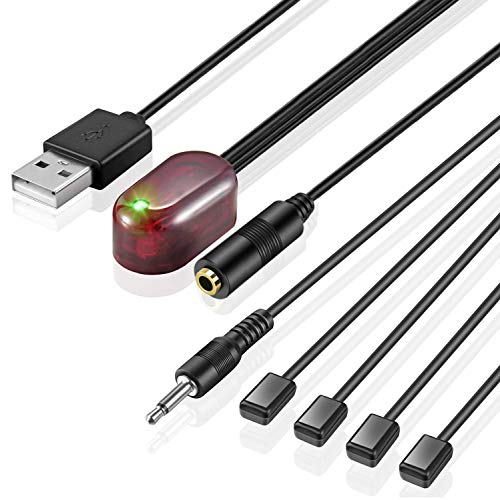
- Controls up to four IR components
- Includes four emitters and one receiver
- 34–60kHz operating range with USB power
Best For: Modest A/V systems and cabinet installations
Best Long-Range Option

- Claims up to 700 feet between modules
- Supports 20–60kHz IR devices
- Includes signal LED and 12-month warranty
Best For: Large layouts requiring substantial emitter-receiver separation
Best Wired Pick
Cable Matters 10ft IR Extender
- 10-foot wired reach for concealed A/V equipment
- Blue LED confirms signal transmission
- USB powered and compatible with most IR devices
Best For: Simple wall-mounted TV and equipment-closet installations
Best Multi-Component Kit

- Four emitter outputs for multiple A/V devices
- Designed for equipment behind doors or walls
- Stated support for up to 32 components
Best For: Centralized control of larger entertainment cabinets
Best Long-Range Wireless

- 433 MHz wireless range rated up to 500 feet
- Two channels help separate nearby systems
- Includes dual power options and two IR extension cables
Best For: Long-distance control of standard IR equipment
Simple Cabinet Control

- Receiver and multiple emitters
- Supports common hidden AV devices
- Simple setup for cabinets and media centers
Best For: Concealed home theater and TV-cabinet equipment
Whole-Home Wireless Reach

- Controls up to four IR devices
- Long-distance wireless transmission
- Expandable multi-zone design
Best For: Multi-room or large-home IR control
High-Capacity AV Control

- Controls up to 10 devices
- Expandable to 12 devices
- Includes five emitters and plug-and-play setup
Best For: Large AV cabinets and multi-component home theaters
Best Multi-Device Coverage – 10-Device IR Repeater System
For shoppers comparing infrared repeaters for home use, this ICESPRING kit is designed for larger entertainment setups. It can control up to 10 IR devices, with expansion to 12, while those components remain inside cabinets or in other rooms.
Best For: Home theaters with multiple concealed A/V components.
Pros:
- Supports up to 10 devices and can expand to 12.
- Includes five emitters with 10-foot cables for flexible component placement.
- Offers real-time transmission, indicator lights, and compatibility with most IR electronics.
Cons:
- Plasma displays may interfere with the receiver.
- Multiple receivers require at least 6 meters of separation to help avoid interference.
- The system is wired rather than wireless.
Its distribution block and multiple emitters make it a practical choice when one receiver needs to serve a sizable cabinet-based system. Pay close attention to receiver placement, especially around plasma displays and multiple receiver connections.
Best Simple Cable Setup – 6ft USB IR Extender
This Cable Matters model is a straightforward option for infrared repeaters for home use when you need to control a concealed Blu-ray player, cable box, receiver, or similar source from a TV-viewing position. Its six-foot cable and USB power make it suited to compact installations.
Best For: Wall-mounted TVs and small home theater setups with one concealed source.
Pros:
- Six-foot Y-cable provides flexible receiver and transmitter placement.
- USB-powered design works with a 5V USB wall charger.
- Adhesive backing helps secure the IR transmitter and receiver.
- Blue LED confirms signal transmission.
Cons:
- The TV’s USB port may not provide power when the TV is off.
- Supports IR devices, not RF-controlled equipment.
- Wi-Fi routers and CFL bulbs may cause interference.
The compact cable design keeps installation simple, especially behind a wall-mounted TV. Use a separate USB wall charger for dependable power and position the receiver’s blue LED facing forward for stronger reception.
Best Value Room-to-Room Kit – 4-Emitter IR Repeater
If you want infrared repeaters for home use across a modest entertainment system, this URWOOW kit offers one receiver and four emitters. It is intended to carry remote commands between rooms or to equipment hidden in a cabinet, with USB power for convenient setup.
Best For: Small to medium A/V systems with up to four controlled components.
Pros:
- Four emitters can control multiple devices simultaneously.
- 34–60kHz operating range supports many common IR components.
- Includes a receiver LED for visual confirmation.
- USB AC power supply supports convenient installation.
Cons:
- Supports a maximum of four devices.
- Remote commands work best when aimed at the IR receiver.
- The receiver and emitter cables are shorter than some larger kits.
With a two-meter receiver cable and one-meter emitter cables, this system balances basic placement flexibility with a relatively compact design. It is a sensible fit when four emitters are enough and you prefer not to pay for a larger distribution system.
Best Long-Range Option – Wireless 700ft IR Repeater
For buyers seeking infrared repeaters for home use over a wider layout, this Fourair wireless kit is built around a claimed 700-foot distance between the emitter and receiver. It supports common 20–60kHz IR equipment and includes an LED indicator for signal activity.
Best For: Large homes, offices, or installations where the emitter and receiver need substantial separation.
Pros:
- Claims up to 700 feet between the infrared emitter and receiver.
- Supports mainstream IR devices in the 20–60kHz range.
- Provides real-time transmission and a signal LED.
- Includes a 12-month warranty.
Cons:
- Compatibility depends on the device having an active IR receiver.
- Does not control Bluetooth remotes or app- and Wi-Fi-controlled devices.
- The emitter should be placed within 2 inches and in line of sight of the source sensor for best performance.
This is the most ambitious option in the group for distance and wireless placement. Verify that every target device uses IR before purchase, and follow the close, line-of-sight emitter placement guidance for reliable operation.
Best Wired Pick – Cable Matters 10ft IR Extender
For straightforward infrared repeaters for home use, the Cable Matters extender is a practical wired option for controlling a concealed Blu-ray player, DVD player, set-top box, receiver, or other IR-equipped A/V source from the TV area. Its 10-foot cable and USB power make it well suited to a wall-mounted television and nearby equipment closet.
Best For: Home theater setups needing a simple, 10-foot wired connection to one concealed A/V source.
Pros:
- Works with most devices that use infrared sensors.
- Blue receiver LED confirms that a signal was transmitted.
- USB-powered design includes adhesive-backed transmitter and receiver cables.
- Supports up to a 15-foot IR signal range under suitable conditions.
Cons:
- It does not work with RF remote-controlled devices.
- The TV’s USB port may not provide power when the TV is off; a USB wall charger is recommended.
- As a wired kit, installation requires routing the 10-foot cable.
This is a sensible choice when reliability and uncomplicated installation matter more than wireless range. Confirm that your equipment uses IR and plan for a separate 5V USB wall charger if the TV cannot power the extender while off.
Best Multi-Component Kit – Ensigear Hidden IR Repeater
The Ensigear hidden repeater is designed for infrared repeaters for home use where several A/V components sit behind cabinet doors or inside an equipment closet. It provides one receiver input and four emitter outputs, with the system described as supporting up to 32 IR-controlled components.
Best For: Multi-device entertainment cabinets or closets where several IR components need centralized control.
Pros:
- Supports control of up to 32 A/V components located behind doors or walls.
- Four IR emitter outputs allow distribution to multiple devices.
- Built-in receiver confirmation LED helps verify received commands.
- Works with practically all brands of IR remote controls and includes a two-year warranty.
Cons:
- The listed range is 4 meters, so it is less suited to long-distance layouts.
- Compatibility depends on the equipment using 38 kHz IR signals.
- It is a wired distribution system rather than a wireless repeater.
Choose this model when the main challenge is hiding multiple components rather than spanning a large property. Its four outputs and high stated component capacity make it more expandable than a basic single-device extender.
Best Long-Range Wireless – OrangeLight 500ft IR Repeater
For infrared repeaters for home use across rooms or separated spaces, the OrangeLight 2CH IRBlast uses a 433 MHz wireless link with a stated range of up to 500 feet. It captures an IR remote command near the user and relays it to compatible equipment, helping control gear stored inside a cabinet or closet without a direct cable run.
Best For: Long-distance wireless control of standard IR devices in larger home theater or multi-room setups.
Pros:
- Offers a stated 500-foot wireless range, with up to 984 feet in open air.
- Two adjustable channels help prevent cross-control between nearby setups.
- Includes receiver, emitter, two extension cables, AC and USB adapters, adhesive pads, and a manual.
- LED indicators provide quick confirmation that an IR signal was received.
Cons:
- It works only with IR remotes, not RF, Bluetooth, or Wi-Fi/app-controlled devices.
- Performance depends on matching the receiver and emitter channels.
- The 500-foot figure is a stated wireless range and may not represent every indoor layout.
This is the most flexible option here for avoiding long signal cables, especially when equipment is far from the viewing position. Check remote compatibility first, then use the channel controls to keep separate nearby systems from interfering with one another.
Simple Cabinet Control – Compact IR Repeater Kit
This compact option is a practical choice for anyone comparing infrared repeaters for home use. It uses one receiver and multiple emitter heads to let you operate hidden cable boxes, disc players, receivers, and other IR-controlled AV equipment with your existing remote.
Best For: TV cabinets, media centers, and home theaters where one or more AV devices need to stay concealed.
Pros:
- Includes an IR receiver and multiple emitters for hidden equipment.
- Works with many common devices, including set-top boxes, DVD/Blu-ray players, amplifiers, and AV receivers.
- Simple setup: position the receiver for remote access and place emitters near device sensors.
- Helps keep entertainment areas organized and uncluttered.
Cons:
- Designed for IR-controlled devices, so compatibility should be confirmed before purchase.
- The supplied notes do not specify the exact number of emitter heads.
Choose this kit when you want a straightforward wired-style solution for controlling concealed AV components without changing your existing remotes. Its one-year manufacturer warranty adds useful purchase reassurance.
Whole-Home Wireless Reach – Long-Range IR Extender
For shoppers seeking infrared repeaters for home use across rooms or floors, this wireless transponder kit emphasizes long-distance transmission and multi-device control. The listed configuration supports up to four infrared devices and can be expanded with additional transmitters or receivers.
Best For: Large homes, multi-room setups, and users who need to control compatible IR appliances from a distant location.
Pros:
- Supports control of up to four devices in the listed model.
- Designed to transmit through walls and across rooms, with a stated indoor range over 50 meters.
- Supports the broad 36–56 kHz IR range for compatibility with many standard IR devices.
- Includes receiving and transmitting hosts, receivers, transmitters, two power supplies, and a manual.
Cons:
- More elaborate than a basic cabinet-only repeater.
- Additional transmitters or receivers may be needed for expanded configurations.
- Compatibility is limited to infrared-controlled equipment.
This is the strongest fit of the three for wireless, multi-zone control. Its expansion capability is useful if your setup may grow, while the included components provide a starting point for a four-device installation.
High-Capacity AV Control – 10-Device IR Repeater
This Herfair system stands out among infrared repeaters for home use when several AV components must be hidden. It can control up to 10 devices, expandable to 12, using the included console box, receiver, five emitters, and 12V power adapter.
Best For: Larger TV consoles, equipment cabinets, and home theaters with many IR-controlled components.
Pros:
- Controls up to 10 devices and can expand to 12.
- Includes five IR emitters for connecting multiple components.
- Broad 20–60 kHz support is designed for compatibility with many AV devices.
- Plug-and-play operation provides real-time transmission, with indicator lights for power and signal activity.
Cons:
- Receivers connected to the system should be spaced at least 20 feet apart to avoid interference.
- The listed range is 8 meters, which may be less suitable for distant, whole-home control.
- Its larger capacity may be unnecessary for a small single-device setup.
If your cabinet contains several receivers, players, boxes, or amplifiers, this kit offers the most device capacity here. Consider the receiver-spacing guidance and 8-meter range when planning the installation.
How We Picked the Best Infrared Repeaters for Home Use
We focused on the features that matter most in a residential installation: reliable signal transmission, practical range, installation flexibility, receiver and emitter design, compatibility with common remote-controlled equipment, and the ability to support one or several devices. We also considered whether each kit suits a straightforward TV setup or a more complex hidden-component arrangement.
Because infrared systems vary widely, specifications should be checked carefully before purchase. Claimed wireless range, for example, can depend on walls, furniture, interference, and the layout of your room.
Quick Comparison
| Best For | Look For | Typical Advantage |
|---|---|---|
| Simple TV or cabinet setup | Basic wired repeater kit | Easy installation and consistent connection |
| Components in another location | Wireless or long-range system | More placement flexibility |
| Multiple hidden devices | Several emitter outputs | Controls multiple components from one receiver |
| Long cabinet or furniture runs | Longer extension cable | More freedom when positioning the equipment |
Key Buying Factors for Infrared Repeaters for Home Use
Wired Vs. Wireless Connection
Wired kits are usually the simplest and most predictable choice when the receiver and hidden equipment are in the same cabinet or nearby. Wireless systems are better when components are separated by furniture, walls, or a larger room, but they may be more sensitive to interference and placement.
Range and Installation Distance
Measure the actual distance between the remote receiver and the equipment before choosing a kit. Cable length matters for wired models, while wireless systems should be judged by realistic indoor performance rather than the maximum advertised range alone.
Number of Devices and Emitters
If you need to control a cable box, streaming player, Blu-ray player, amplifier, or other components, choose a system with enough emitter connections. Check how the emitters attach and whether each device needs a separate transmitter.
Compatibility and Signal Placement
Most repeaters are intended for standard infrared remotes, but unusual equipment may use radio frequency, Bluetooth, or proprietary control signals instead. Confirm that the receiver can see your remote and that the emitters can be positioned directly over each device’s IR sensor.
Who Should Buy Which Infrared Repeaters for Home Use?
Choose a basic wired IR repeater for a single cabinet or uncomplicated TV installation where reliability and low cost are priorities. Select a longer-cable model when equipment is recessed, spread across a wide console, or mounted farther from the remote receiver.
A wireless repeater is the better fit when you want to place components in another cabinet or room without routing a cable. For home theaters and multi-device installations, prioritize systems with multiple emitters and support for several components. Before installing permanently, test the receiver and each emitter with every remote you plan to use.