A Windows handheld can bring your PC game library on the road, but the best choice depends on more than the processor. Screen size, weight, controls, battery life, and storage all shape how enjoyable it is to use.
These 10 options range from familiar console-style devices to compact gaming PCs. Use the guide below to narrow your shortlist around the games you play and where you plan to play them.
Best 10 Windows Handheld Gaming Console Picks for 2026
Big-Screen Versatility

- 8.8-inch 2560 x 1600, 144Hz touchscreen
- Ryzen Z1 Extreme with 16GB RAM
- Customizable controls and dual USB4 ports
Best For: Large-screen play and flexible controls
Everyday Windows Access

- 7-inch 1080p, 120Hz FreeSync display
- Ryzen Z1 processor and 512GB storage
- Supports major Windows game storefronts
Best For: Playing games across Windows storefronts
OLED Multitasker

- 8.8-inch 1920 x 1200, 144Hz OLED
- Ryzen Z2, 32GB RAM, and 1TB SSD
- 74Wh battery and detachable FPS control
Best For: OLED gaming with more memory and storage
Compact Z1 Extreme

- Ryzen Z1 Extreme with 16GB RAM
- 7-inch 1080p, 120Hz touchscreen
- 512GB SSD and microSD compatibility
Best For: Z1 Extreme power in a 7-inch handheld
Best Large-Screen Pick

- 8-inch, 120Hz display
- 32GB RAM and 1TB SSD
- Thunderbolt 4 and microSD
Best For: An 8-inch screen and ample built-in storage
Best Xbox-Style Experience

- Xbox-focused Windows 11 interface
- 7-inch 120Hz FreeSync touchscreen
- Contoured grips; 1.47-pound weight
Best For: Xbox-style controls and access to PC game stores
Best High-Spec Pick
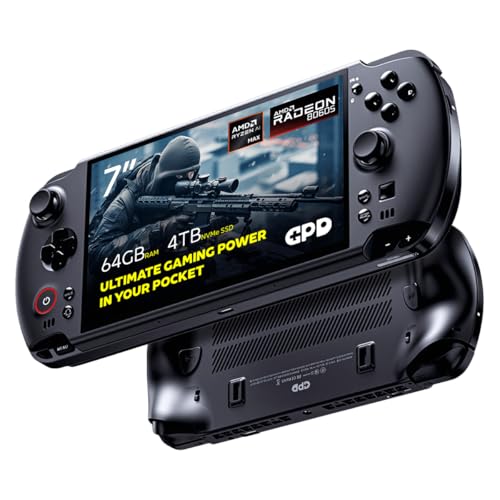
- Ryzen AI Max+ 395 and Radeon 8060S
- 64GB RAM and 4TB SSD
- External 80Wh battery included
Best For: High memory and storage capacity for handheld PC gaming
Best for Xbox-Style Controls

- 7-inch 1080p, 120Hz touchscreen
- 24GB memory and 1TB SSD
- 80Wh battery; 22.3 hours quoted for idle use
Best For: Xbox-style controls and flexible USB-C connections
Most Pocketable Clamshell

- 520g clamshell design
- Ryzen 7 8840U with 16GB RAM
- 44.24Wh battery; runtime unspecified
Best For: Compact PC gaming with built-in controls
Best Larger Display

- 8-inch, 1920 × 1200, 120Hz display
- Ryzen Z2 Extreme and 24GB memory
- 1TB SSD; battery runtime unspecified
Best For: A larger screen in a Windows gaming handheld
Big-Screen Versatility – Lenovo Legion Go
The Lenovo Legion Go is a windows handheld gaming console for players who want a larger display and flexible controls. Its 8.8-inch, 2560 x 1600 touchscreen runs at up to 144Hz, while the Ryzen Z1 Extreme, 16GB of RAM, and 512GB SSD provide a capable PC-gaming setup.
Best For: Players who prioritize screen space, controller flexibility, and USB4 connectivity.
Pros:
- Large, high-resolution 144Hz touchscreen.
- Customizable controllers with 24 on-gamepad controls.
- Two USB4 40Gbps ports and an included carrying case.
Cons:
- 512GB SSD may require selective game installs.
- The 8.8-inch screen makes it less compact than the 7-inch Ally models listed here.
Choose this model when display size and connectivity matter more to you than the smallest possible handheld footprint.
ASUS - ROG Ally Gaming Handheld Console - Z1 Processor, 512GB, 1080p 120Hz Display,White
Check Price On AmazonThe ASUS ROG Ally Z1 is a windows handheld gaming console built around easy access to Windows-compatible games from Steam, Xbox Game Pass, Epic, GOG, and more. Its 7-inch 1080p touchscreen combines a 120Hz refresh rate with AMD FreeSync Premium.
Best For: Players who want a 7-inch handheld for games across multiple Windows storefronts.
Pros:
- Supports Windows-compatible games across several major storefronts.
- 120Hz Full HD touchscreen with FreeSync Premium.
- Can connect to a TV and multiple controllers for shared play.
Cons:
- Uses the Ryzen Z1 rather than the Z1 Extreme processor listed for the other Ally here.
- 512GB storage may fill quickly with larger games.
This is the straightforward Ally choice if storefront access and a smooth 7-inch display are your priorities; check the processor designation before comparing it with the Z1 Extreme version.
The Lenovo Legion Go 2 is a windows handheld gaming console for buyers seeking an OLED screen and roomier memory and storage. It pairs an 8.8-inch 1920 x 1200, 144Hz OLED display with a Ryzen Z2 processor, 32GB of RAM, and a 1TB NVMe SSD.
Best For: Players who want OLED visuals, ample local storage, and detachable-controller options.
Pros:
- Large 144Hz OLED display with vivid color and deep blacks.
- 32GB RAM, 1TB SSD, and a 74Wh battery.
- Detachable right controller supports mouse-style FPS mode.
Cons:
- The 8.8-inch display is less compact than a 7-inch option.
- Its 1920 x 1200 resolution is lower than the original Legion Go’s listed 2560 x 1600 resolution.
The Go 2 stands out for its combination of OLED, capacity, and control options. Its stated battery capacity is useful for comparison, but the notes do not establish a specific runtime.
This ASUS ROG Ally is a windows handheld gaming console that puts the Ryzen Z1 Extreme in a 7-inch format. The listing specifies a 1080p touchscreen with a 120Hz refresh rate, 16GB of RAM, a 512GB SSD, and Windows 11 Home.
Best For: Players who want the listed Z1 Extreme processor in a smaller-screen Ally.
Pros:
- Ryzen Z1 Extreme processor.
- 7-inch 1080p touchscreen with 120Hz refresh rate.
- Supports microSD flash memory and USB-C charging.
Cons:
- 512GB built-in storage may call for game-library management.
- The 7-inch display offers less screen area than either listed Legion Go.
Check this model’s Z1 Extreme designation when comparing Ally listings: the other Ally in this roundup specifies the standard Z1 instead.
Best Large-Screen Pick – MSI Claw 8 AI+
The MSI Claw 8 AI+ is a windows handheld gaming console for buyers who want more screen space without giving up a high refresh rate. Its 8-inch, 1920 x 1200 display runs at 120Hz, while a Core Ultra 7-258V, 32GB of memory, and a 1TB SSD round out the hardware.
Best For: Players who prioritize an 8-inch display, generous memory, and flexible connectivity.
Pros:
- 8-inch, 120Hz display offers more viewing area than the 7-inch option here.
- 32GB RAM, 1TB SSD, and a microSD reader provide room for games and files.
- Thunderbolt 4 adds a useful wired connection option.
Cons:
- At 1.8 pounds, it is heavier than the listed ROG Xbox Ally.
- Its larger screen may be less appealing if compact size is your priority.
The Claw makes the strongest case when display size and storage matter more to you than minimizing handheld weight.
Best Xbox-Style Experience – ASUS ROG Xbox Ally
The ASUS ROG Xbox Ally is a windows handheld gaming console built around a familiar Xbox-style interface. It runs Windows 11, boots into the Xbox experience, and supports games from Xbox, Steam, Epic Games, and other Windows stores.
Best For: Players who want controller-inspired grips and easy access to several PC game libraries.
Pros:
- 7-inch, 1080p touchscreen pairs 120Hz refresh with FreeSync Premium.
- Contoured grips and a listed 1.47-pound weight favor handheld comfort.
- Dual USB-C ports support connecting to a TV; three months of Xbox Game Pass Premium are included, subject to terms.
Cons:
- Its 512GB SSD offers less built-in storage than the other two listed models.
- Its 16GB RAM is the smallest memory configuration in this group.
Choose this model for its Xbox-focused setup and approachable controls rather than the highest memory or storage figures.
Best High-Spec Pick – GPD WIN 5
The GPD WIN 5 is a windows handheld gaming console aimed at buyers who need substantial memory and storage. This configuration combines a Ryzen AI Max+ 395, Radeon 8060S graphics, 64GB of LPDDR5X RAM, and a 4TB SSD.
Best For: Enthusiasts seeking a high-spec handheld for demanding games, emulation, and multitasking.
Pros:
- 64GB RAM and a 4TB SSD offer the largest listed capacities in this group.
- Radeon 8060S graphics support AMD FreeSync Premium and FSR 3.1.
- An external 80Wh battery and a two-year limited warranty are included.
Cons:
- At 915g, it is the heaviest of the three listed handhelds.
- Its included battery is external, adding a separate component to carry.
The WIN 5 stands out on hardware capacity, but its weight and external battery deserve consideration if portability comes first.
Best for Xbox-Style Controls – ASUS ROG Xbox Ally X
The ASUS ROG Xbox Ally X is a windows handheld gaming console for buyers who want familiar Xbox-style controls alongside Windows 11 flexibility. Its 7-inch 1080p, 120Hz touchscreen pairs with a Ryzen AI Z2 Extreme processor, 24GB of memory, and a 1TB SSD.
Best For: Players who want dedicated Xbox controls, generous storage, and multiple USB-C connection options.
Pros:
- 120Hz 1080p touchscreen and a full gamepad layout with macro buttons.
- 24GB LPDDR5X memory and a 1TB PCIe 4.0 SSD.
- 80Wh battery; two USB-C ports support charging and video output.
Cons:
- The advertised 22.3-hour figure is for idle use, not gaming.
- This listing is identified as a Japan version.
Choose it for its combination of handheld controls and connectivity, but compare battery claims using the stated test conditions rather than treating idle runtime as playtime.
Most Pocketable Clamshell – GPD WIN Mini
The GPD WIN Mini takes a compact clamshell approach to the windows handheld gaming console. This Windows 11 mini laptop combines a 7-inch touchscreen and built-in game controls in a 520g body measuring 168 × 109 × 26mm.
Best For: Buyers who prioritize a small clamshell device with both PC and gamepad-style inputs.
Pros:
- Compact 520g design is intended for pocket carry.
- Ryzen 7 8840U, 16GB RAM, and a 1TB M.2 NVMe SSD.
- Hall joysticks, motion sensors, and stereo speakers with DTS:X Ultra support.
Cons:
- The listed 44.24Wh battery capacity does not establish a specific gaming runtime.
- The supplied details list a 1024 × 600 resolution, so confirm the screen specification before buying.
Its main advantage is portability: the clamshell layout offers a different trade-off from larger, conventional handhelds. Verify the display details if resolution is a deciding factor.
Best Larger Display – MSI Claw A8
The MSI Claw A8 is a windows handheld gaming console suited to buyers who prefer more screen space. Its 8-inch, 1920 × 1200 display runs at 120Hz, while a Ryzen Z2 Extreme, 24GB of LPDDR5x memory, and a 1TB NVMe SSD round out the listed hardware.
Best For: Players who value an 8-inch display and Windows 11 Home in a gamepad-style handheld.
Pros:
- 8-inch, 120Hz display with 1920 × 1200 resolution.
- 24GB memory and 1TB NVMe storage.
- Listed SD card reader and Thunderbolt 4 connectivity.
Cons:
- At a listed 1.7 pounds, it is heavier than the 520g GPD WIN Mini.
- The notes promote battery endurance without providing a battery capacity or measured runtime.
The larger screen is the clearest reason to pick this model. If battery life is equally important, look for a verified gaming-runtime figure before deciding.
How We Picked the Best Windows Handheld Gaming Console
We compared the listed processors, memory, storage, screens, and connectivity, then considered how each combination fits common uses: playing away from an outlet, running demanding PC games, using a handheld as a small desktop PC, or carrying something compact. Specifications are a starting point, not a performance guarantee. Game settings, power limits, cooling, and software updates can change the experience substantially. Check current pricing, configurations, and independent battery and game benchmarks before buying.
Quick Comparison: Which Type Fits You?
For a familiar 7-inch layout, compare the ROG Ally models and ROG Xbox Ally models, paying close attention to their different chips and memory. The Lenovo Legion Go offers a larger, sharper listed display; the Legion Go 2 pairs its 8.8-inch size with OLED, 32GB of RAM, and 1TB of storage. The MSI Claw models offer 8-inch screens but use different processor platforms: Intel in the listed Claw and AMD in the Claw A8. The GPD WIN Mini favors a compact mini-laptop design, while the GPD Win 5 targets buyers seeking a high-spec configuration with 64GB of RAM and 4TB of storage.
Key Buying Factors for a Windows Handheld Gaming Console
Performance and Price
Do not treat similar names as interchangeable. A ROG Ally with a Ryzen Z1 differs from the Z1 Extreme version, and the Xbox Ally and Xbox Ally X list different chips and memory. If you mainly play indie games, older titles, or stream games, paying for the highest-end hardware may bring little benefit. For demanding games, look up results for the exact model at the settings and power level you expect to use.
Screen, Size, and Battery
A larger or higher-resolution screen can make text easier to read, but it can also increase the size of the device and the work required to render games. OLED may appeal to buyers who prioritize contrast. High refresh rates make the most sense when a game can reach correspondingly high frame rates. Treat advertised battery figures cautiously: demanding games often draw considerably more power than light tasks. Check tested runtimes, weight, and grip comfort if you plan to play while traveling.
Storage, Controls, and Connections
Modern PC games can fill a 512GB SSD quickly; 1TB offers more room before you need to uninstall titles. Check whether storage is replaceable and whether a card reader supports your plans. Also look for controls that suit your games, useful ports for a dock or accessories, and a Windows interface you are comfortable navigating on a small touchscreen.
Who Should Buy Which Windows Handheld Gaming Console?
Choose a 7-inch Ally-style handheld if you value a conventional console shape. Consider a Legion Go model if a larger display is the priority, or a Claw model if its screen size and connections suit your setup. The GPD WIN Mini is worth considering if you want keyboard-style versatility in a compact device; the Win 5 is for buyers who can use its unusually large memory and storage configuration. Whatever you choose, compare the exact listing against independent tests and your budget rather than buying on a model name alone.