The best voice recorders for lectures make it easier to revisit explanations, capture details, and build accurate study notes without relying on rushed handwriting. The right choice depends on more than storage capacity: microphone quality, battery life, playback controls, and file transfer all matter.
This roundup compares 10 options ranging from straightforward digital dictaphones to AI-enabled recorders that can transcribe and summarize recordings. Use the guide below to match features with your class format, study habits, and budget.
Best 10 Voice Recorders for Lectures Picks for 2026
Best High-Capacity Pick
EVISTR L357 64GB Voice Recorder

- 64GB storage with up to 4,660 hours at 32Kbps
- 1536Kbps stereo recording with adjustable gain
- Voice activation, playback controls, and USB-C transfer
Best For: Long lectures and users who want extensive storage and manual control
Best AI Note-Taking Pick
Plaud Note Pro AI Voice Recorder
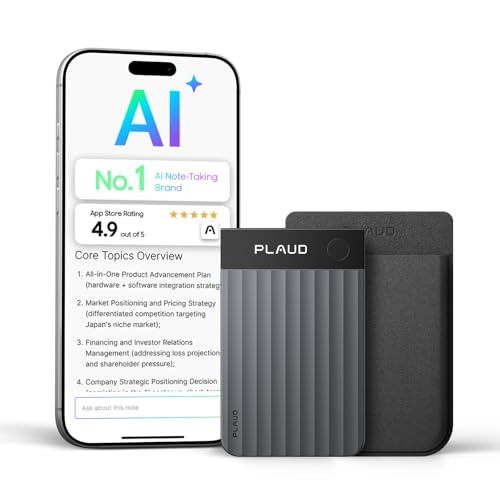
- Transcribes and summarizes recordings with AI tools
- Directional microphones and automatic recording modes
- Up to 50 hours of recording in Endurance Mode
Best For: Users who want searchable transcripts and automated lecture notes
Best Simple Budget Pick
Sunlan 16GB Digital Voice Recorder

- One-button recording and simple playback controls
- Noise reduction and voice-activated recording
- Up to 30 hours of recording with a headphone jack
Best For: Students seeking an uncomplicated recorder for everyday classes
Best Built-In Transcription Pick

- Transcription in 113 languages with summaries and mind maps
- 128GB storage and up to 33 hours of continuous recording
- 3072Kbps audio, privacy lock, and wired OTG transfer
Best For: Frequent users who want high capacity and app-based AI notes
Maximum Storage Pick
Pexqil 136GB AI Voice Recorder

- 136GB storage for up to 18,800 hours
- Voice activation and up to 97% noise reduction
- Up to 48 hours of recording; one-ounce design
Best For: Frequent users who need extensive storage for lectures and other recordings
Simple Everyday Pick
Cappsu 32GB Digital Voice Recorder

- One-click recording with 1536Kbps audio
- Voice activation supports up to 50 hours
- Includes external microphone and two-year warranty
Best For: Students wanting an easy-to-use recorder for regular classes and meetings
Balanced Noise-Reduction Pick
Xelarvex 72GB AI Voice Recorder

- 72GB storage for up to 4,800 hours
- AI noise cancellation and voice activation
- Up to 48 hours of recording in a one-ounce body
Best For: Users seeking a portable lecture recorder with strong storage and noise reduction
Best with Extra Features

- 128GB storage with up to 54 hours of continuous recording
- 1536Kbps PCM, MP3, and WAV recording options
- Voice activation, password protection, and folder organization
Best For: Students and professionals who need extensive storage
Simple Learning Pick

- Three-button controls for quick recording and playback
- Voice activation helps reduce quiet audio sections
- A-B repeat and variable-speed playback aid studying
Best For: Students who prioritize simple lecture review
Playback-Focused Option

- Dual-mic PCM recording up to 1536Kbps
- Advertised 136GB memory and up to 45 hours of battery life
- Sixteen playback speeds with A-B repeat and password protection
Best For: Users who frequently review and manage lecture recordings
Best High-Capacity Pick – EVISTR L357 64GB Voice Recorder
For shoppers comparing voice recorders for lectures, the EVISTR L357 combines high-resolution stereo recording, voice activation, and generous storage in a compact metal body. Its adjustable gain and noise-reduction features are useful when the speaker is at a distance or the room is busy.
Best For: Students and professionals who want long recording capacity, playback controls, and flexible file management.
Pros:
- 64GB storage can hold up to 4,660 hours at 32Kbps.
- 1536Kbps stereo recording, dynamic noise reduction, and seven gain levels support clearer capture.
- Voice activation, variable-speed playback, A-B repeat, and scheduled recording add practical lecture features.
- Up to 32 hours of continuous recording and USB-C file transfers.
Cons:
- The many settings may be more than casual users need.
- Voice activation may omit quiet passages when the speaker pauses.
This is a versatile choice when storage and control matter most. The time-stamped file names and Windows/Mac compatibility also make it easier to organize recordings after class.
Best AI Note-Taking Pick – Plaud Note Pro AI Voice Recorder
The Plaud Note Pro takes a more automated approach to voice recorders for lectures, combining directional microphones with transcription, summaries, and searchable AI assistance. It is designed for users who want to turn recorded speech into organized notes rather than simply replay audio.
Best For: Students and professionals who want transcription, summaries, and cross-device access alongside recording.
Pros:
- AI tools can transcribe, summarize, identify speakers, and answer questions about recordings.
- Four MEMS microphones and a VPU microphone support directional audio capture.
- Enhance Mode offers up to 30 hours of recording, while Endurance Mode offers up to 50 hours.
- Includes 300 transcription minutes per month through the Starter Plan.
Cons:
- AI transcription and expanded usage require working with the Plaud app and plan limits.
- There is no headphone jack for direct wired listening.
- Users should obtain consent and follow applicable privacy laws before recording.
This is the most feature-rich option for a lecture workflow built around transcription and review. Its premium design and app-based features are less necessary if you only need basic audio files.
Best Simple Budget Pick – Sunlan 16GB Digital Voice Recorder
If you want voice recorders for lectures without a complicated interface, this Sunlan model keeps the controls straightforward. One-button recording, playback, voice activation, and a built-in speaker cover the essentials for recording and reviewing classes.
Best For: Students who prefer a basic recorder with physical controls and straightforward USB file transfer.
Pros:
- Simple REC, STOP, and PLAY controls are easy to learn.
- Noise reduction and a sensitive microphone are designed to capture spoken words.
- Voice activation can reduce silent sections and conserve recording time.
- Offers up to 30 hours of recording and includes a 3.5mm headphone jack.
Cons:
- Its 16GB capacity is lower than the other high-capacity options here.
- Battery playback is listed at 7 hours, shorter than its recording runtime.
- The recording format is WAV, which may use more storage than compressed audio.
This recorder suits buyers who value ease of use over advanced organization or AI features. It can also function as a music player and removable USB storage device for compatible Windows computers.
Best Built-In Transcription Pick – EVISTR L359 128GB AI Recorder
The EVISTR L359 is aimed at shoppers who want voice recorders for lectures with a built-in path from audio capture to AI-generated notes. Through the AI DVR Link app, it supports transcription in 113 languages, summaries, mind maps, speaker identification, and follow-up insights.
Best For: Students and professionals who need substantial storage plus transcription and summary tools through a phone app.
Pros:
- Supports transcription in 113 languages along with summaries, mind maps, and speaker identification.
- 128GB storage can hold up to 9,216 hours at 32kbps.
- 3072Kbps recording, noise reduction, and voice activation support lecture capture.
- One-button operation, password encryption, a HOLD switch, and OTG phone transfer are included.
Cons:
- AI features depend on the AI DVR Link app and a compatible phone connection.
- The 33-hour continuous recording time is lower than the device’s total storage capacity might suggest.
- Processing uses a wired OTG connection rather than Bluetooth.
This is a strong middle ground for buyers who want a conventional recorder with modern AI assistance. Its large capacity and privacy lock are particularly useful for frequent recording and sensitive class or interview files.
Maximum Storage Pick – Pexqil 136GB AI Voice Recorder
If you need voice recorders for lectures that can hold extensive audio without frequent file management, the Pexqil is a strong option. It combines 136GB of storage, voice activation, AI noise reduction, and up to 48 hours of continuous recording in a lightweight design.
Best For: Students and professionals who record frequently and want exceptionally high storage capacity.
Pros:
- 136GB built-in storage provides up to 18,800 hours of audio capacity.
- Voice activation pauses during silence to reduce wasted storage.
- DSP 5.0 AI noise reduction is designed to filter up to 97% of ambient noise.
- Supports OTG transfer, one-button recording, and up to 48 hours of continuous use.
Cons:
- Its large storage capacity may be more than occasional users need.
- The supplied specifications do not state whether an external microphone is included.
For lecture recording, the combination of voice activation, noise processing, and long battery life is practical for extended classes. Its one-ounce weight also makes it easy to carry in a notebook or pocket.
Simple Everyday Pick – Cappsu 32GB Digital Voice Recorder
The Cappsu is a straightforward choice among voice recorders for lectures, with one-click operation, 32GB of built-in memory, and recording up to 1536Kbps. Its compact size and included external microphone make it suitable for students who want a simple recorder for classes, meetings, and interviews.
Best For: Students who value easy controls, portability, and included accessories.
Pros:
- One-click recording starts and stops without navigating menus.
- 32GB built-in storage requires no TF card.
- Voice activation can extend use to up to 50 hours by pausing during silence.
- Includes an external microphone, earphones, USB-C cable, and two-year warranty.
Cons:
- Its 20-hour continuous recording time is shorter than some alternatives.
- 32GB offers substantially less storage than the higher-capacity models in this roundup.
The clear controls and small 1.6-ounce body are well suited to daily class use. For longer lectures, voice activation helps conserve both storage and battery, while the included accessories make it usable out of the box.
Balanced Noise-Reduction Pick – Xelarvex 72GB AI Voice Recorder
The Xelarvex balances generous storage and portability for shoppers comparing voice recorders for lectures. It offers 72GB of storage, voice-activated recording, AI noise cancellation, and up to 48 hours of continuous battery life in a one-ounce body.
Best For: Lecture users who want a middle-ground option with substantial storage and noise processing.
Pros:
- 72GB capacity stores up to 4,800 hours of recordings at 192Kbps.
- Voice activation helps eliminate silent gaps and conserve memory.
- AI sound processing is designed to reduce up to 97% of ambient noise.
- Fast 1.5-hour charging and up to 48 hours of continuous recording support extended use.
Cons:
- The supplied notes do not specify a recording bitrate beyond the stated 192Kbps storage estimate.
- No external microphone is listed among the supplied specifications.
This model is a practical compromise between the Pexqil’s very large capacity and the Cappsu’s simpler, smaller-memory design. Automatic file saving before power-off and two-hour file segments are useful safeguards during longer recording sessions.
Best with Extra Features – EVIDA 128GB Voice Recorder
If you need voice recorders for lectures with substantial storage, the EVIDA 9296 is built around capacity and flexible recording quality. It supports PCM, MP3, and WAV formats, voice activation, playback, and password protection, making it suitable for capturing classes and organizing files afterward.
Best For: Students, teachers, and professionals who want extensive storage and multiple recording formats.
Pros:
- 128GB storage and up to 54 hours of continuous recording
- 1536Kbps PCM recording with noise-canceling microphone support
- Voice activation, password protection, A-B repeat, bookmarks, and four-folder file management
- Can also function as an MP3 player and USB flash drive
Cons:
- The listed battery and continuous-recording time are 54 hours, so extended use still requires charging
- Its built-in microphone is mono rather than stereo
- No headphone jack is listed in the specifications
The EVIDA stands out when storage and organization matter more than a minimal feature set. Its voice activation and password protection are especially practical for lecture recording, while computer compatibility simplifies file transfer.
Simple Learning Pick – HoTiyan 16GB Voice Recorder
For shoppers seeking straightforward voice recorders for lectures, the HoTiyan model focuses on easy operation and useful playback tools. Its three-button controls, voice activation, A-B repeat, and variable playback speed can help students record lessons and review important sections later.
Best For: Students who want an uncomplicated recorder for classes, meetings, and study review.
Pros:
- Simple three-button recording, saving, and playback controls
- Voice activation can reduce quiet sections and whisper fragments
- Supports MP3 and WAV files, with up to 20 hours of continuous recording
- A-B repeat and variable playback speed support lecture review
Cons:
- 16GB capacity is considerably lower than the larger-capacity options in this roundup
- Continuous recording is listed at 20 hours
- Recording files are limited to 199 files according to the supplied details
The HoTiyan is a practical choice if ease of use and study playback features are priorities. Its smaller capacity is better suited to users who regularly transfer recordings to a computer rather than storing a large archive on the device.
Playback-Focused Option – Aiworth E36 Voice Recorder
The Aiworth E36 is one of the more feature-rich voice recorders for lectures, combining dual-microphone PCM recording with extensive storage and detailed playback controls. Its 16 playback-speed levels, A-B repeat, voice activation, and password protection are useful for recording lessons and revisiting specific passages.
Best For: Students, journalists, writers, and office users who want high-quality recording with extensive playback control.
Pros:
- Dual-microphone recording supports up to 1536Kbps PCM quality
- 136GB total memory is advertised, including built-in and added storage
- Up to 45 hours of continuous recording from the rechargeable battery
- Sixteen playback-speed levels, A-B repeat, and password protection
Cons:
- The supplied specifications list 72GB storage, which differs from the product description’s 136GB claim
- The product description and specifications report different recording-time figures
- Its broader feature set may take more time to learn than a basic three-button recorder
The E36 is compelling for users who frequently review recordings and need fine control over playback speed. Before buying, verify the current storage and recording-time specifications because the supplied listing information is inconsistent.
How We Picked These Voice Recorders for Lectures
We focused on features that matter in classrooms, lecture halls, seminars, and study sessions: recording clarity, voice activation, noise reduction, storage, battery endurance, playback, and file-transfer convenience. We also included AI-enabled models for shoppers who want automatic transcription or summaries, while keeping simpler recorders in the lineup for users who prefer reliable recording without a subscription or app workflow.
Storage claims and recording-hour estimates can vary with audio quality, file format, and other settings. Treat them as capacity indicators rather than guaranteed real-world results.
Quick Comparison
| Feature | Why It Matters | Best For |
|---|---|---|
| Basic digital recording | Simple controls and dependable playback | Students who want an easy study archive |
| Voice activation | Reduces silent gaps and saves storage | Long lectures and hands-off recording |
| Noise reduction | Helps make speech more intelligible in busy rooms | Large classrooms and shared spaces |
| AI transcription | Converts recordings into searchable text or summaries | Students managing heavy note-taking workloads |
| Large internal storage | Holds more recordings before file transfer | Frequent users and multi-course archives |
Key Buying Factors for Voice Recorders for Lectures
Audio Quality and Microphone Pickup
A recorder should capture the instructor clearly from your usual seat. Noise reduction can help, but it cannot fully compensate for distance, crowd noise, or poor placement. For large rooms, prioritize models with sensitive microphones and test positioning before an important lecture.
Battery Life and Storage
Choose enough battery capacity for your longest class plus a safety margin. Higher storage is useful when you record regularly, but it does not replace routine backups. Transfer files to a computer or cloud service so a full device does not interrupt your study schedule.
Playback, Controls, and File Transfer
Physical playback buttons, adjustable speed, bookmarks, and a clear display can make review faster. USB transfer is convenient, especially if you want to organize recordings by course or date. Check compatibility with your computer and preferred note-taking software.
AI Transcription and Privacy
AI features can turn lectures into searchable notes, but check whether processing occurs on the device, through a phone app, or in the cloud. Review subscription requirements, supported languages, export formats, and privacy terms before recording sensitive classroom discussions.
Who Should Buy Which Voice Recorders for Lectures?
- Choose a basic digital recorder if you want straightforward recording, playback, and file transfer without extra software.
- Choose voice activation and noise reduction if you record long lectures or study in rooms with inconsistent background noise.
- Choose an AI recorder if transcription and summaries will save substantial time, and you are comfortable checking accuracy and managing privacy settings.
- Choose high-capacity storage if you record multiple classes each week and do not want to transfer files after every session.
- Choose a compact model if portability matters most and you typically sit close enough to the speaker for dependable microphone pickup.
Before recording, confirm your school’s policy and obtain any required permission from the instructor or participants. The best recorder is the one that fits your lecture environment and produces files you will realistically review.