The best handheld voice recorders make it easier to capture lectures, meetings, interviews, and ideas without relying on a phone’s battery or storage. The models in this roundup range from simple USB dictaphones to AI-powered recorders that transcribe and summarize conversations.
Use the guide below to compare recording capacity, battery-friendly features, playback controls, and transcription tools so you can choose a recorder that fits the way you work or study.
Best 10 Handheld Voice Recorders Picks for 2026
Best Simple Sony Recorder

- Up to 57 hours of battery life
- Built-in USB file transfer
- 4GB MP3 recorder
Best For: Simple recording and long battery life
Best High-Capacity Recorder

- 128GB storage capacity
- Voice activation with six levels
- Password protection and playback
Best For: Frequent lectures, meetings, and interviews
Best AI Recording System
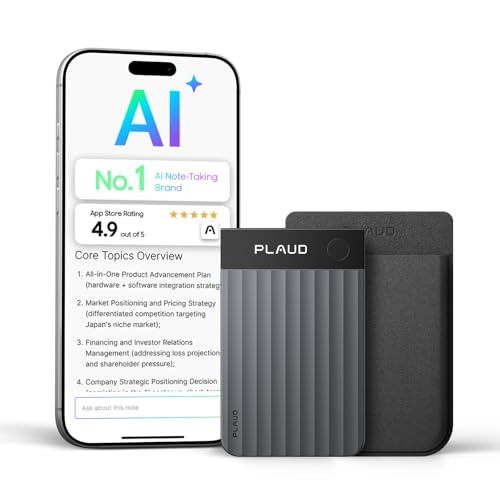
Plaud Note Pro AI Voice Recorder
- AI transcription and summaries
- Directional audio for calls and meetings
- Up to 50 hours of recording
Best For: Professionals managing meetings and calls
Best Easy-Operation Recorder

- One-button recording controls
- Voice activation and noise reduction
- Up to 30 hours of recording
Best For: Students and casual everyday recording
Best AI-Enabled Recorder

- Transcribes in 113 languages and creates smart summaries
- 3072Kbps recording with noise reduction and VOR
- 128GB storage with wired OTG phone transfers
Best For: AI-assisted notes, lectures, meetings, and interviews
Best for Playback Control
Aiworth E36 Digital Voice Recorder

- 1536Kbps dual-mic PCM recording
- Up to 45 hours of continuous recording
- 16 playback speeds and A-B repeat
Best For: Lecture review, transcription, study, and interviews
Best Battery Life
Tonfarb A20 Digital Voice Recorder

- Up to 68 hours of continuous recording
- 136GB storage with MP3 and WAV support
- One-click recording with noise reduction and VOR
Best For: Extended meetings, classes, interviews, and travel
Best Budget-Friendly Pick
- Stereo recording with noise reduction
- Voice activation and A-B repeat
- Up to 20 hours of continuous recording
Best For: Students and casual everyday recording
Best for Long Recording Sessions

- 64GB storage for extended sessions
- 2-inch OLED display
- Up to 72 hours of digital recording time
Best For: Long lectures, meetings, and interviews
Best Feature-Rich Choice

- Adjustable gain and voice sensitivity
- 64GB storage with USB-C transfer
- Scheduled recording and flexible playback
Best For: Users who want advanced recording controls
Best Simple Sony Recorder – Sony ICD-PX370
Sony ICD-PX370 Mono Digital Voice Recorder with Built-In USB Voice Recorder,black
Check Price On AmazonThe Sony ICD-PX370 is a straightforward option among handheld voice recorders for everyday dictation, lectures, interviews, and notes. It records in MP3 format, offers up to 57 hours of battery life, and uses a built-in USB connection for transferring files to a computer.
Best For: Buyers who want a familiar Sony recorder with long battery life and simple computer file transfers.
Pros:
- Up to 57 hours of recording battery life
- Built-in USB connection for convenient file transfer
- 4GB of storage and MP3 recording support
- Compact 4.49-inch design with a built-in microphone
Cons:
- Uses two AA batteries rather than a rechargeable battery
- Mono recording may be less suitable for users seeking more spacious audio
This is a practical, no-frills handheld voice recorder for users who prioritize dependable operation, extended battery life, and easy MP3 file management over advanced recording features.
Best High-Capacity Recorder – EVIDA 128GB Voice Recorder
The EVIDA VR01 stands out among handheld voice recorders for its unusually large 128GB capacity and flexible recording options. It supports MP3 and WAV formats, voice activation, password protection, playback, and direct computer transfers for lectures, meetings, interviews, and speeches.
Best For: Students, professionals, and frequent recorders who need extensive storage and voice-activated recording.
Pros:
- 128GB storage capacity for extensive recording archives
- Voice activation with six sensitivity levels
- Supports MP3 at multiple bit rates and high-quality WAV recording
- Includes playback, password protection, bookmarks, and four-folder file organization
Cons:
- Battery life is listed at up to 54 hours of continuous recording
- No headphone jack is specified
- Feature-rich controls may take more time to learn than a basic recorder
With substantial storage and a broad feature set, the EVIDA is a strong choice when recording volume and file-management tools matter more than having the simplest possible interface.
Best AI Recording System – Plaud Note Pro AI Voice Recorder
The Plaud Note Pro takes handheld voice recorders in a more connected direction, combining recording with transcription, summaries, multimodal notes, and AI-powered questions about your recordings. Its directional audio, four MEMS microphones, AMOLED display, and cross-device app support are designed for meetings and calls rather than basic standalone dictation.
Best For: Professionals who want recordings transformed into searchable insights, summaries, emails, and next-step suggestions.
Pros:
- AI transcription, summaries, and “Ask Plaud” recording analysis
- Directional audio and automatic switching between call and meeting modes
- Up to 30 hours in Enhance Mode or 50 hours in Endurance Mode
- 64GB storage, encrypted data, and desktop, web, and mobile access
Cons:
- Some transcription capacity requires a paid plan after the included Starter Plan allowance
- No headphone jack is included
- Its connected AI workflow is more complex than a basic recorder
The Plaud Note Pro is best viewed as an AI note-taking platform in a slim recorder body. It offers considerable productivity potential, but buyers should account for the app and transcription-plan requirements and follow applicable recording-consent laws.
Best Easy-Operation Recorder – Sunlan 16GB Voice Recorder
The Sunlan 16GB model is one of the more approachable handheld voice recorders for users who want physical controls and quick playback. Its one-button recording workflow, built-in speaker, voice activation, noise reduction, and USB file storage make it useful for lectures, meetings, interviews, and everyday notes.
Best For: Buyers seeking a compact rechargeable recorder with simple controls, voice activation, and built-in playback.
Pros:
- Simple record, stop, and play controls
- Voice activation can reduce silent sections and conserve power
- 16GB storage with up to 30 hours of recording
- Built-in speaker, 3.5mm headphone jack, and USB data-transfer function
Cons:
- Playback battery life is listed at about seven hours
- 16GB provides less storage than some high-capacity alternatives
- Recording is specified as mono
This recorder offers a useful balance of portability and ease of use. It is a sensible pick for students and casual users who want rechargeable operation, straightforward playback, and basic noise-reduction features without a complicated setup.
Best AI-Enabled Recorder – EVISTR L359 AI Voice Recorder
The EVISTR L359 is a strong choice among handheld voice recorders for users who want recording plus built-in AI-assisted organization. It combines 3072Kbps audio, noise reduction, voice-activated recording, and wired OTG transfers for processing recordings in the AI DVR Link app.
Best For: Students, professionals, and anyone who wants transcription, summaries, speaker identification, and searchable note-taking support.
Pros:
- Supports transcription in 113 languages, smart summaries, mind maps, and Ask AI insights through the companion app.
- Offers up to 3072Kbps HD recording with noise reduction and VOR voice activation.
- Includes 128GB of storage, up to 33 hours of continuous recording, password encryption, and a HOLD switch.
- Wired OTG connectivity supports direct phone transfers without relying on Bluetooth.
Cons:
- AI features require the AI DVR Link app and a compatible phone connection.
- The listed 33-hour recording time is shorter than some high-capacity alternatives.
Choose the L359 if AI transcription and organized post-recording workflows matter as much as audio capture. Its compact 65g design and one-touch controls also make it practical for everyday carrying.
Best for Playback Control – Aiworth E36 Digital Voice Recorder
The Aiworth E36 is a practical handheld voice recorder for lectures, meetings, interviews, and personal ideas. Its dual-mic PCM recording, large storage configuration, password protection, and adjustable playback speed make it especially useful when reviewing spoken material in detail.
Best For: Students, writers, journalists, office workers, and listeners who need flexible playback and secure file access.
Pros:
- Dual microphones support PCM recording up to 1536Kbps for clear voice capture.
- Its 136GB configuration and 800mAh battery support extensive storage and up to 45 hours of continuous recording.
- Offers 16 playback-speed levels plus A-B repeat for reviewing specific passages.
- Three-digit password protection helps restrict access to recorded files.
Cons:
- Its recording resolution is lower than the EVISTR model’s 3072Kbps maximum.
- The supplied specifications list differing storage and recording-capacity figures, so buyers should confirm the exact configuration.
The E36 stands out when playback tools are a priority. Variable speed and A-B repeat can make transcribing, studying, or locating a particular statement more convenient than using a basic recorder.
Best Battery Life – Tonfarb A20 Digital Voice Recorder
The Tonfarb A20 is one of the more endurance-focused handheld voice recorders in this group. It pairs dual noise-reduction microphones and 1536Kbps PCM recording with a large battery, one-click operation, a readable LCD, and voice activation for extended meetings, classes, and interviews.
Best For: Users who need long continuous recording sessions, generous storage, and simple controls for lectures or meetings.
Pros:
- Provides up to 68 hours of continuous recording from its 1100mAh rechargeable battery.
- Includes 136GB of storage capacity and supports long MP3 or WAV recording libraries.
- Dual microphones, automatic noise reduction, 1536Kbps PCM recording, and VOR support flexible audio capture.
- Side-mounted one-click recording works even when the device is powered off.
Cons:
- At about 97–100g, it is heavier than the EVISTR and Aiworth models listed here.
- The supplied details cite a 68-hour recording figure as both battery life and digital recording time, so actual capacity may vary by format and settings.
The A20 is a sensible pick for back-to-back sessions where recharging is inconvenient. Its large battery, storage capacity, and fast physical record switch favor dependable operation over advanced AI features.
Best Budget-Friendly Pick – HoTiyan 8GB Voice Recorder
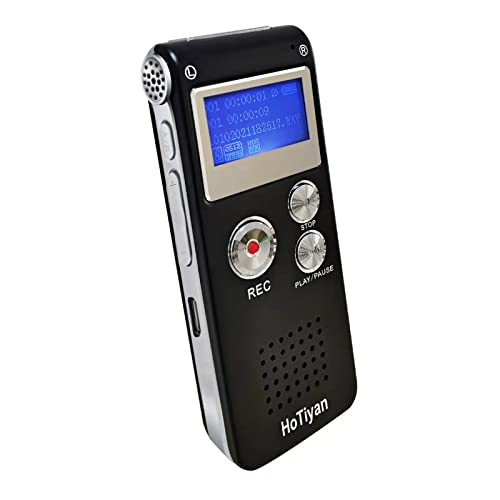
If you need straightforward handheld voice recorders for classes, meetings, or interviews, this HoTiyan model focuses on simple controls and useful playback features. Its stereo microphone, voice activation, and rechargeable battery make it practical for everyday recording.
Best For: Students and casual users who want an affordable recorder with voice activation, A-B repeat, and MP3 playback.
Pros:
- Built-in 8GB storage with MP3 and WAV support
- Voice activation can reduce silent sections and conserve storage
- Up to 20 hours of continuous recording according to the supplied specifications
- Includes variable-speed playback, password protection, and timestamped file names
Cons:
- Lower storage capacity than the two 64GB alternatives
- Small 1.1-inch screen may provide less room for navigation
- Uses a Micro USB connection rather than USB-C
This is a sensible entry-level choice when easy operation matters more than maximum capacity. The included MP3-player function and repeat controls also make reviewing lectures or meeting notes more convenient.
Best for Long Recording Sessions – Jaswill 64GB Voice Recorder
For shoppers comparing handheld voice recorders with generous storage and a larger display, the Jaswill A1 offers 64GB of capacity, a 2-inch OLED screen, and voice activation. Its extended battery specification suits longer meetings, lectures, and interview sessions.
Best For: Users who prioritize high storage capacity, a readable screen, and extended recording time.
Pros:
- 64GB storage accommodates extended recording sessions
- 2-inch OLED display shows recording status and battery information
- Supports MP3 and WAV formats with a 3.5mm headphone jack
- Supplied specifications list up to 72 hours of digital recording time and 80 hours of battery life
Cons:
- Mono microphone operation may be less suitable for users seeking stereo capture
- Larger and heavier than the compact HoTiyan model
- The supplied details do not specify a USB-C connection
The Jaswill stands out for capacity and visibility rather than ultra-compact portability. Its noise-cancellation microphone mode, voice activation, and three-day continuous MP3 recording claim make it a strong option for extended use.
Best Feature-Rich Choice – EVISTR L357 64GB Recorder
The EVISTR L357 is one of the more feature-rich handheld voice recorders in this group. It combines 64GB storage with adjustable recording gain, PCM noise reduction, voice activation, scheduled recording, and USB-C file transfer for users who want more control.
Best For: Students, professionals, and interviewers who need adjustable capture settings, high storage, and flexible playback tools.
Pros:
- 64GB capacity can store up to 4,660 hours at the stated 32Kbps setting
- Adjustable seven-level recording gain and voice-control sensitivity
- Supports up to 1536kbps stereo recording with PCM noise reduction
- USB-C transfer, scheduled recording, A-B repeat, and variable-speed playback
Cons:
- Its broader feature set may require more setup than a basic recorder
- The supplied details do not provide a complete screen-size specification
- Highest-quality recording settings will use storage more quickly than the stated maximum
Choose the EVISTR when recording flexibility is a priority. The gain controls and scheduled-recording options provide more customization, while its metal construction and USB-C connection support regular use and file management.
How We Picked the Best Handheld Voice Recorders
We selected these Handheld Voice Recorders based on the features that matter most in everyday use: recording capacity, voice activation, playback, battery convenience, file transfer, microphone usability, and overall versatility. We also included both straightforward digital dictaphones and newer AI-enabled models, since buyers have different needs and budgets.
Storage claims can be extremely high on inexpensive recorders, but actual recording time depends on audio quality, file format, and whether voice activation is enabled. We therefore treat capacity as one factor rather than the sole measure of value.
Quick Comparison
- Best for simple recording: Sony ICD-PX370, with familiar controls and built-in USB connectivity.
- Best for AI transcription: Plaud Note Pro or EVISTR’s AI model, depending on your preferred workflow and compatibility.
- Best for high storage: The 128GB and 136GB recorders, which suit frequent lectures, interviews, or long-term archiving.
- Best for basic everyday use: Compact 8GB and 16GB models with playback and USB charging.
- Best for visible controls: The Jaswill model, which includes a larger screen for navigating files.
Key Buying Factors for Handheld Voice Recorders
Recording Quality and Microphones
A built-in microphone is convenient, but placement still affects clarity. For lectures or meetings, choose a model with voice activation and a microphone that can capture speech from several seats away. For interviews, a recorder with dependable input sensitivity and easy button access is more important than an inflated storage figure.
Storage and File Management
More storage helps if you record frequently, but simple file navigation matters just as much. Look for playback controls, a readable display, folder support, and straightforward USB transfer. Password protection may be useful when recordings contain private conversations.
Battery and Charging
Consider how long you typically record in one session and whether the device can recharge through a standard USB connection. Voice activation can reduce silent sections and conserve storage, while a low-battery indicator helps prevent missed recordings.
AI Transcription and Summaries
AI-enabled recorders can save time by converting speech into text and producing summaries, but check whether transcription requires an app, account, subscription, or internet connection. These features are especially useful for meetings and interviews, while traditional recorders may be better for users who want local files without added services.
Who Should Buy Which Handheld Voice Recorders?
Students should prioritize clear lecture capture, voice activation, long battery life, and easy playback. A compact 16GB or 64GB model may be sufficient for regular classes.
Professionals recording meetings or interviews may prefer larger-capacity models with password protection, a visible screen, and dependable file transfer. AI transcription is worthwhile when reducing note-taking time is a priority.
Journalists and researchers should focus on microphone performance, recording stability, physical controls, and storage for multiple sessions. Always check local consent laws before recording other people.
Casual users can save money with a basic USB rechargeable recorder. Choose a simple interface and reliable playback rather than paying for features you will not use.