Multi-camera productions need more than a strong wireless signal. The right transmitter system must match your cameras, monitoring displays, range, latency, and crew workflow without adding unnecessary setup complexity.
We’ve selected 10 video transmitters for multi-camera setups spanning compact HDMI kits, professional SDI systems, long-range wireless links, and multi-receiver solutions. Use the guide below to narrow the choices by compatibility, performance, and production needs.
Best 10 Video Transmitters for Multi Camera Setups Picks for 2026
Professional 4K Crew Link

- 4K HDMI and 1080p SDI/HDMI support
- Up to 1,312 feet of stated range
- Monitoring for up to five destinations
Best For: Professional crews needing long-range 4K monitoring and selected camera control
Four-Screen HDMI Expansion
YAOMAISI G9R Pro Wireless HDMI Kit

- One transmitter with four receivers
- 1080p at 60Hz with about 0.1s latency
- Pre-paired, plug-and-play operation
Best For: Duplicating one HDMI source across multiple TVs or monitors
Long-Range SDR Production Link

- Up to 3 km stated transmission distance
- 1080p/60fps at up to 20 Mbps
- Broadcast mode supports unlimited receivers
Best For: Professional crews needing long-range, interference-resistant 1080p monitoring
Portable Multi-TV HDMI Link

- One transmitter with four receivers
- 1080p/60Hz with about 0.1s latency
- Plug-and-play operation without Wi-Fi or apps
Best For: Portable single-source distribution to several TVs or monitors
Best Multi-Receiver Pick

- 4K30 HDMI transmission with 60ms latency
- Supports up to four receivers
- Dual-band smart channel scanning
Best For: Multi-user film production and live streaming
Best Expandable Budget Setup

- One receiver supports up to eight transmitters
- 4K decode with 1080p60 output
- Dual-band 2.4GHz and 5.8GHz operation
Best For: Presentations, events, and multi-source HDMI distribution
Best SDI/HDMI Hybrid

- 4K30 HDMI and HD HDMI/SDI support
- 3G-SDI supports common decimal frame rates
- Multiple monitor and app-viewing options
Best For: Professional productions using mixed HDMI and SDI equipment
Best Multi-Screen Value
YAOMAISI G9R Pro Wireless HDMI Kit

- One transmitter supports up to four receivers
- 1080p at 60Hz with dual-band wireless operation
- Pre-paired plug-and-play setup
Best For: Basic multi-screen HDMI distribution
Best On-Set Monitoring
Wireless HDMI Kit with 7-Inch Monitor
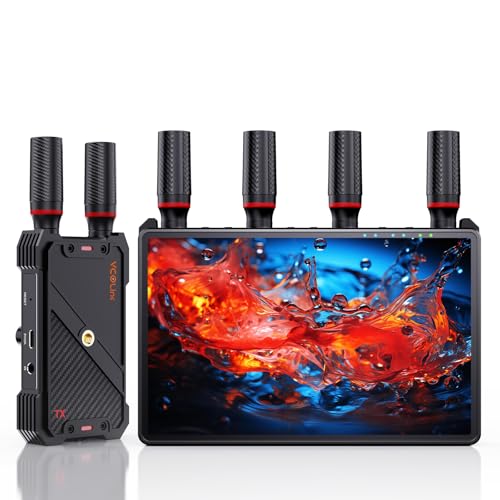
- Built-in 7-inch receiver monitor
- Supports up to five receivers and HDMI loop-out
- Portable NP-F, power-bank, or USB-C power options
Best For: Filming, live production, and shared on-set monitoring
Best Flexible Power Option
Vrriis WL082 Wireless HDMI System

- 1080p at 60Hz with claimed 1,300-foot open-field range
- Loop-out plus dual HDMI receiver outputs
- Supports up to five receivers and multiple power sources
Best For: Flexible multi-display camera monitoring
Professional 4K Crew Link – Accsoon CineView SE 4K
For multi-camera productions that need detailed monitoring and camera-control options, the Accsoon CineView SE 4K is a professional-grade choice among video transmitters for multi camera setups. It accepts 4K HDMI input/output at up to 30p, supports 1080p through SDI or HDMI, and offers wireless transmission up to 1,312 feet in clear line-of-sight conditions.
Best For: Filmmakers, directors, cinematographers, and larger production teams needing 4K monitoring, long range, and compatible camera control.
Pros:
- Supports 4K video at up to 30p through HDMI, plus 1080p via 3G-SDI or HDMI.
- Offers up to 1,312 feet of range and latency as low as 0.05 seconds at 1080p under stated test conditions.
- Can connect to up to five monitoring destinations, including four wireless connections and one wired USB-C connection.
- Supports camera-control functions with selected Sony and Canon cameras.
Cons:
- Performance range depends on clear, unobstructed, interference-free conditions.
- USB-C video output is for compatible mobile monitoring, not UVC capture or computer webcam input.
- Some cables and compatible receivers or mobile devices are sold separately.
The CineView SE 4K stands out when image quality, range, and production-focused features matter more than a basic plug-and-play display link. Verify camera, receiver, and mobile-device compatibility before building it into a multi-camera workflow.
Four-Screen HDMI Expansion – YAOMAISI G9R Pro Wireless HDMI Kit
The YAOMAISI G9R Pro is designed for sending one HDMI source to several displays rather than for advanced cinema camera workflows. As video transmitters for multi camera setups, it can be useful where a laptop, camera, or other HDMI-output device needs to feed up to four TVs or monitors simultaneously at 1080p and 60Hz.
Best For: Presentations, classrooms, conference rooms, churches, venues, and simple multi-display monitoring from one HDMI source.
Pros:
- Includes one transmitter and four receivers for simultaneous expansion to four screens.
- Pre-paired plug-and-play design requires no Wi-Fi, Bluetooth, drivers, or pairing app.
- Supports 1080p at 60Hz with stated latency of about 0.1 seconds.
- Uses 2.4GHz and 5.8GHz bands and includes heat-control technology for extended operation.
Cons:
- The transmitter supports 1080p output only, so source devices may need to be set to 1080p.
- It cannot connect directly to a TV; the transmitter requires an HDMI-output source.
- The stated 165-foot range applies to open areas, while transmission through walls is more limited.
This kit is a practical multi-screen distribution option when the goal is to duplicate one source across several displays. It is less suited to workflows requiring 4K transmission, independent camera feeds, or professional camera-control features.
Long-Range SDR Production Link – DJI SDR Transmission Combo
The DJI SDR Transmission Combo is built for demanding on-site monitoring, making it one of the more production-oriented video transmitters for multi camera setups. It supports 1080p at 60fps, uses automatic frequency hopping across several bands, and provides SDI, HDMI, Wi-Fi, and USB-C monitoring options.
Best For: Live production crews and camera teams working in complex environments where long range, interference resistance, and multiple monitoring points are priorities.
Pros:
- Provides a stated transmission distance of up to 3 km with enhanced penetration capabilities.
- Supports 1080p/60fps at up to 20 Mbps with stated latency as low as 35 ms.
- Automatically switches among 2.4GHz, 5.8GHz, and DFS bands to help avoid interference.
- Broadcast mode supports an unlimited number of receivers according to the supplied specifications.
Cons:
- Its listed video specification is 1080p/60fps rather than 4K.
- The feature set may be more than needed for basic single-source display extension.
- Remote-control and stabilizer features depend on compatible DJI equipment.
DJI’s system is a strong fit for crews that need a robust monitoring link across a large or challenging site. Its broadcast mode and camera-control ecosystem are especially relevant when several people need access to a live feed.
Portable Multi-TV HDMI Link – Wireless HDMI G7R PRO Kit
The Wireless HDMI G7R PRO is a portable distribution kit for sending one HDMI source to multiple displays. For straightforward video transmitters for multi camera setups, it offers one transmitter with four receivers, 1080p/60Hz operation, and a pre-paired setup without requiring Wi-Fi, apps, or drivers.
Best For: Portable presentations, classrooms, meetings, churches, events, home entertainment, and other setups needing one source on several screens.
Pros:
- Includes four receivers and is recommended for up to six screens when using supported mobile connections.
- Provides 1080p at 60Hz with stated latency of about 0.1 seconds.
- Pre-paired plug-and-play operation works without apps, drivers, or a local Wi-Fi network.
- Includes a USB-C-to-HDMI adapter for compatible newer laptops and USB-C devices.
Cons:
- The stated 165-foot range applies to open environments; walls can reduce the usable distance.
- Both transmitter and receivers require a stable 5V/1A power source.
- This is a single-source HDMI distribution system, not a system for independently transmitting multiple camera feeds.
The G7R PRO prioritizes portability and simple multi-display expansion. Choose it when ease of setup and several screens are more important than 4K resolution, SDI connectivity, or independent multi-camera routing.
Best Multi-Receiver Pick – Hollyland Pyro H
For teams comparing video transmitters for multi camera setups, the Hollyland Pyro H stands out when several crew members need to monitor a feed. It supports 4K30 transmission, dual-band operation, smart channel scanning, and up to four receivers, while HDMI loopout and UVC support add useful production flexibility.
Best For: Film production, live streaming, ENG/EFP work, and dynamic shoots requiring multi-user monitoring.
Pros:
- Transmits up to 4K30 over HDMI with 60ms latency.
- Supports up to four receivers for broader crew monitoring.
- Smart channel scan works across 2.4GHz and 5GHz bands.
- HDMI loopout and UVC enable monitoring and computer live streaming.
Cons:
- The listed 1,300-foot range is specified for line-of-sight use.
- This kit includes one transmitter and one receiver; additional receivers are separate components.
The Pyro H is the strongest fit here for collaborative monitoring. Its combination of range, 4K support, app monitoring, and receiver expansion makes it a practical foundation for a growing production setup.
Best Expandable Budget Setup – 2026 Wireless HDMI Kit
This wireless HDMI kit is worth considering for video transmitters for multi camera setups when simple expansion matters more than 4K output at the display. It decodes 4K input but outputs 1080p at 60Hz, supports one receiver with up to eight transmitters, and can run three sets in the same environment.
Best For: Presentations, classrooms, events, houses of worship, home theaters, and basic multi-source HDMI distribution.
Pros:
- One receiver can connect with up to eight transmitters.
- Supports up to three sets simultaneously without signal interference, according to the supplied notes.
- Uses 2.4GHz and 5.8GHz dual-band transmission with a listed 360-foot open-space range.
- Plug-and-play setup supports mirrored and extended display modes.
Cons:
- Output is limited to 1080p at 60Hz despite 4K decoding.
- Walls and other obstacles can reduce the stated transmission distance.
- The notes specify a maximum of one receiver per setup.
Choose this model when you need to switch among several HDMI sources in a relatively straightforward installation. It offers unusual transmitter expansion, but professional 4K workflows should look to a system with 4K output and more production-focused connectivity.
Best SDI/HDMI Hybrid – Hollyland Mars 4K
For video transmitters for multi camera setups that need broadcast-style connectivity, the Hollyland Mars 4K combines HDMI and 3G-SDI input/output. It supports 4K30 over HDMI, decimal-point SDI frame rates, app monitoring, and multiple display options for directors, producers, and other on-set viewers.
Best For: Professional video production where cameras, switchers, monitors, and mobile viewers may use different connection standards.
Pros:
- Supports up to 4K30 through HDMI and HD formats through HDMI or SDI.
- 3G-SDI supports 23.98, 29.97, and 59.94 fps output.
- Can support multiple monitors and up to four app monitoring devices in specified configurations.
- Offers a color LCD, joystick controls, and several power options.
Cons:
- Its listed 450-foot line-of-sight range is shorter than the Pyro H’s stated range.
- 66ms latency is slightly higher than the Pyro H’s listed figure.
- QC/PD charging is not supported, according to the supplied notes.
The Mars 4K is the more suitable choice when SDI compatibility and production-standard frame rates are central requirements. Its mixed HDMI/SDI design makes it more adaptable to professional video infrastructure than a basic HDMI-only kit.
Best Multi-Screen Value – YAOMAISI G9R Pro Wireless HDMI Kit
If you need video transmitters for multi camera setups that can also feed several displays, the YAOMAISI G9R Pro is a straightforward option. Its pre-paired transmitter and receiver support 1080p at 60Hz and can send one source to up to four receivers, making it useful for basic multi-screen monitoring or presentation environments.
Best For: Multi-screen viewing from a laptop, camera, game console, or other HDMI source where simple setup matters.
Pros:
- Supports one transmitter to up to four receivers simultaneously.
- Pre-paired, plug-and-play setup requires no apps, drivers, Wi-Fi, or Bluetooth.
- Offers 1080p at 60Hz with claimed ultra-low 0.1-second latency.
- Compact units include adjustable antennas and dual-band 2.4GHz/5GHz operation.
Cons:
- Open-air range is listed at 165 feet, while operation through walls or ceilings is listed at 32 feet.
- Additional receivers are needed to use the multi-screen capability.
- Stable operation requires a 5V/1A power supply; low-powered USB ports may cause interruptions.
The G9R Pro is best suited to uncomplicated HDMI distribution rather than a full professional production workflow. Its four-receiver capacity and easy pairing make it appealing when several displays need the same feed.
Best On-Set Monitoring – Wireless HDMI Kit with 7-Inch Monitor
For video transmitters for multi camera setups, this kit stands out by combining wireless HDMI transmission with a built-in 7-inch receiver monitor. It supports 1080p at 60Hz, up to five receivers, HDMI loop-out, and several portable power options, giving filming and live-streaming teams more ways to monitor a feed.
Best For: Film crews, studios, and live events that need private receiver monitoring plus optional external displays.
Pros:
- Receiver includes a built-in 7-inch HD screen, brightness and volume controls, headphone output, and sleep mode.
- One transmitter can broadcast to up to five receivers for multi-viewer collaboration.
- Claims 1080p at 60Hz transmission up to 1,312 feet line of sight with less than 0.05-second latency.
- Includes HDMI loop-out, IR remote control, and NP-F battery, power-bank, or USB-C power options.
Cons:
- External HDMI cables are not included for connecting a larger monitor.
- A Type-C to HDMI cable is required for smartphone or tablet compatibility.
- Long-range performance is specified for line-of-sight conditions.
This is the most production-oriented option in the group because the receiver doubles as a portable monitor and can feed another display. It is a strong fit when on-set visibility and flexible mounting or power are more important than the smallest possible kit.
Best Flexible Power Option – Vrriis WL082 Wireless HDMI System
The Vrriis WL082 is worth considering among video transmitters for multi camera setups when you want long-range HDMI transmission and flexible monitoring outputs. It supports 1080p at 60Hz, includes transmitter-side loop-out, provides two HDMI outputs on the receiver, and can expand from one transmitter to up to five receivers.
Best For: Camera, projector, and TV installations needing multiple displays, local monitoring, or portable power choices.
Pros:
- Claims up to 1,300 feet of open-field transmission with 0.05-second latency.
- Transmitter loop-out enables local monitoring while the receiver offers dual HDMI outputs.
- Supports up to five receivers, with the manufacturer noting that added receivers can reduce range.
- Can run from NP-F batteries, USB-C power, adapters, or 5V/2A portable power sources.
Cons:
- Walls, metal, brick, and glass can shorten coverage or cause signal loss.
- NP-F batteries are not included.
- The supplied package lists one transmitter and one receiver, so additional receivers may be needed for expansion.
The WL082 offers a useful balance of range, output flexibility, and portable power. Its loop-out and dual receiver outputs make it particularly practical for setups where an operator needs a local view while other screens receive the same signal.
How We Picked the Best Video Transmitters for Multi Camera Setups
We focused on the factors that matter most when several cameras must feed directors, operators, clients, or remote displays at the same time. Our comparison considers supported inputs and outputs, resolution and frame-rate limits, wireless range, latency, receiver capacity, interference resistance, power options, and setup simplicity.
The list includes both production-focused systems and plug-and-play HDMI extenders. Specifications can vary by line of sight, walls, wireless congestion, antenna placement, source device, and regional configuration, so treat advertised range as an ideal maximum rather than a guaranteed working distance.
Quick Comparison
| Best For | Look For | Most Suitable Options |
|---|---|---|
| Professional camera crews | SDI, reliable links, low latency | Accsoon CineView SE 4K, Hollyland Mars 4K |
| Long-distance monitoring | Extended range and interference management | DJI SDR Transmission, Hollyland Pyro H |
| Several TVs or monitors | One transmitter supporting multiple receivers | G9R Pro, Wireless HDMI PRO, multi-TV kits |
| Budget HDMI distribution | Plug-and-play setup and 1080p support | Compact wireless HDMI systems |
Key Buying Factors for Video Transmitters for Multi-Camera Setups
Inputs, Outputs, and Camera Compatibility
Confirm whether your cameras provide HDMI, SDI, or both. HDMI is common on mirrorless and consumer cameras, while SDI is generally preferred for professional production because locking connectors and longer cable runs are more secure. Check connector size, required adapters, supported frame rates, and whether the receiver offers loop-out for additional displays.
Resolution, Latency, and Frame Rate
4K support is useful for high-resolution monitoring, but many systems transmit 1080p wirelessly to reduce bandwidth and latency. For live switching, sports, events, and focus pulling, prioritize a responsive link over maximum resolution. Verify compatibility with formats such as 23.98, 29.97, 59.94, and 60 fps before buying.
Range, Interference, and Receiver Count
For a multi-camera setup, calculate the distance from each camera to the receiving position and allow room for obstacles. Dual-band systems can help manage crowded environments, but no wireless link is immune to interference. If multiple people need separate views, choose a system designed for several receivers rather than relying on improvised splitting.
Power and Field Workflow
Check battery compatibility, USB power requirements, runtime, mounting options, heat management, and whether transmitters can remain attached without blocking camera controls. A system that starts quickly and reconnects reliably may be more valuable on location than one with a higher headline range.
Who Should Buy Which Video Transmitters for Multi Camera Setups?
Choose a professional SDI/HDMI system if you operate cinema cameras, need dependable monitoring, or regularly work on commercial, documentary, or live-event sets. Choose a long-range dual-band model for large venues, outdoor shoots, or separated camera and director positions. Choose a multi-receiver HDMI kit when one source must feed several nearby TVs or monitors with minimal configuration. Choose a basic 1080p extender for presentations, classrooms, home studios, and occasional monitoring where cost and simplicity matter more than advanced camera features.