The best robot building kits for indoor use turn screen-free play into a practical STEM project. Kids can build moving robots, experiment with mechanisms, and develop problem-solving skills while working at their own pace.
These 10 kits range from beginner-friendly drill-and-build sets to programmable and multi-model robotics systems, making it easier to match a kit with a child’s age, interests, and experience.
Best 10 Robot Building Kits for Indoor Use Picks for 2026
Versatile 5-in-1 Pick

- Five buildable models
- App and remote control
- Rechargeable, expandable design
Best For: Kids ages 8-13 who enjoy varied builds and interactive programming
Early Builder Favorite

- Designed for ages 3-6
- Includes drill and construction tools
- Builds fine-motor skills
Best For: Preschoolers learning basic assembly and tool use
Coding Starter

- Builds in about 15 minutes
- Scratch and Arduino support
- Line-following and obstacle avoidance
Best For: Kids ages 8-12 beginning robotics and programming
Feature-Rich 5-in-1
Sillbird Programmable Robot Kit
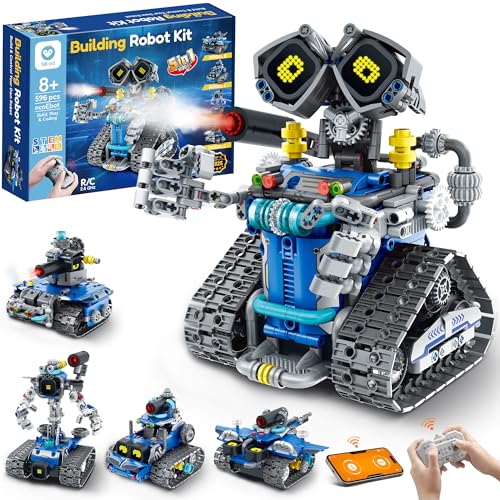
- 596 pieces and five models
- Remote, app, and coding play
- LED, sound, and mist effects
Best For: Kids ages 8-14 seeking varied builds and interactive features
Most Versatile Build Variety

- Build 36 different robots, including 14 motorized models
- Includes a sorting tray and video tutorials
- Designed for STEM-focused indoor family play
Best For: Kids ages 8–13 who want varied robot projects
Best Solar-Powered Learning

- Build 12 robots, cars, and other models
- Runs in sunlight or under strong artificial light
- Includes 190 pieces and detailed instructions
Best For: Kids ages 8–14 exploring solar energy indoors
Best Multi-Project Value

- Includes six robotics and science projects
- Builds construction, creative, and problem-solving skills
- Comes with a screwdriver and step-by-step manuals
Best For: Kids ages 8–12 who like varied STEM activities
Hands-On Mechanical Coding
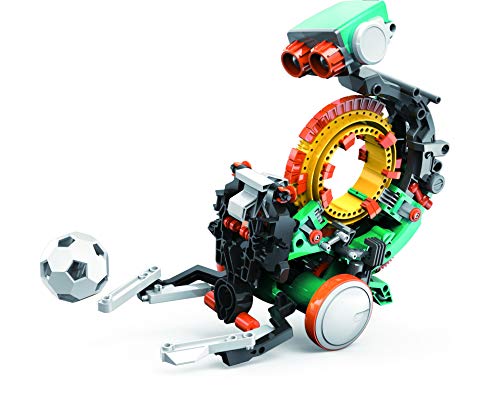
- Mechanical coding wheel programs multiple actions
- Multi-hour, step-by-step STEM build
- Designed for ages 10 and up
Best For: Older kids who enjoy detailed mechanical projects
Three-Build Remote-Control Fun

- 440 pieces create three different models
- App and controller support programmed movement
- Includes sturdy blocks and extra pieces
Best For: Kids who want building variety and remote-controlled play
App-Programmable Building
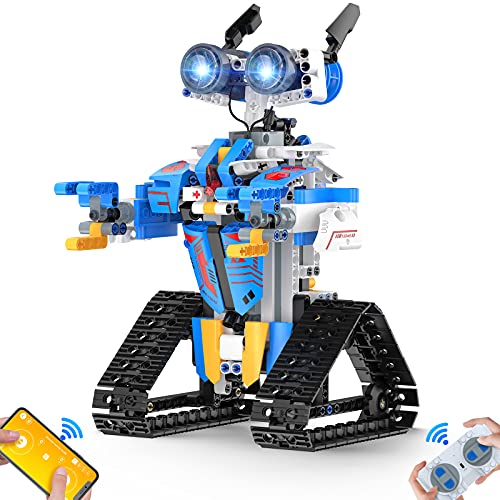
- 468+ pieces with marked assembly instructions
- Six listed control and programming modes
- Lights, rotating joints, and 360-degree movement
Best For: Kids who want varied controls after building
Versatile 5-in-1 Pick – Opmind STEM RC Robot Kit
The Opmind 5-in-1 kit is a flexible choice for families comparing robot building kits for indoor use. Its 419 building pieces support five models, while the remote and app add driving, navigation, gyroscope, and AI programming activities.
Best For: Kids ages 8-13 who want multiple builds and app-based control.
Pros:
- Builds five models, including a warrior robot, ninja, boar, chariot, and buggy.
- App offers remote driving, 360-degree rotation, navigation paths, and AI programming.
- Rechargeable battery and ABS construction support repeated indoor play.
Cons:
- The product information lists differing age guidance, including 6-12 and 8-13.
- Some app features may require more setup than basic remote control.
Choose this kit if variety and digital experimentation matter more than a quick, simple build. Its multiple models and expandable block compatibility give children several ways to continue playing after assembly.
Early Builder Favorite – Design & Drill Robot Workshop
For younger children seeking robot building kits for indoor use, the Design & Drill Robot Workshop focuses on hands-on assembly rather than coding. Children use the included toy drill and screwdriver to attach bolts, gears, and interchangeable pieces to create custom robot designs.
Best For: Children ages 3-6 developing fine-motor and early construction skills.
Pros:
- Includes a kid-friendly drill, screwdriver, gear socket bit, 32 bolts, seven gears, and 26 interchangeable pieces.
- Encourages fine-motor coordination, problem-solving, and creative construction.
- Manual operation makes the activity straightforward for independent indoor play.
Cons:
- Two AA batteries are required and not included.
- It is a take-apart construction toy, not a programmable or driving robot.
This is a practical introductory option for preschoolers who enjoy using tools and taking things apart. Older children looking for app control or coding will likely need a more advanced kit.
Coding Starter – Makeblock mBot Robot Kit
The Makeblock mBot is a strong option for shoppers seeking robot building kits for indoor use with a clear path into coding. It can be assembled in about 15 minutes, then used for remote control, line following, obstacle avoidance, and programming through Scratch and Arduino resources.
Best For: Kids ages 8-12 ready to connect robot building with beginner coding.
Pros:
- Designed to introduce electronics, robotics, Scratch, and Arduino programming.
- Supports remote control, line following, and obstacle avoidance.
- Open-source platform works with more than 100 electronic modules and 500 Makeblock parts, plus LEGO parts.
Cons:
- The robot requires four AA batteries, and the remote requires a CR2025 battery; batteries are not included.
- It offers one primary robot platform rather than several block-built models.
mBot makes sense when the main goal is a structured transition from construction to coding. Its tutorials, apps, and expansion options can keep the project useful beyond the initial assembly.
Feature-Rich 5-in-1 – Sillbird Programmable Robot Kit
The Sillbird kit combines multi-model construction with interactive features, making it a compelling choice among robot building kits for indoor use. Its 596 pieces create five designs, while remote control, a Bluetooth app, LED eyes, sounds, and a water-activated mist feature add variety after building.
Best For: Kids ages 8-14 who want creative builds and playful robot effects.
Pros:
- Includes 596 pieces and five models with gradually different difficulty levels.
- Offers remote and app control, coding activities, LED expressions, sound effects, and mist spray.
- Rechargeable battery provides up to 40 minutes of continuous play per charge.
Cons:
- The mist feature requires adding a little water.
- Up to 40 minutes of play per charge may require recharging during longer sessions.
This kit is well suited to children who want the building process and an attention-grabbing finished robot. The color manual and graduated models also make it easier to start with a simpler design before attempting a harder build.
Most Versatile Build Variety – 36-in-1 Motor Robotics Kit
For shoppers comparing robot building kits for indoor use, the JOVA Klever Kits set stands out for its broad selection of build options. Kids ages 8–13 can assemble 36 different robots, including 14 motorized models, with support from a color instruction booklet and video tutorials.
Best For: Kids who want lots of robot-building variety for screen-free solo, sibling, or family play.
Pros:
- Offers 36 different robot builds, including walking machines and racing cars.
- Supports hands-on learning in science, engineering, and mechanics.
- Includes a parts tray for sorting and storage.
- Provides printed instructions and video tutorials.
Cons:
- The large number of pieces may require careful sorting before building.
- Its recommended age range is 8–13, so it may not suit younger children without help.
With 334 pieces and many possible configurations, this kit is a practical pick when variety matters more than a single finished model. The organized tray and tutorials also help make repeated indoor building sessions easier to manage.
Best Solar-Powered Learning – 12-in-1 Solar Robot Kit
The Sillbird Solar Building Robot Kit brings renewable-energy concepts into robot building kits for indoor use. It includes 12 models and can run with sunlight outdoors or a strong artificial light source, such as a flashlight, indoors.
Best For: Children ages 8–14 interested in solar power, beginner engineering, and hands-on STEM projects.
Pros:
- Offers 12 buildable models with varying difficulty levels.
- Uses a larger solar panel intended to provide stronger power output.
- Can operate indoors with a strong artificial light source.
- Includes 190 pieces and step-by-step instructions.
Cons:
- Indoor use depends on having a sufficiently strong light source.
- Solar-powered play may be less consistent in weak or indirect light.
This kit is a good choice for families that want building activity paired with an introduction to renewable energy. The 12 models provide progression, while the artificial-light option makes the set more practical when outdoor sunlight is unavailable.
Best Multi-Project Value – 6-in-1 Robotics STEM Set
For families seeking robot building kits for indoor use with several different activities, this six-set robotics kit offers more than a single robot design. Children can build projects such as a reptile robot, balance car, bubble machine, fiber lamp, and sliding plane while practicing construction and problem-solving skills.
Best For: Kids ages 8–12 who enjoy switching between robotics builds and science-themed craft projects.
Pros:
- Includes six separate robot-building and science experiment projects.
- Encourages creativity, logical thinking, hand-eye coordination, and construction skills.
- Comes with a screwdriver and detailed step-by-step instruction manuals.
- Can support family bonding, classroom activities, or independent projects.
Cons:
- The projects may appeal less to children seeking only traditional robots.
- Assembly requires following instructions and handling multiple project components.
This set offers useful variety for indoor activity time, especially when children lose interest in repeating one build. Its mix of motorized crafts and experiments makes it a flexible STEM gift for home or classroom use.
Hands-On Mechanical Coding – Mech-5 STEM Robot
For shoppers comparing robot building kits for indoor use, the TEACH TECH Mech-5 stands out as a hands-on mechanical engineering project for ages 10 and up. Kids assemble the robot and program its actions by snapping coding buttons onto a mechanical coding wheel, rather than relying on an app or remote control.
Best For: Future engineers who want a deeper, multi-hour build focused on mechanical coding, problem solving, and STEM learning.
Pros:
- Mechanical coding wheel enables actions such as throwing, lifting, kicking, and drawing.
- Detailed step-by-step assembly provides an in-depth building experience.
- Encourages learning about mechanical engineering and coding basics.
- Designed for indoor, hands-on play with a compact 9-inch robot.
Cons:
- Assembly can take multiple hours and requires careful attention to instructions.
- It is a build project rather than a ready-to-use preassembled toy.
- Requires two AAA batteries.
Choose Mech-5 if the building process matters as much as the finished robot. Its mechanical programming system offers a distinctive alternative to app-based kits, though younger or less patient builders may need adult guidance during assembly.
Three-Build Remote-Control Fun – 3-in-1 RC Robot Kit
This 440-piece IQKidz set is a versatile option among robot building kits for indoor use, combining construction with remote-controlled play. Kids can build a robot, stunt tank, or robot girl, then use the controller or app to drive, spin, and follow programmed paths.
Best For: Kids ages 8 to 12 who want multiple builds, remote-control features, and an approachable introduction to programming.
Pros:
- 440 pieces support three different builds: robot, stunt tank, and robot girl.
- App and remote control offer movement and programmed-path options.
- Sturdy plastic blocks and extra pieces help support repeated building.
- Supports engineering, creative thinking, hand-eye coordination, and STEM skills.
Cons:
- The recommended age information varies between the listed details.
- Disposable batteries are required.
- Multiple builds and controls may require time to learn.
This kit is a strong pick when variety and interactive play are priorities. Its three configurations can keep indoor play fresh, while the app and controller add a gentle introduction to coding and robot movement.
App-Programmable Building – 468-Piece STEM Robot
For families seeking robot building kits for indoor use with several control options, this 468-piece STEM set combines block construction with app, remote, and programmable play. The completed robot can move in multiple directions, perform 360-degree spins, and use features such as lights and flexible hand joints.
Best For: Kids ages 8 and up who want a feature-rich building project with app control, voice control, path mode, and STEM programming.
Pros:
- Includes more than 468 pieces, an assembly guide, remote, and USB charging cable.
- Offers app Bluetooth, remote, path, voice, gravity-sensor, and programming modes.
- Robot moves forward, backward, left, right, and in 360-degree rotations.
- Individually packaged parts and marked instructions are designed to simplify assembly.
Cons:
- The supplied manufacturer age listing is inconsistent, so buyers should use the broader stated 8+ guidance.
- The many control modes may feel more complex than a basic remote-control toy.
- Requires a lithium-ion battery, though one is listed as included.
This model suits children who want to build and then explore several ways to control the result. Its rechargeable design and broad feature set make it engaging for indoor projects, while the marked assembly instructions can make the sizable build more approachable.
How We Picked These Robot Building Kits for Indoor Use
We focused on kits that combine meaningful construction with an engaging result, such as a moving robot, programmable vehicle, or working mechanical model. We also considered the stated age range, number of pieces, control method, project variety, educational value, and suitability for indoor spaces.
Because product contents and specifications can vary, check the current listing for battery requirements, app compatibility, included tools, and assembly details before buying.
Quick Comparison
| Kit type | Best for | What to check |
|---|---|---|
| Basic build-and-play | First-time builders | Clear instructions and manageable piece count |
| Remote-control robot | Interactive play | Controller range, floor compatibility, and batteries |
| Programmable robot | Older or experienced kids | App, coding platform, and device support |
| Multi-model kit | Longer-lasting projects | Number of build options and reusability |
| Solar-powered kit | Energy-focused STEM learning | Indoor lighting limitations and motor performance |
Key Buying Factors
Age, Patience, and Build Complexity
Use the recommended age as a starting point, but also consider a child’s comfort with small parts, diagrams, and multi-step assembly. A simpler kit is usually more rewarding for a beginner than an advanced set that requires frequent adult help.
Control and Coding Features
Remote control offers immediate play, while app control and programmable functions provide deeper learning. Confirm whether the app works with the child’s phone or tablet and whether coding uses visual blocks or a more advanced platform.
Indoor Practicality
Look for robots that work well on the floors or tables where they will be used. Small wheels may struggle on carpet, while fast-moving models need open space. Consider noise, loose parts, charging needs, and whether the finished build is compact enough to store.
Project Variety and Durability
Multi-build sets can extend play value, but only if instructions are clear and parts are easy to rebuild. Check reviews for reports of fragile connectors, missing pieces, difficult gears, or motors that lose power quickly.
Who Should Buy Which Robot Building Kits for Indoor Use?
Choose a basic workshop-style kit for younger beginners who enjoy hands-on construction without complicated electronics. Remote-control sets suit children who want an immediate interactive result, while programmable options are better for curious builders ready to experiment with code and sensors.
For families seeking longer-term value, a 5-in-1, 12-in-1, or 36-in-1 kit can provide multiple projects from one purchase. Solar kits are a good fit for introducing alternative energy, but they may perform best near a bright window rather than in a dim room. Older children and experienced builders should look for sturdier parts, more challenging instructions, and flexible coding or mechanical features.