If you need portable 3D scanners that can travel from desk to workshop to field, the right pick depends on more than resolution alone. Accuracy, tracking, scan speed, and surface support all matter.
This roundup focuses on buyer-friendly options for 3D printing, reverse engineering, and general capture, so you can choose a scanner that fits your workflow and budget.
Best 10 Portable 3d Scanners Picks for 2026
Flagship Precision Scanner
Revopoint POP 4 for 3D Printing
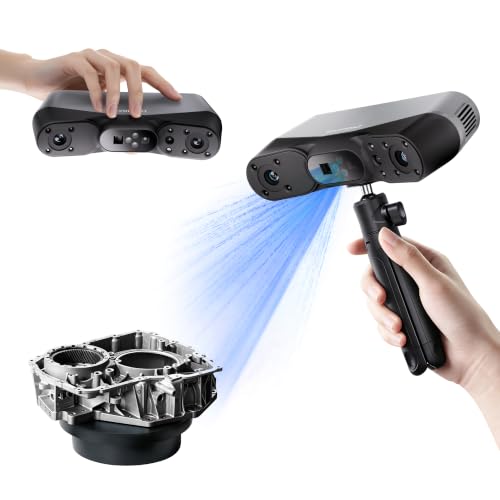
- 0.03 mm single-frame accuracy
- Up to 105 fps scanning speed
- Multiple modes for indoor/outdoor use
Best For: Precision-focused users who scan indoors and outdoors
Entry-Level Medium-Format Scanner

- 0.07 mm accuracy and 0.10 mm resolution
- Markerless AI tracking recovers fast
- JMStudio handles scan-to-edit workflow
Best For: Beginners and hobbyists wanting easy medium-format scanning
Pocket Wireless Scanner
Creality Pika Portable 3D Scanner

- 260g pocket-sized wireless design
- 0.03 mm accuracy with dual scan modes
- AI tools for body completion and cleanup
Best For: Travel-friendly scanning across small parts and full bodies
Lightweight Color Scanner
Revopoint POP 3 Plus for Portable Work
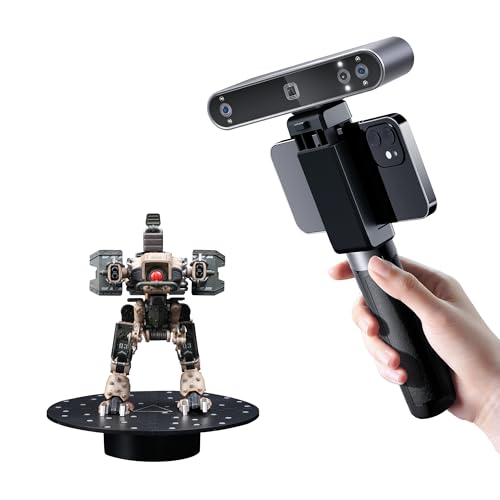
- Only 190g for easy portability
- Full-color scanning with HD RGB camera
- Wi-Fi 6 and USB-C across major platforms
Best For: Creators who want lightweight full-color scanning
Precision Pick
3DMakerpro Seal Lite Small-Format Scanner

- Up to 0.02mm accuracy for small objects
- Blue LED source captures fine surface detail
- Indoor-focused with anti-shake and scan-back
Best For: Small-format 3D printing and detailed indoor scanning
Wireless Workflow
Creality CR-Scan Ferret Pro Handheld Scanner

- WiFi 6 bridge enables wireless scanning
- Up to 0.1mm accuracy at 30FPS
- Outdoor scanning works up to 30,000 lux
Best For: Mobile scanning and beginner-friendly outdoor use
Advanced All-Rounder
Revopoint POP 4 Standard 3D Scanner

- Up to 0.03mm accuracy with five scan modes
- WiFi 6.0 wireless scanning and live mobile preview
- Covers objects from 10mm to 2m
Best For: Precision modeling and mixed indoor/outdoor scanning
Portable 3D Scanner for Beginners

- 105g lightweight body for easy travel
- WiFi6 wireless scanning across major platforms
- Up to 0.1mm accuracy with 24-bit color capture
Best For: Entry-level users and DIY creators who want a portable, wireless scanner
Portable 3D Scanner for Premium Outdoor Scans

- 190g lightweight scanner with WiFi 6.0
- Outdoor scanning support up to 20,000 lux
- Dual modules with up to 0.05mm accuracy
Best For: Mobile creators who want a premium, well-equipped scanner for outdoor and detailed work
Portable 3D Scanner for Value Outdoor Use

- 190g body with WiFi 6.0 wireless scanning
- Up to 0.05mm accuracy and 0.03mm precision
- Built-in RGB camera captures full-color texture
Best For: Shoppers who want a portable outdoor scanner with color capture in a simpler package
Flagship Precision Scanner – Revopoint POP 4 for 3D Printing
If you want portable 3d scanners that can handle demanding capture jobs, the Revopoint POP 4 is built around high accuracy, fast acquisition, and multiple scan modes. It is aimed at users who need reliable detail for 3D printing, reverse engineering, and field work without giving up mobility.
Best For: Users who need premium portable scanning for precision modeling, outdoor capture, and mixed object sizes.
Pros:
- Up to 0.03 mm single-frame accuracy for fine detail capture
- Fast scanning modes with up to 105 fps and 5,000,000 points/s
- AI segmentation and photo-grade retopology help clean up results
- Works on dark, reflective, and outdoor scenes with multiple scan modes
Cons:
- Windows-only AI object segmentation limits that feature for some users
- Professional workflow features may be more than casual hobbyists need
The POP 4 stands out as a high-end portable option when scan quality matters more than simplicity. Its mix of precision, speed, and outdoor flexibility makes it a strong pick for serious scanning projects.
Entry-Level Medium-Format Scanner – 3DMakerpro Fox for Beginners
The 3DMakerpro Fox is a practical choice for buyers comparing portable 3d scanners at the entry level. It focuses on approachable scanning, solid detail, and software that handles scanning, editing, and optimization in one workflow.
Best For: Beginners and hobbyists who want a simple medium-format scanner for useful 3D prints and models.
Pros:
- 0.07 mm accuracy and 0.10 mm resolution for detailed capture
- Markerless AI visual tracking helps recover from missed movement
- JMStudio combines scanning, editing, and optimizing
- Designed as an accessible medium-format option for new users
Cons:
- Not aimed at the highest-end precision workflows
- Heavier than ultra-compact pocket-style scanners
Fox makes sense if you want a straightforward scanner that still produces detailed, usable results. It is a sensible middle ground for people who want to start scanning without jumping straight into a premium system.
Pocket Wireless Scanner – Creality Pika Portable 3D Scanner
If portability is your top priority, the Creality Pika is one of the more travel-friendly portable 3d scanners here. It combines a compact body, wireless PC mode, dual batteries, and dual-mode capture for everything from tiny parts to full-body scans.
Best For: Users who want a compact, wireless scanner for detailed parts, dark surfaces, and body scanning.
Pros:
- Very compact at 260g with Wi-Fi 6 wireless PC mode
- 0.03 mm accuracy and 0.1 mm resolution for fine detail
- Blue laser and NIR structured light support different scan types
- AI body completion, retexturing, and hole filling speed cleanup
Cons:
- Feature-rich setup may take time to learn
- Best results may depend on choosing the right scan mode for the subject
Pika is a strong fit if you want one scanner that can travel easily and still tackle a wide range of scan jobs. Its wireless design and AI tools make it especially appealing for flexible, on-the-go use.
Lightweight Color Scanner – Revopoint POP 3 Plus for Portable Work
The Revopoint POP 3 Plus is a compact option for shoppers comparing portable 3d scanners that balance ease of use with full-color capture. It is designed for medium-sized objects, quick setup, and smooth scanning across common desktop and mobile workflows.
Best For: Makers and creators who want a lightweight scanner with full-color output and broad device support.
Pros:
- Lightweight at 190g and easy to move between setups
- Full-color scans with HD RGB camera and Flash LED lighting
- Wi-Fi 6 and USB Type-C support Windows, macOS, iOS, and Android
- Broad file export options for CAD, modeling, and slicer use
Cons:
- 18 fps scanning is slower than some faster performance-focused models
- x86_64 software compatibility may limit some computer setups
POP 3 Plus is a practical portable scanner for users who value convenience, full-color output, and software support. It offers a balanced feature set that should suit a wide range of creative and design tasks.
Precision Pick – 3DMakerpro Seal Lite Small-Format Scanner
If you’re comparing portable 3d scanners for small objects, the 3DMakerpro Seal Lite stands out for its fine-detail capture and compact scanning range. It’s built for indoor work on objects from 10 to 300mm, with a recommended working distance of 180–280mm, so it makes the most sense when your priority is precision over size.
Best For: Small-format 3D printing, detailed indoor scans, and users who want high accuracy on compact objects.
Pros:
- Up to 0.02mm accuracy for capturing tiny dents and edge texture.
- Blue LED light source helps project finer structured light.
- Includes scan-back and anti-shake features for steadier results.
- JMStudio software supports auto-alignment, error correction, and common export formats.
Cons:
- Monochrome texture only, so it does not capture full color.
- Designed mainly for indoor use.
- Has a learning curve and needs a relatively powerful PC.
For buyers who want a handheld scanner focused on small parts and fine surface detail, the Seal Lite is a practical pick. It is less about all-purpose portability and more about delivering accurate scans once you have the workflow dialed in.
Wireless Workflow – Creality CR-Scan Ferret Pro Handheld Scanner
The Creality CR-Scan Ferret Pro is a strong option if you want portable 3d scanners with wireless convenience and broad device support. It combines WiFi 6 bridge scanning with anti-shake tracking, and its outdoor-ready performance makes it more flexible than many budget handheld models.
Best For: Mobile scanning, beginner-friendly handheld use, and outdoor projects that need wireless flexibility.
Pros:
- Up to 0.1mm accuracy and 30FPS scanning speed.
- WiFi 6 bridge supports wireless data transfer for smoother workflow.
- Anti-shake tracking helps maintain scans even with hand movement.
- Works in outdoor ambient light up to 30,000 lux and exports OBJ, STL, or PLY.
Cons:
- Best results may depend on avoiding reflective, transparent, or very dark surfaces.
- Wireless mode requires compatible devices and the dedicated bridge.
- Performance requirements vary by platform and can be demanding for some setups.
Overall, the Ferret Pro is aimed at users who value flexibility as much as scan quality. If you want a handheld scanner that can move between PC and mobile workflows without feeling tethered, this is an easy model to shortlist.
Advanced All-Rounder – Revopoint POP 4 Standard 3D Scanner
The Revopoint POP 4 is built for buyers who want portable 3d scanners with serious capability across both indoor and outdoor work. With multiple scanning modes, wireless connectivity, and support for very small to very large objects, it is positioned as a versatile choice for demanding 3D printing and reverse engineering tasks.
Best For: Users who need one scanner for precision modeling, mixed object sizes, and fieldwork.
Pros:
- Single-frame accuracy up to 0.03mm and volumetric accuracy of 0.03mm + 0.05mm x L(m).
- Five scanning modes cover fine detail, fast capture, dark objects, and reflective surfaces.
- Wireless scanning with WiFi 6.0 and live preview to phone or tablet.
- Handles a huge scan range from 10x10x10mm up to 2x2x2m.
Cons:
- Some outdoor accessories, like the filter and battery grip, are sold separately.
- Feature set is broad enough that it may take time to learn the best mode for each job.
- Advanced workflow may be more than casual users need.
If you want one scanner that can move from small parts to large field subjects without losing precision, the POP 4 has the most depth in this group. Its mix of scanning modes and wireless control makes it especially appealing for serious creators and technical users.
Portable 3D Scanner for Beginners – Creality Ferret Pro
If you want one of the more approachable portable 3d scanners for travel, studio, or quick at-home scanning, the Creality CR-Scan Ferret Pro is built around ease of use and wireless flexibility. It weighs just 105g, supports Windows, macOS, Android, and iOS, and uses WiFi6 for stable handheld scanning without feeling tied to a desk.
Best For: Entry-level users, DIY creators, and 3D printing hobbyists who want a lightweight wireless scanner.
Pros:
- Very lightweight at 105g, making it easy to carry anywhere
- Wireless scanning with WiFi6 and cross-platform support
- Up to 0.1mm accuracy with full-color 24-bit capture
- Includes a useful kit with tripod, power bank, phone holder, and case
Cons:
- Not ideal for very small or highly detailed items like jewelry or precision parts
- Best results require some practice, especially for beginners
- Reflective, transparent, or very dark surfaces can be challenging
This is a strong pick if portability and simple setup matter more than maximum pro-level versatility. It offers a practical balance of mobility, color scanning, and beginner-friendly operation.
Portable 3D Scanner for Premium Outdoor Scans – Revopoint INSPIRE 2 Premium
Among portable 3d scanners, the Revopoint INSPIRE 2 Premium stands out for users who want more advanced capture options in a compact 190g design. It combines WiFi 6.0 wireless scanning, dual scanning modules, and outdoor support up to 20,000 lux, making it a flexible choice for mobile work and detailed scanning sessions.
Best For: Users who want a lightweight premium scanner for outdoor scanning, detailed models, and scan-to-CAD workflows.
Pros:
- Lightweight 190g body with durable aluminum alloy front panel
- Supports outdoor scanning in shaded or semi-bright conditions up to 20,000 lux
- Dual scanning modules and up to 0.05mm accuracy for detailed capture
- Includes extras like markers, mini turntable, calibration board, and outdoor filters
Cons:
- Revo Design is sold separately
- Windows-only AI segmentation limits some advanced workflow features
- Minimum system requirements are relatively demanding for Windows and macOS
The Premium package makes sense if you want the most complete accessory bundle and plan to work across different environments. It is especially compelling for users who value precision and portability together.
Portable 3D Scanner for Value Outdoor Use – Revopoint INSPIRE 2 Standard
If you’re comparing portable 3d scanners and want a lighter-weight model with advanced features, the Revopoint INSPIRE 2 Standard is a practical middle ground. It keeps the same 190g portable form factor, WiFi 6.0 wireless scanning, dual scanning modules, and outdoor usability up to 20,000 lux, while also adding full-color texture capture.
Best For: Buyers who want portable outdoor scanning and color texture capture without stepping up to the Premium bundle.
Pros:
- Compact 190g design that stays easy to carry
- Wireless scanning with WiFi 6.0 and PC-to-mobile interactive streaming
- Captures full-color textures with a built-in RGB camera
- Up to 0.05mm accuracy and 0.03mm precision for detailed models
Cons:
- Revo Design is paid software sold separately
- Windows-only support applies to some workflow tools
- Minimum hardware requirements may be high for some users
The Standard version keeps the same portable scanning core but trims the accessory bundle. It is a smart option if you want strong scan quality, outdoor flexibility, and color capture in a leaner package.
How We Picked the Best Portable 3d Scanners
We prioritized Portable 3d Scanners that balance accuracy, ease of use, and real-world versatility. That means handheld designs with dependable tracking, useful software features, and scanning modes suited to common objects, parts, and even larger subjects. We also favored models that are practical for 3D printing workflows, since many buyers want clean meshes and fewer cleanup steps.
Quick Comparison
Use the scan size first: small objects and fine detail call for higher precision, while larger subjects benefit from stable tracking and broader capture area. Then compare light source and mode support. Blue light and laser systems often help with detail and tricky surfaces, while structured light can be a strong all-around choice for general use. If you plan to scan people or outdoor subjects, look for models that specifically support those scenarios.
Key Buying Factors for Portable 3d Scanners
Accuracy and Detail
Lower listed accuracy can be important for mechanical parts, figurines, and anything that must fit back into a design. For creative work and general scanning, you may value ease of capture more than the smallest theoretical measurement.
Tracking and Stability
Good tracking reduces holes, drift, and rescans. Anti-shake processing, marker support, and stronger software assistance can make a major difference when scanning by hand.
Object Size and Scan Range
Choose a scanner that matches the size of what you capture most often. Small-format models are better for compact items and detail work, while medium-format and body-focused options are more useful for larger objects.
Lighting and Surface Handling
Shiny, dark, or textured surfaces can be challenging. Systems with blue light, laser assistance, or AI-based cleanup features may improve results, but no scanner eliminates prep entirely. Matte spray or scanning markers can still help.
Software and Export Workflow
A scanner is only as convenient as its software. Look for easy mesh export, simple alignment tools, and support for your printing or CAD workflow. If you plan to edit scans often, software quality matters as much as hardware specs.
Who Should Buy Which Portable 3d Scanners?
If you want the most flexible option for mixed use, choose a balanced handheld model with strong tracking and broad scanning support. Makers focused on small parts and detail should lean toward higher-accuracy compact scanners. Users scanning people, larger objects, or outdoor subjects should prioritize devices built for those scenarios specifically. For beginners, the best Portable 3d Scanners are usually the ones with the simplest setup and the most forgiving software, even if they sacrifice some top-end precision.
In short, buy for your most common scan type, not the biggest spec number. That approach usually leads to better results, less frustration, and a scanner you’ll actually use regularly.