Choosing between handheld 3D scanners can be tricky because accuracy, tracking, color capture, and workflow matter as much as the headline specs. The best model for you depends on what you scan most often.
This roundup focuses on practical buying value: reliable performance, easier setup, and the features that help you get usable results faster.
Best 10 Handheld 3d Scanners Picks for 2026
Premium Detail Scanner

- 0.02mm accuracy and 0.1mm fine detail
- Blue laser plus NIR for small to large objects
- 24-bit color scanning with fast 60fps capture
Best For: Precision-focused scanning across many object sizes
Wireless Value Scanner
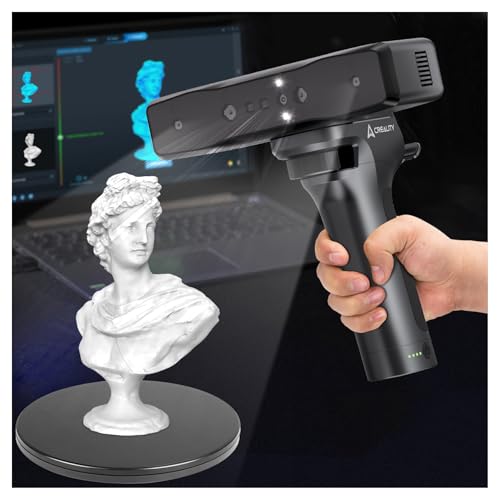
- 0.05mm accuracy for everyday precision
- Wi-Fi and mobile control for cable-free scanning
- Handles objects from tiny screws to large parts
Best For: Portable scanning with wireless convenience
Pro Multi-Mode Scanner
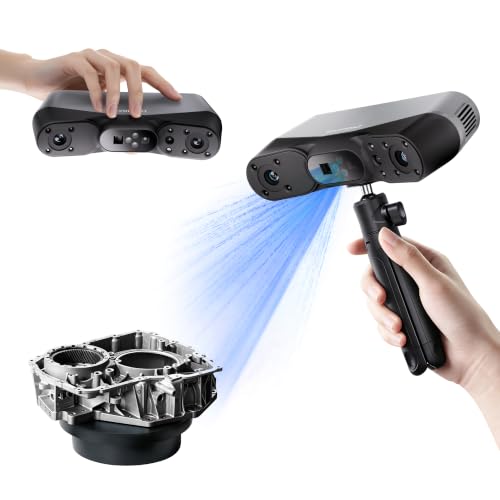
- Up to 0.03mm single-frame accuracy
- Five modes for laser, structured light, and VCSEL
- Wireless scanning with AI segmentation
Best For: Advanced scanning with multi-mode flexibility
Entry-Level Starter Scanner

- 0.07mm accuracy with 0.10mm resolution
- Markerless AI tracking helps prevent scan restarts
- JMStudio handles scanning, editing, and optimization
Best For: Beginners and hobbyists starting with 3D scanning
Pro-Grade All-Rounder

- Up to 0.03 mm single-frame accuracy
- Five scan modes for varied surfaces and sizes
- WiFi 6.0 wireless scanning and cross-screen preview
Best For: Mixed-use scanning for printing, reverse engineering, and outdoor capture
Wireless Beginner-Friendly Scanner

- 0.1 mm accuracy with 30FPS scanning
- WiFi 6 bridge for wireless handheld use
- Anti-shake tracking helps stabilize scans
Best For: Beginners who want portable wireless scanning for printing projects
Lightweight Precision Pick
3DMakerpro Moose Lite Premium Kit

- 0.05 mm accuracy with blue-light scanning
- AI visual tracking and point-cloud cleanup
- 250g lightweight body with quiet operation
Best For: Medium-object scanning where portability and detail are priorities
Entry-Level Wireless Pick

- Wireless WiFi6 scanning across major platforms
- 0.1 mm accuracy with 24-bit color capture
- 105 g body with included travel-friendly kit
Best For: Beginners and DIY makers who want an easy wireless handheld scanner
Balanced Pro Choice
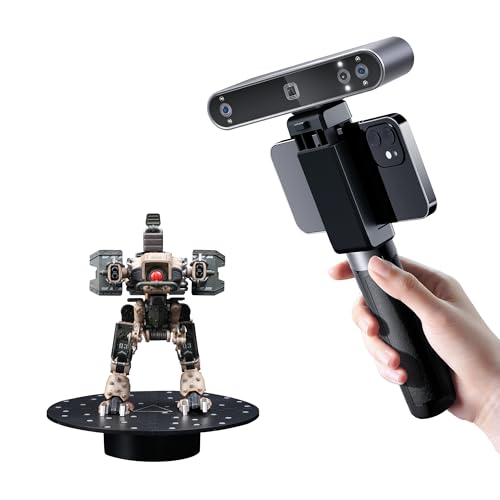
- Up to 20 microns of accuracy with 18 fps scanning
- Wi-Fi 6 or USB-C connection for flexible use
- Broad export support for CAD and slicer workflows
Best For: Makers and designers who want a portable all-rounder with strong precision
Outdoor Detail Leader

- 0.05 mm accuracy with 0.03 mm precision
- Handles reflective or dark surfaces without spray
- Wireless scanning with outdoor support up to 20,000 lux
Best For: Advanced users who need outdoor-ready scanning and better material flexibility
Premium Detail Scanner – Creality CR-Scan Raptor
If you want handheld 3d scanners that can handle both small parts and larger objects, the Creality CR-Scan Raptor is built for that mix of precision and flexibility. It combines blue laser and NIR scanning, offers up to 0.02mm accuracy, and adds fast 60fps capture for efficient workflows.
Best For: Users who need high-detail scanning for miniatures, mechanical parts, faces, and larger industrial objects.
Pros:
- Dual blue laser and NIR scanning covers a wide range of object sizes.
- Up to 0.02mm accuracy and 0.1mm fine-detail resolution support sharp geometry.
- Up to 60fps blue laser scanning and marker-free scanning help speed up capture.
- 24-bit full-color scanning with LED texture lights improves visual output.
Cons:
- Windows and macOS users need reasonably capable hardware for best results.
- Advanced features may be more than casual users need for simple scans.
The Raptor stands out when scan quality and versatility matter more than keeping things basic. For buyers comparing handheld 3d scanners, it offers a strong blend of fine detail, color capture, and broad object compatibility.
Wireless Value Scanner – Creality Otter Lite
The Creality Otter Lite is a practical pick if you want handheld 3d scanners with wireless convenience and solid everyday accuracy. It targets a broad range of objects, from tiny screws to large automotive parts, while keeping setup flexible with Wi-Fi and mobile control.
Best For: Makers, designers, and hobbyists who want a wireless handheld scanner for flexible indoor or outdoor use.
Pros:
- 0.05mm accuracy supports detailed scanning for many common projects.
- Wi-Fi and smartphone control reduce cable clutter during scans.
- Works in low light and bright outdoor conditions up to 30,000 lux.
- 30fps real-time scanning and anti-shake tracking help maintain smooth capture.
Cons:
- Accuracy is lower than Creality’s higher-end scan models.
- Best results still depend on compatible Windows or macOS setups.
Otter Lite is a balanced choice when wireless freedom matters as much as scan quality. It is especially appealing for users who want a portable scanner that can move between tabletop work and outdoor environments.
Pro Multi-Mode Scanner – Revopoint POP 4 Premium
For buyers comparing handheld 3d scanners at the high end, the Revopoint POP 4 Premium focuses on accuracy, speed, and advanced scanning modes. It is built for demanding work like 3D printing, reverse engineering, and outdoor capture, with wireless features and AI-assisted workflow tools.
Best For: Advanced users who need multi-mode scanning, outdoor performance, and strong post-processing tools.
Pros:
- Single-frame accuracy up to 0.03mm supports detailed modeling.
- Five scanning modes cover small parts, reflective surfaces, and large objects.
- Up to 105 fps in multi-line laser mode with NVIDIA GPU acceleration.
- AI segmentation and wireless cross-screen control streamline workflow.
Cons:
- Several advanced features are Windows-only, including AI object segmentation.
- Its broad feature set may be more than basic users need.
The POP 4 Premium is designed for users who want one scanner that can adapt to many environments and materials. Its combination of speed, outdoor stability, and software support makes it a capable option for serious scanning work.
Entry-Level Starter Scanner – 3DMakerpro Fox
The 3DMakerpro Fox is aimed at users who want handheld 3d scanners without a steep learning curve. It offers a medium-format approach with 0.07mm accuracy, markerless AI visual tracking, and bundled JMStudio software to simplify the scan-to-edit process.
Best For: Beginners and hobbyists who want an approachable scanner for 3D printing and basic inspection tasks.
Pros:
- 0.07mm accuracy and 0.10mm resolution are solid for an entry-level model.
- Markerless AI visual tracking helps recover quickly if you move too fast.
- JMStudio combines scanning, editing, and optimizing in one workflow.
- Designed for useful results in 3D printing, modeling, and measurement.
Cons:
- It is positioned as an entry-level scanner, so it is not the most advanced choice here.
- Package weight and size suggest a relatively substantial handheld kit.
Fox makes sense if you want a straightforward way into 3D scanning and value software support. It is the most approachable option in this roundup, especially for users who care more about usability than ultra-premium specs.
Pro-Grade All-Rounder – Revopoint POP 4 Standard
If you want handheld 3d scanners that can handle everything from small precision parts to large objects, the Revopoint POP 4 is built for broad coverage and serious detail. Its mix of laser and structured-light modes makes it a flexible option for 3D printing, reverse engineering, and field work where surface type and lighting can vary.
Best For: Users who need one scanner for precision work, outdoor capture, and mixed object types.
Pros:
- Single-frame accuracy up to 0.03 mm and volumetric accuracy of 0.03 mm + 0.05 mm x L(m)
- Five scanning modes, including blue laser for reflective or dark surfaces and deep-hole capture
- Supports large and small objects, from 10x10x10 mm up to 2x2x2 m
- Wireless scanning with WiFi 6.0 and cross-screen preview on phone or tablet
Cons:
- Outdoor filter is sold separately for the highest ambient-light stability
- Some AI segmentation features are Windows only
- Battery grip is also sold separately for untethered scanning
This is a strong pick if you need a capable all-around scanner with serious accuracy and a wide operating range. The POP 4 stands out most when you need multiple scan modes instead of a single-purpose device.
Wireless Beginner-Friendly Scanner – Creality CR-Scan Ferret Pro
The Creality CR-Scan Ferret Pro is a practical choice among handheld 3d scanners if you want wireless scanning without giving up portability. With 0.1 mm accuracy, 30FPS capture, and anti-shake tracking, it is aimed at smoother scans for users who want a simpler workflow on phones, tablets, or a PC.
Best For: Beginners and mobile users who want stable wireless scanning for 3D printing and basic reverse engineering.
Pros:
- Up to 0.1 mm accuracy and 0.16 mm resolution with 30FPS scanning
- WiFi 6 wireless transmission for faster and more stable data transfer
- Anti-shake tracking and one-shot 3D imaging help improve scan success rates
- Supports OBJ, STL, and PLY export for common workflows
Cons:
- Not ideal for highly reflective, transparent, or extremely dark surfaces
- Outdoor scanning is rated up to 30,000 lux, below some higher-end rivals
- Wireless mobile use depends on compatible iOS or Android devices and the bridge accessory
For buyers who value ease of use and wireless convenience, this scanner covers the basics well. It is a sensible middle-ground option when you want handheld flexibility and straightforward file export.
Lightweight Precision Pick – 3DMakerpro Moose Lite Premium Kit
If you are comparing handheld 3d scanners for detailed printing work, the 3DMakerpro Moose Lite Premium Kit is tuned for precision on medium-sized objects. It combines 0.05 mm accuracy, blue-light scanning, and AI visual tracking in a compact body that is easy to carry and quieter than many fan-cooled alternatives.
Best For: Makers who want a lightweight, accurate scanner for medium objects and detailed print-ready models.
Pros:
- 0.05 mm accuracy and 0.10 mm resolution for detailed captures
- AI visual tracking and point-cloud processing help simplify scanning and cleanup
- Scan range from 15 mm to 1500 mm covers a useful spread of object sizes
- Lightweight 250g design with no fan noise
Cons:
- 10FPS scanning speed is slower than some faster handheld scanners
- Best suited to medium objects rather than very large captures
- Premium kit positioning may be more than casual users need
This model makes sense if detail matters more than raw speed. It is especially appealing for users who want a compact scanner that stays focused on clean, accurate results for printing and display.
Entry-Level Wireless Pick – Creality CR-Scan Ferret Pro
If you want handheld 3d scanners that are easy to get started with, the Creality CR-Scan Ferret Pro is built for beginners who want a practical path into 3D printing. It combines wireless scanning, anti-shake tracking, and full-color capture in a compact body, making it a flexible option for home, studio, or on-the-go use.
Best For: Beginners, DIY creators, and 3D printing enthusiasts who want a lightweight wireless scanner with broad device support.
Pros:
- WiFi6 wireless scanning works with Windows, macOS, Android, and iOS.
- Up to 0.1 mm accuracy with 24-bit full-color scanning.
- Very lightweight at 105 g and includes a carrying case, tripod, power bank, and phone holder.
- Supports OBJ, STL, and PLY exports for common workflows.
Cons:
- Not intended for very small or highly detailed items like jewelry or precision parts.
- Performs best when avoiding reflective, transparent, or very dark surfaces.
- Outdoor use is limited to lighting under 30,000 lux.
Overall, this is a straightforward handheld scanner for users who value portability and simple setup more than advanced pro-level capture. The included accessories and cross-platform support make it especially appealing as an entry point into 3D scanning.
Balanced Pro Choice – Revopoint POP 3 Plus
Among handheld 3d scanners, the Revopoint POP 3 Plus stands out as a balanced option for users who want more precision without giving up portability. It offers full-color scanning, fast frame rates, and Wi-Fi or USB-C connectivity, making it a versatile fit for 3D printing, product design, and content creation.
Best For: Makers, designers, and hobbyists who want a lightweight scanner with better precision and flexible workflow support.
Pros:
- Claims 20% more accuracy and stays within 20 microns of accuracy.
- Up to 18 fps scanning with a 9-axis IMU for more stable captures.
- Full-color scanning with an HD RGB camera and Flash LED lighting system.
- Wide export support includes PLY, OBJ, STL, ASC, 3MF, GLTF, and FBX.
Cons:
- Software is only compatible with x86_64 architecture.
- Best suited to medium-sized objects rather than tiny precision items.
The POP 3 Plus is a strong all-around choice if you want a portable scanner that can slot into a variety of workflows. Its software, file compatibility, and connectivity options make it easy to integrate into everyday scanning tasks.
Outdoor Detail Leader – Revopoint INSPIRE 2 Premium
If your shortlist of handheld 3d scanners needs better performance on difficult surfaces and in brighter environments, the Revopoint INSPIRE 2 Premium is built for that job. It combines infrared structured light, multi-line laser scanning, and wireless operation to handle reflective or dark surfaces more confidently than many entry-level models.
Best For: Users who need a lightweight scanner for outdoor work, tricky surfaces, and more advanced scan-to-CAD workflows.
Pros:
- Built-in Wi-Fi 6 supports mobile scanning and real-time PC-to-mobile streaming.
- Scans reflective or dark surfaces without scanning spray using 11 infrared laser lines.
- Up to 0.05 mm accuracy and 0.03 mm precision for detailed captures.
- Works outdoors in up to 20,000 lux lighting and weighs just 190 g.
Cons:
- Best outdoor results are limited to shaded or semi-bright conditions.
- Windows AI object segmentation is Windows-only.
- Revo Design is sold separately.
This is the most capable option here if you need a scanner that can handle more demanding materials and lighting. The included accessories and software workflow make it a good fit for serious hobbyists and reverse-engineering tasks.
How We Picked the Best Handheld 3d Scanners
We prioritized Handheld 3d Scanners that balance real-world accuracy, scan stability, software support, and usability. We also looked at whether a scanner is better suited to small detailed objects, medium-size parts, or larger subjects, since a strong spec sheet does not always translate into a better scanning experience.
Quick Comparison
As you compare the 10 models, narrow your options by use case first. Entry-level scanners are often easier to learn and better for occasional use, while higher-end Handheld 3d Scanners usually offer stronger tracking, better detail preservation, and more dependable results on complex surfaces. Wireless convenience can also be a major advantage if you scan on the move or around larger objects.
Key Buying Factors for Handheld 3d Scanners
Accuracy and Detail
Look for the stated precision, but also consider the kind of objects you scan. Small mechanical parts, figurines, and product prototypes benefit from tighter precision, while larger objects may need stable tracking more than extreme detail.
Tracking and Anti-Shake Performance
Good tracking reduces rescans and cleanup time. Features such as anti-shake stabilization, AI segmentation, and stronger motion handling can make Handheld 3d Scanners easier to use, especially for beginners.
Scan Speed and Connectivity
Faster frame rates can improve productivity, but only if the scanner can maintain consistent alignment. Wireless options and Wi-Fi bridge support are useful when cable management would slow you down.
Surface Compatibility
Some objects are harder to capture because they are shiny, dark, translucent, or featureless. If you frequently scan challenging surfaces or outdoor subjects, prioritize models designed for broader environmental flexibility.
Software and Export Workflow
A scanner is only as useful as the software around it. Check for straightforward alignment, cleanup, meshing, and export options so your scans move smoothly into 3D printing, CAD, or digital archiving.
Who Should Buy Which Handheld 3d Scanners?
Choose a premium scanner if you want the best mix of precision and feature depth for regular work, especially for detailed parts or production-style tasks. Pick a wireless or portability-focused model if mobility matters more than raw specs. Entry-level Handheld 3d Scanners are a smart fit for hobbyists, first-time users, and anyone scanning medium-size objects without a steep learning curve. If you need outdoor or more flexible capture conditions, focus on models built for those environments instead of chasing the highest accuracy number alone.
For most buyers, the right choice comes down to matching scan size, object type, and workflow priorities rather than simply selecting the most expensive option.