Managing two or more Windows computers from one keyboard, mouse, and monitor setup can reduce desktop clutter and simplify your workflow. The best KVM switches for Windows make it easy to switch between systems while supporting modern resolutions, multiple displays, and shared USB accessories.
This roundup compares 10 options ranging from compact single-monitor HDMI models to advanced dual- and triple-monitor switches. Pay close attention to display outputs, refresh-rate support, USB connectivity, switching methods, and compatibility with your specific computers.
Best 10 Kvm Switches for Windows Picks for 2026
Best Premium Docking Hub

- Combines KVM switching with an 11-in-1 dock
- Supports high-refresh dual-monitor setups
- Adds 100W charging, Ethernet, and 10Gbps USB
Best For: Hybrid Windows desks using a laptop and desktop
Best Budget Pick

- Shares one HDMI monitor and USB peripherals
- Supports 4K@60Hz with driver-free setup
- Includes HDMI and USB cables
Best For: Simple one-monitor Windows home-office setups
Best Laptop Expansion

- Connects two laptops to up to three monitors
- Adds Ethernet, card slots, USB, and charging
- Supports Windows extended display mode
Best For: Windows dual-laptop triple-monitor workstations
Best 4-Computer KVM for Windows
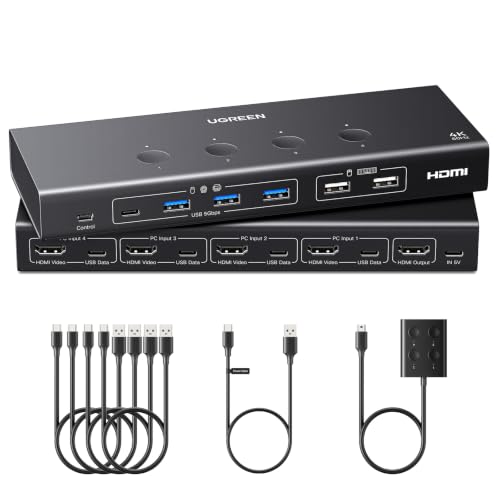
- Controls four computers from one monitor
- Supports 4K@60Hz and six USB ports
- EDID emulation helps retain display settings
Best For: Four-computer Windows workstations
Best Triple-Monitor KVM for Windows

- Switches two computers across three monitors
- Supports up to 8K@60Hz and 4K@240Hz
- Includes cables, power adapter, and controller
Best For: High-resolution Windows multi-monitor setups
Best Simple 2-Computer KVM for Windows
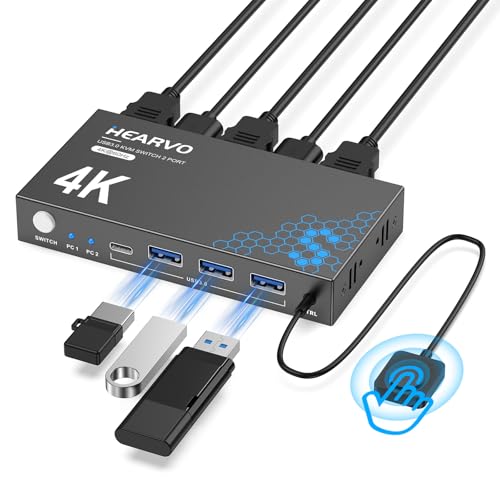
- Switches two computers through one monitor
- Supports 4K@60Hz and four USB 3.0 ports
- Works with Windows 7 through 11
Best For: Two-computer, single-monitor Windows desks
Best Dual-Screen HDMI Value

- Dual-monitor mirror and extend modes
- 4K at 60Hz with HDR support
- Four USB 3.0 ports and desktop controller
Best For: Windows HDMI workstations sharing two monitors between two computers
Best High-Refresh Dual-Display Pick

- 8K at 60Hz and 4K at 120Hz
- Mirror or extend across two monitors
- Four-port USB 3.0 hub with 12V power
Best For: Dual-HDMI Windows systems using high-resolution or high-refresh monitors
Best Plug-and-Play 8K Option

- 8K at 60Hz and 4K at 120Hz
- Four USB 3.0 ports with charging support
- Front button and wired remote switching
Best For: Mixed-platform desks needing simple high-resolution dual-monitor control
Best Triple-Monitor Value – 3-Monitor HDMI KVM for Windows PCs
If you need kvm switches for windows that can manage two computers across three monitors, this HDMI model focuses on straightforward switching and broad USB connectivity. It supports up to 4K at 60Hz, but each computer must connect three HDMI cables and support three-screen output for the full setup.
Best For: Windows users sharing three HDMI monitors and USB peripherals between two computers.
Pros:
- Supports extended or duplicate display modes through Windows display settings.
- Offers up to 4K at 60Hz and four USB 3.0 ports for peripherals.
- Includes a wired controller, front-panel switching, LED status indicators, and a 12V power adapter.
Cons:
- Requires three HDMI cables from each computer for triple-monitor output.
- Keyboard hotkey switching is not supported.
- Three-screen operation depends on the computer supporting three displays.
This is a practical choice for a fixed three-monitor Windows workstation, especially when powered USB devices such as hard drives or webcams need additional stability. Confirm your graphics output and cable requirements before buying.
Best Premium Docking Hub – AV Access Dual-Monitor 8K KVM
Among kvm switches for windows, this AV Access model stands out as an all-in-one docking station for a USB-C laptop and desktop PC. It combines dual-monitor KVM switching with Ethernet, charging, audio, SD storage, and multiple high-speed USB ports.
Best For: Hybrid workers, creators, and power users who want one shared dual-monitor desk setup for a Windows laptop and desktop.
Pros:
- Supports desktop output up to dual 8K at 60Hz or dual 4K at 165Hz, with compatible hardware.
- A single full-featured USB-C connection can provide dual 4K video, data, and up to 100W charging.
- Includes 10Gbps USB ports, Gigabit Ethernet, and switching by top button or wired remote.
Cons:
- Windows laptop resolution depends on the laptop’s USB-C video capabilities.
- Mac users may get mirrored rather than extended dual displays because of MST limitations.
- Its docking features make it more elaborate than a basic KVM switch.
This is the most versatile option here for a Windows-centered desk that needs fast displays, networking, charging, and shared accessories in one unit. Check your laptop’s USB-C specifications and the included-cable requirements before purchase.
Best Budget Pick – 4K HDMI KVM for Two Computers
For shoppers seeking simple kvm switches for windows, this two-port HDMI model provides a compact way to share one monitor, keyboard, mouse, and printer between two computers. It is driver-free, supports 4K at 60Hz, and switches with a physical button.
Best For: Home offices and basic Windows setups using one HDMI monitor with two computers.
Pros:
- Supports 4K at 60Hz and is backward compatible with 4K at 30Hz and 1080p.
- Works with Windows 10/8/8.1/7/Vista/XP, Mac OS, Linux, and Chrome OS.
- Includes two USB cables and two HDMI cables, with no external power required.
Cons:
- Designed to share one monitor rather than a multi-monitor setup.
- Switching is handled by a physical button rather than a remote controller or hotkey.
- USB connectivity is listed as USB 2.0 rather than USB 3.0.
This is a sensible entry-level choice when your priority is uncomplicated one-monitor switching between two computers. Its included cables and driver-free operation can simplify installation, provided your setup does not require multiple displays or high-speed USB transfers.
Best Laptop Expansion – USB-C KVM for Three Monitors
This KCEVE unit is aimed at Windows laptop users who need more than basic switching. It connects two laptops through full-function USB-C ports and shares up to three monitors, Ethernet, USB devices, memory-card slots, and charging across the setup.
Best For: Windows laptop users building a triple-monitor desk with shared networking, storage, and peripherals.
Pros:
- Supports two 4K at 60Hz displays plus one 1080p at 60Hz display.
- Provides four 5Gbps USB 3.0 ports, two USB 2.0 ports, SD and TF slots, and Gigabit Ethernet.
- Offers extended or duplicate display modes on Windows and includes a wired remote.
Cons:
- Both laptops need full-function USB-C ports supporting video and USB control protocols.
- MacOS is limited to duplicate mode because it does not support MST.
- Optimal charging requires two 100W chargers, while the unit provides up to 80W per laptop.
This is a strong fit for a Windows-focused dual-laptop workspace where display expansion and docking features matter as much as KVM switching. Verify USB-C compatibility carefully, since ordinary USB-C data ports will not provide the required video functionality.
Best 4-Computer KVM for Windows – UGREEN 4-Port HDMI KVM
For shoppers comparing kvm switches for windows, this UGREEN model is designed for controlling four computers from one monitor while sharing a keyboard, mouse, and other USB accessories. It supports up to 4K at 60Hz and offers both onboard and wired-controller switching, but each PC requires HDMI and USB-A-to-C data connections, and the HDMI cables and power adapter are not included.
Best For: Windows workspaces that need one monitor and shared USB peripherals across four computers.
Pros:
- Supports four computers sharing one monitor.
- Offers 4K@60Hz video with HDR, 3D, and HDCP support.
- Includes four USB 3.0 and two USB 2.0 ports for shared accessories.
- EDID emulation can help preserve display settings when switching.
Cons:
- Requires a separate HDMI cable and USB-A-to-C data cable for each PC.
- Power adapter and HDMI cables are not included.
- Not intended for use with docking stations.
This is a strong choice when four-system capacity and multiple shared USB ports matter most. Confirm your cable inventory, power setup, and laptop wake behavior before buying.
Best Triple-Monitor KVM for Windows – UGREEN 8K Triple-Display KVM
This UGREEN switch is aimed at demanding kvm switches for windows setups that use three monitors with two computers. It combines two DisplayPort 1.4 outputs and one HDMI 2.1 output, supports high refresh rates, and includes the necessary connection cables and power adapter. Triple-display operation depends on both computers supporting two DisplayPort outputs plus one HDMI output.
Best For: Windows users who need to switch between two computers while retaining a three-monitor workspace.
Pros:
- Supports three monitors shared between two computers.
- Handles up to 8K@60Hz or 4K@240Hz when the connected equipment supports it.
- Offers mirror and extend display modes.
- Package includes DP cables, HDMI cables, USB cables, power adapter, and desktop controller.
Cons:
- Both computers must support the required triple-monitor output configuration.
- Does not support keyboard-shortcut switching.
- Docking stations and signal converters may create compatibility issues.
This is the most capable option here for a high-resolution, multi-monitor Windows desk, provided your computers have the required ports and display support. Its lack of EDID emulation may matter if you frequently switch between systems.
Best Simple 2-Computer KVM for Windows – S7232H 4K HDMI KVM Switch
For a simpler desk setup, this S7232H is a practical pick among kvm switches for windows, allowing two computers to share one HDMI monitor and four USB 3.0 peripherals. It supports Windows 7 through 11 along with several other operating systems, provides 4K@60Hz video, and includes both a device button and wired remote. The notes state that it requires no separate power supply or driver software.
Best For: Windows users switching between two computers on one monitor with shared USB accessories.
Pros:
- Supports Windows 7/8/10/11 and multiple other operating systems.
- Provides 4K@60Hz video and HDCP 2.2 support.
- Includes three USB-A and one USB-C USB 3.0 ports.
- Offers onboard and wired-remote switching without driver installation.
Cons:
- Limited to two computers and one monitor.
- Uses HDMI video connections only.
- Shared peripherals and computers still require the included USB connections to be set up correctly.
This model fits buyers who want straightforward two-computer switching without a separate power adapter or software. It is less suitable for triple-monitor users or workstations needing more than two host systems.
Best Dual-Screen HDMI Value – UGREEN 4K Dual-Monitor KVM
For shoppers comparing KVM switches for windows, this UGREEN model is a practical choice for controlling two computers with one keyboard, mouse, and dual-monitor setup. It supports 4K at 60Hz, mirror or extend modes, plug-and-play operation, and four USB 3.0 ports. Note that it uses HDMI rather than DisplayPort and does not support hotkeys or EDID emulation.
Best For: Windows home offices and professional desks that need two HDMI monitors shared between two computers.
Pros:
- Supports two monitors with mirror and extend modes.
- Handles resolutions up to 4K at 60Hz with HDR support.
- Provides four USB 3.0 ports, including USB-A and USB-C connectivity.
- Includes HDMI cables, USB cables, power adapters, and a desktop controller.
Cons:
- Each computer needs two HDMI connections and one USB-A connection.
- Does not support keyboard hotkey switching or EDID emulation.
- The two monitors must display video from the same computer at a time.
This is a well-equipped option when your computers and monitors use HDMI and you value included accessories. Verify dual-display support and cable lengths before buying.
Best High-Refresh Dual-Display Pick – 8K HDMI KVM Switch
This 8K HDMI model stands out among KVM switches for windows when high-resolution or high-refresh output matters. It controls two computers across two monitors, supports 8K at 60Hz and 4K at 120Hz, and includes a four-port USB 3.0 hub. Your computer must have two HDMI outputs and support an extended or copied display configuration.
Best For: Windows users with dual-HDMI computers who want high-refresh displays and shared USB peripherals.
Pros:
- Supports up to 8K at 60Hz and 4K at 120Hz.
- Offers mirror and extended dual-monitor modes.
- Four USB 3.0 ports support peripherals such as printers, scanners, webcams, and input devices.
- Includes an external controller, USB cables, and a 12V power adapter.
Cons:
- Requires two HDMI outputs and a computer capable of dual-monitor operation.
- Does not support keyboard hotkey switching.
- High-power USB devices require the included external power supply.
The combination of 8K output and 4K/120Hz support makes this attractive for demanding displays, but it is not a workaround for a computer with only one monitor output. Confirm your graphics hardware first.
Best Plug-and-Play 8K Option – HDMI Dual-Monitor KVM
If you want KVM switches for windows with straightforward controls and modern display support, this dual-monitor HDMI unit is worth considering. It switches two computers between one keyboard, mouse, and two monitors, supports 8K at 60Hz and 4K at 120Hz, and includes both a front button and wired remote.
Best For: Windows, Mac, or Linux desks that want high-resolution dual-monitor switching with a wired remote.
Pros:
- Supports mirror and extend modes for two monitors.
- Provides 8K at 60Hz and 4K at 120Hz output support.
- Includes four USB 3.0 ports with 5Gbps data transfer and charging support.
- Uses a powered metal design and includes an 8K braided HDMI cable.
Cons:
- Uses HDMI connections, so it is not a DisplayPort solution.
- The supplied notes do not specify EDID emulation or hotkey support.
- Requires suitable dual-display outputs from the connected computers for extended mode.
This model balances high-resolution support, simple switching, and a useful wired remote. It is a sensible fit for mixed-platform desks, provided your computers can drive the desired dual-monitor arrangement.
How We Picked the Best Kvm Switches for Windows
We evaluated these switches by comparing the features that matter most in a Windows workstation: supported resolution and refresh rate, number of computers and displays, video connection types, USB port selection, switching options, and ease of setup. Models supporting 4K at 60Hz are suitable for most productivity and general-use systems, while 8K or 4K at 120Hz models are better suited to high-refresh monitors, creative work, and gaming.
We also considered whether each switch supports extended multi-monitor output rather than simply mirroring one display, and whether its USB ports can share peripherals such as keyboards, mice, storage drives, printers, and webcams.
Quick Comparison
- Single-monitor setups: Choose a two-computer HDMI KVM with USB 3.0 if you only need one shared display and basic peripherals.
- Dual-monitor workstations: Look for a model explicitly supporting two independent displays and the required HDMI or DisplayPort connections.
- Triple-monitor setups: Select a three-monitor KVM only if both computers can produce the required number of video outputs.
- Several computers: Four-computer models reduce the need for separate switches when managing multiple systems.
- High-refresh displays: An 8K or 4K-at-120Hz switch provides more headroom than standard 4K at 60Hz, but requires compatible cables and source devices.
Key Buying Factors for Kvm Switches for Windows
Video Compatibility
Confirm the switch’s input and output connectors before buying. HDMI-only models are convenient for common laptops and desktops, while HDMI and DisplayPort combinations may better suit modern graphics cards and docking stations. Check the maximum resolution at the refresh rate you actually use; headline 8K support does not guarantee every connected device can achieve it.
Monitor Arrangement
Determine whether you need one, two, or three independent monitors. A KVM designed for dual displays may require two video cables per computer. Also verify that it supports extended desktop mode on Windows rather than duplicating the same image across screens.
USB and Peripheral Sharing
USB 3.0 ports are useful for faster storage and responsive peripherals, but some switches include only USB 2.0 ports for keyboard and mouse connections. Check the total port count and confirm whether high-power devices, printers, audio interfaces, or webcams are supported.
Switching and Setup
Button controls, wired remotes, keyboard hotkeys, and software controls each suit different desks. Plug-and-play operation is convenient, but Windows may still need updated graphics drivers or display settings after switching. Use certified cables of suitable length for high-resolution signals.
Who Should Buy Which Kvm Switches for Windows?
Home-office users should favor a simple two-computer, single-monitor model with USB 3.0. Professionals using two displays should choose a dual-monitor switch with clear extended-display support and enough USB ports for their main peripherals. Content creators and power users may benefit from triple-monitor or 8K models, provided their computers and monitors support the necessary bandwidth. Users managing several Windows PCs should consider a four-computer KVM to keep switching centralized. Finally, gamers and high-refresh users should prioritize 4K at 120Hz support, low-latency operation, and compatible HDMI versions rather than choosing solely by the maximum advertised resolution.