A quality landing pad gives your drone a cleaner launch and a more controlled landing, especially on grass, gravel, sand, or dusty ground. The right design can also make setup faster and protect delicate gimbal and propeller components from debris.
This roundup compares 10 drone landing pads in different sizes and formats, from compact fast-fold models for small DJI drones to weighted pads suited to larger aircraft and demanding outdoor use.
Best 10 Drone Landing Pads Picks for 2026
Rugged Weighted Pick
Hoodman LP21 Trifold Landing Pad

- 1.9-pound weighted design needs no stakes
- Springs open quickly from its folded state
- Vinyl surface wipes clean and seals out dew
Best For: Stable outdoor launches without staking
Visibility-Focused Travel Pick
17-Inch Reflective Landing Pad
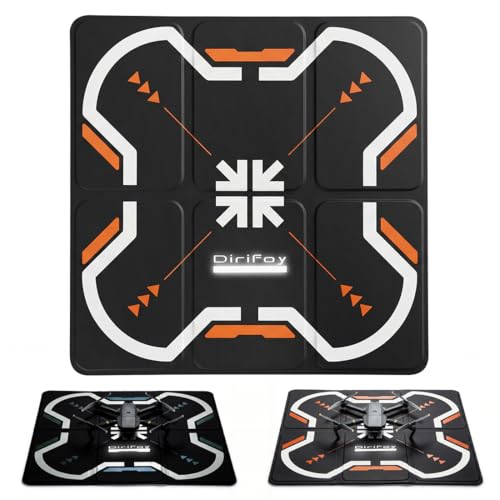
- Reflective markings improve low-light visibility
- Folds to 8.6 by 5.9 inches
- Waterproof, non-slip surface rinses clean
Best For: Portable dusk and dawn flying
Large Waterproof Value

- Large 25-by-25-inch landing surface
- Waterproof, foldable PU PVC construction
- Reversible two-color design improves visibility
Best For: Broad, portable landing coverage
Extra-Large Practice Pad
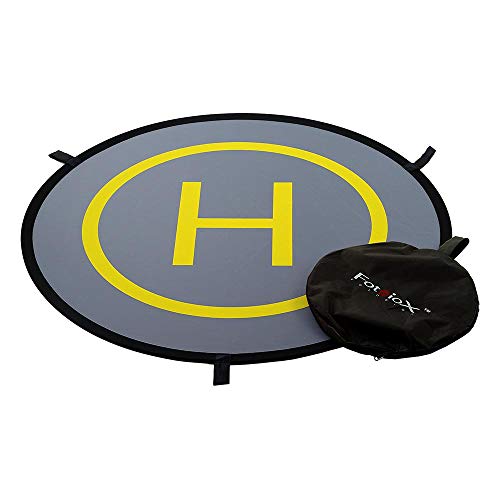
- Generous 32-inch landing target
- Automatically springs open and folds smaller
- Three stake loops support stability and practice
Best For: Large-area landing practice
Best Compact All-Weather Pick
STARTRC 22-Inch Foldable Landing Pad
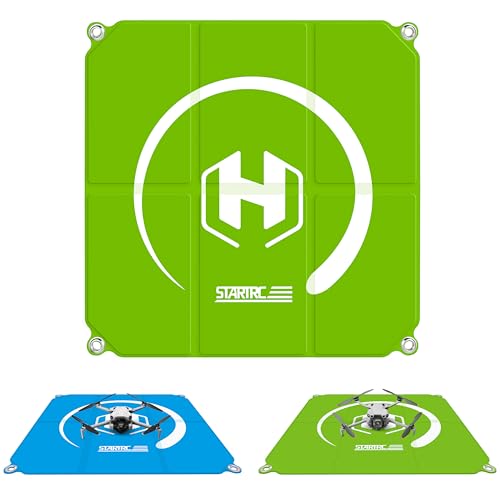
- Waterproof, wipe-clean surface
- Includes stakes and safety buckles
- Bright double-sided visibility
Best For: Compact DJI and FPV drones flown outdoors
Best Large-Drone Stability Pick
40-Inch Weighted UAV Landing Pad

- Large 40-inch landing area
- Weighted edges resist downwash
- Waterproof and foldable
Best For: Large multirotors, helicopters, and field missions
Best Travel Value
22-Inch Weighted Foldable Landing Pad

- Waterproof, rinse-clean surface
- Weighted for outdoor stability
- Folds for backpacks and hard cases
Best For: Portable everyday flying with compact and mid-size drones
Best Reflective Pick
30-Inch Waterproof Foldable Landing Pad
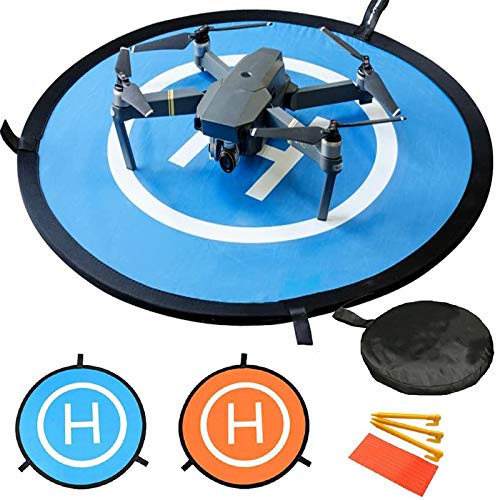
- Waterproof, sun-resistant nylon construction
- Eight reflective strips for low-light visibility
- Includes storage bag and three ground nails
Best For: Portable outdoor flights and nighttime visibility
Best Weighted Option
Reflective Double-Sided PU Landing Pad
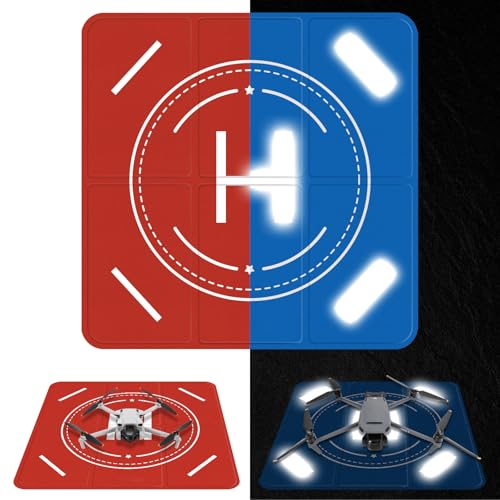
- Waterproof PU leather wipes or rinses clean
- Weighted design helps resist strong wind
- Blue-and-red reversible surface improves visibility
Best For: Rough outdoor terrain and stable takeoffs
Best Value Size
55cm Yellow and Gray Foldable Pad

- Generous 55cm landing surface
- Waterproof PU material for outdoor conditions
- Includes storage bag and four ground nails
Best For: Beginners wanting a roomy, visible landing target
Rugged Weighted Pick – Hoodman LP21 Trifold Landing Pad
The Hoodman LP21 is a practical choice for drone pilots who want a dependable landing surface without setting stakes. This weighted drone landing pad springs open from its folded state, stays put on turf, and helps protect the drone from grass, pebbles, dust, and damp ground.
Best For: Pilots who prioritize stability, quick setup, and a rugged pad for outdoor takeoffs and landings.
Pros:
- Built-in 1.9-pound weight requires no stakes.
- Trifold design springs into shape for quick deployment.
- Vinyl surface and sealed bottom are easy to wipe clean.
- Helps reduce grass and pebble strikes to rotors and camera components.
Cons:
- Heavier than lightweight foldable landing pads.
- Its 22.8-inch size is less compact than smaller travel pads.
The LP21 stands out when a stable, no-stakes setup matters more than minimizing carry weight. Its weighted construction and durable vinyl design make it a strong all-purpose option for outdoor use.
Visibility-Focused Travel Pick – 17-Inch Reflective Landing Pad
This 17-inch drone landing pad combines portability with high-visibility markings for pilots who fly during low-light conditions. It folds to 8.6 by 5.9 inches, uses a waterproof non-slip surface, and accommodates many drones with wheelbases under 14 inches.
Best For: Travelers and pilots who want a compact, easy-clean pad with reflective visibility for dusk or dawn landings.
Pros:
- Reflective strips and logo create a visible landing target in low light.
- Folds compactly for storage in many hard-case side pockets.
- Waterproof, textured surface resists slipping and rinses clean.
- Optional modular weights can be added when conditions are windy.
Cons:
- Additional weights are sold separately.
- Its 17-inch size is intended for smaller and mid-sized drones under a 14-inch wheelbase.
For pilots who value packability and visibility, this pad offers a useful balance of travel convenience and landing-surface protection. The modular weight system also lets you avoid carrying extra ballast in calm conditions.
Large Waterproof Value – VCUTECH 25-Inch Weighted Pad
The VCUTECH 25-inch pad gives drone pilots a broad, clearly marked surface for outdoor takeoffs and landings. Its waterproof PU PVC construction folds for transport, while the double-sided color design helps make the landing location easier to identify.
Best For: Pilots who want a large, lightweight, portable pad with broad drone compatibility and a two-color landing target.
Pros:
- Generous 25-by-25-inch landing area.
- Waterproof PU PVC material is lightweight and portable.
- Double-sided design provides two contrasting color options.
- Listed as compatible with models including DJI Mini, Mavic, Air, FPV, and Avata lines.
Cons:
- The supplied notes do not specify a built-in weight or included stakes.
- Its larger deployed size may take more storage space than compact pads.
This is a sensible option when landing-area size and portability matter more than specialized wind resistance. The wide surface and reversible colors make it adaptable to different outdoor backgrounds.
Extra-Large Practice Pad – Fotodiox 32-Inch Launch Pad
The Fotodiox 32-inch collapsible launch pad is designed for pilots who want a generous target on grass, beaches, or concrete. It springs into shape, folds to about one-third of its deployed size, and includes a storage bag for transport.
Best For: Pilots practicing accurate landings or flying drones that benefit from an extra-large, easy-to-see target.
Pros:
- 32-inch diameter provides a spacious landing area.
- Automatically springs into shape for fast setup.
- Collapses to roughly one-third size and includes a storage bag.
- Three stake loops can improve stability and landing practice.
Cons:
- Stakes are not listed among the supplied included components.
- Larger dimensions may be less convenient for compact travel than smaller pads.
The Fotodiox is a strong fit for pilots who want maximum target area and practice-friendly features. Its stake loops and large visible surface make it particularly useful for improving landing accuracy across varied surfaces.
Best Compact All-Weather Pick – STARTRC 22-Inch Foldable Landing Pad
For pilots seeking practical drone landing pads for compact DJI models, the STARTRC 22-inch pad combines a wipe-clean waterproof surface with bright, double-sided colors. Its included stakes and safety buckles make it suitable for varied outdoor surfaces.
Best For: DJI Mini, NEO, AVATA, FLIP, FPV, and similar compact drones flown outdoors.
Pros:
- Waterproof nylon helps block rain, snow, mud, and dust.
- Four stakes and two safety buckles help secure it on grass, sand, or concrete.
- Folds compactly and includes a storage bag for portable use.
- High-contrast blue and green sides support visibility and positioning.
Cons:
- The 22-inch size is not the recommended option for DJI Air 3S or Mavic 4 Pro; the notes suggest STARTRC’s 65-inch pad instead.
- Stakes and buckles add setup components compared with a simple flat pad.
This is a well-rounded choice when portability, weather resistance, and secure outdoor setup matter. Its 22-inch footprint is best matched to smaller drones rather than larger airframes.
Best Large-Drone Stability Pick – 40-Inch Weighted UAV Landing Pad
Among larger drone landing pads, this 40-inch weighted UAV model is designed for sizable multirotors and helicopters. Heavy edges help it stay in place under strong downwash, while the large surface gives bigger aircraft more room for takeoff and landing.
Best For: DJI Matrice, Inspire, Mavic 3E/T/M, large multirotors, helicopters, and field operations on uneven terrain.
Pros:
- 40-by-40-inch surface accommodates larger drones and helicopters.
- Weighted edges resist movement from wind and rotor downwash.
- Waterproof, wear-resistant, and stain-resistant material suits outdoor use.
- Folds for transport and includes a storage bag.
Cons:
- At 5.5 pounds, it is substantially heavier than compact landing pads.
- The large size may be excessive for small recreational drones.
- Its weighted construction is less convenient for lightweight travel.
This is the strongest fit for pilots who prioritize stability and landing space over minimum carry weight. It is particularly practical for professional, rescue, or rough-terrain missions involving larger aircraft.
Best Travel Value – 22-Inch Weighted Foldable Landing Pad
This 22-inch weighted option is one of the more versatile drone landing pads for everyday travel. Its waterproof, double-sided surface is designed for quick setup on grass, sand, snow, rocky ground, and uneven dirt.
Best For: DJI Mini, Neo, Flip, Avata, Air 3S, and other compact or mid-size RC quadcopters.
Pros:
- Waterproof PU/PVC surface is stain-resistant and easy to rinse clean.
- Weighted construction helps keep the 22-inch pad in place in wind.
- Folds compactly for backpacks and many hard cases.
- Bright and dim color sides provide visibility options in different conditions.
Cons:
- Its 22-inch footprint may not provide enough clearance for especially large aircraft.
- The supplied notes do not mention ground stakes for added anchoring.
Choose this model if you want a portable, low-maintenance pad with more stability than a lightweight fabric-only design. Its broad compatibility and all-terrain positioning make it a practical general-purpose option.
Best Reflective Pick – 30-Inch Waterproof Foldable Landing Pad
This 30-inch drone landing pad is a practical choice for pilots who want a portable, weather-resistant surface for takeoffs and landings. Its nylon construction, reflective strips, storage bag, and included ground nails make it suitable for outdoor flying, including low-light and breezy conditions.
Best For: Drone pilots who prioritize nighttime visibility, portability, and basic wind anchoring.
Pros:
- Waterproof, sun-resistant nylon with high-precision printing.
- Eight reflective strips help improve visibility during night flights.
- Folds into a carrying bag and includes three ground nails.
- Compatible with many DJI, RC, and other popular drones.
Cons:
- The 30-inch size may provide less landing room than larger pads.
- Reflective strips require attachment to the pad’s outer circle.
- The notes do not specify a built-in weighted design.
Choose this model if reflective guidance and a lightweight carry setup matter more to you than maximum landing-area size or integrated weight.
Best Weighted Option – Reflective Double-Sided PU Landing Pad
This double-sided drone landing pad is designed for pilots who want a stable, easy-to-clean surface across muddy, gravelly, or uneven locations. Its PU leather material, weighted construction, and contrasting blue-and-red sides provide a practical combination of durability, visibility, and outdoor stability.
Best For: Pilots who fly in changing outdoor conditions and want a weighted, washable landing surface.
Pros:
- Waterproof and dustproof PU leather can be rinsed clean.
- Weighted construction helps keep the pad stable in strong wind.
- Blue and red sides improve visibility without separate reflective tape.
- Folds quickly and can fit in many drone cases or backpacks.
Cons:
- The notes do not provide the pad’s exact dimensions or weight.
- Its weight may make it less lightweight than simpler fabric pads.
- Compatibility is broad, but fit and landing room will vary by drone size.
This is a strong choice when stability and easy cleanup are priorities, especially for flights over rough ground, mud, or other less predictable surfaces.
Best Value Size – 55cm Yellow and Gray Foldable Pad
With a 55cm landing area and a high-visibility yellow-and-dark-gray design, this drone landing pad gives pilots a roomy target for takeoff and landing. The waterproof PU material, folding format, storage bag, and four ground nails make it a versatile option for sand, grass, dirt, and snow.
Best For: Beginners and outdoor pilots who want a larger, colorful pad with included anchoring accessories.
Pros:
- The 55cm square surface offers generous landing space.
- Yellow and dark gray sides are easier to spot than an all-black pad.
- Waterproof, wear-resistant, stain-resistant PU material suits outdoor use.
- Includes a storage bag and four ground nails.
Cons:
- At 55cm, it may take more storage space than smaller landing pads.
- Ground nails are useful outdoors but may not suit hard surfaces.
- The notes do not identify an integrated reflective strip system.
Consider this pad if you want more landing room and clear daytime contrast while retaining a foldable setup for transport between flying locations.
How We Picked These Drone Landing Pads
We focused on the features that matter during real outdoor flights: stability, portability, landing-surface size, weather resistance, visibility, and compatibility with popular drone sizes. Weighted and non-staked designs were considered for locations where stakes are impractical, while foldable construction was prioritized for pilots who carry equipment between launch sites.
Because product specifications can vary by seller and production run, confirm the listed dimensions, packed size, and supported aircraft before ordering. A pad should provide enough clearance for the drone and its propeller wash without becoming unnecessarily bulky to transport.
Quick Comparison
| Best For | Recommended Size | Useful Features |
|---|---|---|
| Compact camera drones | 17–22 inches | Lightweight, fast-folding, easy to pack |
| Most consumer drones | 22–30 inches | More landing margin, visible markings, waterproof surfaces |
| Large or professional drones | 32–40 inches | Extra clearance, stronger construction, weighted stability |
| Low-light flying | Any suitable size | Reflective markings or high-contrast surfaces |
Key Buying Factors for Drone Landing Pads
Size and Aircraft Clearance
Measure the drone’s overall footprint, including propellers, and choose a pad with visible space around it. A 17-inch pad may suit a small Mini-series drone, while larger aircraft generally benefit from 30 inches or more.
Weight and Wind Stability
Weighted pads are convenient on hard surfaces and can be more reliable in breezy conditions, but they add carrying weight. Pads with stake points are useful on soil or grass; some pilots may prefer a lightweight pad that can be weighted with nearby gear.
Surface and Weather Resistance
Waterproof, wipe-clean materials make maintenance easier after landing on damp or dusty ground. A smooth, durable surface also helps prevent grit from reaching the drone’s motors, sensors, or camera assembly.
Visibility and Portability
Bright colors, contrasting markings, and reflective details improve visibility from the air and during evening setup. Fast-fold frames and compact storage bags are valuable when the pad must share space with batteries, controllers, and spare propellers.
Who Should Buy Which Drone Landing Pads?
Choose a compact 17- or 22-inch model if you fly a DJI Mini, Neo, or another small consumer drone and value minimal kit weight. A 25- to 30-inch pad is the most versatile choice for owners of Mavic, Air, Phantom, and similar aircraft who want more landing margin without carrying a full-size helipad.
Professional operators, enterprise pilots, and users of larger Matrice or Inspire aircraft should look toward 32- or 40-inch weighted options. If you regularly fly at dusk or in changing light, a reflective or high-contrast design can make the launch area easier to locate. For frequent travel, prioritize fast folding and a manageable packed size; for fixed outdoor locations, favor weight, durability, and maximum clearance.