The right charger can make RC battery maintenance faster, safer, and far less frustrating. These 10 balance RC battery chargers cover everything from compact USB-C models to high-output dual chargers for serious hobbyists.
Before choosing, match the charger to your battery chemistry, cell count, connector, charging speed needs, and available power source. The buying guide below highlights the practical differences that matter most.
Best 10 Balance Rc Battery Chargers Picks for 2026
Best High-Power Pick
OVONIC X1 Pro Dual Balance Charger
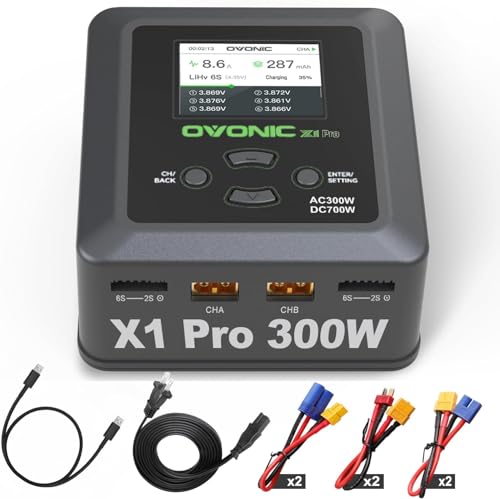
- 300W AC or 700W DC output with up to 16A charging
- Dual ports and Sync Charging mode
- Supports 1S–6S lithium and 1S–16S NiMH batteries
Best For: High-output, multi-battery RC charging
Best Simple Traxxas Option
Traxxas EZ-Peak iD USB-C Charger

- 40W output with up to 4A charging
- Auto-recognizes Traxxas iD batteries
- Supports 5–7-cell NiMH and 2–3-cell LiPo
Best For: Compatible Traxxas iD battery users
Best Feature-Rich Value
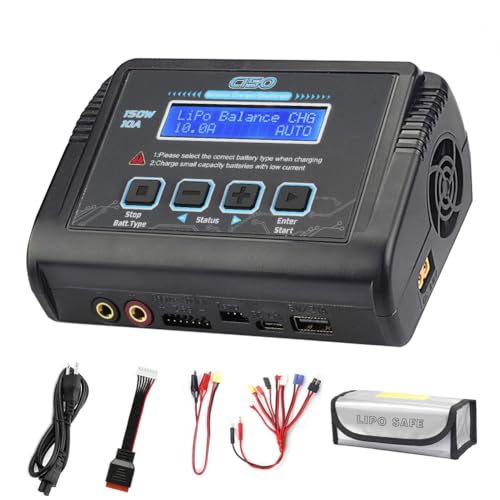
- 150W output with adjustable charging up to 10A
- Supports lithium, NiMH/NiCd, Pb, and smart batteries
- Battery meter and internal-resistance checking included
Best For: Versatile RC car and drone battery maintenance
Best Portable Budget Pick
Hilldow B6 Mini Balance Charger

- Compact 80W charger with up to 6A output
- Supports 1S–6S lithium and 1S–15S NiMH/NiCd
- LCD, balance, storage, and resistance-testing functions
Best For: Portable everyday RC battery charging
Compact 2S–3S Choice

- Dedicated 2S and 3S LiPo support
- Separate balance ports and LED status
- Multiple charging safety protections
Best For: Users with compatible 2S or 3S LiPo packs
Most Versatile Setup
Haisito C150 Multi-Chemistry Charger

- Supports seven battery chemistries
- 150W output with up to 10A charging
- Includes memory profiles and connector harness
Best For: Experienced users with varied RC batteries
Balanced All-Rounder

- 80W output and up to 6A charging
- Built-in individual-cell balancer
- Supports multiple common battery types
Best For: Everyday charging across mixed RC battery types
Best Compact Option
SSUPCHG 2S/3S XHR LiPo Charger
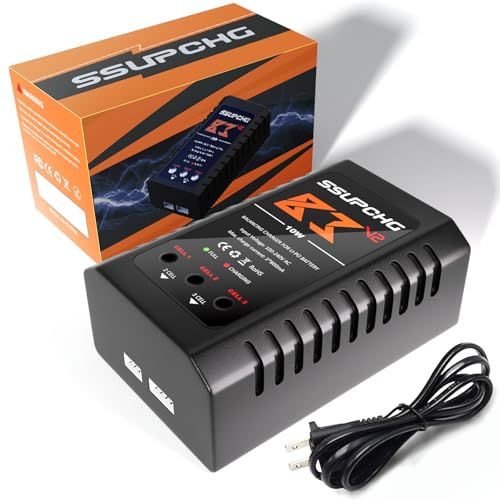
- Smart chip supports balanced cell charging
- Multiple built-in safety protections
- Designed for 2S/3S XHR LiPo packs
Best For: RC models using compatible 2S or 3S XHR LiPo batteries
Best Dual-Channel Pick

- Charges two batteries through separate channels
- Supports multiple lithium, nickel, lead-acid, and smart batteries
- Includes charge, balance, discharge, and storage modes
Best For: Hobbyists managing several battery types or charging two packs
Best Versatile Single-Charger Value
Haisito HB6 80W Balance Charger

- Balances 1S-6S lithium battery packs
- Supports lithium, nickel, and SLA chemistries
- Includes LCD controls and multiple adapters
Best For: RC users wanting one adaptable charger for varied battery packs
Best High-Power Pick – OVONIC X1 Pro Dual Balance Charger
For demanding RC setups, the OVONIC X1 Pro is one of the most capable balance rc battery chargers in this roundup. It delivers up to 300W on AC or 700W on DC, supports two batteries, and includes Sync Charging for faster multi-battery workflows.
Best For: Hobbyists who need high output, dual-port charging, and broad battery chemistry support.
Pros:
- Supports 1S–6S LiPo, Li-Ion, LiFe, and LiHV batteries plus 1S–16S NiMH.
- Offers up to 16A output, 300W AC power, and 700W DC power.
- Includes balance, storage, discharge, resistance-checking, and digital-power modes.
- Provides overvoltage, overtemperature, overcurrent, short-circuit, and reverse-polarity protection.
Cons:
- Its advanced feature set may be more than casual users need.
- The highest advertised output requires DC input rather than AC power.
With two ports, extensive diagnostics, and included XT60 adapter cables, the X1 Pro is a strong choice for experienced RC users charging multiple battery types.
Best Simple Traxxas Option – Traxxas EZ-Peak iD USB-C Charger
The Traxxas EZ-Peak iD is a straightforward choice among balance rc battery chargers for owners of compatible Traxxas vehicles. Its USB-C design provides up to 40W and automatically recognizes Traxxas iD batteries to optimize the charging settings.
Best For: Traxxas owners who want a compact, easy-to-use charger for iD batteries.
Pros:
- Automatically recognizes Traxxas iD batteries and adjusts charger settings.
- Supports 5–7-cell NiMH and 2–3-cell LiPo batteries.
- USB-C input makes it convenient for compatible power supplies.
- LED progress indication provides a quick charging-status check.
Cons:
- USB-C cable and power supply are required but not included.
- It has one charging port and is designed around Traxxas iD batteries.
This is a focused, low-complexity option rather than a universal workshop charger. It makes the most sense when your RC fleet already uses Traxxas iD battery technology.
Best Feature-Rich Value – HTRC 150W 10A Balance Charger
The HTRC 150W charger combines broad chemistry support with adjustable charging controls, making it a versatile pick among balance rc battery chargers. It supports 1S–6S lithium packs, NiMH/NiCd, lead-acid, and smart batteries while offering AC/DC input flexibility.
Best For: RC car and drone users who want broad compatibility, battery testing, and adjustable charge settings.
Pros:
- Provides up to 150W and 10A charging with 0.1–2A discharge output.
- Supports 1S–6S LiPo, Li-Ion, LiFe, and LiHV batteries plus NiMH/NiCd, Pb, and smart batteries.
- Displays cell count, total voltage, capacity percentage, individual cell voltage, and internal resistance.
- Includes a 5V/2.1A USB output, cooling fan, and multiple charging modes.
Cons:
- AC and DC power cables should not be used at the same time.
- Adjustable terminal-voltage controls are intended for experienced users.
Its broad battery support and measurement functions make it a practical all-around charger, especially for users who maintain several types of RC packs.
Best Portable Budget Pick – Hilldow B6 Mini Balance Charger
The Hilldow B6 is a compact and accessible option for shoppers comparing balance rc battery chargers. Its LCD interface supports common lithium, NiMH/NiCd, and lead-acid batteries, while the included adapters help connect a range of RC battery plugs.
Best For: Beginners and mobile RC users who want a small charger with essential testing and balance functions.
Pros:
- Supports 1S–6S LiPo, LiHV, Li-Ion, and LiFe batteries, plus 1S–15S NiMH/NiCd and 2V–20V Pb batteries.
- Offers charge, balance, discharge, and storage modes with up to 6A charging.
- LCD display provides access to voltage, current, cell count, capacity, and battery-resistance information.
- Includes multiple common connector adapters and a DC power cable.
Cons:
- Its 80W output and single port are less suited to high-volume charging.
- Correct battery-type selection is required before charging.
For basic charging and battery maintenance on a budget, the B6 provides useful controls in a portable package. Its included adapters also make it convenient for mixed RC connector setups.
Compact 2S–3S Choice – HTRC LiPo Balance Charger
For straightforward balance rc battery chargers shopping, this compact HTRC model is designed specifically for 2S and 3S LiPo packs rated at 7.4V or 11.1V. Its built-in smart chip charges cells through separate balance lines, while the dual-color LED keeps status information simple.
Best For: RC users who need a dedicated charger for compatible 2S or 3S LiPo batteries.
Pros:
- Supports 2S and 3S LiPo batteries with 800mA balance charging and up to 1000mA output.
- Compact design includes separate balance ports for each battery pack.
- Includes over-voltage, over-temperature, overcharge, over-current, and short-circuit protection.
- Red and green LED indicators make charging status easy to read.
Cons:
- Only supports LiPo batteries.
- Cannot charge 2S and 3S batteries simultaneously.
- Its 2S–3S range is less versatile than multi-chemistry chargers.
This is a practical, lightweight option when your battery collection is limited to compatible LiPo packs. Choose it for simplicity rather than broad battery support or high-speed charging.
Most Versatile Setup – Haisito C150 Multi-Chemistry Charger
Among balance rc battery chargers, the Haisito C150 stands out for broad battery compatibility and adjustable charging controls. It supports LiPo, Li-ion, LiFe, LiHV, NiMH, NiCd, and lead-acid batteries, with AC/DC operation, discharge functions, memory storage, and included connector cables.
Best For: Experienced RC hobbyists managing several battery chemistries, pack sizes, and connector types.
Pros:
- Supports seven battery types, including 1S–6S lithium packs and up to 15-cell NiMH/NiCd batteries.
- Offers 150W power, up to 10A charging, balance charging, discharging, battery metering, and data storage.
- Stores up to 20 battery memory profiles and includes multiple connector options.
- Provides adjustable terminal voltage control for advanced users.
Cons:
- Advanced voltage controls require careful, expert use.
- The broad feature set may be more than beginners need.
- Connector compatibility depends on the included harness and the user’s battery setup.
The C150 is the strongest fit for a varied RC collection and users who want detailed control. Its extensive settings reward experience, but beginners should follow battery-type and voltage guidance closely.
Balanced All-Rounder – Aorika B6AC 80W Charger
The Aorika B6AC is a practical middle ground for balance rc battery chargers, combining an 80W output with a 6A charge rate and support for several common RC battery types. Its built-in individual-cell balancer means compatible balance charging does not require an external balancer.
Best For: RC owners who want one charger for common LiPo, Li-ion, LiFe, NiMH, NiCd, and lead-acid batteries.
Pros:
- Supports 1S–6S LiPo, Li-ion, and LiFe batteries, plus 1–15S NiMH/NiCd and 2V–20V lead-acid batteries.
- Provides 80W output and up to 6A charging for efficient everyday use.
- Built-in individual-cell balancer eliminates the need for an external balancer.
- Includes short-circuit, overcharge, overcurrent, and overheat protection.
Cons:
- Does not support LiHV batteries.
- Its 80W and 6A ratings are below the Haisito C150’s stated power and current.
- Users must select the correct battery type and settings before charging.
This B6AC offers useful flexibility without the extensive controls of a higher-powered charger. It is a sensible choice for routine charging across common battery types, provided LiHV support is not required.
Best Compact Option – SSUPCHG 2S/3S XHR LiPo Charger
For shoppers seeking balance rc battery chargers for common RC toys, this compact SSUPCHG model is designed specifically for 2S and 3S LiPo batteries with XHR plugs. Its smart chip and built-in protections make it a straightforward choice for compatible packs.
Best For: RC drones, planes, trucks, and boats using 2S or 3S XHR-plug LiPo batteries.
Pros:
- Smart chip supports balanced charging for individual cells.
- Includes over-voltage, over-temperature, overcharge, over-current, and short-circuit protection.
- AC100-240V input and simple plug-in operation.
Cons:
- Compatible only with LiPo batteries.
- Supports 2S and 3S XHR batteries rather than a broad range of pack types.
- 2S and 3S batteries should not be charged at the same time.
This is a focused, easy-to-use charger rather than a programmable hobby charging station. Choose it when your battery uses the specified XHR connection and you value simple balanced charging.
Best Dual-Channel Pick – Aorika Dual 10A RC Charger
Among balance rc battery chargers, the Aorika dual-channel model stands out for users who need to charge two different batteries simultaneously. It offers up to 10A per channel, multiple charging modes, and broad chemistry compatibility for more advanced RC setups.
Best For: RC hobbyists charging multiple battery types, including 1S-6S lithium packs and 1S-15S NiCD/NiMH packs.
Pros:
- Two channels can charge two different batteries at the same time.
- Supports LiPo, LiHV, Li-ion, LiFe, NiCD, NiMH, lead-acid, and smart batteries.
- Offers charge, balance, discharge, storage, cycling, and memory functions.
- Includes multiple cables and adapters for common RC connections.
Cons:
- Two different batteries should not be charged on the same channel.
- AC and DC power cables cannot be used simultaneously.
- Requires selecting the correct battery chemistry and connection sequence.
With dual-channel operation and adjustable charging functions, this is the most versatile option of the three for busy workbenches. Its broader feature set also means users should follow the setup instructions carefully.
Best Versatile Single-Charger Value – Haisito HB6 80W Balance Charger
The Haisito HB6 is a practical choice for balance rc battery chargers when you want broad battery compatibility without moving to a dual-channel unit. It handles several lithium, nickel, and SLA battery formats and includes an LCD screen for navigating charging and discharging modes.
Best For: RC users who need one charger for 1S-6S lithium packs, 1S-15S NiMH/NiCD packs, or 2V-20V SLA batteries.
Pros:
- Built-in balancer monitors and balances individual lithium cells.
- Supports LiPo, Li-ion, LiFePO4, NiMH, NiCD, and SLA batteries.
- Includes fast, storage, cyclic charging, discharging, and data-storage functions.
- Comes with XT60, JST, Deans, Futaba J Servo, and other connection accessories.
Cons:
- Limited to 6A charging current and 80W output.
- Users must select the correct battery type before charging.
- It is a single charger rather than a dual-channel model.
The HB6 balances capability and cost for hobbyists with mixed battery collections. Its LCD controls and included adapters add convenience, while its 6A/80W limits make it better suited to moderate charging demands than high-throughput setups.
How We Picked These Balance Rc Battery Chargers
We focused on chargers that offer useful balance-charging functionality for common RC battery packs, including LiPo, Li-ion, LiFe, NiMH, NiCd, and LiHV models where supported. We also considered charging wattage, amperage, cell-count range, AC/DC flexibility, discharge capability, connector compatibility, and ease of use.
Because charger specifications vary widely, buyers should confirm the exact product listing before ordering. Included cables, adapters, power supplies, and supported battery plugs can differ even when two models have similar names.
Quick Comparison
- Best for high output: Look for dual-channel or 300W-plus models with independent charging controls.
- Best for portability: Compact 40W to 80W chargers are easier to store and transport.
- Best for broad compatibility: A 1–6S multi-chemistry charger provides more flexibility as your battery collection grows.
- Best for simple setups: A dedicated 2S or 3S charger can be convenient when you use one battery type consistently.
Key Buying Factors for Balance Rc Battery Chargers
Battery Chemistry and Cell Count
Make sure the charger supports your battery chemistry and cell count. A 2S LiPo requires different settings from a 3S, 4S, or 6S pack, while LiHV batteries need a compatible high-voltage charging mode. Never select a battery type or cell count based only on a similar-looking connector.
Power and Charging Speed
Wattage and amperage determine how quickly a charger can charge a pack, but the battery’s permitted charge rate remains the limit. High-output chargers are most useful for larger packs, multiple batteries, or future upgrades. Compact chargers may be adequate for smaller batteries and occasional use.
Balance Leads and Connectors
Balance charging requires the correct balance lead connection as well as the main power connection. Common plug styles include JST-XH, XT30, XT60, Traxxas, and proprietary connectors. An adapter may be required, and poor-quality adapters can create safety risks or unreliable connections.
Safety and Controls
Prioritize chargers with cell-count detection, overcharge protection, short-circuit protection, temperature monitoring, and clear status displays. Adjustable charge current and storage-charge modes are especially useful for regular RC users. Always charge batteries on a fire-resistant surface and monitor them during charging.
Who Should Buy Which Balance Rc Battery Chargers?
Choose a compact 40W–80W charger if you mainly run small RC cars, drones, or model batteries and want an affordable, portable option. Choose a 150W 10A model if you need faster charging for larger packs or want more headroom for future equipment.
Choose a dual charger if you regularly charge multiple packs and can provide sufficient AC or DC power. Choose a Traxxas-specific option when convenience and native ecosystem compatibility matter more than broad connector support. For mixed hobby collections, a programmable 1–6S multi-chemistry charger is usually the most versatile long-term choice.