The right charger can make RC battery maintenance faster, safer, and far less frustrating. The best AC/DC RC battery chargers support common LiPo packs while giving you the flexibility to charge from a wall outlet or a higher-powered DC supply.
This roundup compares 10 options across charging power, channel count, battery compatibility, controls, and practical features. Whether you need a simple NiMH charger or a versatile dual-channel balance charger, use the guide below to narrow the field.
Best 10 Ac Dc Rc Battery Chargers Picks for 2026
Best High-Power Dual Charger

- Dual-channel charging with up to 16A
- AC/DC input and broad chemistry support
- Seven modes plus smart G-Tech identification
Best For: Power users charging multiple RC battery types
Best Compact AC/DC Charger

- Compact 200W charger with 10A output
- Supports AC, DC, QC3.0, and PD input
- Includes balance checking and multiple protections
Best For: Portable, versatile RC charging setups
Best Dual-Channel AC/DC Charger

- Up to 300W AC or 350W per DC channel
- Dual-channel charging with 16A output
- Seven modes and multiple safety protections
Best For: High-output 1–6S RC battery charging
Best Compact Pick

- AC/DC input with detachable power supply
- Supports 1–6S lithium and common NiMH/Pb batteries
- Compact single-channel design with XT60 output
Best For: Straightforward charging for general RC, drone, and hobby use
Best Value Dual Charger

- Two independent 10A charging channels
- Broad support for lithium, NiMH, NiCD, and Pb batteries
- Includes multiple RC connector and balance cables
Best For: Multi-battery owners who want flexible charging and useful accessories
Best High-Power Upgrade

- Dual channels with up to 650W total DC output
- Detailed cell-voltage and internal-resistance monitoring
- AC/DC use with USB and wireless-device charging
Best For: Advanced RC and FPV users who need fast, feature-rich field charging
Versatile All-Chemistry Pick
Haisito C150 150W AC/DC Balance Charger

- Supports seven battery chemistries
- Includes multiple charging connectors
- Stores up to 20 battery profiles
Best For: Hobbyists managing varied RC battery packs
High-Power Dual-Channel Choice
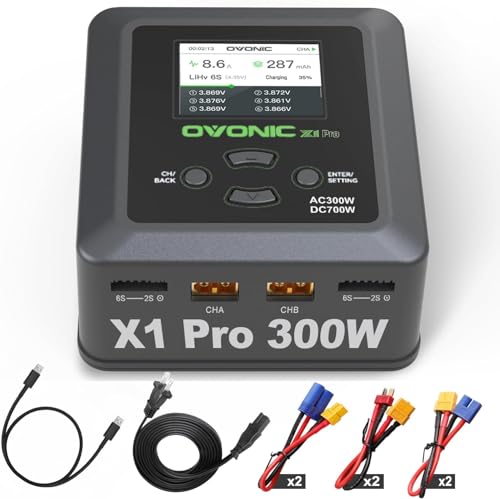
- Provides dual-port charging
- Delivers up to 700W on DC
- Includes extensive smart protections
Best For: Experienced users charging multiple RC packs
Beginner-Friendly RC Setup
AKIRVEX 150W 10A Smart Charger
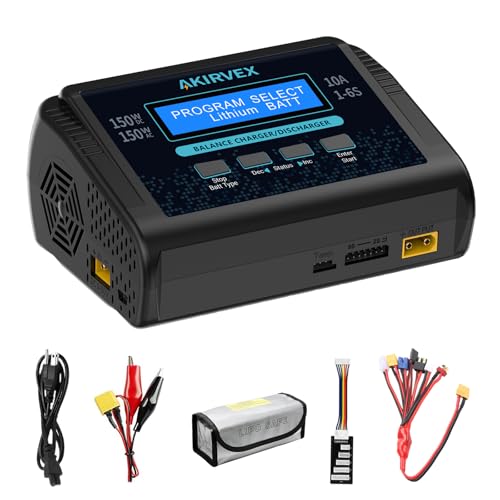
- Supports AC and DC input
- Covers common RC battery types
- Includes cables and LCD monitoring
Best For: Beginners and general RC hobbyists
Best High-Power Dual Charger – Gens Ace iMars D300
For hobbyists comparing ac dc rc battery chargers, the Gens Ace iMars D300 stands out with two charging channels, adjustable charging current up to 16A, and support for several battery chemistries. Its smart-chip features can automatically identify compatible G-Tech smart battery information and stop charging when full.
Best For: RC users who need a powerful dual-channel charger for LiPo, Li-ion, LiHV, LiFe, NiMH, or NiCd packs.
Pros:
- Supports AC 100–240V and DC 7–30V input.
- Offers two channels, up to 16A charging current, and multiple operating modes.
- Supports 1–6S lithium packs and 1–16S NiMH/NiCd packs.
- Provides real-time charging information on a 2.4-inch IPS display.
Cons:
- Its advanced features may be more than beginners need.
- The listed warranty description is “Nope.”
The D300 is a strong choice when charging speed, flexibility, and dual-battery capability matter. It also includes several adapters, making it easier to connect common RC battery plugs.
Best Compact AC/DC Charger – SKYRC B6AC Neo
The SKYRC B6AC Neo is a compact option for shoppers seeking ac dc rc battery chargers with flexible input choices. It supports AC and DC power, several lithium and nickel battery types, and includes balance checking, safety protections, and a digital power-supply function.
Best For: RC enthusiasts who want a small, versatile charger for 1–6S lithium packs, 1–15S NiMH/NiCd packs, or 3S/6S lead-acid batteries.
Pros:
- Accepts 100–240V AC, 10–30V DC, and compatible QC3.0/PD input.
- Provides up to 200W charging power and 10A charge current.
- Measures individual cell voltage and balance status through the balance port.
- Includes short-circuit, overload, reverse-polarity, over-voltage, capacity, and over-temperature protection.
Cons:
- Its 200W output is lower than the higher-powered dual chargers in this roundup.
- The small 1.77-inch display may be less convenient for users who prefer larger screens.
With its small footprint and multiple power-input options, the B6AC Neo is well suited to portable setups. It offers useful charging and diagnostic functions without the size of a larger dual-channel unit.
Best Simple NiMH/NiCd Charger – Tenergy 9.6V RC Charger
The Tenergy 9.6V charger is a straightforward choice among ac dc rc battery chargers for a specific battery setup. It is designed only for 9.6V NiMH/NiCd packs and uses a standard Tamiya connector, with simple LED indicators for charging status.
Best For: Owners of 9.6V (8S) NiMH or NiCd RC car and remote-control toy battery packs with a standard Tamiya connector.
Pros:
- Simple plug-in design with red and green charging indicators.
- Works with universal 100–240V AC input.
- Includes a standard or large Tamiya connector.
- Includes a 12-month warranty.
Cons:
- Compatible only with 9.6V NiMH/NiCd packs.
- Must not be used for LiPo batteries or other battery types.
- Single-port, 400mA charging is slower than higher-power smart chargers.
This charger makes sense when compatibility is narrow but clear. Confirm both the pack voltage and connector before buying, since it is not a multipurpose RC charger.
Best Dual-Channel AC/DC Charger – IMARS D300 Balance Charger
The IMARS D300 is a dual-channel option for shoppers comparing ac dc rc battery chargers for high-output RC use. It supports AC and DC operation, offers up to 16A per channel, and includes charging, balancing, storage, discharge, sync, and digital power-supply modes.
Best For: RC users who need high-power dual charging for compatible 1–6S RC battery packs and already have a suitable DC power supply for DC operation.
Pros:
- Supports AC 100–240V and DC 7–30V input.
- Offers up to 300W in AC mode and up to 350W per channel in DC mode.
- Includes short-circuit, overcurrent, overcharge, and overvoltage protection.
- Displays voltage, current, and operating time in real time.
Cons:
- A DC power supply and parallel charging cable are not included.
- The supplied notes specify support for 1–6S RC batteries rather than a broad range of chemistries.
- The listed warranty is limited to 90 days against manufacturer defects.
The D300 is appealing for users who want substantial output and two-channel flexibility. Its value is strongest in an established RC charging setup, especially when the required DC accessories are already available.
Best Compact Pick – ISDT 608AC Smart Charger
The ISDT 608AC is a compact option for anyone comparing ac dc rc battery chargers for everyday hobby use. It supports AC or DC input, offers charge, discharge, and storage modes, and works with several common RC battery chemistries.
Best For: New and experienced RC hobbyists who want a straightforward single-channel charger for cars, drones, planes, and other models.
Pros:
- AC/DC input flexibility with a detachable power supply
- Supports 1–6S LiPo, LiFe, Li-Ion, LiHV, Pb, NiMH, and related battery types
- Simple shuttle-roll control and a compact 12.32-ounce design
- Can function as an adjustable digital power supply with an XT60 port
Cons:
- Single charging port limits simultaneous battery charging
- Digital power-supply mode is limited to 50W
This is a practical, space-saving charger with broad battery compatibility and an approachable interface. Choose it when portability and simplicity matter more than dual-channel or high-output charging.
Best Value Dual Charger – Aorika Dual 10A RC Charger
The Aorika dual charger is a versatile choice among ac dc rc battery chargers, especially if you need to charge two packs at once. Its two independent channels support up to 10A each, while the included cables help connect several popular RC battery formats.
Best For: RC users who maintain multiple batteries for cars, drones, competitions, or other models and want broad chemistry support.
Pros:
- Two independent channels can charge different batteries simultaneously
- Supports 1–6S LiPo, LiHV, Li-Ion, and LiFe packs, plus NiCD/NiMH and lead-acid batteries
- Offers charge, balance, discharge, storage, cycling, and battery-meter modes
- Includes AC power, XT60, Tamiya, Deans, crocodile-clip, and balance cables
Cons:
- AC and DC power cables should not be used at the same time
- Correct battery chemistry and connections must be selected manually
- Its larger 5.9-by-8.6-by-3.1-inch body is less compact than a single-channel charger
With two channels and a generous accessory package, this charger offers strong flexibility for the price. It is a good fit for busy hobbyists, provided they carefully verify battery condition, chemistry, and cable connections before charging.
Best High-Power Upgrade – HOTA D6 Pro Dual Charger
The HOTA D6 Pro is a premium choice among ac dc rc battery chargers for serious RC and FPV users. It combines dual-channel charging with up to 650W total DC output, AC operation, detailed battery monitoring, and convenient USB and wireless charging features.
Best For: FPV pilots, racers, and advanced RC hobbyists who need fast dual charging at home, in the garage, or in the field.
Pros:
- Two independent channels support up to 325W each on DC input
- Works with 1–6S lithium packs, up to 1–16S NiMH/NiCd/NiZn, smart batteries, and 2–24V Pb batteries
- Includes storage, balance, discharge, synchronous-charge, and digital-power modes
- Provides cell-voltage and internal-resistance readouts plus extensive protection features
Cons:
- Higher performance and advanced features may be more than casual users need
- Battery and other accessories are not included
- Maximum 650W output requires suitable DC input and compatible batteries
The D6 Pro is the strongest performance option in this group, particularly for users charging multiple packs under time pressure. Its monitoring tools and field-friendly power options add value for advanced users, while its sophisticated feature set may be unnecessary for basic charging.
Versatile All-Chemistry Pick – Haisito C150 150W AC/DC Balance Charger
For shoppers comparing ac dc rc battery chargers, the Haisito C150 is a flexible option for hobbyists managing several battery chemistries and connector types. Its 150W, 10A output supports 1-6S lithium packs, up to 15-cell NiMH/NiCd batteries, and 2-20V lead-acid batteries.
Best For: Hobbyists who want one charger for varied RC battery packs and multiple connectors.
Pros:
- Supports LiPo, LiHV, Li-ion, LiFe, NiMH, NiCd, and Pb batteries.
- Offers balance charging, fast charging, discharge, storage, cyclic charging, and battery-meter functions.
- Stores up to 20 battery profiles and includes a broad multi-connector harness.
- Provides adjustable terminal voltage settings for advanced users.
Cons:
- Its adjustable end-voltage feature is intended for expert users.
- At 150W and 10A, it has less stated power than the dual-channel OVONIC model.
The C150 stands out for compatibility rather than maximum throughput. Its safety limits, memory profiles, and included adapters make it a practical all-purpose choice, while beginners should use the standard charging settings unless they understand terminal-voltage adjustments.
High-Power Dual-Channel Choice – OVONIC X1 Pro Dual RC Charger
The OVONIC X1 Pro is a strong contender among ac dc rc battery chargers when simultaneous charging and higher output matter. It delivers up to 300W on AC, 700W on DC, and 16A, with two ports and a dedicated Sync Charging mode.
Best For: Experienced RC users who charge two compatible packs or need higher-power DC charging.
Pros:
- Dual ports support charging workflows for two batteries.
- Offers 300W AC and 700W DC power with up to 16A output.
- Supports 1-6S LiPo, Li-ion, LiFe, and LiHV batteries plus 1-16S NiMH packs.
- Includes extensive monitoring, safety, storage, discharge, and firmware-update functions.
Cons:
- Its advanced controls may be more than casual users need.
- Requires suitable external DC power to reach its stated 700W output.
- The included battery adapters are centered on XT60 connections.
With high conversion efficiency, dual ports, and extensive diagnostics, the X1 Pro is the most capable option here for demanding charging setups. Its full performance depends on the input source and the user’s familiarity with advanced charger settings.
Beginner-Friendly RC Setup – AKIRVEX 150W 10A Smart Charger
The AKIRVEX combines AC/DC input, a 150W 10A rating, and common RC charging modes in a straightforward package. For anyone shopping ac dc rc battery chargers for cars, drones, aircraft, helicopters, or boats, it covers a broad range of pack types and includes the cables needed for several connectors.
Best For: Beginners and general RC users who want a complete charger kit with clear LCD monitoring.
Pros:
- Accepts AC 100-240V or DC 11-20V input.
- Supports 1-6S lithium batteries, 1-15S NiMH/NiCd packs, and 2-20V Pb batteries.
- Includes balance, fast, discharge, storage, cyclic, battery-meter, and resistance-check functions.
- Comes with AC/DC cords, a balance board, and a multi-connector harness.
Cons:
- Its 150W and 10A output is more modest than the OVONIC X1 Pro.
- The supplied details do not specify dual-channel charging.
The AKIRVEX is a practical starter-oriented package: it supports common RC applications, offers useful battery-management modes, and includes a built-in fan and protective shell. It is a sensible fit for users who value broad compatibility over maximum charging capacity.
How We Picked the Best Ac Dc Rc Battery Chargers
We evaluated the selected chargers by looking at charging output, AC and DC input capability, supported battery chemistries, cell-count range, balance-charging functions, and ease of use. We also considered whether each model offers one or two charging channels, useful safety controls, USB outputs, wireless charging, or other features that may matter to RC hobbyists.
Specifications can vary by input source and operating mode, so always confirm the manufacturer’s limits before charging. A charger’s maximum wattage does not mean every battery will charge at that rate.
Quick Comparison
| Charger type | Best suited to | What to prioritize |
|---|---|---|
| Single-channel AC/DC | Casual hobbyists and one-pack setups | Simple controls, supported chemistries, and balance accuracy |
| Dual-channel AC/DC | Drivers charging multiple packs | Independent outputs, total wattage, and per-channel limits |
| High-power DC-capable | Frequent racers and large battery packs | DC wattage, power supply requirements, and cooling |
| NiMH/NiCd-focused | Older RC cars and transmitters | Correct connector, pack voltage, and charge termination |
Key Buying Factors for AC/DC RC Battery Chargers
Battery Chemistry and Cell Count
Choose a charger that explicitly supports your battery type. LiPo, LiHV, Li-ion, LiFe, NiMH, NiCd, and lead-acid packs use different charging profiles. For LiPo packs, verify that the charger supports the exact series count, such as 2S, 3S, or 6S.
AC/DC Power and Charging Output
AC input is convenient at home, while DC input can provide substantially more power when paired with a suitable power supply. Check both AC and DC wattage, maximum amperage, and whether output is shared between channels. Higher power is useful only when your batteries, wiring, and power source can support it.
Balance Charging and Safety
For lithium-based packs, balance charging helps keep individual cells at appropriate voltages. Look for cell monitoring, adjustable charge rates, storage-charge modes, discharge functions, reverse-polarity protection, overcurrent protection, and temperature monitoring where available. Never leave a charging battery unattended.
Connectors and Usability
Confirm that the charger includes or supports the connector and balance lead used by your packs. A clear screen, intuitive menus, memory presets, and independent channel controls can save time, especially when charging regularly.
Who Should Buy Which Ac Dc Rc Battery Chargers?
Choose a basic single-channel model if you charge one compatible pack at a time and want a straightforward home setup. Choose a dual-channel charger if you regularly maintain two packs and want to reduce charging time. Choose a high-output model if you use larger packs, race frequently, or plan to run the charger from a powerful DC supply. Choose a dedicated NiMH/NiCd charger for older battery packs when broad lithium compatibility is unnecessary.
Before buying, match the charger to your battery chemistry, connector, cell count, and available power source. The safest choice is the model that meets those requirements without relying on its headline wattage alone.