Choosing a 3D scanner for reverse engineering comes down to more than raw resolution. You need reliable tracking, accurate edge capture, and a workflow that makes it easy to move from physical part to usable CAD data.
This roundup focuses on scanners that balance precision, scanning speed, and versatility for engineering, product design, and 3D printing workflows.
Best 10 3d Scanner for Reverse Engineering Picks for 2026
Industrial Precision Pick

- 0.01 mm precision for detailed capture
- Four scan modes for varied surfaces
- Auto turntable and real-time streaming
Best For: Precision modeling, industrial measurement, and reverse engineering
Flexible Handheld Pick

- Blue light and NIR for small to large objects
- Up to 0.02 mm accuracy in blue mode
- Lightweight 372 g handheld design
Best For: Mixed-size scanning, CAD workflows, and portable reverse engineering
Workflow Speed Pick

- 0.01 mm precision with five scan modes
- No spray needed in laser modes
- Wi-Fi 6 and real-time streaming
Best For: Fast, high-accuracy reverse engineering and metrology work
Deep Detail Pick

- Blue laser modes reach holes and recessed areas
- Up to 0.02 mm accuracy at 90 FPS
- Works with Geomagic and Verisurf tools
Best For: Engineering scans with deep detail and broad part coverage
Photogrammetric Metrology Scanner
Revopoint MIRACO Plus for Reverse Engineering

- Integrated photogrammetric metrology kit
- Quad camera system for small to large parts
- Portable 750 g body with Wi‑Fi 6
Best For: All-in-one reverse engineering and scan-to-CAD workflows
Metrology Laser Scanner
Creality Raptor Pro for Reverse Engineering

- Up to 0.02 mm + 0.08 mm/m accuracy
- Blue laser plus NIR structured light modes
- Wireless scanning for 5 mm to 4000 mm objects
Best For: Industrial reverse engineering and detailed part capture
Ultra-Precise Blue Laser Scanner
Revopoint MetroY Ultra for Reverse Engineering

- Up to 0.01 mm single-frame precision
- Scans dark, shiny, and metallic parts without spray
- Five modes including deep-hole and turntable scanning
Best For: Tight-tolerance reverse engineering on small to medium parts
Precision All-Rounder
Creality Sermoon S1 for Engineering Printing
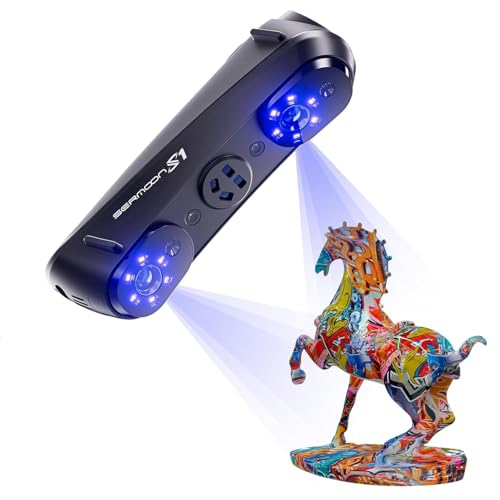
- 5 mm to 4 m scan range
- Triple blue-laser scan modes
- 0.02 mm accuracy and AI-assisted workflow
Best For: Broad reverse-engineering and CAD work across small to large parts
Fast Detail Capture

- 7 blue laser lines for sharp edges
- Blue light and NIR scanning modes
- Up to 0.02 mm accuracy and 60 fps
Best For: Fast, precise reverse engineering on small to large objects
Heavy-Duty Workflow

- 22 crossed + 7 parallel blue lasers
- Scans black, metallic, and glass-like surfaces
- 24-bit color with wireless scanning support
Best For: Professional reverse engineering with difficult materials and color capture
Industrial Precision Pick – Revopoint MetroX Pro
If you need a 3d scanner for reverse engineering, the Revopoint MetroX Pro is built for detailed work where precision matters. Its blue laser and structured-light modes give you flexibility for different surface types, while the turntable and real-time streaming tools help streamline the capture process.
Best For: Precision modeling, industrial measurement, and reverse engineering workflows that benefit from high accuracy and multiple scan modes.
Pros:
- Up to 0.01 mm single-frame precision and 0.02 mm accuracy for detailed capture.
- Four scan modes handle flat, shiny, dark, and feature-rich objects.
- Auto turntable scanning adds one-click automation for complex objects.
- Scan data can transfer into Revo Measure, Revo Design, and other 3D software.
Cons:
- Revo Design and Revo Measure are paid software sold separately.
- Windows-only workflow for the separate measurement and design software.
- Heavier than handheld scanners at 14.82 pounds.
For users focused on high-detail engineering capture, this scanner stands out for its accuracy, surface versatility, and workflow tools. It is a strong fit when reverse engineering needs repeatable results and clean data for downstream modeling.
Flexible Handheld Pick – Creality CR-Scan Raptor
The Creality CR-Scan Raptor is a practical 3d scanner for reverse engineering when you want handheld flexibility across very small to very large objects. Its blue light and NIR combination makes it adaptable for different scanning scenarios, and the software supports common export formats for CAD and design workflows.
Best For: Users who want a lightweight handheld scanner for mixed-size objects, design work, and general reverse engineering tasks.
Pros:
- 2-in-1 blue light and NIR modes cover objects from 5 mm to 2000 mm.
- Up to 0.02 mm accuracy in blue light mode.
- Lightweight 372 g body makes it easier to hold and carry.
- Outputs OBJ, STL, and PLY for broad software compatibility.
Cons:
- Windows requirements are fairly demanding for recommended performance.
- macOS support needs newer M3/M4 hardware and 16 GB RAM.
- Blue light mode requires care with direct eye exposure.
This is a versatile option if you need a portable scanner that can switch between fine-detail work and larger objects. It is especially appealing when scan exports need to move easily into downstream modeling or printing software.
Workflow Speed Pick – Revopoint MetroY Pro
The Revopoint MetroY Pro is a strong 3d scanner for reverse engineering if you want high detail and efficient workflows in one package. It combines blue laser scanning with multiple modes, including single-line deep hole scanning and marker-free structured light, so you can adapt to different part geometries without changing tools.
Best For: Reverse engineering, metrology, and 3D printing projects that need high accuracy and fast scan acquisition.
Pros:
- Up to 0.01 mm precision and 0.02 mm accuracy for detailed parts.
- Five scan modes include deep hole, parallel line, and auto turntable options.
- No scanning spray needed in laser modes, even on shiny or dark surfaces.
- Wi-Fi 6 and real-time streaming make cable-free monitoring easier.
Cons:
- Some companion software is paid separately.
- Requires relatively powerful Windows or macOS hardware.
- Best results may depend on choosing the right mode for the part.
MetroY Pro is aimed at users who want both precision and efficiency, especially when moving from capture to measurement or redesign. Its mix of scanning modes and workflow features makes it a capable pick for technical projects.
Deep Detail Pick – Creality Sermoon S1
The Creality Sermoon S1 is designed as a practical 3d scanner for reverse engineering when you need both detail capture and speed. Its blue laser modes are especially useful for recesses, holes, and larger shapes, while the NIR structured-light modes broaden the scanner’s range for different object sizes.
Best For: Engineering projects, reverse engineering, and inspection tasks that involve both fine features and larger objects.
Pros:
- Single-line blue laser reaches deep holes and narrow gaps.
- 34 cross laser lines help cover larger objects more efficiently.
- Up to 0.02 mm accuracy with 90 FPS scanning.
- Supports Geomagic Control X, Geomagic Design X, and Verisurf Inspect.
Cons:
- Recommended Windows and macOS specs are relatively strong.
- Some features focus on professional workflows, which may be more than casual users need.
- Face and body modes are included, but this model is still centered on technical scanning.
This scanner makes sense for users who want a detailed handheld tool with strong software integration for engineering work. It balances laser precision with broad coverage, which is helpful when reverse engineering parts with both small and large geometry.
Photogrammetric Metrology Scanner – Revopoint MIRACO Plus for Reverse Engineering
If you need a 3d scanner for reverse engineering that can handle both small features and larger objects, the Revopoint MIRACO Plus is built around flexibility. Its integrated photogrammetric metrology kit, high-accuracy scanning modes, and scan-to-CAD workflow make it a practical pick for users who want detailed captures without piecing together a separate setup.
Best For: Users who want an all-in-one scanner for reverse engineering, scan-to-CAD work, and mixed-size objects.
Pros:
- Photogrammetric kit supports high-resolution capture and length accuracy of 0.02 mm + 0.05 mm x L(m).
- Quad depth camera system handles everything from tiny screws in Near mode to larger machinery in Far mode.
- 0.04 mm single-point cloud accuracy and improved calibration board performance.
- Portable 750 g design with Wi‑Fi 6, USB-C transfer, and up to 2 hours of scanning.
Cons:
- Revo Design for scan-to-CAD is sold separately.
- Photogrammetric software is only compatible with x86-based PCs.
- Best color/detail results depend on using the provided workflow and hardware setup.
Overall, the MIRACO Plus is a strong choice when reverse engineering calls for measurement-focused capture plus versatile scanning modes. It is especially appealing if you want one scanner that can move between small parts, large surfaces, and photogrammetric measurement in a single workflow.
Metrology Laser Scanner – Creality Raptor Pro for Reverse Engineering
The Creality Raptor Pro is a strong 3d scanner for reverse engineering if you want metrology-grade precision and fast capture across a wide size range. Its blue laser and infrared structured-light modes are designed for industrial inspection, automotive parts, body scans, and feature-rich workpieces that need detailed digital reproduction.
Best For: Reverse engineering users who want high precision, fast scanning, and marker-free capture on a broad range of objects.
Pros:
- Metrology-grade accuracy up to 0.02 mm + 0.08 mm/m.
- 660,000 points/s scan speed helps speed up industrial and detailed part capture.
- NIR structured light can scan feature-rich objects without markers.
- Supports objects from 5 mm to 4000 mm and includes wireless support.
Cons:
- Windows setup is more demanding, with specific CPU, GPU, and RAM requirements.
- Mac users are recommended to use M1/M2/M3 processors and 16 GB memory.
- Resolution adjustments range from 0.05 mm to 2 mm, so workflow tuning may be needed.
For technical users, the Raptor Pro balances precision and speed in a way that fits serious reverse engineering tasks. Its combination of laser lines, structured light, and wide object support makes it especially useful when you need detailed scans without slowing down the workflow.
Ultra-Precise Blue Laser Scanner – Revopoint MetroY Ultra for Reverse Engineering
If your priority is a 3d scanner for reverse engineering with tight-tolerance capture, the Revopoint MetroY Ultra is aimed squarely at industrial-grade work. It combines high single-frame precision, multiple scan modes, and strong performance on dark or shiny surfaces to support inspection and reverse engineering tasks.
Best For: Engineers and makers who need accurate scans of small to medium parts, including reflective industrial components.
Pros:
- Up to 0.01 mm single-frame precision and 0.015 + 0.04 mm x L(m) volumetric accuracy.
- Five scanning modes cover cross-line, fine-detail, deep-hole, structured-light, and automatic turntable workflows.
- Can scan black, high-gloss, and metallic parts without spray.
- Works outdoors in sunlight up to 100,000 lux and supports Wi‑Fi 6.
Cons:
- High-performance system requirements may limit casual laptop use.
- Best suited to small and medium-sized objects rather than very large assemblies.
- Battery grip runtime is about 2.5 hours, so extended field sessions still need planning.
The MetroY Ultra stands out when detail and surface handling matter more than convenience alone. For reverse engineering, it offers a focused toolset that is well suited to precise capture, cleaner prep, and consistent results across challenging materials.
Precision All-Rounder – Creality Sermoon S1 for Engineering Printing
If you need a 3d scanner for reverse engineering that can move from tiny features to full-size assemblies, the Creality Sermoon S1 is built for that broad workload. Its 5 mm to 4 m scan range, triple blue-laser modes, and 0.02 mm accuracy make it a practical pick for engineering parts, restoration, prototyping, and CAD prep.
Best For: Users who want one scanner for both fine-detail reverse engineering and large-object capture.
Pros:
- Ultra-wide 5 mm to 4 m scanning range covers small parts and large objects.
- Triple blue-laser modes help with fast scanning, fine detail, and deep holes or grooves.
- Up to 0.02 mm accuracy and 0.08 mm/m volumetric precision suit engineering workflows.
- AI-assisted software is designed to reduce alignment, mesh, and cleanup time.
Cons:
- Windows and macOS setups need fairly strong hardware.
- Large professional scanner design may be more than casual users need.
This is the most flexible option here if your projects vary a lot in size and geometry. It emphasizes workflow efficiency as much as precision, which is exactly what many reverse-engineering users need.
Fast Detail Capture – Creality CR-Scan Raptor
The Creality CR-Scan Raptor is a strong 3d scanner for reverse engineering when you want fine edge detail without giving up speed. With 7 parallel blue laser lines, NIR mode, and up to 0.02 mm accuracy, it is aimed at users scanning everything from small components to larger objects in a mix of industrial and creative workflows.
Best For: Detail-focused scanning with flexible blue-laser and marker-free infrared modes.
Pros:
- 7 parallel blue laser lines with 0.1 mm line width help capture sharp edges.
- Blue light and NIR modes support both precise and marker-free scanning.
- Up to 60 fps scanning keeps capture quick for moving around parts.
- Works with objects from 5×5×5 mm up to 2000×2000×2000 mm.
Cons:
- High-performance PC requirements may limit some setups.
- Mac support still calls for relatively modern Apple silicon hardware.
If your priority is crisp geometry and fast capture, the Raptor is the more focused tool. It gives you precision scanning with enough mode flexibility to handle different object types without changing hardware.
Heavy-Duty Workflow – Creality CR-Scan Raptor Pro
If you need a 3d scanner for reverse engineering that can handle tricky surfaces and larger jobs, the Creality CR-Scan Raptor Pro is the most capability-packed option in this group. It combines 22 crossed blue lasers, 7 parallel lasers, and NIR structured light with 0.02 mm accuracy, plus support for black, metallic, and even partially transparent glass surfaces without spray powder.
Best For: Advanced reverse engineering workflows that need speed, material flexibility, and full-color capture.
Pros:
- 22 crossed lasers plus 7 parallel lasers give strong coverage for detailed and medium-to-large parts.
- Handles black, metallic, and 71% transparent glass surfaces without powder.
- 24-bit RGB camera adds true-color texture capture.
- Supports wireless scanning and works in bright outdoor conditions.
Cons:
- Higher-end workflow comes with demanding system requirements.
- Broader feature set may be more than simple scanning jobs require.
The Raptor Pro is the most versatile choice when your reverse-engineering work involves difficult materials and you want strong scan speed as well as color data. It is clearly aimed at professional users who need fewer compromises in real-world scanning.
How We Picked the Best 3d Scanner for Reverse Engineering
We prioritized metrology-minded specifications that matter in real projects: stated accuracy, scan speed, tracking stability, minimum and maximum scan size, and support for detailed geometry capture. We also looked at whether each scanner is practical for common reverse-engineering tasks such as brackets, housings, mechanical parts, and medium-size assemblies.
Because workflow matters as much as specs, we favored models with flexible scanning modes, strong handheld ergonomics, and features that reduce rescans and cleanup time.
Quick Comparison
For small precision parts, laser-heavy scanners with tighter accuracy targets are usually the best fit. For larger objects or mixed-size projects, a scanner with broader scan range and dependable tracking is more forgiving. If you want the fastest path from object to editable model, look for a 3d Scanner for Reverse Engineering that combines stable alignment, good surface handling, and software that exports clean mesh data.
Key Buying Factors for a 3d Scanner for Reverse Engineering
Accuracy and Repeatability
Published accuracy is important, but repeatability is what helps you trust measurements across multiple passes. For engineering work, consistency matters when you are matching hole locations, mating surfaces, and critical dimensions.
Object Size and Scan Range
Match the scanner to the parts you actually reverse engineer. A device optimized for tiny components may be inefficient on larger housings, while a broad-range handheld scanner is better for mixed workflows.
Tracking and Surface Handling
Parts with matte, reflective, or complex geometry can challenge any scanner. Good tracking, blue laser or hybrid light sources, and anti-shake features help reduce drift and missed detail.
Software and Export Workflow
Reverse engineering is rarely finished at the scan stage. Look for software that supports cleanup, alignment, hole filling, and export formats that fit your CAD or inspection workflow.
Who Should Buy Which 3d Scanner for Reverse Engineering?
If you need the highest precision for small to medium parts, choose a metrology-focused handheld model with strong laser performance. If you value flexibility across different object sizes, a scanner with multiple scan modes or broader range is the safer choice. If you want an easier all-in-one experience for design, prototyping, or classroom use, a more integrated scanner can be the better fit even if it is not the most specialized option.
For most buyers, the best 3d Scanner for Reverse Engineering is the one that matches part size, accuracy needs, and your post-scan workflow—not just the one with the longest feature list.