Resin 3D printing can give students detailed, professional-looking results, but washing uncured resin and curing finished models adds time, mess, and safety concerns to the classroom workflow.
The best 3D printer wash and cure stations for schools make those steps more consistent by combining dedicated washing and UV curing in a controlled setup. This roundup compares ten options across capacity, compatibility, convenience, and likely school use.
Best 10 3d Printer Wash Cure Stations for Schools Picks for 2026
Large-Batch Pick

- 7.6L washing capacity for larger resin prints
- Focused gooseneck light for detailed curing
- Dual-layer platform supports more models per cycle
Best For: School labs processing larger prints and higher model volumes
Throughput Choice

- Separate wash and cure machines can run simultaneously
- 7.5L container handles larger resin parts
- Covered 405nm curing system with UV protection
Best For: Busy school makerspaces processing large models in parallel
Compact Classroom Pick

- 4L cleaning bucket suits smaller resin workflows
- Gooseneck light targets detailed areas
- Simple controls with quieter operation
Best For: Classrooms using smaller LCD resin printers
All-in-One Value
Creality UW-01 Wash and Cure Station

- Large sealed washing container for bigger models
- 360-degree rotating platform with 18 UV LEDs
- Cover removal pauses curing for safer operation
Best For: School labs wanting a simple enclosed wash-and-cure workflow
Large-Format Classroom Workhorse

- 15.1L washing capacity for large resin prints
- One-click automatic washing and curing
- Customizable modes with detergent-saving cleaning
Best For: Schools processing large models and frequent resin-print projects
Flexible 2-in-1 Station
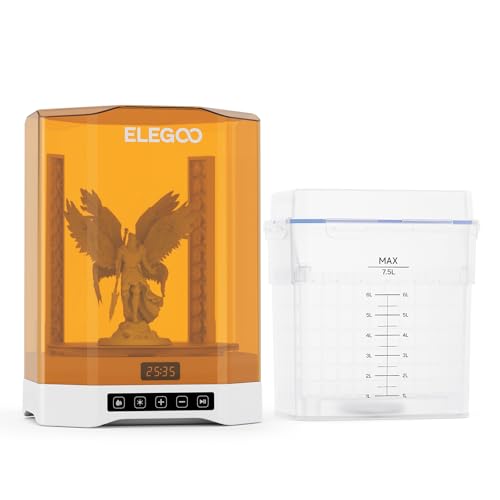
- 7.5L cleaning capacity for larger models
- Basket and hanging cleaning modes
- 24 LEDs and rotating 360° curing design
Best For: Schools using compatible ELEGOO resin printers
Detail-Focused Mid-Size Pick

- 7.6L basket and 12L total bucket volume
- Gooseneck light targets delicate model details
- Adjustable heights and 1–30 minute timing
Best For: Schools curing detailed models from mid-size resin printers
Large-Capacity Choice

- 7.5-liter washing tank for larger resin prints
- All-round 405nm UV curing system
- Simple controls with UV-blocking protective cover
Best For: School makerspaces processing larger MSLA, SLA, or DLP prints
Quiet Classroom Pick

- 3-liter basket and 4-liter cleaning bucket
- Adjustable 100 mm and 165 mm basket heights
- 1–30-minute timer and quieter operation
Best For: Classrooms using resin printers up to about 7.3 inches
Flexible Handling Option

- Basket or suspension washing methods
- 360-degree rotating turntable for curing
- UV-blocking cover with automatic pause feature
Best For: School labs needing flexible and sealed resin cleaning
Large-Batch Pick – ANYCUBIC Wash and Cure 3 Plus
For schools looking for 3d printer wash cure stations for schools, the ANYCUBIC Wash and Cure 3 Plus is designed for larger resin-printing workflows. Its 7.6L washing capacity, adjustable platform heights, and dual-layer curing platform make it a practical choice for shared makerspaces handling multiple or larger models.
Best For: School labs using larger LCD resin printers and processing several models per cycle.
Pros:
- Large 7.6L washing basket supports printers up to 10.6 inches and larger prints.
- Flexicure gooseneck light adds focused curing for detailed areas.
- Dual-layer curing platform can increase the number of models cured per cycle.
- Adjustable basket heights help maximize IPA usage.
Cons:
- Its larger 21.65-inch footprint may require dedicated workspace.
- The system weighs 15.4 pounds, making it less convenient to move between classrooms.
The 3 Plus stands out when capacity and workflow efficiency matter more than portability. It is especially well suited to an established school lab with room for a larger post-processing station.
Throughput Choice – ELEGOO Mercury X Bundle
The ELEGOO Mercury X Bundle is a two-machine setup for schools that want washing and curing handled as separate stages. Because the washing and post-curing machines can operate at the same time, it can help student teams move prints through resin post-processing more efficiently.
Best For: School makerspaces that prioritize simultaneous washing and curing for larger resin models.
Pros:
- Separate washing and curing machines support parallel workflow.
- 7.5L container accommodates large parts from compatible Saturn and Mars printers.
- 405nm UV lighting uses two light bars and additional LEDs beneath the turntable.
- UV cover blocks 99.9% of ultraviolet rays during curing.
Cons:
- The two-machine design requires more counter space than a single unit.
- Prints should be dried after washing before curing.
- The wash bucket needs liquid in advance to prevent the wheel from getting stuck.
Mercury X is a strong classroom option when throughput is the priority and staff can manage a two-step setup. Schools should also note that the supplied guidance recommends running water instead for water-washable resin.
Compact Classroom Pick – ANYCUBIC Wash and Cure 3
For classrooms needing 3d printer wash cure stations for schools without a large footprint, the ANYCUBIC Wash and Cure 3 offers a more compact post-processing approach. Its 4L cleaning bucket, adjustable basket, one-click controls, and quieter operation fit routine resin-printing activities with smaller LCD printers.
Best For: Classrooms and smaller labs using LCD resin printers up to 7.3 inches.
Pros:
- 4L cleaning bucket and enlarged basket support more models than the prior generation.
- Gooseneck light focuses additional energy on subtle model areas.
- Adjustable basket heights accommodate platforms from 5.9 to 7.3 inches.
- One-click mode selection and 1-to-30-minute timing simplify student use.
Cons:
- Its stated compatibility is limited to LCD printers sized 7.3 inches or less.
- The 4L cleaning capacity is smaller than the larger stations in this roundup.
This model balances useful curing adjustments with straightforward controls and a smaller operating scale. It is a sensible fit where students need guided, repeatable post-processing rather than maximum production capacity.
All-in-One Value – Creality UW-01 Wash and Cure Station
The Creality UW-01 is an all-in-one option for schools seeking a straightforward station for washing and curing resin models. Its sealed washing container, flexible bracket, touch controls, and cover-safety pause are useful features for shared instructional spaces.
Best For: School labs wanting one station with guided controls and support for larger models.
Pros:
- 190 x 154 x 200mm washing container supports larger models.
- Sealed container and lid help limit solution volatilization and allow storage between uses.
- 18 UV LEDs and a 360-degree rotating platform provide broad curing coverage.
- Removing the cover during curing immediately pauses the process.
Cons:
- It has a single all-in-one workflow rather than separate machines for simultaneous processing.
- The supplied notes do not specify an exact resin-printer size limit for washing.
The UW-01 offers a practical middle ground for school environments that value enclosed operation and simple controls. Its flexible bracket and broad curing platform also make it adaptable to varied resin-printing projects.
Large-Format Classroom Workhorse – ANYCUBIC Wash & Cure Max 3.0
For schools handling larger resin prints or multiple classroom projects, this 3D printer wash cure station offers an unusually large 15.1L washing capacity and a 305 × 165 × 300 mm maximum wash size. Its automated workflow can simplify routine post-processing for students and staff.
Best For: Schools with larger resin printers and frequent, high-volume model processing.
Pros:
- Extra-large washing capacity and compatibility with resin printers up to 13.6 inches.
- Automatic mode washes and cures models in one streamlined process.
- Supports independent or customized washing and curing times.
- 360° spray rinsing, bottom cleaning, and claimed detergent savings of nearly 50%.
Cons:
- Its 18.96 kg weight may make it less convenient to move between classrooms.
- The large capacity may be more than smaller programs need.
The Wash & Cure Max 3.0 is a strong choice when capacity and reduced hands-on processing matter most. It is especially practical for makerspaces that need to accommodate larger prints while keeping wash and cure settings flexible.
Flexible 2-in-1 Station – ELEGOO Mercury Plus 3.0
The ELEGOO Mercury Plus 3.0 is a practical option for schools seeking 3D printer wash cure stations for schools that can handle larger classroom models without requiring separate washing and curing equipment. It combines two cleaning methods with a one-step post-processing design.
Best For: School labs using ELEGOO Mars or Saturn printers and wanting flexible model-cleaning options.
Pros:
- 7.5L cleaning capacity with a maximum cleaning size of 230 × 135 × 260 mm.
- One-step cleaning, drying, and curing workflow.
- Basket cleaning and hanging cleaning accommodate different print setups.
- Twenty-four 405 nm LEDs, reflective mirrors, and a rotating turntable support all-around curing.
Cons:
- Its stated compatibility is limited to resin printers up to 10 inches.
- The cleaning capacity is smaller than the largest station in this roundup.
With its hanging-cleaning option, the Mercury Plus 3.0 can help limit direct contact with uncured resin during classroom workflows. It is a balanced pick for schools that value compatibility and operational flexibility over maximum wash volume.
Detail-Focused Mid-Size Pick – ANYCUBIC Wash & Cure Plus 3.0
For school makerspaces using resin printers up to 10.6 inches, the ANYCUBIC Wash & Cure Plus 3.0 provides a mid-size solution with a 7.6L washing basket and 12L bucket. Its adjustable cleaning heights and specialized gooseneck light are useful when classroom models include fine details.
Best For: Schools that need efficient IPA use and more targeted curing for detailed resin models.
Pros:
- 7.6L basket capacity and compatibility with LCD resin printers up to 10.6 inches.
- Flexicure gooseneck light provides targeted curing for delicate areas and figure details.
- Adjustable 150 mm and 250 mm cleaning heights can help use IPA more efficiently.
- Wash and cure times can be adjusted from 1 to 30 minutes.
Cons:
- It is not intended for the largest resin printer formats in this group.
- The unit’s listed dimensions may require dedicated workspace in a classroom or lab.
The Plus 3.0 stands out for schools where detail quality and straightforward controls are priorities. Its adjustable platform heights and targeted curing option offer useful control for student projects without moving to the largest station format.
Large-Capacity Choice – ELEGOO Mercury Plus 3.0
For schools comparing 3d printer wash cure stations for schools, the ELEGOO Mercury Plus 3.0 is a strong option when student projects require more post-processing space. Its 7.5-liter washing tank supports larger resin prints, while separate wash and cure functions simplify routine lab workflows.
Best For: School makerspaces and classrooms handling larger MSLA, SLA, or DLP resin prints.
Pros:
- Large 7.5-liter washing tank accommodates models up to 230 × 135 × 260 mm without build-plate cleaning.
- 405nm UV light system provides all-round curing for more uniform results.
- Adjustable timer and simple controls support straightforward classroom operation.
- Protective cover blocks 99.9% of UV light during operation.
Cons:
- Its larger capacity may be more than needed for small printers or occasional use.
- Designed for resin-print post-processing, so it is not a general-purpose cleaning station.
The Mercury Plus 3.0 is particularly practical where multiple students share equipment or where print sizes vary. Its broad compatibility with ELEGOO Saturn and Mars series printers and other MSLA, SLA, and DLP models adds flexibility to a school lab.
Quiet Classroom Pick – ANYCUBIC Wash & Cure 3.0
Among 3d printer wash cure stations for schools, the ANYCUBIC Wash & Cure 3.0 suits classrooms using resin printers up to about 7.3 inches. It combines a 3-liter cleaning basket with adjustable washing heights and a gooseneck curing lamp for more focused treatment of small details.
Best For: Classrooms using smaller resin printers that value quiet operation and flexible cleaning modes.
Pros:
- Expanded 3-liter cleaning basket and 4-liter cleaning bucket support routine classroom use.
- Dual-layer basket offers 100 mm and 165 mm height settings for different platforms.
- Flexicure gooseneck design improves irradiation around the top and smaller parts.
- Dedicated buttons and a rotary knob allow curing times from 1 to 30 minutes.
Cons:
- Washing size is limited to 165 × 100 × 180 mm.
- Its stated fit is primarily resin printers measuring 7.3 inches or less.
The Wash & Cure 3.0 is a sensible fit for school environments where equipment needs to be approachable and unobtrusive. Its adjustable basket, quieter operation, and separate cleaning and curing controls help students follow a repeatable post-processing routine.
Flexible Handling Option – ELEGOO Mercury Plus 2.0
The ELEGOO Mercury Plus 2.0 is a practical choice for schools seeking 3d printer wash cure stations for schools with flexible model-cleaning options. It supports basket washing or suspension washing from the build platform, then uses a rotating turntable and 405nm LEDs for even curing.
Best For: School labs that want sealed cleaning and the choice to wash models in a basket or directly on the platform.
Pros:
- Two-in-one cleaning and curing design streamlines resin-print post-processing.
- Basket and suspension washing methods provide flexibility and can reduce direct resin exposure.
- 360-degree rotating curing turntable helps use the light source evenly.
- Cover blocks up to 99.95% of 405nm UV rays and pauses operation when lifted during curing.
Cons:
- Its sealed washing container measures 180 × 150 × 206 mm, limiting larger projects.
- It is an older model than the Mercury Plus 3.0 and has a smaller stated capacity.
For supervised student use, the Mercury Plus 2.0 stands out for its sealed cleaning setup and suspension-washing option. The adjustable bracket and automatic pause feature add useful handling safeguards, while compatibility with many LCD, DLP, and SLA printers makes it adaptable to mixed equipment.
How We Picked the Best 3d Printer Wash Cure Stations for Schools
We focused on stations that combine washing and UV curing, since a two-step machine can simplify resin-printing workflows and reduce the need for separate classroom equipment. The selection includes compact models for limited workspaces, larger systems for shared makerspaces, and bundles designed for larger resin prints.
We compared stated washing volume, compatibility with common LCD, MSLA, SLA, and DLP printers, curing flexibility, operating simplicity, and the practical needs of repeated student use. We also considered whether a machine’s capacity is likely to match typical print sizes rather than treating the largest specification as automatically best.
Quick Comparison
| Best for | What to prioritize |
|---|---|
| Individual classroom or small lab | Compact footprint, simple controls, and manageable cleaning |
| Shared makerspace | Larger basket or container capacity and durable workflow |
| Large resin models | Extra washing volume and compatibility with large build platforms |
| Multiple printer brands | Adjustable washing setup and broad printer compatibility |
| Student supervision | Clear operating steps, enclosed curing, and accessible controls |
Key Buying Factors for 3D Printer Wash and Cure Stations for Schools
Capacity and Print Size
Check the usable washing dimensions, not only the headline tank capacity. A station should accommodate the largest prints and build plates students are likely to handle. Oversized models may require a larger unit or multiple cleaning cycles.
Safety and Classroom Workflow
These machines do not replace ventilation, gloves, eye protection, spill control, or proper resin-waste disposal. Look for enclosed curing, stable containers, straightforward controls, and a setup that lets an instructor supervise loading, washing, and post-processing.
Compatibility and Flexibility
Confirm that the station works with the school’s printer type and intended washing method. Some workflows use removable build plates, while others require parts to be placed in a basket. Flexible designs are useful when students use different printer sizes or brands.
Maintenance and Operating Cost
Washing fluid becomes contaminated and needs responsible replacement or disposal. Consider how easy it is to remove the container, clean residue, replace consumables, and keep the unit ready for the next class. A slightly smaller station may be more practical if it is easier to maintain regularly.
Who Should Buy Which 3d Printer Wash Cure Stations for Schools?
Choose a compact station for a single classroom with modest print sizes and limited counter space. A larger-capacity model is a better fit for a school makerspace where several students may process parts during the same session. For large-format resin printing, prioritize the models with extra washing volume and dimensions that match the printer’s build area.
Schools buying their first resin post-processing system should favor simple operation and clear supervision over maximum speed. Programs with several printer types should choose a flexible station with broad compatibility. Regardless of model, place the machine in a designated post-processing area and establish written procedures for personal protective equipment, resin handling, washing-fluid management, and curing times.