A well-designed ergonomic office chair with headrest can make long workdays more comfortable by supporting your neck, lower back, shoulders, and posture. The best options combine adjustable features with breathable materials and a stable base.
We compared 10 popular chairs across headrest design, lumbar support, adjustability, seat comfort, weight capacity, and overall value to help you choose the right fit for your desk and daily routine.
Best 10 Ergonomic Office Chair with Headrest Picks for 2026
Best for Adjustability
Wide Mesh Chair with 3D Headrest

- Adjustable headrest, lumbar, backrest, and seat height
- Wide breathable mesh seat supports up to 300 lb
- Flip-up arms and 90–120° tilt lock
Best For: Users seeking a roomy, highly adjustable chair for long work sessions
Best for Padded Comfort
Marsail Chair with 2D Headrest
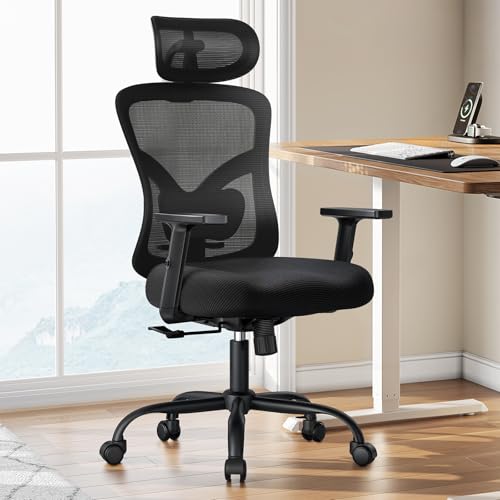
- 3.15-inch foam seat cushion
- Adjustable lumbar and 2D tilting headrest
- Breathable mesh back with 300-lb capacity
Best For: Desk, gaming, and reading setups that favor extra seat padding
Best for Taller Users

- Recommended for users about 5'6" to 6'2"
- Adjustable headrest, lumbar, seat, and back support
- Three-position recline and 330-lb stated capacity
Best For: Taller home-office users seeking breathable mesh support
Best for Space-Saving Arms

- Retractable padded armrests tuck under desks
- Large cushioned seat with breathable mesh back
- Adjustable headrest, lumbar pillow, and seat height
Best For: Home offices needing a roomy chair with fold-away arms
Flexible Support Pick

- 3D headrest and adjustable lumbar support
- Breathable mesh with 350-pound capacity
- 125-degree tilt and flip-up armrests
Best For: Versatile home offices, gaming setups, and workplaces
Most Adjustable

- 2D headrest and 3D adjustable armrests
- 4.5-inch lumbar adjustment and three recline angles
- 330-pound capacity with mesh and pocket-spring seat
Best For: Extended desk work and highly customized seating
Space-Saving Comfort
NEO CHAIR Beige Mesh Headrest Chair
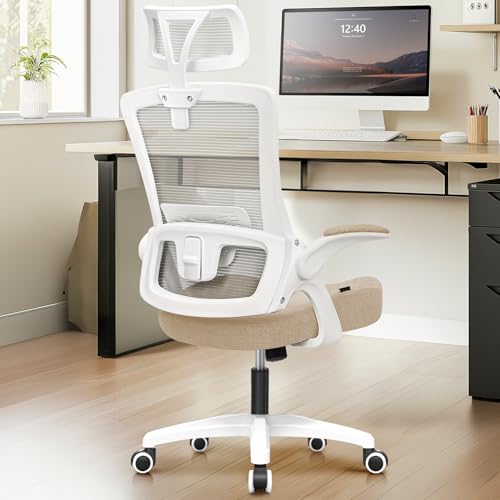
- Breathable mesh with supportive headrest
- Flip-up arms and waterfall seat design
- Adjustable lumbar, height, tilt, and swivel
Best For: Compact home offices and study spaces
Reliable Everyday Support
TRALT Ergonomic Office Chair with Headrest

- High-resilience molded foam seat
- Depth-adjustable lumbar support
- Breathable mesh back and 330-lb capacity
Best For: Everyday home-office, study, and gaming use
Flexible Workday Adjustments
Marsail Ergonomic Mesh Chair with Headrest

- 2D adjustable headrest and 90–120° recline
- Highly adjustable lumbar support
- 3D flip-up armrests and 330-lb capacity
Best For: Users who want extensive office-chair adjustments
Premium Reclining Comfort
ELABEST X100 Chair with Footrest

- 3D dynamic lumbar and 3D headrest
- 5D flip-up armrests with footrest
- Three-stage recline and breathable mesh
Best For: Work, gaming, and reclining relaxation
Best for Adjustability – Wide Mesh Chair with 3D Headrest
This ergonomic office chair with headrest is built for users who want broad adjustability and a roomy seat. It combines adjustable seat height, backrest, headrest, lumbar support, and flip-up arms with a 90–120° tilt range, making it a practical option for extended home or office use.
Best For: Users from about 5’2″ to 6’1″ who want a spacious, breathable chair with flexible positioning and space-saving arms.
Pros:
- Large mesh seat and back promote airflow and accommodate different body types.
- Adjustable headrest, lumbar support, seat height, backrest, and flip-up arms.
- Supports up to 300 pounds and includes a three-year warranty in the supplied product notes.
- Three-stage tilt lock and smooth-rolling PU casters add everyday versatility.
Cons:
- The recommended height range may not suit shorter or taller users.
- Assembly is required, although the supplied notes estimate 15–20 minutes.
Choose this model if you prioritize a wide cushion, extensive adjustment options, and the ability to tuck the chair beneath a desk. Its mesh construction favors airflow, while the 300-pound capacity broadens its appeal.
Best for Padded Comfort – Marsail Chair with 2D Headrest
The Marsail ergonomic office chair with headrest emphasizes cushioned comfort and targeted support. Its adjustable lumbar pad, tilting 2D headrest, thick foam seat, breathable mesh back, and height-adjustable arms make it suited to desk work, gaming, reading, and relaxing.
Best For: Users who prefer a thick padded seat and adjustable neck and lower-back support in a high-back chair.
Pros:
- 3.15-inch foam seat cushion is designed to support the hips and thighs.
- Lumbar support adjusts through a 2.4-inch height range.
- 2D headrest offers 45° tilt and 2.8 inches of height adjustment.
- Metal base, Class 3 gas lift, and 360° PU casters support up to 300 pounds.
Cons:
- The armrests adjust vertically only, according to the supplied details.
- The chair requires assembly.
This is a strong fit when seat cushioning matters as much as adjustability. The breathable mesh back helps with airflow, while the padded seat and movable support points are intended for daylong comfort.
Best for Taller Users – SIHOO M18 Mesh Chair
The SIHOO M18 is an ergonomic office chair with headrest designed around adjustable support and a breathable mesh back. It includes seat-height, headrest, lumbar, and back-support adjustments, plus a three-position recline, making it a versatile choice for work and study.
Best For: Users approximately 5’6″ to 6’2″ who want a mesh chair with adjustable lumbar support and a 330-pound stated capacity.
Pros:
- Adjustable headrest, lumbar support, seat height, and back support.
- Breathable mesh back helps keep the chair cooler during extended sitting.
- Three-position recline provides multiple working or relaxing angles.
- Supplied details list BIFMA testing, a 330-pound capacity, and replacement parts during a three-year warranty period.
Cons:
- The recommended user height range excludes some shorter users.
- The supplied dimensions are inconsistent across the product details, so verify the listing before purchase.
The M18 makes sense for taller users who want a straightforward mesh task chair with several support adjustments. Its higher stated weight capacity and three-position recline add flexibility, but shoppers should confirm sizing details.
Best for Space-Saving Arms – Yaheetech Chair with Headrest
This ergonomic office chair with headrest pairs a roomy cushioned seat with a breathable mesh back and retractable padded armrests. Its adjustable headrest, movable lumbar pillow, rocking function, and 3.7-inch seat-height range provide useful flexibility for work, study, reading, or relaxing.
Best For: Users who need a large, comfortable chair that can be pushed under the desk when not in use.
Pros:
- Extra-large 20.5-inch-wide by 20-inch-deep cushioned seat.
- Retractable padded armrests help save desk space.
- Adjustable headrest, movable lumbar pillow, rocking function, and seat height.
- Breathable mesh back, 360° swivel, and 300-pound weight capacity.
Cons:
- The supplied details list only one reclining position.
- Assembly is required.
- The listed seat-height information appears inconsistent, so confirm the current specifications before ordering.
The Yaheetech is a practical choice for compact work areas where flip-up arms are valuable. Its generous seat and padded support suit longer sessions, while the mesh back and rolling casters keep the design functional.
Flexible Support Pick – 3D Headrest Mesh Office Chair
If you need an ergonomic office chair with headrest for a home office, gaming setup, or workplace, this black mesh model focuses on adjustable support and easy positioning. It combines a newly designed 3D headrest, adjustable lumbar support, flip-up armrests, and a breathable mesh back.
Best For: Users who want a versatile, breathable chair with a higher 350-pound weight capacity and multiple adjustment features.
Pros:
- 3D headrest and adjustable lumbar support help accommodate different sitting postures.
- Breathable mesh fabric and a high-density foam cushion support longer sitting sessions.
- 125-degree tilt, adjustable armrests, 360-degree swivel, and quiet casters add flexibility.
- Flip-up armrests and a stated 15-minute assembly process suit multipurpose spaces.
Cons:
- The listed specifications show only one reclining position.
- It has a one-year warranty, which may be shorter than some competing chairs.
This is a practical choice if adjustability and weight capacity matter more than a wide range of recline-lock positions. Its mesh construction and flip-up arms also make it adaptable for shared home-office or study areas.
Most Adjustable – Quelsoft High-Back Mesh Chair
This white ergonomic office chair with headrest is designed for detailed customization, with a 2D headrest, adjustable lumbar support, 3D armrests, and a reclining backrest. Its mesh back and thick foam seat with pocket-spring support are aimed at users who spend extended periods at a desk.
Best For: Users seeking extensive headrest, armrest, lumbar, height, and recline adjustments in a professional-style chair.
Pros:
- The headrest adjusts 3.6 inches in height and rotates 60 degrees.
- 3D armrests provide height, pivot, and forward/backward adjustments.
- Lumbar support offers 4.5 inches of height adjustment, while the backrest reclines through 100, 120, and 130 degrees.
- Breathable mesh, a thick foam cushion, pocket-spring support, and a 330-pound capacity provide a supportive seating setup.
Cons:
- The white finish may require more frequent cleaning than darker upholstery.
- The many adjustment ranges may take time to set up for individual users.
Among these options, this model offers the most detailed adjustment system and the clearest testing and certification information in the supplied specifications. It is a strong fit for buyers who prioritize fine-tuning posture and recline settings.
Space-Saving Comfort – NEO CHAIR Beige Mesh Headrest Chair
For shoppers looking for an ergonomic office chair with headrest in a lighter, compact design, the NEO CHAIR pairs a beige mesh back with a supportive headrest, adjustable lumbar support, and flip-up arms. Its waterfall seat edge is designed to reduce pressure at the front of the seat during longer sitting periods.
Best For: Home offices and study spaces where breathable seating, flip-up arms, and a lighter chair are useful.
Pros:
- Breathable elastic mesh and a supportive headrest provide airflow and neck support.
- Flip-up armrests can help save space when the chair is stored under a desk.
- Waterfall seat design is intended to improve comfort and circulation around the legs.
- Adjustable height, lumbar support, tilt, and swivel allow a personalized setup.
Cons:
- The maximum recommended weight is 275 pounds, lower than the other listed models.
- The specifications list two reclining positions rather than a broad range of lockable angles.
- The one-year warranty is limited to defects in workmanship and materials under normal use.
This chair stands out for its space-conscious flip-up arms, beige finish, and relatively light 12.6-pound listed weight. Consider it if you want basic ergonomic adjustability and a waterfall seat without choosing a bulkier high-capacity model.
Reliable Everyday Support – TRALT Ergonomic Office Chair with Headrest
The TRALT is a practical ergonomic office chair with headrest for home offices, study areas, and gaming setups. Its breathable mesh back, adjustable lumbar support, molded foam seat, and 330-pound capacity focus on dependable comfort during extended sitting.
Best For: Users who want durable everyday support and a breathable chair with a straightforward adjustment range.
Pros:
- High-resilience molded foam seat is designed to resist flattening over time.
- Adjustable lumbar support changes in depth to better match the spine.
- Breathable mesh back helps reduce heat buildup, while the BIFMA-certified lift is designed to hold its height.
- 19.7-inch-wide seat, adjustable height, and 330-pound capacity suit a broad range of users.
Cons:
- The listed seat-height range may not suit every desk or user.
- The supplied notes do not specify a recline range or detailed headrest adjustments.
The TRALT stands out as a sensible value-oriented option when seat durability, adjustable lumbar support, and cool mesh matter more than extensive reclining features.
Flexible Workday Adjustments – Marsail Ergonomic Mesh Chair with Headrest
The Marsail is an ergonomic office chair with headrest built for users who want multiple ways to fine-tune their sitting position. It combines a 2D headrest, adjustable lumbar support, 3D armrests, a breathable mesh back, and a 90-to-120-degree recline range.
Best For: Office users who prioritize adjustability, posture-focused lumbar positioning, and flexible arm support.
Pros:
- Lumbar support adjusts 1.18 inches forward and backward and 2.16 inches up and down.
- 3D armrests move forward, backward, and side to side, and can flip up.
- 2D headrest and 90-to-120-degree backrest recline support different work postures.
- Thick foam seat, wide seating area, breathable mesh, and 330-pound capacity support longer sessions.
Cons:
- Assembly is required.
- The supplied specifications list a relatively deep overall footprint, which may require careful desk-space planning.
Choose the Marsail if you value detailed positioning controls more than a minimalist adjustment setup. Its combination of headrest, lumbar, armrest, and recline adjustments makes it particularly adaptable for changing work positions.
Premium Reclining Comfort – ELABEST X100 Chair with Footrest
The ELABEST X100 is an ergonomic office chair with headrest designed for extended work, gaming, and relaxation. It adds a footrest, 3D lumbar support, 5D flip-up armrests, a wide 3D headrest, and a three-stage reclining mechanism to its breathable mesh design.
Best For: Users seeking a feature-rich chair that can transition from focused work to reclining breaks and gaming.
Pros:
- Dynamic 3D lumbar system offers depth, height, and rotation adjustments.
- 18-inch extendable footrest and three-stage recline support relaxation between tasks.
- 5D flip-up armrests provide extensive positioning and can tuck under a desk.
- Breathable Dual-Stripe AirMesh, adjustable 3D headrest, and BIFMA-certified 300-pound support add versatility.
Cons:
- The feature-rich design may take longer to configure than a simpler task chair.
- Its 300-pound capacity is lower than some competing models in this roundup.
- The footrest and larger adjustment system may require more room around the chair.
The X100 is the most versatile choice here for users who want more than upright desk seating. Its footrest, reclining system, and numerous adjustment points make it well suited to mixed work-and-relaxation use.
How We Picked the Best Ergonomic Office Chair with Headrest
We focused on features that have the greatest effect on everyday comfort and fit: headrest adjustability, lumbar support, seat depth and width, armrest movement, recline range, height adjustment, material breathability, and weight capacity. We also considered whether each chair suits typical home-office use, extended work sessions, gaming, or larger body types.
Because comfort is personal, no single chair is ideal for everyone. A chair with more adjustment points may offer a better fit, while a simpler model can be a practical choice for occasional use or a tighter budget.
Quick Comparison
| Feature | What to Look For | Best For |
|---|---|---|
| Headrest | Height, angle, and tilt adjustment | Neck and upper-back support |
| Lumbar support | Adjustable depth or height | Long desk sessions |
| Seat | Wide cushion and suitable depth | Pressure relief and larger users |
| Recline | Lockable tilt range | Working, reading, or resting |
| Armrests | Flip-up or multi-directional adjustment | Flexible desk positioning |
Key Buying Factors for an Ergonomic Office Chair with Headrest
Headrest Fit
The headrest should support the base of your head or upper neck without pushing your head forward. Height and angle adjustment are especially useful if multiple people share the chair or if you alternate between upright work and reclining.
Lumbar and Back Support
Look for lumbar support that meets the curve of your lower back. Adjustable support is preferable, but a well-shaped fixed design can still work if its position matches your body. Mesh backs promote airflow, while cushioned backs may feel warmer but offer a softer sensation.
Seat Dimensions and Capacity
Check seat width, depth, height range, and stated weight capacity before buying. Your feet should rest flat on the floor with your knees near a right angle. Big-and-tall designs may provide a wider cushion and stronger frame, but they can be oversized for smaller users.
Adjustability and Construction
Useful adjustments include seat height, tilt tension, recline lock, armrest position, and headrest movement. Also check the base, casters, warranty, assembly requirements, and return policy. These details often matter as much as the feature list.
Who Should Buy Which Ergonomic Office Chair with Headrest?
Choose a highly adjustable model if you work full-time at a desk, share your chair, or frequently change posture. A mesh Ergonomic Office Chair with Headrest is a strong choice for warm rooms and users who prioritize airflow. Look for a wide-seat or big-and-tall model if you need additional space or a higher weight rating.
For occasional home-office use, a simpler chair with basic lumbar support and a reclining headrest may provide better value. If you take regular breaks to read, relax, or join calls, prioritize a smooth recline function and a headrest that remains comfortable outside an upright typing position.