A gaming projector can deliver a far larger image than a television, but the right model must balance input lag, refresh rate, resolution, brightness, and room placement. Laser light sources also add convenience with fast startup, consistent brightness, and long operating life.
We selected 10 laser projectors for gaming across 4K and 1080p resolutions, short-throw and standard-throw designs, and a range of brightness levels. The best choice depends on your console or PC, screen size, ambient light, and whether you also want a serious home-theater display.
Best 10 Laser Projectors for Gaming Picks for 2026
Premium Competitive Pick

- 4ms input lag and 240Hz refresh rate
- 4K, Dolby Vision, HDR10, and RGB triple laser
- Google TV with automated setup features
Best For: Competitive gamers seeking a feature-rich home theater projector
Bright Short-Throw Pick

- 3,200 ANSI lumens for brighter rooms
- 4K HDR10 visuals with 95% Rec.709 coverage
- 4ms response at 1080p and 240Hz
Best For: Bright living rooms and competitive console or PC gaming
Xbox Gaming Pick

- 4.2ms input lag and 240Hz refresh rate
- 4K UHD, HDR/HLG, and SuperColor visuals
- 1.3x optical zoom with flexible adjustment
Best For: Xbox players wanting bright, flexible home theater projection
Compact Short-Throw Pick

- Ultra-compact short-throw design
- 3,500 lumens with HDR support
- Up to 30,000 hours of laser life
Best For: Space-conscious buyers wanting bright Full HD gaming projection
Best Xbox Pick

- 4K resolution and 4,000 ANSI lumens
- 240Hz refresh rate and 4.2ms input lag
- Xbox support with 1440p at 120Hz
Best For: Xbox gaming in a bright home theater
Best Premium Laser

- RGB triple laser with 3,200 ISO lumens
- 1ms response, 240Hz, VRR, and ALLM
- Google TV, Dolby Vision, and built-in speakers
Best For: Premium gaming and cinematic all-in-one setups
Best Short-Throw Value
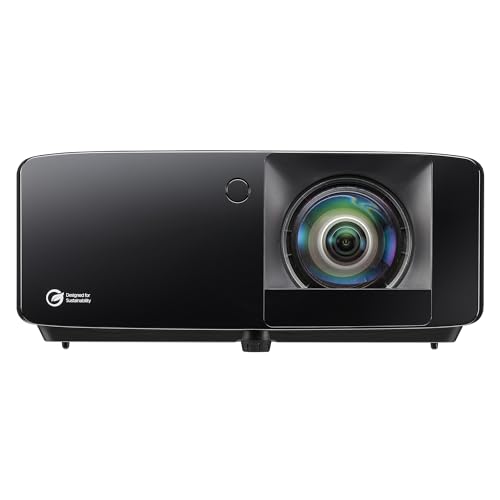
- 1080p resolution with 4,200 ANSI lumens
- Short-throw projection for compact rooms
- 30,000-hour laser source with IP6X protection
Best For: Bright gaming and golf simulation in smaller spaces
Bright-Room Gaming Pick

- 4K UHD with HDR10/HLG
- 4ms at 1080p/240Hz
- 3,200 ANSI-lumen laser source
Best For: Living-room console and PC gaming
Color-Rich Portable Pick

- Triple-laser 4K with HDR10
- 17ms latency and HDMI 2.1
- Portable gimbal design with Google TV
Best For: Portable gaming and streaming
Large-Screen Simulation Pick

- 5,500 ANSI-lumen brightness
- Up to a 300-inch Full HD image
- Golf mode and flexible installation
Best For: Golf simulators and large installed gaming spaces
Premium Competitive Pick – Valerion StreamMaster Plus2
The Valerion StreamMaster Plus2 is a feature-rich choice among laser projectors for gaming, pairing 4K UHD visuals with a claimed 4ms input lag and 240Hz refresh rate. Its RGB triple-laser design, Google TV, and automated setup features also make it suitable for more than gaming.
Best For: Competitive gamers who want a large, versatile home entertainment setup with advanced smart and image features.
Pros:
- 4ms input lag and 240Hz refresh rate, with dedicated FPS and RPG modes.
- 4K support with Dolby Vision, HDR10, dynamic tone mapping, and a 10,000:1 contrast ratio.
- Google TV, AirPlay 2, Miracast, and Chromecast built in.
- Automatic focus, keystone correction, alignment, and obstacle avoidance.
Cons:
- Its extensive features may be more than casual gamers need.
- Brightness is listed at 2,000 ISO lumens, lower than some competing models here.
The StreamMaster Plus2 stands out for combining high-refresh-rate gaming with premium cinema features. Choose it if smart-home integration, automated setup, and broad HDR support matter as much as gaming responsiveness.
Bright Short-Throw Pick – BenQ TK710STi
The BenQ TK710STi is a practical option among laser projectors for gaming when you need a bright image in a living room or other space with ambient light. Its 4K resolution, short-throw design, and 4ms response at 1080p and 240Hz target fast-paced console and PC play.
Best For: Gamers who want bright 4K projection, low latency, and Android TV in a compact tabletop setup.
Pros:
- 3,200 ANSI lumens helps keep images punchy with lights on.
- 4K resolution with HDR10 and 95% Rec.709 color coverage.
- 4ms response at 1080p and 240Hz for responsive gaming.
- Short-throw design and built-in Android TV streaming.
Cons:
- The listed 4ms gaming response applies to 1080p at 240Hz, not 4K.
- Its minimum image size is listed as 120 inches, which may be large for some rooms.
With strong brightness and a gaming-focused response mode, the TK710STi is well suited to bright rooms and large-screen play. It is a particularly sensible fit for buyers who want streaming features without adding an external device.
Xbox Gaming Pick – ViewSonic LX700-4K
The ViewSonic LX700-4K is a strong choice among laser projectors for gaming, especially for Xbox players who want 4K resolution and a high refresh rate. It combines a claimed 4.2ms input lag with 240Hz support, HDR compatibility, and flexible image adjustment for home theater use.
Best For: Xbox gamers and home theater users who want a bright, large image with flexible installation options.
Pros:
- Designed for Xbox with 4.2ms ultra-low input lag and 240Hz refresh rate.
- 4K UHD resolution, HDR/HLG support, and SuperColor technology.
- 3,500 ANSI lumens for use in rooms with ambient light.
- 1.3x optical zoom, keystone correction, and four-corner adjustment.
Cons:
- It lacks the built-in smart TV platform highlighted on some competing models.
- The product is relatively focused on Xbox and home theater rather than broad streaming features.
The LX700-4K balances gaming speed, brightness, and installation flexibility. Its dedicated Xbox positioning and support for 1440p at 120Hz make it an appealing option for console-focused buyers who also want a cinematic screen.
Compact Short-Throw Pick – Optoma GT2000HDR
The Optoma GT2000HDR is a compact, straightforward option among laser projectors for gaming. It uses a short-throw design, delivers 1080p Full HD resolution at 3,500 lumens, and supports gaming consoles, laptops, smartphones, tablets, and televisions.
Best For: Buyers who prioritize a compact short-throw design, bright Full HD projection, and long laser life.
Pros:
- Ultra-compact short-throw form factor for easier placement.
- 3,500 ANSI lumens and HDR support for bright, high-contrast images.
- Laser light source rated for up to 30,000 hours.
- Compatible with gaming consoles and several personal devices.
Cons:
- Native resolution is 1080p rather than 4K.
- The supplied notes do not list a gaming input-lag or refresh-rate specification.
- Connectivity is more limited than models with integrated smart TV platforms.
The GT2000HDR makes the most sense when space and simplicity matter more than 4K detail or competitive gaming specifications. Its short-throw format, bright output, and long-life laser source suit casual gaming and everyday home cinema.
Best Xbox Pick – ViewSonic PX749-4K
The ViewSonic PX749-4K is a strong choice among laser projectors for gaming if you want bright 4K visuals and Xbox-focused features. Its 4,000 ANSI lumens, 240Hz refresh rate, 4.2ms input lag, and 1440p-at-120Hz Xbox support suit fast, action-heavy games.
Best For: Xbox players building a bright, large-screen gaming and home theater setup.
Pros:
- 4K UHD resolution with 4,000 ANSI lumens for clear images in moderate ambient light.
- Designed for Xbox, with 1440p at 120Hz support, 240Hz refresh rate, and 4.2ms input lag.
- Supports HDR/HLG, SuperColor technology, screens up to 300 inches, and flexible image adjustment.
Cons:
- Its 4,000-hour light-source operating life is shorter than some laser alternatives.
- The stationary, ceiling-mount-oriented design may be less convenient for portable setups.
Choose the PX749-4K when gaming responsiveness and Xbox compatibility matter more than built-in streaming or portability. Optical zoom, keystone controls, and four-corner adjustment make installation easier in a dedicated room.
Best Premium Laser – XGIMI HORIZON 20 4K
The XGIMI HORIZON 20 combines an RGB triple-laser engine with 4K resolution, making it one of the more feature-rich laser projectors for gaming. With 1ms response, 240Hz fluidity, VRR, and ALLM, it is built for responsive play while also adding Dolby Vision, Google TV, and integrated speakers.
Best For: Gamers who want premium image quality and an all-in-one entertainment projector.
Pros:
- RGB triple laser delivers 3,200 ISO lumens and a stated 100,000:1 contrast ratio.
- Gaming features include 1ms response, 240Hz operation, VRR, and ALLM.
- Includes Google TV, licensed Netflix, Harman Kardon speakers, optical zoom, and lens shift.
- Supports IMAX Enhanced, Dolby Vision, HDR10+, and Filmmaker Mode.
Cons:
- Its 4.9 kg portable form factor is less suited to permanent ceiling installation.
- It offers 3,200 ISO lumens, lower than the brightest model in this comparison.
The HORIZON 20 is the most complete option here for buyers who want gaming performance without giving up cinematic features. Its lens adjustments and integrated stand also provide more setup flexibility than a basic fixed projector.
Best Short-Throw Value – Optoma GT2400HDR
The Optoma GT2400HDR is a practical short-throw choice among laser projectors for gaming, especially where room space is limited. It delivers Full HD 1080p resolution, 4,200 ANSI lumens, low input lag, and a laser light source rated for up to 30,000 hours.
Best For: Gamers and golf-simulation users who need a bright projector for a compact room.
Pros:
- Short-throw design projects from as close as 2.6 feet, with a maximum throw distance of 3.7 feet.
- 4,200 ANSI lumens help maintain visibility in brighter spaces.
- 30,000-hour DuraCore laser light source and IP6X-rated dust protection support long-term use.
- Supports gaming consoles and is described as golf-simulation ready.
Cons:
- Its native resolution is Full HD 1080p rather than 4K.
- The supplied notes do not specify a numeric input-lag figure or refresh rate.
- It has a shorter one-year projector parts-and-labor warranty.
The GT2400HDR makes the most sense when installation distance and brightness are priorities. It gives up some resolution and documented gaming specifications, but its short-throw format and durable laser source are useful for dedicated gaming or simulation spaces.
Bright-Room Gaming Pick – BenQ TK710
For gamers seeking laser projectors for gaming in a living room with some ambient light, the BenQ TK710 combines 4K UHD resolution with a bright 3,200 ANSI-lumen laser light source. Its low-latency modes are designed for responsive console and PC play.
Best For: Living-room gaming with PS5, Xbox, or PC, especially when 4K detail and bright-room visibility matter.
Pros:
- True 4K UHD resolution with HDR10/HLG support
- 4ms response at 1080p/240Hz and 16ms input lag at 4K/60Hz
- 3,200 ANSI lumens and a long-lasting laser light source
- Supports up to a 144-inch image, with lens shift and 1.3x zoom
Cons:
- Native resolution is 4K, but the fastest 4ms mode is specified for 1080p/240Hz
- Its tabletop form factor may be less suitable for fully portable setups
The TK710 is a strong choice when gaming responsiveness is the priority without giving up 4K movie performance. Its brightness, HDR support, and 3-year warranty make it particularly practical for a dedicated living-room entertainment setup.
Color-Rich Portable Pick – JMGO N1S 4K Upgrade
The JMGO N1S 4K Upgrade is a flexible option for shoppers comparing laser projectors for gaming and home cinema. Its triple-laser design emphasizes vivid color, while Google TV, a built-in gimbal, and a portable 4.4-pound body simplify setup in different rooms.
Best For: Portable gaming and movie nights where color performance, smart streaming, and easy repositioning are important.
Pros:
- 4K UHD resolution with HDR10 and triple-laser color technology
- Ultra-low 17ms latency with HDMI 2.1 and MEMC motion compensation
- Integrated gimbal offers 127° vertical adjustment, with auto focus and keystone correction
- Google TV includes officially licensed Netflix, Google Cast, and access to thousands of apps
Cons:
- Its 1,700 ISO-lumen brightness is lower than the brightest projector in this roundup
- Recommended setup guidance calls for adjusting keystone before focus
- Active 3D glasses are required for Blu-ray 3D viewing
Choose the N1S 4K Upgrade if you want a projector that can move easily between rooms and serve equally well for gaming and streaming. The triple-laser system and broad color coverage are compelling, while 17ms latency is suitable for general immersive play rather than the most competitive gaming.
Large-Screen Simulation Pick – ViewSonic LS740HD
For gamers who need a large, bright image, the ViewSonic LS740HD brings 5,500 ANSI lumens and Full HD resolution to laser projectors for gaming. Its golf mode, 300-inch maximum screen size, and installation flexibility make it especially relevant for simulation rooms and permanent setups.
Best For: Golf simulators, large gaming spaces, classrooms, and installed home theaters where brightness and screen size outweigh 4K resolution.
Pros:
- Bright 5,500 ANSI-lumen laser phosphor light source
- Supports images from 30 to 300 inches with 1.3x optical zoom
- Golf mode is designed for realistic simulator play
- H/V keystone, four-corner adjustment, portrait mode, and 360-degree projection aid installation
Cons:
- Full HD 1920×1080 resolution rather than 4K
- Stationary, ceiling-mount-oriented design is less convenient for casual portability
- Gaming-specific latency information is not provided in the supplied specifications
The LS740HD makes the most sense when a bright, oversized image is the main requirement. It is a capable installation projector for simulation and group gaming, but shoppers focused on pixel density or verified low input lag should consider the 4K gaming-focused alternatives.
How We Picked the Best Laser Projectors for Gaming
We compared each projector’s stated resolution, brightness, input-lag or response claims, refresh-rate support, throw characteristics, connectivity, and gaming-focused features. We also considered practical ownership factors such as laser longevity, installation flexibility, HDR support, built-in smart platforms, and suitability for movies or simulation games.
Specifications can vary by input, resolution, picture mode, and firmware, so treat maximum refresh rates and response times as conditional claims rather than guarantees for every game or device. Always confirm the manual’s supported signal formats before buying.
Quick Comparison
| Priority | What to Look For | Best-Fit Models in This Roundup |
|---|---|---|
| Competitive gaming | Low input lag, high refresh support, and a responsive game mode | Valerion StreamMaster Plus2, ViewSonic LX700-4K, ViewSonic PX749-4K |
| Small rooms | Short-throw placement and flexible image sizing | BenQ TK710STi, Optoma GT2000HDR, Optoma GT2400HDR |
| Bright rooms | High light output and a suitable screen or wall | ViewSonic PX749-4K, Optoma GT2400HDR, ViewSonic LS740HD |
| Movies plus gaming | 4K detail, HDR, strong color, and convenient streaming | XGIMI HORIZON 20, JMGO N1S 4K, BenQ TK710 |
Key Buying Factors for Laser Projectors for Gaming
Input Lag and Refresh Rate
Input lag matters more than headline resolution in fast competitive games. Look for a dedicated gaming mode and verify the lag at the resolution and refresh rate you plan to use. A projector advertising 120Hz or 240Hz may require a compatible source, cable, and reduced resolution.
Resolution and HDR
Native 4K or 4K-enhanced output can make large maps, text, and cinematic games look sharper. HDR support is useful only when the projector has enough contrast and brightness to display it effectively, so avoid choosing solely by the HDR label.
Brightness, Throw Distance, and Screen
Short-throw models are easier to place in compact rooms and help reduce shadows from people sitting near the screen. Brighter projectors handle ambient light better, but a controlled room still produces superior black levels and contrast. A proper projection screen can improve perceived brightness and color consistency.
Connectivity and Everyday Use
Check the number and type of HDMI ports, eARC or optical audio support, USB media features, wireless options, and compatibility with consoles, PCs, soundbars, and AV receivers. Smart-TV platforms are convenient, but external streaming hardware may offer longer-term app support.
Who Should Buy Which Laser Projectors for Gaming?
- Choose the Valerion StreamMaster Plus2 if you want an enthusiast-oriented large-screen 4K gaming and home-theater experience with very high refresh-rate claims.
- Choose the BenQ TK710STi or Optoma GT2000HDR if your room is compact and short-throw placement is a priority.
- Choose the ViewSonic LX700-4K or PX749-4K for a gaming-first 4K setup with bright output and high-refresh support.
- Choose the Optoma GT2400HDR or ViewSonic LS740HD when brightness, Full HD gaming, or simulation use matters more than maximum 4K detail.
- Choose the XGIMI HORIZON 20 or JMGO N1S 4K if built-in smart features, flexible living-room use, and vivid RGB laser color are important.
- Choose the BenQ TK710 for a balanced 4K HDR projector that can serve both gaming and movie nights.
Before ordering, measure the distance from the lens to the screen, confirm your console’s output settings, and budget for audio and screen upgrades if the projector’s built-in speakers will not meet your needs.