Soldering fumes can quickly collect around a small electronics bench, making a dedicated extractor a practical upgrade for hobbyists, technicians, and makers. The best desktop models combine useful airflow with HEPA and activated-carbon filtration without taking over your workspace.
This roundup compares 10 desktop solder fume extractors across portability, suction control, filter design, noise, and long-term maintenance considerations so you can choose equipment that fits your projects and bench layout.
Best 10 Desktop Solder Fume Extractors Picks for 2026
Simple Smoke Control
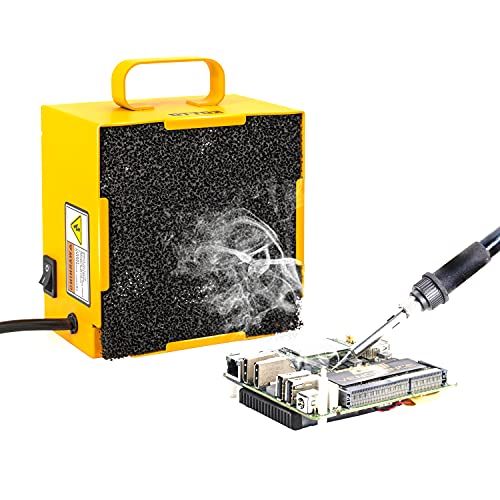
- 3000 RPM low-noise fan
- Activated carbon filter
- Compact unit with replacement filter
Best For: DIY soldering stations needing portable smoke capture
Adjustable Dual Filtration

- Front-and-rear filtration
- 30-degree tiltable stand
- Eight filtration adsorbers included
Best For: Close-range soldering and wood-burning work
Flexible HEPA Capture
JJ-Z131 Compact Fume Extractor

- H13 HEPA plus activated carbon
- 25.6-inch flexible suction arm
- 50 CFM airflow, below 50 dB
Best For: Compact home workshops and directed fume capture
Lighted Magnetic Mount
SainSmart Portable Fume Extractor

- Magnetic base and included clamp
- Adjustable three-temperature LED
- 3700 RPM fan with up to 10-inch reach
Best For: DIY repair benches needing flexible mounting and lighting
Best Compact Pick
NT-M1 Desktop Solder Fume Extractor
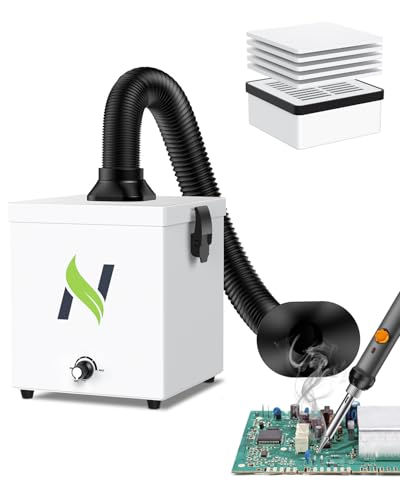
- Compact 3-pound desktop footprint
- 168m³/h adjustable airflow
- H13 HEPA plus carbon and pre-filter layers
Best For: Small workbenches, hobby soldering, and DIY projects
Best Filtration Value
FumeClear FC-2001S Portable Extractor

- Three-stage filtration system
- High-iodine activated carbon layer
- 110V/220V universal-voltage operation
Best For: Precision soldering and odor-conscious compact workspaces
Best Wide-Voltage Design

- 168m³/h strong suction
- 110V–220V wide-voltage operation
- Metal-alloy body with H13 HEPA filtration
Best For: DIY makers, electronics repair, and flexible-voltage setups
Most Adjustable
Smart 2-in-1 HEPA Desktop Extractor

- 0–100 stepless speed control with digital display
- H13 HEPA plus activated-carbon filtration
- 400-hour filter reminder and five pre-filters included
Best For: Makers and home workspaces needing precise airflow control
Best Heavy-Duty Build
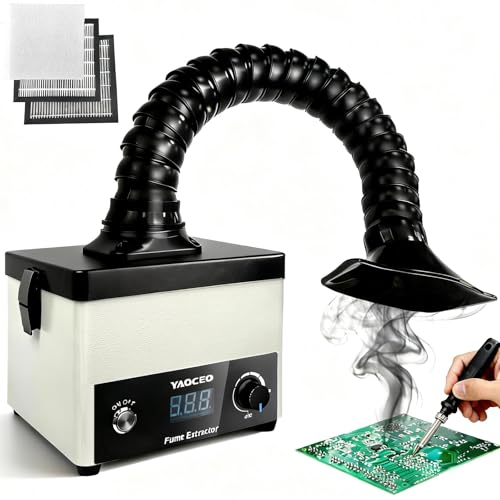
- Up to 71 CFM airflow
- All-metal frame with brushless motor
- Heat-resistant 360-degree arm and sub-50 dB operation
Best For: Frequent soldering and maker work requiring a durable unit
Best for Strong Airflow

- 106 CFM (180 m³/h) stated airflow
- HEPA and activated-carbon filter with five pre-filters
- 360-degree, 20-inch heat-resistant gooseneck
Best For: Light-duty soldering and PCB repair needing high airflow
Simple Smoke Control – KOTTO Solder Smoke Absorber
For shoppers comparing desktop solder fume extractors, the KOTTO is a straightforward benchtop smoke absorber with a 3000 RPM fan and activated carbon filter. It is designed to pull fumes from soldering, flux, chemicals, and gases from roughly 5–6 inches away.
Best For: DIY soldering stations that need a compact, portable smoke trap.
Pros:
- 0.4-inch activated carbon filter helps capture solder and flux fumes.
- 3000 RPM fan is designed for low-noise operation.
- Non-slip rubber feet and a carrying handle support stable, portable use.
- Includes one replacement smoke-trap filter.
Cons:
- Its stated effective extraction distance is limited to about 5–6 inches.
- The supplied specifications list both 120V and 220V references, so buyers should verify compatibility before ordering.
The KOTTO focuses on simple source-near fume capture rather than advanced multi-stage filtration. Its replaceable filter and compact format make it a practical choice for occasional bench work.
Adjustable Dual Filtration – YIHUA 948DQ-I Fume Extractor
The YIHUA 948DQ-I is one of the desktop solder fume extractors built around front-and-rear filtration. Its tiltable stand and side fenders help position the unit for source capture within a stated straight-line distance of 10 cm.
Best For: Soldering or wood-burning workspaces that benefit from adjustable positioning and included replacement adsorbers.
Pros:
- Dual filtration uses adsorbers at the front and rear to reduce particles and odors.
- 30-degree tiltable stand helps adjust the filtering angle.
- Two fenders are designed to reduce disruptive airflow.
- Includes eight filtration adsorbers and offers 12-month US-exclusive technical coverage.
Cons:
- Its effective capture distance is specified as 10 cm, requiring close placement.
- The unit is designed for 110–127V with a US-standard plug.
With its angle adjustment, fenders, and dual-filter layout, the 948DQ-I offers more positioning flexibility than a basic flat smoke absorber. It is best suited to users who can keep the extractor close to the work area.
Flexible HEPA Capture – JJ-Z131 Compact Fume Extractor
The JJ-Z131 stands out among desktop solder fume extractors for its compact housing, flexible suction arm, and two-stage filter setup. A pre-filter handles larger dust, while the H13 HEPA and activated carbon filter is rated to capture fine particles down to 0.3 microns.
Best For: Home workshops and benchtop tasks where flexible, directed extraction is more useful than a fixed fan.
Pros:
- H13 HEPA and activated carbon filtration is paired with a replaceable pre-filter.
- 30W brushless motor provides stated airflow of 50 CFM.
- 25.6-inch flexible suction arm can be directed toward the source.
- Includes one main filter, five pre-filters, a hose, power cord, and manual.
Cons:
- At 5.9 × 5.9 × 7.3 inches, it still requires dedicated benchtop space.
- The supplied notes do not specify replacement intervals for the filters.
The JJ-Z131 is a versatile option for users who want source-directed extraction and finer filtration in a small footprint. Its included pre-filters may also help protect the main filter during regular use.
Lighted Magnetic Mount – SainSmart Portable Fume Extractor
The SainSmart Portable Fume Extractor adds flexible mounting and task lighting to the desktop solder fume extractor category. Its magnetic cone base, included clamp, memory stainless-steel gooseneck, and 3700 RPM fan are designed for adaptable positioning during soldering and other DIY work.
Best For: Electronics repair and DIY users who want adjustable mounting plus integrated work lighting.
Pros:
- Magnetic base works on vertical metal surfaces, while the included clamp supports non-metal mounting.
- 400 mm gooseneck retains its shape when extended.
- Three-color-temperature LED lighting offers adjustable illumination.
- 3700 RPM fan is rated for smoke absorption from up to 10 inches away.
Cons:
- The activated carbon filter cotton is a consumable component.
- Mounting flexibility may be less useful where neither a suitable metal surface nor clamp position is available.
For a workbench where access and visibility matter, the SainSmart combines fume capture with a repositionable light and gooseneck. Its mounting options make it especially adaptable for electronics repair, woodworking, and jewelry-making setups.
Best Compact Pick – NT-M1 Desktop Solder Fume Extractor
For crowded benches and small workspaces, the NT-M1 is one of the most space-conscious desktop solder fume extractors. It combines 168m³/h adjustable airflow with H13 HEPA filtration, a flexible positioning hose, and a compact 3-pound design.
Best For: Hobbyists, apartment workbenches, PCB repair, and DIY projects where compact size and adjustable suction matter.
Pros:
- Compact 5.1 x 5.1 x 6.3-inch footprint and lightweight 3-pound build.
- 168m³/h airflow with a stepless speed-control knob.
- H13 HEPA, activated carbon, and 10mm pre-filter layers.
- 360-degree flexible hose extending up to 25.6 inches.
Cons:
- The compact airflow capacity may be less suitable for high-volume industrial work.
- The supplied notes do not specify a sound-level rating.
The NT-M1 is a practical choice when bench space is limited but you still want targeted extraction and layered filtration. Its adjustable fan and bendable hose make it easy to position for routine soldering and related crafts.
Best Filtration Value – FumeClear FC-2001S Portable Extractor
The FumeClear FC-2001S is a portable desktop solder fume extractor built around three-stage filtration. Its pre-filter, H12 HEPA filter, and high-iodine activated carbon layer are paired with airflow up to 168m³/h for compact precision-soldering setups.
Best For: Soldering enthusiasts who want activated-carbon odor reduction, included replacement pre-filters, and worldwide 110V/220V adaptability.
Pros:
- Three-stage filtration includes pre-filter, H12 HEPA, and activated carbon.
- High-iodine coconut-shell carbon is specified at 500–700mg/g.
- Universal-voltage design supports 110V and 220V environments.
- Includes five pre-filters, a hose, hood, and main filter.
Cons:
- Its listed 55 dB sound level may matter in noise-sensitive workspaces.
- The extractor is rated up to 168m³/h, rather than offering a higher-capacity industrial specification.
With a small 5 x 5 x 8-inch form factor and a stated lifetime warranty, the FC-2001S emphasizes convenience and filtration depth. Aligning its nozzle with the smoke source should help achieve the intended extraction performance.
Best Wide-Voltage Design – 168m³/h H13 HEPA Extractor
This compact desktop solder fume extractor combines 168m³/h suction with a metal-alloy housing and 110V–220V operation. Its H13 HEPA and coal-based activated-carbon composite filter target fine dust, particles, and rosin odors, while the flexible hose supports precise placement.
Best For: DIY soldering, electronic repair, jewelry work, and users who need wide-voltage compatibility in a durable compact unit.
Pros:
- 168m³/h airflow from a high-speed centrifugal motor.
- Stable 110V–220V operation through inverter technology.
- H13 HEPA and activated-carbon composite filtration with a 10mm pre-filter.
- Includes five pre-filters plus a 360-degree, 25.6-inch flexible hose.
Cons:
- The supplied notes do not provide a sound-level rating.
- The compact design is aimed at desktop use rather than stated industrial-scale extraction.
The metal-alloy construction and wide-voltage design distinguish this model from basic desktop units. Stepless speed control and a shape-retaining hose also make it adaptable for different projects and smoke levels.
Most Adjustable – Smart 2-in-1 HEPA Desktop Extractor
For shoppers comparing desktop solder fume extractors, this model stands out for its stepless airflow control and filter-monitoring features. Its H13 HEPA and activated-carbon filter is designed to capture fine dust, smoke, VOCs, and odors, while the flexible gooseneck helps position suction close to the work area.
Best For: Home workshops, electronics repair, nail salons, jewelry making, resin projects, and other users who want precise airflow control.
Pros:
- 0–100 stepless speed adjustment with a real-time digital display.
- Combines H13 HEPA filtration with activated carbon for particles, smoke, and odors.
- 400-hour filter replacement reminder and tool-free filter access.
- Includes five extra pre-filter cotton pads.
Cons:
- Its compact tabletop design may be better suited to light-duty or personal workspaces than larger production areas.
- The supplied notes do not specify replacement-filter pricing.
This is a flexible choice among desktop solder fume extractors, particularly for users who value quiet operation, targeted capture, and reminders that simplify filter maintenance.
Best Heavy-Duty Build – YC60 High-Airflow Extractor
The YC60 is a substantial option for desktop solder fume extractors, pairing up to 71 CFM airflow with a three-stage filter system. Its all-metal frame, heat-resistant adjustable arm, and wide-voltage support make it suited to demanding maker and repair environments.
Best For: Frequent soldering, welding, 3D printing, stained glass, pyrography, and jewelry work where durability and higher airflow are priorities.
Pros:
- Provides airflow up to 71 CFM (120 m³/h) and wind speed up to 21 ft/s.
- Three-layer filtration includes a pre-filter, H13 HEPA, and activated carbon.
- All-metal frame and brushless motor rated for more than 10,000 hours of operation.
- 360-degree heat-resistant arm, digital speed display, and operation below 50 dB.
Cons:
- At 8.18 pounds, it is less portable than smaller desktop units.
- The listed airflow is 120 m³/h, lower than some models rated at 180 m³/h.
Choose the YC60 if you want a sturdier extractor with strong stated airflow and individually replaceable filter components. Its larger footprint and weight are trade-offs for the more robust construction.
Best for Strong Airflow – DX50 180 m³/h Extractor
Among desktop solder fume extractors, the DX50 emphasizes strong airflow and straightforward three-level control. It combines a metal housing with HEPA and activated-carbon filtration, a flexible 20-inch gooseneck, and a side exhaust intended to maintain a stable suction path.
Best For: Desktop soldering, PCB repair, jewelry soldering, and light-duty work that benefits from high stated airflow.
Pros:
- Delivers a stated 106 CFM (180 m³/h) airflow from a 7,500 RPM motor.
- Includes HEPA and activated-carbon filtration plus five pre-filters.
- 20-inch, heat-resistant gooseneck adjusts 360 degrees and holds its position.
- Side exhaust helps avoid disruption from bottom ventilation.
Cons:
- Only three airflow levels are available, rather than stepless adjustment.
- It is intended for light-duty desktop tasks and is not designed for high-volume laser engraving.
- At 9.15 pounds, it is relatively heavy for a desktop extractor.
The DX50 is a practical pick when airflow capacity and a stable adjustable hood matter more than portability or fine-grained speed control. Keep its stated light-duty limitation in mind when matching it to your projects.
How We Picked These Desktop Solder Fume Extractors
We focused on compact extractors designed to sit directly on or beside a workbench. Key comparison points included stated airflow, filtration type, fan adjustment, positioning flexibility, portability, and the availability of replaceable filters or pre-filters. Models advertising both HEPA and activated-carbon filtration received particular attention because the two stages address different concerns: particulate capture and odor or vapor reduction.
Specifications can vary by seller and operating conditions, so treat published airflow and filtration percentages as reference points rather than guarantees of complete protection. A desktop extractor should supplement good ventilation and safe soldering practices, not replace them.
Quick Comparison
| Feature | What to look for | Why it matters |
|---|---|---|
| Filtration | HEPA plus activated carbon | Helps address particles and odors |
| Airflow | Adjustable output, commonly 120–180 m³/h in this group | Balances capture performance and noise |
| Positioning | Tilting body, flexible duct, or directional intake | Keeps capture closer to the soldering point |
| Maintenance | Accessible filters and replacement indicators | Makes consistent performance easier to maintain |
| Portability | Compact housing, handle, or magnetic accessories | Useful for shared benches and field work |
Key Buying Factors for Desktop Solder Fume Extractors
Filtration and Filter Cost
Look for a genuine multi-stage design when possible. A pre-filter can extend the life of finer media, while activated carbon helps reduce soldering odors. Check replacement-filter pricing and availability before buying, since an inexpensive unit can become costly if consumables are difficult to find.
Airflow and Capture Distance
Higher airflow is not automatically better. The extractor needs to pull fumes from the joint before they reach your breathing zone, so placement and intake design matter just as much as the headline rating. Adjustable speed lets you use stronger suction for larger jobs and lower airflow for quieter bench work.
Noise, Size, and Controls
For frequent use, consider fan noise, control placement, and the unit’s footprint. A tilting or directional design can be more useful than a larger fan that cannot be positioned near the work. Compact models are easier to store but may offer less filter area or lower sustained airflow.
Power and Maintenance
Confirm the input voltage, plug configuration, switch layout, and expected filter-change process. Filter reminders, washable pre-filters, and included spares can reduce downtime, but they do not eliminate the need for regular inspection and replacement.
Who Should Buy Which Desktop Solder Fume Extractors?
Choose a compact magnetic or portable model if you move between benches or only solder occasionally. A tilting unit suits users who want straightforward directional control without adding a separate arm or duct. For regular electronics repair, prioritize adjustable airflow, dual filtration, and readily available replacement filters. If you solder for long sessions or work with higher fume loads, choose the strongest suitable airflow and pair the extractor with room ventilation and appropriate personal protective equipment.