Sharing one audio source with several listeners does not require a full studio rack. The best headphone distribution amplifiers for small setups provide multiple outputs, independent level control, and straightforward connections in a compact footprint.
This roundup compares 10 practical options for home recording, podcast monitoring, teaching, rehearsals, and casual audio sharing. Focus on output count, connector compatibility, power requirements, and the headphones you plan to use.
Best 10 Headphone Distribution Amplifiers for Small Setups Picks for 2026
Best Compact Pick

- Four independent headphone outputs
- Compact metal enclosure
- Supports 1/4-inch and 1/8-inch sources
Best For: Small tracking sessions and rehearsals
Best Value 4-Channel Option
- Four independent stereo outputs
- Metal construction and compact design
- Power adapter included
Best For: Home studios and shared stereo monitoring
Best for Six Listeners

- Six independently controlled outputs
- 3.5mm and 6.35mm compatibility
- Stereo/mono switch and bass boost
Best For: Small studios needing up to six headphone feeds
Best Portable Budget Choice

- Powers four headphones
- Independent volume controls
- Compact travel-friendly design
Best For: Portable four-person monitoring setups
Maximum-Capacity Choice
Bolanle PH800 16-Output Headphone Amplifier

- 16 outputs: eight 3.5mm and eight 6.35mm
- Drives headphones up to 250Ω
- Mono/stereo switch with volume control
Best For: Bands, rehearsals, and studios needing many headphone connections
Compact Studio Pick
Fosi Audio PH05 5-Channel Headphone Amplifier

- Five independently amplified stereo channels
- Supports 16–300Ω headphones and IEMs
- Separate level controls plus master volume and mute
Best For: Small studios, podcasts, teaching, and shared listening
Flexible Eight-Channel Option
STABCL Stereo Headphone Amp Splitter

- Eight stereo channels with independent volume controls
- Includes nine 6.35mm-to-3.5mm adapters
- Mono/stereo switch and metal construction
Best For: Home studios and recording setups needing eight adjustable outputs
Best for Large Monitoring Groups
Arklove HP10 10-Channel Headphone Amplifier
- Up to 10 independently controlled outputs
- Compact design for studio and stage use
- Includes power switch and 12V adapter
Best For: Shared recording and stage monitoring with individual volume control
Best for Versatile Connections
S-600 6-Channel Stereo Headphone Amp

- Six stereo channels with independent volume control
- 3.5 mm and 6.35 mm input and output support
- Selectable mono/stereo mode and metal construction
Best For: Flexible home-studio and portable monitoring systems
Best Compact Four-Channel Option
HA400 Mini Stereo Headphone Amplifier
- Powers up to four headphones
- Independent volume control for each channel
- Compact metal body with 12V DC adapter
Best For: Small studios, rehearsals, and four-person monitoring
Best Compact Pick – Mackie HM-4
The Mackie HM-4 is a straightforward choice among headphone distribution amplifiers for small setups. It sends one source to four listeners, with separate level controls and a compact metal enclosure that fits easily on a desk, stand, or rack.
Best For: Small tracking sessions, rehearsals, and desktop monitoring where four people need individual volume control.
Pros:
- Four independent headphone outputs with individual level controls
- Works with 1/4-inch or 1/8-inch source outputs
- Compact metal build can be attached to a desk, rack, or stand
- Plug-and-play operation with corded power
Cons:
- Limited to four headphone outputs
- Uses 6.35mm headphone connections on the unit
Choose the HM-4 when simplicity, compact size, and per-listener volume control matter more than additional features. Its four-channel layout is well matched to small shared-monitoring setups.
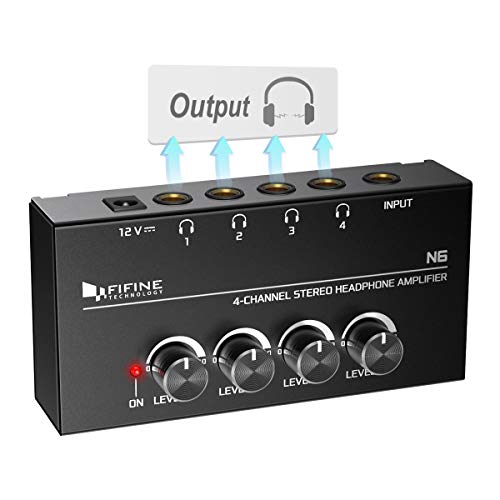
Best Value 4-Channel Option – FIFINE N6
The FIFINE N6 is a compact four-output option for headphone distribution amplifiers for small setups. It shares one stereo source across four headphones, provides separate volume knobs, and includes a 12V DC power adapter.
Best For: Home studios, stage monitoring, computer audio, or TV listening with up to four people sharing a source.
Pros:
- Four 1/4-inch stereo headphone outputs with independent volume controls
- Metal construction with smoothly operating knobs
- Designed for low noise and minimal distortion at high volume
- 12V DC power adapter and power indicator included
Cons:
- Input and outputs use 6.35mm ports, so adapters or suitable cables may be needed
- TRS/TS cables are not included
- It is a one-input, four-output amplifier, not a mixer
The N6 is a practical fit when four listeners need independent monitoring from one stereo source. Confirm your cable requirements before buying, especially if your source uses a different connector.
Best for Six Listeners – LZSIG LHA2 6-Channel Amp
The LZSIG LHA2 expands beyond the usual four-output format, making it useful among headphone distribution amplifiers for small setups that may need room to grow. It offers six independently controlled outputs, 1/8-inch and 1/4-inch compatibility, and selectable stereo/mono operation.
Best For: Home studios, shared monitoring, and small stage setups requiring up to six headphone connections.
Pros:
- Six outputs with independent level controls
- Compatible with 3.5mm and 6.35mm TS/TRS connections
- Includes stereo/mono switching and a bass-boost function
- Solid metal chassis and heavy-duty control knobs
Cons:
- Its extra channels may be unnecessary for four-person setups
- Bass boost changes the listening character and may not suit every monitoring task
- Designed for headphones in the stated 32–100Ω range
The LHA2 is the most flexible choice here for groups that need six outputs or mixed connector support. Its extra controls are useful, but a simpler four-channel unit may be easier to justify for smaller sessions.
Best Portable Budget Choice – Pyle PHA40 4-Channel Amp
The Pyle PHA40 is a compact four-channel option for headphone distribution amplifiers for small setups. It powers up to four pairs of headphones from one source and gives each listener a dedicated rotary volume control.
Best For: Portable studio or stage applications where four people need to monitor the same mix.
Pros:
- Drives up to four headphones simultaneously
- Independent volume controls for each output
- Four 1/4-inch stereo headphone outputs and a 1/4-inch input
- Compact size is convenient for travel and on-stage use
Cons:
- Uses a plastic enclosure
- All connections are 1/4-inch, which may require adapters for smaller plugs
- Limited to four channels
The PHA40 keeps the feature set focused on basic multi-listener monitoring. It is worth considering when portability and four independent headphone levels are the main priorities.
Maximum-Capacity Choice – Bolanle PH800 16-Output Headphone Amplifier
For bands, rehearsal spaces, and larger recording setups, the Bolanle PH800 is one of the more expansive headphone distribution amplifiers for small setups. It provides eight 3.5mm and eight 6.35mm outputs, with a mono/stereo switch and support for headphones up to 250Ω.
Best For: Band rehearsals, studio monitoring, live performances, and recording sessions needing many headphone connections.
Pros:
- Offers 16 total outputs across 3.5mm and 6.35mm connections.
- Designed to drive high-impedance headphones up to 250Ω.
- Includes mono/stereo switching and individual volume control.
- Rugged metal housing and an illuminated seven-color volume knob.
Cons:
- Its eight-channel layout may be more capacity than a very small setup requires.
- It requires a wired connection and a DC 12V/2A power supply.
- No wireless operation or noise-control feature is listed.
The PH800 makes the most sense when output count is the priority. Its combination of broad headphone compatibility, dual connector formats, and mono/stereo flexibility suits shared monitoring duties better than minimalist desktop use.
Compact Studio Pick – Fosi Audio PH05 5-Channel Headphone Amplifier
The Fosi Audio PH05 is a practical middle ground for headphone distribution amplifiers for small setups. Its five independently amplified stereo channels, separate level controls, and support for 16–300Ω headphones make it suitable when several listeners need personalized monitoring.
Best For: Small studios, podcasts, teaching, shared listening, and monitoring with different headphone types.
Pros:
- Connects up to five sets of headphones simultaneously.
- Each channel has independent amplification and level control.
- Supports headphones and IEMs from 16 to 300Ω.
- Provides a master volume control and one-touch mute button.
Cons:
- Offers fewer outputs than larger eight-channel models.
- It is a wired unit that requires the included 12V power adapter.
- Its compact channel count may not suit larger bands or full studio sessions.
The PH05 is a balanced choice for compact monitoring stations. Independent controls are especially useful when listeners use different headphones or prefer different volume levels, while its aluminum construction keeps the unit substantial without making it bulky.
Flexible Eight-Channel Option – STABCL Stereo Headphone Amp Splitter
For buyers comparing headphone distribution amplifiers for small setups, the STABCL eight-channel model combines broad output capacity with straightforward controls. It provides eight stereo amplifier channels, independent volume knobs, mono/stereo switching, and support for both 1/4-inch and 1/8-inch connections through the included adapters.
Best For: Home studios, recording spaces, stage use, and portable setups requiring eight separately controlled outputs.
Pros:
- Provides eight stereo output channels with individual volume controls.
- Includes nine 6.35mm-to-3.5mm jack adapters for connection flexibility.
- Offers mono/stereo switching for different source and monitoring needs.
- Aluminum-alloy construction and a 12V AC adapter support stable use.
Cons:
- 1/8-inch devices require a conversion plug, according to the product notes.
- The included power adapter is required for operation.
- The supplied information does not specify a supported headphone impedance range.
The STABCL is a useful fit when eight listeners need their own volume adjustment and connector compatibility matters. Its adapter bundle adds convenience, while the compact metal design keeps it practical for home, studio, or mobile use.
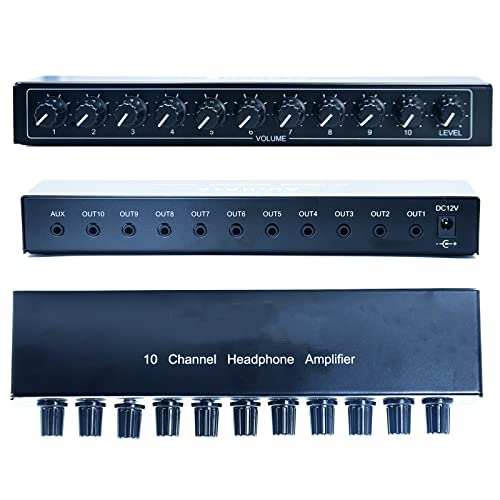
Best for Large Monitoring Groups – Arklove HP10 10-Channel Headphone Amplifier
For small studios that need flexible headphone distribution amplifiers for small setups, the Arklove HP10 provides multiple independently controlled outputs in a compact metal enclosure. It supports 3.5 mm headphones directly, while 6.35 mm headphones can be connected with an adapter.
Best For: Recording sessions or stage monitoring where several listeners need the same main mix with individual volume control.
Pros:
- Offers up to 10 independently controlled headphone outputs.
- Compact 9.8 x 2 x 1.1-inch design is convenient for studio and stage use.
- Includes a power switch, 3.5 mm headphone output, 12V DC adapter, and an 18-month warranty.
Cons:
- Only four pairs of headphones are described as being powered simultaneously, despite the 10-channel designation.
- 6.35 mm headphones require a separate 3.5 mm-to-6.35 mm adapter.
The HP10 is a practical choice when individual volume adjustment matters more than a minimalist connection count. Its compact size and multiple outputs make it especially useful for shared monitoring during recording.
Best for Versatile Connections – S-600 6-Channel Stereo Headphone Amp
The S-600 is one of the more flexible headphone distribution amplifiers for small setups, with both 3.5 mm and 6.35 mm input and output options. Six stereo channels, independent volume controls, and a mono/stereo switch make it suitable for compact recording or playback systems.
Best For: Home studios, portable rigs, and small production setups that need mixed connector support and selectable mono or stereo operation.
Pros:
- Provides six high-power stereo amplifier channels with separate volume controls.
- Accepts and distributes audio through both 3.5 mm and 6.35 mm connections.
- Aluminum-alloy construction, included 12V AC adapter, and mono/stereo switching add practical flexibility.
Cons:
- Its 1.28-pound weight and larger package dimensions make it less compact than the smallest four-channel options.
- The listed power supply is a 12V AC adapter, so users should account for the included adapter when planning their setup.
With six independently adjustable outputs and broad plug compatibility, the S-600 is a strong fit for setups that connect a variety of headphones. The mono/stereo control is also useful when sources or monitoring requirements vary.
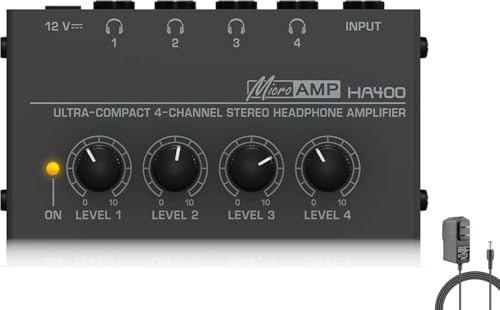
Best Compact Four-Channel Option – HA400 Mini Stereo Headphone Amplifier
For a straightforward small rig, the HA400 is a compact headphone distribution amplifier for small setups that powers up to four pairs of headphones. Its four stereo amplifier channels provide separate output-level control, making it useful for basic recording, rehearsal, and shared listening applications.
Best For: Small studios, bands, home karaoke, and stage applications where four listeners need independent volume adjustment.
Pros:
- Four high-power stereo amplifier channels support up to four headphones.
- Each channel has its own output-level control.
- Small 4.07 x 1.18 x 2.24-inch metal design is easy to carry and includes a 12V DC adapter.
Cons:
- It provides fewer channels than the six- and 10-channel alternatives.
- The listed headphone jack is 6.35 mm, so users with 3.5 mm headphones may need an adapter.
The HA400 keeps the feature set focused and the footprint small. It is a sensible pick when four independently controlled headphone feeds are enough and portability is a priority.
How We Picked the Best Headphone Distribution Amplifiers for Small Setups
We focused on compact, readily usable amplifiers designed to distribute one stereo source to multiple headphones. Selection criteria included channel and output count, 3.5mm and 6.35mm connector support, metal or portable construction, power arrangements, advertised headphone compatibility, and suitability for common small-room workflows.
Because product listings vary in how they describe channels and outputs, verify the manufacturer’s specifications before buying—especially when a listing combines several connector types or uses adapters to increase the total number of listening points.
Quick Comparison
| Setup need | Recommended configuration | What to prioritize |
|---|---|---|
| Two to four listeners | 4-channel amplifier | Compact size, independent volume controls, standard input |
| Podcast or rehearsal group | 5- or 6-channel amplifier | Reliable power, clear labeling, enough output headroom |
| Larger shared listening setup | 8- or 10-channel amplifier | Output count, connector flexibility, stable desktop placement |
| Mixed headphone connectors | 3.5mm/6.35mm-compatible model | Included adapters and secure jack fit |
Key Buying Factors
Output Count and Control
Choose more outputs than your normal listener count if you expect guests or occasional expansion. Separate volume controls are important because headphones differ in sensitivity and impedance. A shared master level is convenient, but it should not be the only adjustment available.
Inputs, Outputs, and Adapters
Most small distribution amplifiers accept a stereo line-level source through a 3.5mm or 6.35mm connection. Match the input to your mixer, interface, phone, or computer, and check whether the package includes the adapters you need. Avoid assuming that every jack is electrically identical simply because it looks similar.
Power and Placement
Many multi-output units use a 12V adapter, while portable models may suit mobile or temporary setups better. Confirm the power supply is included and allow ventilation around the unit. A metal enclosure can improve durability, but it does not replace sensible cable management or careful level setting.
Headphone Compatibility
Check the amplifier’s stated impedance range when using high-impedance studio headphones. For ordinary low- to mid-impedance headphones and earbuds, output availability and volume control are usually more important. Balanced headphones also require particular attention: standard distribution amps generally use unbalanced stereo connections.
Who Should Buy Which Headphone Distribution Amplifiers for Small Setups?
Home Musicians and Small Podcast Teams
A four- to six-channel model is usually the most practical balance of size, cost, and capacity. It provides enough monitoring positions without adding unnecessary cabling.
Teachers, Rehearsal Leaders, and Audio-Sharing Users
Choose a higher-output-count unit when several people need to listen at once. Prioritize clearly labeled controls and sturdy construction over features you will not use.
Traveling or Temporary Setups
Look for a compact amplifier with a familiar input, simple power requirements, and included adapters. Keep a spare source cable and headphone adapter available so connector differences do not interrupt a session.
For most buyers, the right choice is the smallest model that provides one extra output beyond today’s needs, independent volume control, and direct compatibility with the source and headphones already in use.