Sharing one audio source with multiple listeners does not have to mean sacrificing volume control, connection flexibility, or sound quality. The right headphone distribution amplifier can make a desktop setup, rehearsal room, recording space, or listening station easier to manage.
This roundup compares 10 options across compact, portable, and multi-channel designs, with attention to output count, connector compatibility, power, controls, and practical everyday use.
Best 10 Headphone Distribution Amplifiers for Audiophiles Picks for 2026
Professional Stage Hub

- Eight headphone amplifier channels
- TRS connectivity for studio setups
- Built for stage and studio use
Best For: Multi-listener professional monitoring
Class A Desktop Pick

- Compact two-channel design
- 3.5mm and 6.35mm support
- Upgradeable op-amp socket
Best For: Personal desktop listening and DIY tuning
Simple Session Splitter

- Four independent headphone outputs
- Individual volume controls
- Compact metal enclosure
Best For: Small rehearsals and tracking sessions
High-Capacity Monitoring Choice

- 16 outputs in two connector sizes
- Supports headphones up to 250Ω
- Mono/stereo monitoring switch
Best For: Bands and studios with many listeners
Rack-Ready Studio Hub
8-Channel Headphone Distribution Amplifier

- Eight channels with 16 headphone outputs
- Mono/stereo modes and flexible input routing
- 1U rack design with LED metering
Best For: Professional studio and live monitoring systems
Compact Hi-Fi Splitter
LZSIG 4-Channel Headphone Amplifier
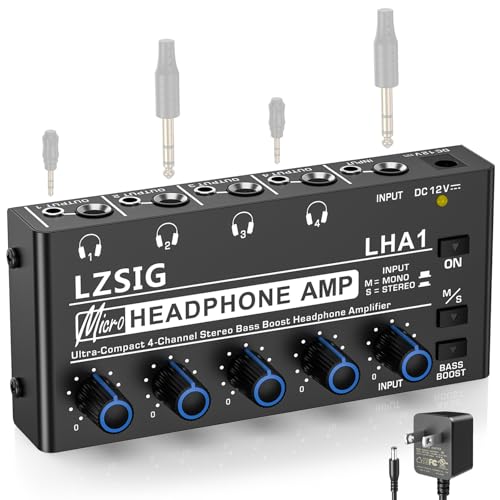
- Four independent headphone outputs
- 3.5mm and 6.35mm input compatibility
- Stereo/mono switching and bass boost
Best For: Home studios and portable shared monitoring
Simple Session Monitor
Pyle PHA40 4-Channel Amplifier

- Four individually controlled headphone outputs
- Compact design for studio or stage use
- 1/4-inch TRS input and output connections
Best For: Basic four-person recording and rehearsal monitoring
Six-Channel Studio Choice
LZSIG LHA2 6-Channel Headphone Amplifier

- Six independently controlled headphone outputs
- 3.5mm and 6.35mm TS/TRS compatibility
- Selectable bass boost and stereo/mono modes
Best For: Home studios and shared monitoring with up to six headphones
Maximum Output Capacity
STABCL S-800 8-Channel Headphone Amplifier

- Eight independently controlled stereo channels
- Includes nine 6.35mm-to-3.5mm conversion plugs
- Aluminum-alloy CNC unibody construction
Best For: Studios and sessions needing up to eight headphone feeds
Flexible Six-Output Setup
STABCL S-600 6-Channel Headphone Amplifier

- Six individually controlled stereo outputs
- 3.5mm and 6.35mm inputs and outputs
- Metal build with stereo/mono switching
Best For: Mixed-connector studio and home listening setups
Professional Stage Hub – Behringer HA8000 V2
For teams comparing headphone distribution amplifiers for audiophiles and studio users, the Behringer HA8000 V2 stands out for its eight-channel design and professional stage and studio orientation. Its TRS connectivity and corded operation make it suited to centralized monitoring setups.
Best For: Professional stage, rehearsal, and studio applications requiring multiple headphone channels.
Pros:
- Provides eight headphone amplifier channels.
- Designed for stage and studio applications.
- Uses TRS audio input and output connections.
- Promises high-quality sound with a broad range of headphones.
Cons:
- Its rack-oriented, multi-channel format may be more than needed for casual desktop listening.
- Requires corded electric power.
The HA8000 V2 is a practical choice when several performers or listeners need independent headphone amplification in a professional environment. Choose it over a compact desktop unit when channel capacity is the priority.
Class A Desktop Pick – Douk Audio U3 Headphone Amp
The Douk Audio U3 is a compact option for shoppers seeking headphone distribution amplifiers for audiophiles in a home or office desktop system. It combines RCA input, 3.5mm and 6.35mm headset support, and a Class A output stage in a small freestanding enclosure.
Best For: Desktop listeners who want a compact amplifier with strong drive capability and op-amp upgrade flexibility.
Pros:
- Supports both 3.5mm and 6.35mm headphones.
- Class A circuit uses a TI NE5532 op amp and high-current output transistor.
- Designed to drive many high-impedance headphones, including models up to the listed examples.
- Pluggable op-amp socket adds DIY upgrade flexibility.
Cons:
- Provides two channels rather than a large multi-listener distribution system.
- Requires a 5–20V DC power input.
With its small footprint, warm sound description, and upgradeable design, the U3 is aimed at personal listening rather than group monitoring. It is especially appealing to desktop audiophiles who enjoy experimenting with components.
Simple Session Splitter – Mackie HM-4 4-Channel Amp
The Mackie HM-4 is a straightforward choice among headphone distribution amplifiers for audiophiles who need to share one source with a small group. Its four independent outputs give each listener a separate volume control, while the compact metal enclosure fits easily on a desk, rack, or stand.
Best For: Tracking sessions, rehearsals, and compact setups with up to four listeners.
Pros:
- Drives four headphones from a 1/4-inch or 1/8-inch source output.
- Provides independent level control for each listener.
- Compact metal build can be placed or secured in tight spaces.
- Offers plug-and-play operation without power-supply complications.
Cons:
- Has only four outputs.
- Its feature set is focused on splitting and volume control rather than advanced monitoring functions.
The HM-4 makes sense when ease of use and independent listener volume matter more than extensive channel capacity. It is a compact, practical solution for small recording and rehearsal environments.
High-Capacity Monitoring Choice – Bolanle PH800 16-Output Amp
The Bolanle PH800 targets buyers comparing headphone distribution amplifiers for audiophiles, bands, and studios that need many simultaneous connections. It offers eight 3.5mm and eight 6.35mm outputs, plus mono/stereo switching and support for headphones up to 250Ω.
Best For: Bands, recording sessions, live sound checks, and studios needing numerous headphone connections.
Pros:
- Provides 16 total outputs across 3.5mm and 6.35mm connections.
- Designed to drive high-impedance headphones up to 250Ω.
- Mono/stereo switching supports different monitoring workflows.
- Metal housing and a seven-color LED volume indicator suit dim studio or stage environments.
Cons:
- Requires a DC 12V/2A power supply.
- Wired operation does not provide wireless connectivity.
- Its large output capacity may be unnecessary for individual listeners.
The PH800 is the most capacity-focused option in this group, combining numerous outputs with high-impedance headphone support. It is best suited to organized group monitoring rather than a simple personal desktop system.
Rack-Ready Studio Hub – 8-Channel Headphone Distribution Amplifier
For audiophiles and studio users comparing headphone distribution amplifiers for audiophiles, this 1U rack-mount model emphasizes flexible monitoring. It provides eight independently controlled channels, dual input routing, mono/stereo operation, and 16 front-and-rear headphone outputs.
Best For: Professional studios, live-sound monitoring, and setups where up to eight listeners need separate mixes or level control.
Pros:
- Supports up to 16 headphones across eight channels.
- Offers mono/stereo modes, IN1/IN2 switching, and dedicated rear inputs.
- Includes six-segment LED meters, overload protection, and independent volume controls.
- Uses a durable 1U metal rack-mount design.
Cons:
- The rack-mount format is less convenient for casual desktop use.
- Its extensive routing and metering may be more than a simple splitter setup requires.
This is the most capable choice of the group for multi-channel monitoring, particularly when routing flexibility, real-time level visibility, and rack integration matter more than portability.
Compact Hi-Fi Splitter – LZSIG 4-Channel Headphone Amplifier
The LZSIG LHA2 is a practical pick among headphone distribution amplifiers for audiophiles who need shared monitoring without a large rack unit. Its four independently controlled outputs accept both 3.5mm and 6.35mm connections and are designed for low-noise stereo listening.
Best For: Home studios, small recording sessions, and portable setups sharing one source with up to four listeners.
Pros:
- Drives up to four pairs of 32–100Ω headphones.
- Provides independent volume control for every channel.
- Accepts 3.5mm and 6.35mm TS/TRS plugs.
- Includes stereo/mono switching and a selectable bass-boost function.
Cons:
- It is a four-output amplifier rather than a mixer.
- The bass-boost function may not suit listeners seeking strictly flat playback.
With its compact metal chassis, broad connector compatibility, and individual level controls, the LHA2 is a versatile solution when four-person monitoring is enough and portability is valuable.
Simple Session Monitor – Pyle PHA40 4-Channel Amplifier
The Pyle PHA40 keeps headphone distribution straightforward for audiophiles and recording users who need four listeners on one source. This compact wired unit offers four 1/4-inch stereo outputs, individual level controls, and a 1/4-inch input for a mixer or other compatible source.
Best For: Basic studio or stage monitoring where four people need separate headphone volume adjustments.
Pros:
- Powers up to four headphones simultaneously.
- Gives each listener an independent rotary volume control.
- Compact dimensions make it convenient for travel and small workspaces.
- Uses four 1/4-inch TRS outputs and a 1/4-inch TRS input.
Cons:
- It uses a plastic enclosure rather than a metal chassis.
- Its connection options are less versatile than models supporting 3.5mm plugs.
The PHA40 is a sensible entry-level distribution option for uncomplicated four-person monitoring, especially when small size and individual volume control are the main priorities.
Six-Channel Studio Choice – LZSIG LHA2 6-Channel Headphone Amplifier
For audiophiles comparing headphone distribution amplifiers, the LZSIG LHA2 is a compact six-output option designed for shared monitoring. It combines independent level controls, stereo/mono switching, 3.5mm and 6.35mm compatibility, and a selectable bass boost in a metal chassis.
Best For: Home studios, shared listening, and small recording or stage setups needing six independently controlled headphone feeds.
Pros:
- Six independent headphone outputs with separate volume controls.
- Supports 3.5mm and 6.35mm TS/TRS headphone plugs without an adapter.
- Offers stereo/mono switching and a selectable bass-boost function.
- Metal construction, low-noise circuitry, and compatibility with sources including PCs, phones, interfaces, and mixers.
Cons:
- Designed for headphones in the 32–100Ω range.
- The bass-boost function changes the tonal balance and may not suit neutral listening.
- Provides six outputs, fewer than some larger distribution amplifiers.
The LZSIG is a practical fit when six listeners need convenient individual level adjustment and broad plug compatibility. Its bass boost and stereo/mono controls add flexibility, while the compact metal build suits desk or mobile studio use.
Maximum Output Capacity – STABCL S-800 8-Channel Headphone Amplifier
Among headphone distribution amplifiers for audiophiles, the STABCL S-800 stands out for its eight-channel capacity. Its metal construction, independent output controls, mono/stereo switch, and included 6.35mm-to-3.5mm adapters make it suited to multi-person studio monitoring.
Best For: Recording studios, rehearsals, and other setups where one source must feed up to eight headphones.
Pros:
- Eight high-power stereo amplifier channels with individual volume controls.
- Functions as a one-input, eight-output audio distributor.
- Includes nine 6.35mm-to-3.5mm conversion plugs for broader headphone compatibility.
- Aluminum-alloy CNC unibody construction provides a sturdy, portable design.
Cons:
- The 1/8-inch device requires a conversion plug.
- It uses an included 12V AC adapter rather than being battery powered.
- Its eight-channel layout may be more capacity than smaller sessions require.
The S-800 is the strongest choice here for maximizing simultaneous headphone connections. It adds useful individual control and flexible plug support, though users with only a few listeners may prefer a smaller unit.
Flexible Six-Output Setup – STABCL S-600 6-Channel Headphone Amplifier
The STABCL S-600 is a flexible pick among headphone distribution amplifiers for audiophiles who want six independently adjustable outputs without choosing a single connector format. It accepts and distributes audio through both 3.5mm and 6.35mm inputs and outputs, with stereo/mono switching for different source configurations.
Best For: Portable studio rigs, recording rooms, and home setups using a mix of 3.5mm and 6.35mm equipment.
Pros:
- Six high-power stereo channels with separate volume controls.
- Provides both 3.5mm and 6.35mm input and output connections.
- Includes stereo/mono switching and can distribute one source to six outputs.
- Aluminum-alloy metal construction and included 12V AC power supply support stable operation.
Cons:
- Requires external 12V AC power.
- Six outputs may not be enough for larger ensemble sessions.
- The product notes describe simulated stereo operation for mono input rather than a true stereo source.
The S-600 balances capacity and connection flexibility well. Its dual-format input and output layout is especially convenient when a setup mixes consumer and studio headphone plugs, while individual controls simplify shared listening.
How We Picked the Best Headphone Distribution Amplifiers for Audiophiles
We selected these Headphone Distribution Amplifiers for Audiophiles by comparing their channel counts, input and output formats, amplification features, power requirements, physical design, and intended use. The list includes compact four-channel splitters, desktop headphone amps, and larger eight-channel units suited to studios or group listening.
Because product listings vary in the level of technical detail provided, buyers should verify impedance support, included cables, connector types, and power-supply requirements before ordering. A high output count is useful only when it matches the headphones and workflow you actually use.
Quick Comparison
- Best for large groups: Eight-channel models with multiple 6.35mm and 3.5mm outputs.
- Best for small desktop setups: Compact four-channel amplifiers with simple stereo inputs.
- Best for portability: Mini units powered by USB or a compact external adapter.
- Best for studio routing: Rack-friendly distribution amplifiers with individual level controls and professional connectors.
- Best for flexible connections: Models offering both 3.5mm and 6.35mm compatibility, especially when several headphone styles are in use.
Key Buying Factors for Headphone Distribution Amplifiers for Audiophiles
Output Count and Layout
Choose the number of independent headphone outputs based on your maximum listening group, not just your current setup. Four outputs suit most home and desktop applications, while six- and eight-channel designs are more practical for teaching, recording, rehearsals, and shared listening.
Power and Impedance Support
Check whether the amplifier can drive your headphones comfortably at clean listening levels. Sensitive headphones need less power, while high-impedance models may benefit from stronger amplification. Individual volume controls are particularly valuable because listeners rarely prefer the same level.
Connections and Channel Behavior
Confirm whether the input is RCA, 3.5mm, 6.35mm, or another format, and whether adapters are included. Stereo operation is the default for music, but mono or link functions can be useful for monitoring and certain production workflows.
Build and Power Requirements
Metal housings, stable controls, and clear labeling matter when a unit will be used frequently. Also consider whether the amplifier needs mains power, USB power, or a 12V adapter, particularly if you plan to move it between rooms or use it in a mobile rig.
Who Should Buy Which Headphone Distribution Amplifiers for Audiophiles?
Desktop listeners and casual home users should prioritize a compact model with straightforward stereo input, convenient volume controls, and the connectors their headphones already use. Families, classrooms, and small teams will usually benefit from a four- or six-channel unit that balances size with enough independent outputs.
Recording engineers, rehearsal spaces, and larger listening groups should look for eight-channel distribution amplifiers, robust construction, and clear per-channel level adjustment. If you use demanding headphones or frequently switch between 3.5mm and 6.35mm plugs, verify both the claimed power capability and the included adapters before buying.