The best voice recorders for musicians make it easier to capture song ideas, rehearsals, live performances, interviews, and location sound before inspiration disappears. The right model depends on whether you need quick voice memos, high-quality stereo recording, multitrack inputs, or reliable clipping protection.
This roundup covers compact handheld recorders, USB-capable field units, and flexible multitrack options so you can match recording quality and workflow to your music-making needs.
Best 10 Voice Recorders for Musicians Picks for 2026
Best Multitrack Pick

- Four-track recording with bounce and undo
- 32-bit float clip-free capture
- Built-in rhythms, effects, and USB interface
Best For: Layered demos and portable songwriting
Best All-Purpose Handheld

- Four-track recording for music and media
- Two XLR/TRS inputs plus stereo mics
- USB-C recording with SD-card backup
Best For: Performances, instruments, and versatile field recording
Best Budget Voice Memo Recorder

- 64GB storage in a compact metal body
- Voice activation with adjustable sensitivity
- WAV/MP3 recording and USB-C file transfer
Best For: Song ideas, spoken notes, and everyday recording
Best Built-In Mic Flexibility

- Three mics with nine recording patterns
- 32-bit float/96kHz clip-free capture
- USB microphone mode with SD backup
Best For: Room sound, rehearsals, and wide stereo recording
Best Value Pick

- 32-bit float and MP3/WAV recording
- 125dB SPL omnidirectional microphones
- USB-C 2-in/2-out audio interface
Best For: Portable rehearsal, songwriting, and general music recording
Best for Multitrack Recording

- Large 19.4mm X/Y stereo microphones
- Up to four tracks at 192kHz WAV
- Two XLR/TRS inputs and USB interface
Best For: Musicians recording multiple sources or tracks on location
Best Compact All-Rounder

- Stereo 32-bit float recording up to 96kHz
- 130dB SPL X/Y microphones
- USB microphone, auto-record, and pre-record modes
Best For: Portable music, podcasting, and USB-connected recording
Professional Clip-Free Recording

- 32-bit float recording helps prevent clipped takes
- Two locking XLR/TRS inputs
- Low-noise preamps and flexible power options
Best For: Musicians and recordists using external microphones
Versatile Six-Track Studio Companion

- Six-track 32-bit float recording
- Four XLR/TRS inputs plus X/Y microphones
- USB interface with simultaneous SD backup
Best For: Bands and creators recording multiple sources
Expandable Four-Track Value
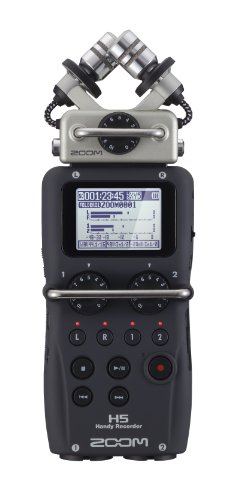
- Four-track simultaneous recording
- Interchangeable microphone capsules
- Two XLR/TRS inputs with phantom power
Best For: Portable stereo and small multitrack recording
Best Multitrack Pick – Zoom R4 Multi-Track Recorder
The Zoom R4 is a strong choice among voice recorders for musicians who want to build songs in layers rather than capture a single take. It combines four-track recording, two XLR/TRS combo inputs, clip-free 32-bit float recording, built-in effects, and rhythm patterns in a portable, battery-powered design.
Best For: Musicians developing song ideas, demos, and layered arrangements without a computer.
Pros:
- Records, bounces, and expands up to four tracks with undo support.
- 32-bit float recording helps avoid clipping without constant gain adjustments.
- Includes over 80 rhythm patterns plus effects and built-in stereo microphones.
- Works as a USB audio interface and runs on AA batteries or USB-C.
Cons:
- Its multitrack workflow may be more than needed for simple voice memos.
- The recorder uses four AA batteries, which adds to travel requirements.
Choose the R4 if your priority is arranging and layering musical parts on the go. Its inputs and clip-free recording make it flexible for vocals, instruments, and quick songwriting sessions.
Best All-Purpose Handheld – Zoom H4 Essential Recorder
The Zoom H4 Essential is a versatile option among voice recorders for musicians who need to capture rehearsals, live performances, interviews, or external sources. Its built-in stereo microphones work alongside two XLR/TRS inputs, while 32-bit float recording helps protect takes from distortion.
Best For: Musicians and creators recording performances, instruments, podcasts, or sound through a mixer.
Pros:
- Supports four-track recording for larger creative projects.
- Offers built-in stereo microphones and two XLR/TRS inputs.
- 32-bit float capture helps handle quiet and loud sources without clipping concerns.
- Can record or stream over USB-C while saving a backup to an SD card.
Cons:
- Its broader feature set may be unnecessary for basic dictation.
- Runs on two AA batteries, so battery life depends on having replacements available.
The H4 Essential is a balanced pick when one recorder needs to cover music, spoken audio, and field work. It offers more connection flexibility than a basic handheld recorder while retaining built-in microphones for fast setup.
Best Budget Voice Memo Recorder – EVISTR L357 Digital Recorder
The EVISTR L357 is a practical alternative to larger audio recorders for musicians who mainly need quick voice notes, rehearsal reminders, or lecture-style recordings. It offers a built-in microphone, voice activation, adjustable gain, MP3/WAV recording, and 64GB of storage in a compact metal body.
Best For: Songwriters, students, and musicians who want a simple recorder for ideas, meetings, and spoken notes.
Pros:
- Compact design with 64GB storage for extended recording capacity.
- Voice activation can reduce silent sections and conserve storage.
- Supports WAV and MP3 recording with playback speed and A-B repeat controls.
- USB-C transfer works with Windows and Mac computers.
Cons:
- It is designed around a built-in microphone rather than XLR/TRS instrument connections.
- Its feature set is less suited to multitrack music production.
For musicians who want to capture melodies and spoken ideas without managing inputs or tracks, the L357 keeps the process straightforward. It is best viewed as a portable voice-note and general-purpose recorder rather than a studio multitracker.
Best Built-In Mic Flexibility – Zoom H2 Essential Recorder
The Zoom H2 Essential stands out among voice recorders for musicians who want flexible built-in microphone coverage. Its three microphones and nine selectable patterns support mono, stereo, and surround recording, while 32-bit float capture provides clip-free recording for changing sound levels.
Best For: Musicians recording rehearsals, room sound, acoustic performances, and wide stereo or surround perspectives.
Pros:
- Three built-in microphones provide nine recording patterns.
- Captures up to 32-bit float/96kHz audio without manual gain adjustment.
- Works as a USB microphone while recording a backup to an SD card.
- Supports Bluetooth timecode synchronization for multiple H2 Essential units.
Cons:
- It does not list XLR/TRS inputs for connecting external microphones or instruments.
- Its specialized microphone-pattern options may take time to learn.
The H2 Essential is a compelling fit when microphone placement and room coverage matter more than multitrack input connections. Its pattern selection gives musicians several ways to capture a performance with one handheld unit.
Best Value Pick – TASCAM DR-05XP
For musicians seeking practical voice recorders for musicians, the TASCAM DR-05XP combines stereo built-in microphones, flexible recording formats, and 32-bit float capture in a compact handheld design. It can also serve as a USB-C audio interface for recording directly to a computer.
Best For: Musicians who want a lightweight recorder for rehearsals, songwriting ideas, live sources, and computer-based recording.
Pros:
- Supports 32-bit float, 24-bit, 16-bit, WAV, and MP3 recording.
- Omnidirectional condenser microphones handle sources up to 125dB SPL.
- USB-C connectivity provides 2-in/2-out audio interface functionality.
- Offers up to 17.5 hours of operation on two AA batteries.
Cons:
- SD card and batteries are not included.
- Built-in microphones are omnidirectional rather than directional X/Y microphones.
The DR-05XP is a well-rounded choice when portability, straightforward operation, and flexible file-quality options matter more than multiple inputs.
Best for Multitrack Recording – Zoom H5 Studio
The Zoom H5 Studio is one of the more capable voice recorders for musicians in this lineup, pairing large 19.4mm X/Y microphones with 32-bit float recording and dedicated gain controls. Its multiple inputs and multitrack support make it suited to more involved musical setups.
Best For: Musicians and creators who need hands-on level control, multiple tracks, and professional recording flexibility in a portable unit.
Pros:
- Large 19.4mm X/Y microphone capsule is designed for detailed stereo audio.
- 32-bit float recording helps provide clip-free capture and extended dynamic range.
- Records up to four tracks simultaneously at up to 192kHz in WAV format.
- Includes two XLR/TRS inputs and a USB audio interface.
Cons:
- At 14.4 ounces, it is heavier than the other listed recorders.
- Requires four AA batteries, compared with two for the other models.
- Its broader feature set may be more than needed for simple voice memos.
Choose the H5 Studio when your recording plans extend beyond quick stereo captures and you want dedicated controls, additional inputs, and multitrack capability.
Best Compact All-Rounder – Xvive XV1-R
The Xvive XV1-R is a compact option among voice recorders for musicians, offering stereo 32-bit float recording, directional X/Y microphones, and automatic recording features. Its USB-C microphone mode also lets it connect to computers, tablets, smartphones, and other compatible devices.
Best For: Musicians, podcasters, and creators who want a lightweight recorder with flexible file formats and USB microphone functionality.
Pros:
- X/Y microphones capture audio up to 130dB SPL without distortion, according to the supplied specifications.
- Supports 32-bit float and 24-bit PCM WAV recording at sample rates up to 96kHz.
- Offers WAV and compressed AAC recording for balancing quality and storage space.
- Includes auto-record, pre-record, noise reduction, and USB microphone modes.
Cons:
- Does not include a headphone jack for direct monitoring.
- USB microphone mode uses a fixed 48kHz sample rate.
- Maximum listed battery and recording time is 12 hours.
The XV1-R stands out for flexible connectivity and compact portability, though the lack of a headphone jack may matter for musicians who need direct monitoring while recording.
Professional Clip-Free Recording – Zoom F3
For musicians seeking voice recorders for musicians that can handle unpredictable performances and rehearsals, the Zoom F3 offers a focused, professional setup. Its 32-bit float recording, dual A/D converters, and locking inputs are designed to help preserve clean audio without constant level adjustments.
Best For: Musicians and recordists using external microphones in demanding or unattended recording setups.
Pros:
- 32-bit float recording helps capture quiet passages and sudden peaks without clipping.
- Dual locking XLR/TRS inputs keep microphone connections secure.
- Ultra-low-noise preamps support clean recordings in uncontrolled environments.
- Flexible battery-powered and USB workflows suit long sessions and location work.
Cons:
- Its two-input design is less suitable for larger ensembles or complex multitrack setups.
- The recorder is designed around external microphones rather than a built-in stereo microphone workflow.
The F3 is a strong choice when recording reliability and clip-free capture matter more than having numerous inputs or interchangeable microphone options.
Versatile Six-Track Studio Companion – Zoom H6 Essential
The Zoom H6 Essential is a versatile option for musicians comparing voice recorders for musicians with multitrack needs. It combines built-in X/Y microphones with four XLR/TRS inputs, six-track 32-bit float recording, interchangeable capsules, and USB audio interface functionality.
Best For: Bands, solo performers, podcasters, and filmmakers recording several sources or connecting directly to a computer or mobile device.
Pros:
- Six-track 32-bit float recording provides clip-free capture across multiple sources.
- Four XLR/TRS combo inputs support vocals, instruments, and external microphones.
- Built-in X/Y microphones capture up to 135 dB SPL.
- Can record to an SD card while functioning as a USB audio interface.
Cons:
- Its four-AAA battery requirement may be less convenient for compact sessions.
- The larger feature set may be more than needed for simple voice memos or single-source recording.
Choose the H6 Essential when you want one recorder for rehearsals, live sources, multitrack projects, and computer-based recording, with capsule flexibility for changing setups.
Expandable Four-Track Value – Zoom H5
For musicians who want practical flexibility without moving to a larger recorder, the Zoom H5 is a capable option among voice recorders for musicians. It offers four-track recording, a detachable shock-mounted X/Y capsule, two XLR/TRS inputs, and USB interface operation.
Best For: Musicians and filmmakers who need a portable recorder for stereo capture, two external inputs, and occasional multitrack work.
Pros:
- Interchangeable input capsules adapt the recorder to different recording scenarios.
- Four-track simultaneous recording supports stereo microphones plus external sources.
- Two XLR/TRS inputs include selectable phantom power and a -20 dB pad.
- Works as a multichannel or stereo USB audio interface.
Cons:
- Its SD/SDHC storage support is listed up to 32GB.
- Compared with newer models, its listed digital recording time is 10 hours.
- It has fewer external inputs and tracks than the H6 Essential.
The H5 remains a sensible middle-ground recorder for musicians who value capsule expansion and straightforward four-track operation over the newer H6 Essential’s six-track, 32-bit float workflow.
How We Picked the Best Voice Recorders for Musicians
We focused on the features that matter most in real musical workflows: microphone quality, input flexibility, recording formats, portability, ease of use, monitoring, battery practicality, and computer connectivity. The selection includes simple voice-recording devices as well as dedicated field recorders with XLR inputs, multitrack capability, built-in effects, or 32-bit float recording.
Because musicians use recorders differently, we considered several scenarios, including capturing melodies, documenting rehearsals, recording acoustic instruments, making demos, sampling environmental sound, and recording performances. A good recorder should fit the job without forcing you to pay for controls or inputs you will not use.
Quick Comparison
- For quick ideas: Choose a compact handheld or digital voice recorder that starts quickly and offers straightforward playback.
- For stereo music recording: Look for quality built-in X/Y or adjustable microphones, WAV recording, and dependable headphone monitoring.
- For microphones and instruments: Select a model with XLR/TRS inputs, phantom power when required, and gain controls that are easy to reach.
- For unpredictable volume: 32-bit float recording can provide greater flexibility when recording levels are difficult to judge in advance.
- For demos and layered arrangements: A multitrack recorder with bouncing, overdubbing, or built-in effects can reduce the need for a computer.
Key Buying Factors for Voice Recorders for Musicians
Microphones and Input Options
Built-in stereo microphones are convenient for rehearsals, acoustic instruments, and live-room recordings. If you plan to use studio microphones, guitar pickups, mixers, or external preamps, prioritize XLR/TRS inputs and suitable gain control. Check whether phantom power is available before choosing condenser microphones.
Recording Quality and Headroom
WAV recording is preferable for editing and mixing, while compressed formats can save storage for casual notes. 32-bit float models are especially useful for sudden volume changes because they can make level recovery easier during editing, although microphone placement and distortion before the converter still matter.
Workflow and Connectivity
Consider startup speed, physical controls, screen visibility, file transfer, and whether the recorder works as a USB audio interface. A simple interface is valuable for songwriting; multitrack controls, overdubbing, and effects are more useful for building complete demos away from a computer.
Portability, Power, and Monitoring
For travel or live use, check size, battery type, storage support, wind protection options, and headphone output quality. A tripod mount or microphone stand compatibility can also improve recordings by reducing handling noise.
Who Should Buy Which Voice Recorders for Musicians?
Songwriters and students should favor a compact recorder that is fast to operate and easy to carry. Acoustic musicians and rehearsal recordists will benefit from a stereo handheld model with capable built-in microphones. Artists recording demos should consider multitrack features, overdubbing, effects, and multiple inputs. Field-recording musicians and filmmakers may prefer 32-bit float, strong preamps, and flexible USB connectivity. Musicians recording with external microphones or instruments should prioritize XLR/TRS inputs, phantom power, and reliable monitoring over basic dictation features.