If you want a compact mechanical board that keeps the desktop clear without giving up tactile feedback, the 60% Wired Mechanical Gaming Keyboard with Blue Switches is a straightforward fit.
It targets gamers, typists, and anyone who wants a portable, plug-and-play keyboard with a louder, clicky feel.
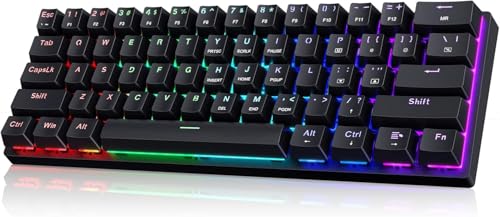
60% Mechanical Keyboard Review Summary
The case for this keyboard is simple: it combines a tiny 61-key footprint, blue mechanical switches, and rainbow backlighting in a format that is easy to carry and easy to use.
It suits buyers who value desk space, portable use, and tactile feedback more than silent operation or advanced customization.
The listing points to a keyboard built for fast movement and travel convenience.
The detachable Type-C cable helps portability, while the Fn+Space shortcut restores direction keys when the compact layout would otherwise feel restrictive.
That makes it more flexible than many bare-bones 60% boards.
What makes it worth considering is the balance of features rather than any single standout spec.
You get anti-ghosting, foldable kickstands, double-injection ABS keycaps, and compatibility with Windows, Mac, and other common setups.
For a budget-minded or space-conscious buyer, those are the right priorities.
Review Scorecard
| Category | Score | Rationale |
|---|---|---|
| Compact design | 9/10 | 61 keys free up mouse room and travel space. |
| Typing feel | 8/10 | Blue switches promise tactile, clicky feedback. |
| Lighting | 7/10 | 18 backlight effects and brightness levels add flexibility. |
| Portability | 8/10 | Detachable Type-C cable makes transport easier. |
| Gaming utility | 7/10 | Anti-ghosting and compact reach help fast input. |
| Everyday compatibility | 8/10 | Plug-and-play support covers common desktop platforms. |
| Comfort | 7/10 | Stair-step keycaps and kickstands aim to reduce fatigue. |
Key Features and Specifications of 60% Mechanical Keyboard
The core specification is the 61-key layout.
That is the main reason to buy this board, because it shrinks the keyboard footprint enough to open up desk space for a mouse or to fit better in a bag.
For FPS players or travelers, that compactness is not cosmetic; it is the product’s whole identity.
The switch type is another defining feature.
The board uses blue mechanical switches, which usually means a tactile bump and a pronounced click.
That makes it more satisfying for people who like clear actuation feedback, but it also makes it a poor match for shared spaces, late-night office use, or anyone who prefers a quiet board.
Lighting is more than decorative here.
The listing calls out 18 rainbow backlight effects, five brightness levels and speeds, and one customization mode.
That suggests a keyboard aimed at users who want visual variety rather than software-heavy RGB control.
Other practical details matter too:
- Detachable Type-C cable on the right side
- Fn+Space shortcut to switch to direction keys
- Double-injection ABS keycaps for clearer backlight
- Full anti-ghosting support
- Foldable kickstands and stair-up keycap design
- Plug-and-play operation with no driver or software requirement
- Compatibility with Windows, Mac OS, and Windows Vista
The compatibility claim is broad, which is useful for mixed-device homes or basic office setups.
The absence of driver software also lowers friction, especially if you just want to plug it in and get to work.
Pros and Cons of 60% Mechanical Keyboard
Pros
- Very compact 61-key layout that saves desk space
- Clicky blue switches for users who like strong tactile feedback
- Multiple backlight effects and adjustable brightness
- Detachable cable improves travel convenience
- Anti-ghosting supports faster multi-key input
- No software needed to start using it
Cons
- Blue switches are likely too loud for quiet environments
- 60% layouts can feel cramped if you rely on dedicated arrows and function keys
- The compact format may slow some office or spreadsheet workflows
- Lighting options are built in, but there is no sign of deeper software customization
- ABS keycaps and entry-level construction may not satisfy premium-keyboard buyers
The main tradeoff is obvious: this board saves space by removing keys. If you are already comfortable with 60% layouts, that is a benefit.
If you depend on arrow clusters, navigation keys, or function rows all day, the compact format can become a hassle.
Who Should Buy 60% Mechanical Keyboard?
This keyboard makes the most sense for gamers who want more mouse room on a small desk.
The 61-key layout and anti-ghosting support align well with quick input and low clutter.
It is also a reasonable choice for travelers, students, or hybrid workers who need a portable keyboard that does not require a software setup.
The detachable cable and plug-and-play design keep things simple.
Typists who enjoy audible blue switches may also like it, especially if they want a more mechanical, expressive feel than a membrane board can deliver.
The deeper key travel and tactile response should appeal to that audience.
You should probably skip it if you need a quiet office keyboard, depend on a full-size navigation cluster, or want advanced macro support and software-driven customization.
If you type in shared rooms, the clicky switch choice is a real downside, not a minor detail.
How the 60% Layout Feels in Use
Space-Saving Desk Setup
The biggest day-to-day advantage of a 60% board is the open desk space it creates.
That matters when you play low-sensitivity games, use a large mouse pad, or work from a cramped setup.
The keyboard stays out of the way and lets your right hand move more freely.
Blue Switch Feedback
Blue switches are about confirmation.
Each press should feel deliberate, with a click that tells you the key registered.
That is useful for typing rhythm and for users who dislike vague membrane travel.
The downside is equally clear: the sound profile is part of the experience, and not everyone will want that.
Lighting and Night Use
The 18 backlight effects and brightness controls are most useful in dim rooms.
The double-injection keycaps are meant to make the legends easier to read under lighting, which improves visibility and gives the board a more polished look than plain opaque caps.
Portable Control Scheme
The Fn+Space direction-key shortcut is a practical answer to the 60% layout problem.
It does not restore every missing key, but it does reduce the friction of going compact.
For users who learn the shortcuts, the layout becomes much easier to live with.
Alternatives to 60% Mechanical Keyboard
If you like the idea of a compact mechanical keyboard but want different tradeoffs, these are sensible alternatives:
The Royal Kludge RK61 is a good comparison point if you want the same compact idea with a more established 60% mechanical market presence.
Keychron K6 is the better look if you want a compact board with stronger mainstream appeal and broader keyboard enthusiast interest.
Redragon K617 is worth checking if you want a similar gaming-first budget lane.
HyperX Alloy Origins 60 is the more premium alternative if you want a polished compact gaming keyboard from a major peripheral brand.
Is 60% Mechanical Keyboard Worth It?
Yes, if you want a small wired mechanical keyboard with tactile switches and simple plug-and-play use. The layout, lighting, and portability features are all aligned around a clear goal: save space without making the board feel bare.
It is less compelling if you need silence, full-size navigation keys, or advanced customization.
But for gamers, travelers, and compact-desk users who specifically want a clicky 60% board, this one covers the basics well and does so without unnecessary complexity.