Loop stations can turn a single performer into a full-sounding setup, whether you are building practice layers, songwriting ideas, or live performance loops.
Below, we break down 10 strong options for different budgets and use cases, from simple stompbox loopers to advanced multi-track systems.
Best 10 Loop Stations Picks for 2026
Budget-Friendly Starter Loop Station

- Simple record, overdub, undo/redo workflow
- 12 minutes of stereo recording time
- Stereo in/out with memory retention
Best For: Beginners and players who want a simple, reliable looper
Value Bundle Loop Station

- RC-1 pedal bundled with power and cables
- 24-segment LED loop status indicator
- Simple stereo looper with 12-minute record time
Best For: New users who want the pedal and accessories together
Performance-Ready Dual-Track Looper
Sheeran Looper + Dual Track Pedal

- Dual-track looping with four modes
- Stores up to 128 loops with 3+ hours total audio
- USB audio interface plus mic input
Best For: Performers and creators who need advanced looping plus recording
Advanced All-Rounder Loop Station

- 32-bit processing with 13 hours of stereo recording
- 99 phrase memories plus built-in rhythms
- MIDI, USB, and external control support
Best For: Players who want premium looping features in a compact pedal
Pro-Grade Dual-Track Choice

- Dual-track looper with 99 phrase memories
- 32-bit audio processing for high-quality sound
- Built-in rhythms, Loop FX, and MIDI support
Best For: Live musicians and solo performers who want advanced looping control
Simple Budget Looping Pick

- 9 loops and up to 40 minutes of recording time
- 48K/24bit uncompressed audio with Analog-Dry-Through
- Built-in tuner and USB WAV import/export
Best For: Guitar and bass players who want a simple, affordable looper
Tabletop Creative Performance Pick

- Two stereo tracks with hands-on tabletop control
- Four input FX and four track FX for live shaping
- 64 phrase memories plus USB audio/MIDI
Best For: Club performers and beatboxers who want fingertip looping control
Tabletop Creator Hub

- Five stereo tracks for layered loops
- Two XLR mic inputs with phantom power
- Two stereo line input pairs for flexibility
Best For: Vocalists and tabletop performers needing a hands-on looper
Floor Performance Workhorse
BOSS RC-600 Floor-Based Loop Station
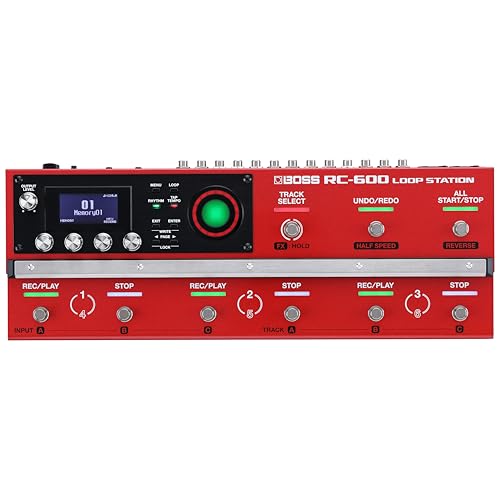
- Six stereo tracks for complex looping
- Nine assignable footswitches for live control
- 49 Input FX and 53 Track FX types
Best For: Live performers who need advanced floor-based looping control
Studio-Style Tabletop Pro
- Five stereo phrase tracks for layering
- 32-bit processing for professional-grade audio
- Two XLR mic inputs plus dual line inputs
Best For: Tabletop performers who want advanced effects and routing
Budget-Friendly Starter Loop Station – BOSS RC-1 Loop Station Pedal
If you want one of the most straightforward loop stations for guitar, bass, or keys, the BOSS RC-1 keeps things simple without feeling limited. It offers record, playback, overdub, and undo/redo in a compact stompbox, plus stereo I/O and up to 12 minutes of stereo recording time.
Best For: Players who want an easy, no-frills looper for practicing, layering ideas, and live basic looping.
Pros:
- Very user-friendly layout with an easy-to-read loop indicator
- Record, overdub, undo/redo, and playback in a compact pedal
- Stereo inputs and outputs for broader setup options
- Memory retains your phrase after power-off
Cons:
- Only 12 minutes of stereo record time
- Battery life is about 4.5 hours on the included 9V battery
- Advanced looping features are more limited than higher-end models
The RC-1 is a solid choice if you value speed and simplicity over deep editing. It covers the essential looping workflow cleanly, making it a practical first loop station or a dependable minimalist option.
Value Bundle Loop Station – Boss RC-1 Loop Station Bundle
This bundle puts the BOSS RC-1 loop station in a ready-to-play package, adding a power adapter, instrument cable, patch cable, and picks. The pedal itself keeps the same straightforward looping approach, with a circular 24-segment LED indicator, stereo I/O, and up to 12 minutes of stereo recording time.
Best For: Buyers who want the RC-1 plus useful starter accessories in one purchase.
Pros:
- Includes a power adapter, cable, patch cable, and picks
- 24-segment LED loop indicator is easy to read
- Simple operation with record, overdub, and play modes
- Stereo inputs and outputs for flexible connections
Cons:
- Still limited to 12 minutes of stereo recording time
- Battery-powered operation is described separately from the included adapter bundle
- Does not add advanced looping features beyond the core RC-1 design
If you are starting from scratch, this bundle makes the RC-1 easier to plug in and use right away. It is a practical pick for players who want a basic loop station and a few essential extras in one box.
Performance-Ready Dual-Track Looper – Sheeran Looper + Dual Track Pedal
The Sheeran Looper + is built for players who want a more advanced loop station with modern workflow and stage-friendly features. It offers single and dual-track modes, a full-color display, RGB loop status ring, USB recording and streaming, and internal storage for up to 128 loops with more than 3 hours of total audio.
Best For: Performers, streamers, and multi-instrument players who want flexible looping and easy loop storage.
Pros:
- Dual-track looper with four workflow modes: single, multi, sync, and song
- Save, load, and share loops with up to 128 stored loops
- USB connection works as a 2-in/2-out audio interface
- Mic input and stereo I/O support guitar, bass, keyboard, and vocals
Cons:
- Larger than a compact stompbox-style looper
- More features may be more than a casual user needs
- Requires more setup attention than a basic single-button looper
This is a strong choice if you need a loop station that goes beyond simple phrase stacking. The combination of dual-track control, storage, and USB audio makes it especially useful for live performance and home recording.
Advanced All-Rounder Loop Station – BOSS RC-5 Loop Station
The BOSS RC-5 is a feature-rich loop station for players who want serious recording capacity and modern control in a compact pedal. It includes 32-bit AD/DA and floating-point processing, up to 13 hours of stereo recording time, 99 phrase memories, built-in rhythms, MIDI I/O, USB connectivity, and a multi-color LCD for clear status monitoring.
Best For: Musicians who want a compact looper with high audio quality, deep storage, and rhythm support.
Pros:
- 32-bit audio processing for high-quality capture and playback
- Huge 13-hour stereo recording capacity with 99 phrase memories
- Built-in rhythms with 57 patterns and 7 drum kits
- MIDI, USB, and external control support for more complex setups
Cons:
- Single-track design may be less flexible than dual-track loopers
- Feature set may feel advanced for absolute beginners
- Requires optional adapter for non-battery power use
The RC-5 stands out as a compact but capable loop station for players who want more than the basics. Its combination of long record time, rhythms, and connectivity makes it a strong centerpiece for practice, composition, or performance.
Pro-Grade Dual-Track Choice – BOSS RC-500 Loop Station
If you want loop stations with serious performance control, the BOSS RC-500 is built for players who need more than a basic looper. Its dual-track design, advanced BOSS audio processing, onboard rhythms, and deep external control options make it a strong fit for structured live looping and layered compositions.
Best For: Live musicians, solo performers, and creators who want a dual-track loop station with deep control and onboard rhythm support.
Pros:
- Two-track looping with 99 phrase memories for saving and recalling ideas.
- 32-bit AD/DA conversion and 32-bit floating-point processing for high-quality audio.
- 16 drum kits and 57 preset rhythms with A/B variations for performance support.
- USB file management plus MIDI, footswitch, and expression pedal support.
Cons:
- More complex than a simple looper, so it may take time to learn.
- Requires a corded power setup rather than battery use.
The RC-500 stands out as a feature-rich loop station for players who want precision, memory, and performance tools in one unit. If you need a compact but advanced center for live looping, this model brings a lot to the table.
Simple Budget Looping Pick – LEKATO Looper Guitar Pedal
For buyers comparing loop stations on a tighter budget, the LEKATO Looper Guitar Pedal keeps the controls simple while still covering the essentials. It offers 9 loops, up to 40 minutes of total recording time, unlimited overdubs, and a built-in tuner, making it a practical option for straightforward practice and songwriting.
Best For: Guitar and bass players who want an easy-to-use looper with basic recording features and a built-in tuner.
Pros:
- 9 loops with up to 40 minutes of total recording time.
- 48K/24bit uncompressed audio and Analog-Dry-Through design.
- Built-in tuner for quick tuning between phrases.
- USB support for importing and exporting WAV loop files.
Cons:
- Single-button control is simple, but it may feel limited for more advanced users.
- Best suited to basic looping rather than deep performance editing.
The LEKATO is a good fit if you want a compact looper that handles core looping tasks without extra complexity. It focuses on ease of use, making it appealing for practice sessions and casual looping setups.
Tabletop Creative Performance Pick – BOSS RC-202 Loop Station
If you need loop stations for hands-on creative performance, the BOSS RC-202 is designed as a tabletop unit you operate with your hands. With two stereo tracks, four input FX, four track FX, and USB/MIDI connectivity, it is aimed at performers who want fast control for club-style looping and beat-based sets.
Best For: Club performers, electronic musicians, and beatboxers who want a tabletop loop station with hands-on control and performance effects.
Pros:
- Two simultaneous stereo tracks with dedicated controls and loop indicators.
- Four input FX and four track FX for DJ- and sampler-style processing.
- 64 phrase memories for saving loop setups and settings.
- USB audio/MIDI interface plus optional external control support.
Cons:
- Tabletop format is less convenient if you specifically want a foot-operated pedal.
- More suited to performance setups than ultra-simple looping.
The RC-202 is a strong choice when you want looping control at your fingertips rather than underfoot. Its mix of track control, effects, and memory storage makes it especially useful for structured live performance work.
Tabletop Creator Hub – Boss RC-505 Mk2 Loop Station
The Boss RC-505 Mk2 loop station is built for tabletop performers who want hands-on control over layered live performances. With five stereo tracks, dual XLR mic inputs with phantom power, and two stereo line input pairs, it gives vocalists and multi-instrumentalists a flexible way to build and shape loops on the fly.
Best For: Vocalists, beatboxers, and tabletop performers who want a compact, performance-focused loop station with mic and line flexibility.
Pros:
- Five stereo tracks support detailed loop layering.
- Two XLR mic inputs with phantom power suit vocal recording.
- Two stereo line input pairs expand connection options.
- Includes rhythm generator and looping controls for live use.
Cons:
- Tabletop format may not suit players who prefer a floor pedal.
- Requires external power.
Overall, this loop station leans into hands-on creativity with the track count and input options to support complex tabletop performances. It is a practical choice if you want vocal and instrument looping in one dedicated desktop unit.
Floor Performance Workhorse – BOSS RC-600 Floor-Based Loop Station
The BOSS RC-600 is a floor-based loop station designed for musicians who want deep control during live performances. It records and edits up to six loops in real time, pairs that with nine freely assignable footswitches, and adds a large onboard effects set for building complex arrangements.
Best For: Guitarists, singer/songwriters, and multi-instrumentalists who want a flagship floor looper with extensive control.
Pros:
- Six simultaneous stereo phrase tracks allow complex layering.
- Nine freely assignable footswitches support flexible live control.
- 32-bit AD/DA and 32-bit floating-point processing deliver class-leading sound quality.
- 49 Input FX and 53 Track FX types provide broad sound-shaping options.
Cons:
- Floor-based design takes up more stage space than a tabletop unit.
- Higher-powered feature set may be more than casual loopers need.
As a flagship loop station, the RC-600 is aimed at serious performers who need advanced routing, effects, and foot control. Its depth makes sense when live flexibility and sound quality are top priorities.
Studio-Style Tabletop Pro – BOSS RC-505mkII Loop Station
The BOSS RC-505mkII loop station builds on the brand’s tabletop format with more control, better sound, and stronger flexibility for live creation. It offers five simultaneous stereo phrase tracks, dual effects sections, and extensive connectivity, making it a strong fit for performers who want a studio-style workflow at the table.
Best For: Beatboxers, vocal performers, and tabletop loopers who want detailed control and extensive onboard effects.
Pros:
- Five stereo phrase tracks support layered performances.
- 32-bit AD/DA and 32-bit floating-point processing provide professional-grade audio.
- Two XLR mic inputs with phantom power and two stereo line input pairs offer versatile routing.
- 49 Input FX and 53 Track FX types expand creative sound design.
Cons:
- Tabletop design may not be ideal for players who prefer foot control.
- Advanced feature set may be more than needed for simple looping.
This loop station stands out for performers who want precise control over phrases, effects, and memory storage in a tabletop unit. If you value hands-on mixing and flexible routing, it is one of the most capable options in the lineup.
How We Picked These Loop Stations
We focused on recording time, track count, overdub flexibility, ease of use, and real-world performance features such as rhythm support, memory slots, inputs/outputs, and USB connectivity. We also considered how well each unit fits different players, from beginners to advanced loop artists.
Quick Comparison
If you want the simplest setup, a compact stompbox is usually the easiest way to start. If you need more control over layered arrangements, stereo routing, or stored phrases, step up to a multi-track desktop or floor unit. For vocalists, beatboxers, and performance creators, tabletop models often offer the most hands-on control.
Key Buying Factors for Loop Stations
Number of Tracks and Memory Slots
Single-track units are great for practice and basic looping, but they can feel limited once you start stacking parts. Multi-track Loop Stations let you build fuller arrangements and switch between saved ideas more easily.
Ease of Timing and Controls
Good timing matters more than almost anything else in Loop Stations. Look for clear footswitch or button layouts, quantize features, level controls, and undo/redo functions that help keep performances clean.
Inputs, Outputs, and Connectivity
Think about what you will connect: guitar, bass, microphone, keyboards, or stereo instruments. USB audio/MIDI support can be especially useful for recording, syncing, and integrating with a DAW.
Portability Vs. Performance Depth
Compact pedals are best for grab-and-go use, while larger floor and tabletop units usually provide more layers, more control, and better options for live arrangement building.
Who Should Buy Which Loop Stations?
Beginners and casual players should start with a simple stompbox-style looper. Singer-songwriters and buskers may prefer a compact dual-track or midrange floor model for more arrangement control. Advanced performers, loop artists, and electronic creators will usually get the most from higher-end tabletop or multi-track Loop Stations with memory banks and deeper routing options.
If you want the most flexible setup, choose based on your instrument, performance style, and how much control you need over layering, storage, and live switching.