Choosing the right synth for the stage is about more than sound. The best picks for live use need fast control, dependable workflow, and features that fit how you actually perform.
Below, we focus on synthesizers for live performances that balance portability, playability, and real-time sound shaping so you can stay creative under pressure.
Best 10 Synthesizers for Live Performances Picks for 2026
Portable Vocal-Ready Performance Synth

- 37 full-size keys for expressive playing
- Vocal processor with harmonizer and hard-tuning
- Portable build with loop recorder and visual editing
Best For: Live players who want synth tones plus vocal effects in a compact keyboard
All-in-One Mobile Idea Station

- Standalone unit with drums, synths, sequencing, and sampling
- Built-in speaker, microphone, and rechargeable battery
- Advanced sequencer for quick arrangement and playback
Best For: Creators who want a portable sketchpad for live ideas and quick performance setup
Hybrid Experimental Performance Synth
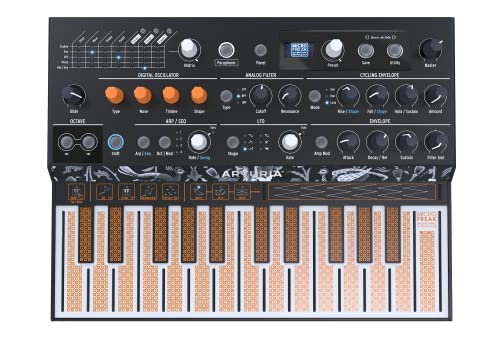
- 17 oscillator modes from physical modeling to wavetable
- Poly-aftertouch touch plate for expressive control
- CV, USB, and MIDI connectivity for flexible rigs
Best For: Advanced players who want an experimental compact synth for expressive live sets
Standalone Pad-Based Performance Groovebox

- 32 velocity-sensitive pads with polyphonic aftertouch
- Standalone battery-powered design with speaker and mic
- Sampling, slicing, and four flexible tracks for live building
Best For: Performers who want a portable, computer-free groovebox for live sketching and control
Moog Live-Ready Mono Power

- Classic Moog analog sound in a portable monosynth
- 32 full-size keys with velocity and aftertouch
- Sequencer, arpeggiator, presets, and CV/MIDI connectivity
Best For: Expressive live bass, leads, and hands-on performance control
Portable Stylus Performer

- Battery-powered with built-in speaker for portability
- Expression strip adds pitch bends, LFO modulation, and filter sweeps
- CV/Gate outputs can control modular and semi-modular gear
Best For: Mobile performers and compact hardware setups
Compact Bass Groove Machine

- Three oscillators for fat analog bass tones
- 16-step sequencer with slide and Active Step functions
- Compact, battery-powered design with MIDI and sync support
Best For: Acid-style bass lines and portable groove building
Standalone Studio Keyboard

- Standalone MPC3 OS for track-based production
- 37 keys, 16 pads, and touchscreen control
- USB-C audio/MIDI integration in one cable
Best For: Live performers who want a full-featured standalone keyboard workstation
Portable FM Performance Synth
Wireless Portable FM Synthesizer

- Battery-powered with built-in speaker
- 6 operators, 32 algorithms, and 6 effects
- Bluetooth MIDI plus USB and 3.5mm MIDI inputs
Best For: Portable performers who want a compact FM synth with built-in sound and sequencing
Expressive FM Performance Synth

- True six-operator FM synthesis with 64 voices
- 37 velocity-sensitive keys with assignable aftertouch
- 30 effects plus motion sequencing and step sequencer
Best For: Players who want deep FM synthesis and expressive live control
Portable Vocal-Ready Performance Synth – Korg microKORG2
If you’re comparing synthesizers for live performances, the Korg microKORG2 is built for players who want hands-on sound shaping in a compact format. Its 37 full-size keys, loop recorder, updated XMT sound engine, and new vocal processor make it a flexible pick for stage use, sound design, and vocal effects.
Best For: Performers who want a compact synth with keys, vocoder-style vocal processing, and quick sound editing on stage.
Pros:
- 37 full-size keys support expressive playing and dynamic performance.
- Vocal processor adds harmonizer and hard-tuning functions for live vocal effects.
- 2.8-inch full-color IPS display and animated guides make editing easier.
- Loop recorder and 4-voice polyphony expand performance options.
Cons:
- 4-voice polyphony is more limited than larger stage synths.
- Portable size may not suit players wanting a larger keyboard.
The microKORG2 stands out as a practical live-performance synth for musicians who value portability and vocal processing as much as synth tones. It offers a modern workflow without giving up the immediate feel that works well on stage.
All-in-One Mobile Idea Station – Yamaha SEQTRAK
For synthesizers for live performances, the Yamaha SEQTRAK is a strong all-in-one option when you want to sketch, sequence, and perform from a single portable device. Its built-in speaker, microphone, rechargeable battery, and advanced sequencer make it useful for capturing ideas quickly and taking them straight into a live workflow.
Best For: Mobile creators who want a compact standalone unit for sketching beats, synth parts, and performance ideas anywhere.
Pros:
- Standalone design includes drums, synths, sound design, and sequencing.
- Built-in speaker, microphone, and rechargeable battery support making music anywhere.
- Advanced sequencer enables quick arrangement and dynamic playback.
- Onboard sampler helps capture sounds from your environment.
Cons:
- Plastic body may feel less premium than larger stage keyboards.
- Compact format is geared more toward sketching and portability than full-size playing.
The SEQTRAK is especially appealing if you want a lightweight music station that keeps the creative process moving without extra gear. It fits live setups where portability and fast idea capture matter most.
Hybrid Experimental Performance Synth – Arturia MicroFreak
If you’re shopping synthesizers for live performances and want a more experimental edge, the Arturia MicroFreak brings hybrid sound design into a compact format. Its 17 oscillator modes, resonant analog filter, poly-aftertouch touch plate, and built-in sequencer functions give performers a lot of expressive control in a small footprint.
Best For: Players who want a compact, experimental synth with deep modulation and expressive touch control.
Pros:
- 17 oscillator modes cover a wide range of timbres, from physical modeling to wavetable.
- Poly-aftertouch touch-plate keyboard responds to pressure on each note.
- Spice and Dice plus automation recording support evolving live patterns.
- CV, USB, and MIDI connectivity make it easy to integrate into larger rigs.
Cons:
- The flat touch-plate design is not a traditional keyboard feel.
- Best suited to advanced users comfortable with more experimental workflows.
The MicroFreak is a smart choice if your live set benefits from unusual textures, modulation, and quick pattern changes. It rewards players who want to push beyond standard subtractive synth sounds.
Standalone Pad-Based Performance Groovebox – Ableton Move
For synthesizers for live performances in a modern portable format, the Ableton Move is designed around standalone creation, sampling, and performance. With 32 velocity-sensitive pads, polyphonic aftertouch, a built-in speaker and microphone, and four flexible tracks, it works well for building live ideas without relying on a computer.
Best For: Beatmakers and performers who want a portable standalone tool for sketching, sampling, and controlling live sets.
Pros:
- Standalone design includes battery power, speaker, microphone, and processor.
- 32 pads with polyphonic aftertouch support chords, melodies, drums, and samples.
- Four flexible tracks can act as drum kits, samplers, or synthesizers.
- Sampling, slicing, and resampling tools make it easy to reshape sounds on the device.
Cons:
- Included Live 12 Intro has limited tracks and instruments/effects.
- Pad-based layout may not suit players who prefer a traditional keyboard.
The Ableton Move is best viewed as a performance-focused sketchpad that bridges songwriting and live control. It offers a lot of creative range for artists who want to stay untethered and build sets on the fly.
Moog Live-Ready Mono Power – Messenger Analog Synth
For synthesizers for live performances, the MOOG Messenger gives you a portable mono synth with the brand’s classic analog character and modern performance tools. Its knob-per-function layout, 32 full-size semi-weighted keys, presets, sequencer, and deep connectivity make it easy to build and control parts on stage.
Best For: Players who want a hands-on Moog monosynth for expressive live basses, leads, and sequenced patterns.
Pros:
- Two continuously variable-shape VCOs with sync, frequency modulation, and a sub-oscillator for strong low end
- Next-gen ladder filter with multiple response modes and RES BASS compensation
- 32 full-size semi-weighted keys with velocity and aftertouch for expressive playing
- 64-step sequencer, probability behavior, arpeggiator, and 256 presets for performance flexibility
Cons:
- Monophonic design limits it to one note at a time
- Larger and heavier than pocket-sized performance synths
- May be more synth than needed if you only want a simple portable sound source
The Messenger stands out as a serious stage instrument when you want Moog tone plus practical live control. It is especially compelling if you value tactile sound shaping, preset recall, and flexible syncing with other gear.
Portable Stylus Performer – GENX-2 Analogue Synth
If you want synthesizers for live performances that can go anywhere, the Stylophone GENX-2 is built for portability and quick setup. It runs on batteries, includes a built-in speaker, and adds performance-friendly touches like a finger-sensitive expression strip, CV/Gate outputs, and onboard delay for more animated sounds.
Best For: Mobile performers, improvisers, and hardware users who want a compact analog synth with expressive control.
Pros:
- Battery operation and built-in speaker make it easy to play anywhere
- Finger-sensitive expression strip supports pitch bends, LFO modulation, and filter sweeps
- CV and Gate outputs let it control modular and semi-modular gear
- Analogue delay, dual sub-octave switches, filter, and LFO expand sound design options
Cons:
- Stylus-style playing may not suit everyone’s performance workflow
- Smaller format means less traditional keyboard feel
- Built-in speaker is handy, but external monitoring will be better for serious stage use
The GENX-2 is a strong pick when portability and expressive gestures matter more than a full-size keyboard. It is best viewed as a compact performance instrument and control hub rather than a conventional stage synth.
Compact Bass Groove Machine – Volca Bass Analog Synth
For synthesizers for live performances focused on bass lines, the Korg Volca Bass keeps the setup simple while still offering classic analog punch. Its three oscillators, sequencer, slide function, and compact battery-powered design make it a practical choice for building driving patterns on the fly.
Best For: Performers and producers who want a small analog bass synth for grooves, acid lines, and synced setups.
Pros:
- Three oscillators deliver powerful analog bass tones and varied bass sounds
- 16-step Electribe-inspired sequencer helps create grooves quickly
- Slide and Active Step functions are well suited to acid and evolving bass patterns
- Compact, battery-powered, and includes a built-in speaker for portable use
Cons:
- Simple structure means fewer shaping controls than larger synths
- Built-in speaker is useful, but limited for stage monitoring
- Best suited to bass parts rather than broad multi-role performance duties
The Volca Bass is a focused live tool for thick low-end parts and sequenced movement. If your set needs compact analog bass with easy sync and immediate groove-building, it fits the job well.
Standalone Studio Keyboard – Akai MPC Key 37 G2
If you want synthesizers for live performances that can also handle full-track production, the Akai MPC Key 37 G2 gives you a strong all-in-one setup. The 37-key synth-action keyboard, MPC pads, touchscreen, and standalone MPC3 OS make it practical for building, arranging, and triggering music without relying on a computer.
Best For: Performers and producers who want a hands-on standalone keyboard workstation for live sets, sampling, and song building.
Pros:
- 37-key synth-action keybed with pitch and mod wheels plus 16 MPC pads
- Standalone MPC3 OS supports track-based workflow, linear arranging, and full-song creation
- 8-core processor, up to 16 stereo audio tracks, and 32 plugin instruments per project
- USB-C connectivity offers multichannel audio, expanded MIDI, and host/device support over one cable
Cons:
- May be more than needed if you only want a simple stage synth
- Best suited to users comfortable with a production-oriented workflow
The MPC Key 37 G2 stands out when your live setup needs both performance control and serious music-making tools. It is especially appealing if you want to sample, sequence, and finish ideas in one instrument.
Portable FM Performance Synth – Wireless Portable FM Synthesizer
For synthesizers for live performances on the go, this portable FM synth is built around quick access and easy mobility. Battery power, a built-in speaker, wireless Bluetooth MIDI, and compact silicone keys make it a convenient choice when you need sound ready anywhere.
Best For: Mobile players who want a compact FM synth for practice, sketching ideas, and lightweight live performance setups.
Pros:
- Battery-powered design with built-in speaker for true portable use
- 128 preset sounds and FM SYSEX import support for a wide sound palette
- 6 operators, 32 algorithms, and 6 built-in effects for FM sound shaping
- Arpeggiator, 16-step sequencer, and 3-channel MIDI connectivity for flexible control
Cons:
- 27-key silicone layout is compact rather than full-size
- Designed more for portability than a large stage keyboard rig
This model makes sense if your priority is carrying a synth that can still cover classic FM sounds and basic performance features. It is a practical pick for quick sessions where convenience matters as much as tone.
Expressive FM Performance Synth – Korg opsix MKII
If you are comparing synthesizers for live performances, the Korg opsix MKII is a strong choice for players who want deep FM sound design and expressive control. Its 37 velocity-sensitive keys, 64 voices, motion sequencing, and assignable aftertouch give you a lot of room to shape evolving stage sounds.
Best For: Keyboard players who want a versatile FM synth with expressive control and deep programming options for performance.
Pros:
- True six-operator FM synthesis with 64 voices for wide sonic range
- 37 velocity-sensitive keys plus assignable aftertouch for expressive playability
- Polyphonic motion sequencing and a 16-step sequencer for dynamic patterns
- 30 onboard effects and a modulation matrix for detailed sound shaping
Cons:
- FM programming can be more complex than simpler performance synths
- No built-in speaker or battery power listed, so it is less portable than ultra-compact options
The opsix MKII is a good fit if your live set depends on evolving digital textures and hands-on modulation. It offers enough depth for sound design while still providing the control surface needed for performance.
How We Picked These Synthesizers for Live Performances
We prioritized instruments that make sense onstage: immediate hands-on control, reliable preset recall, clear performance workflows, and features that support quick transitions between sounds. Portability and setup speed also mattered, especially for players who move between rehearsals, gigs, and home production.
We also looked for strong sound design options, because live synths should cover more than one role. The best choices here can function as lead instruments, bass sources, groove tools, or compact all-in-one rigs.
Quick Comparison: What Each Type Does Best
Some Synthesizers for Live Performances are built for expressive keyboard playing, while others are better as sequencer-driven boxes, desktop sound engines, or ultra-portable sketchpads. A compact synth with a vocoder or delay can be ideal for front-and-center performance. A standalone workstation may be better if you want one device to handle sequencing, samples, and arrangement duties.
Compact Performance Synths
Choose these if you want fast access, smaller footprints, and easy transport. They tend to fit well on crowded stages and in lightweight rigs.
Standalone Groove and Production Tools
These are better if you want to build full parts without a laptop. They suit performers who trigger patterns, layer sounds, and improvise arrangements live.
Key Buying Factors for Synthesizers for Live Performances
First, consider control layout. Knobs, sliders, and dedicated buttons usually matter more onstage than deep menus. If you need to tweak filter cutoff, envelopes, or effects mid-song, direct controls save time and reduce mistakes.
Next, think about voice architecture. Monophonic synths are often great for bass and lead work, while polyphonic and multi-timbral instruments are better when you need chords, pads, or broader set coverage. Sequencers and onboard arpeggiators are also valuable if your set depends on locked-in rhythmic movement.
Connectivity is another major factor. MIDI, audio outputs, USB, CV/gate, and headphone monitoring all affect how easily a synth integrates with pedals, mixers, DAWs, and modular gear. Built-in speakers or battery power can be useful for practice and mobile setups, though they matter less than stage output quality for larger shows.
Finally, match the instrument to your performance style. If you play keys, prioritize feel and playability. If you build electronic sets, favor sequencing, sampling, and hands-on sound design. If you travel often, weight and durability may matter more than a wide feature set.
Who Should Buy Which Synthesizers for Live Performances?
Keyboard players who want expressive control should lean toward performance-friendly synths with strong presets and easy sound shaping. Producers who perform solo may prefer standalone instruments that combine sequencing and sampling. Bass and lead specialists often benefit from compact analog or FM synths with immediate tweakability.
If you want the most flexible setup, choose a synth that matches your stage role first, then your workflow. The right instrument will feel fast, dependable, and inspiring every time you step onstage.