When you move huge video libraries, disk images, backups, or photo archives, speed and drive compatibility matter as much as capacity. The best docks make those transfers simpler and safer.
This roundup focuses on hard drive docking stations for large files that balance fast connections, multi-bay support, and practical features like offline cloning and broad SATA compatibility.
Best 10 Hard Drive Docking Stations for Large Files Picks for 2026
Dual-Bay Cloning Dock
SABRENT USB 3.0 Dual Bay Hard Drive Docking Station & Cloner
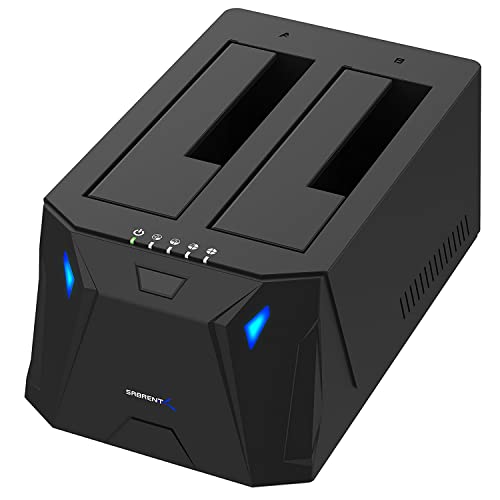
- Dual-bay support for 2.5"/3.5" SATA HDDs and SSDs
- Offline cloning built in for drive duplication
- USB 3.0 plug-and-play design with no drivers needed
Best For: Backups, cloning, and large SATA drive access
High-Speed USB-C Hub Dock
Baseus Spacemate 11-in-1 Triple Display Dock

- 10Gbps USB-C and USB-A data ports for fast transfers
- HDMI and DisplayPort support for Windows triple displays
- 100W USB-C PD input with pass-through charging
Best For: Windows workstations needing ports, displays, and fast file transfers
IDE/SATA Pro Dock
StarTech Dual-Bay USB 3.0 SATA/IDE Dock

- Supports both SATA and IDE hard drives
- Dual bays with separate power and eject buttons
- Tool-less top-loading dock for hot-swapping
Best For: Data recovery and transfer work across SATA and IDE drives
22TB USB 3.0 Dock
ORICO Hard Drive Docking Station for 2.5/3.5 Inch HDD SSD

- Supports 2.5"/3.5" SATA drives up to 22TB
- USB 3.0 with UASP for up to 5Gbps transfers
- Works across Windows, Mac, Linux, and more
Best For: High-capacity single-drive backups and transfers
5-Bay Offline Cloner for Bulk Backups

- 5-bay SATA dock with offline clone
- Up to 110TB capacity expansion
- USB 3.1 / 5Gbps with UASP
Best For: Offline cloning and large-file backup workflows
10Gbps Daisy-Chain DAS for Heavy Storage

- 10Gbps USB-C transfer speed
- Up to 120TB, daisy-chain expansion
- Hot-swappable bays with active cooling
Best For: Fast expanding storage for large-file workflows
4-Bay Offline Cloner with Strong Value

- 4-bay dock with 96TB capacity
- 1-to-3 offline clone with display
- SATA III chipset with dual USB-C/USB-A cables
Best For: Affordable multi-drive backup and cloning
Simple SATA Dock
SABRENT USB 3.0 SATA Docking Station
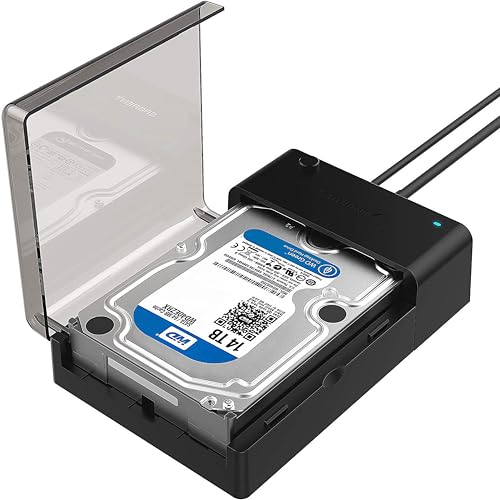
- Single-bay dock for bare SATA HDDs and SSDs
- USB 3.0 with UASP for practical transfer speeds
- Includes 12V adapter for 3.5-inch drive stability
Best For: Simple one-drive SATA backups and file transfers
Two-Bay Copy Station

- Two SATA bays for simultaneous read/write access
- Offline cloning without a computer
- USB-C cable included for modern connections
Best For: Drive copying and two-drive SATA workflows
Fast Mixed-Drive Backup Dock

- Supports one NVMe SSD and one SATA drive
- Up to 10Gbps NVMe and 6Gbps SATA speeds
- Built-in 3-speed cooling fan
Best For: Mixed NVMe/SATA backups and drive migrations
Dual-Bay Cloning Dock – SABRENT USB 3.0 Dual Bay Hard Drive Docking Station & Cloner
If you need hard drive docking stations for large files, this SABRENT dual-bay dock gives you an easy way to back up, move, or clone data without opening your PC. It supports 2.5″ and 3.5″ SATA drives or SSDs, handles drives up to 10TB, and offers USB 3.0 speeds for practical everyday transfers.
Best For: Users who want a simple dual-bay dock for backups, offline cloning, and large SATA drives.
Pros:
- Supports two 2.5″/3.5″ SATA drives or SSDs at once.
- Offline cloning support is built in, so you can duplicate drives without a computer.
- USB 3.0 connection and plug-and-play setup keep it straightforward.
- Supports drives up to 10TB per the supplied notes.
Cons:
- Maximum drive support is lower than some newer high-capacity docks.
- Cloning speed is listed up to 60Mbps, which is not especially fast for very large jobs.
- Only covers SATA drives, not IDE or other interfaces.
This is a practical pick if your priority is easy access to large SATA drives and occasional cloning. It is less about extra features and more about dependable, no-drivers-required storage handling.
High-Speed USB-C Hub Dock – Baseus Spacemate 11-in-1 Triple Display Dock
This Baseus model is more of a workspace expansion dock than one of the usual hard drive docking stations for large files, but it does include fast 10Gbps USB ports for moving data quickly. If you also need monitors, Ethernet, power delivery, and multiple USB connections in one vertical unit, it can streamline a busy setup.
Best For: Windows users who want a multiport dock with fast file transfers and triple-display support.
Pros:
- Two USB-A and one USB-C data ports support up to 10Gbps transfers.
- Triple-display output works with Windows through HDMI and DisplayPort.
- Includes 100W USB-C PD input with pass-through charging up to 85W.
- Compact upright design with a screen-lock button and LED status display.
Cons:
- It is not a dedicated hard drive dock for direct SATA drive access.
- Triple-display mode is not supported on macOS as described in the notes.
- Power adapter is not included.
For buyers who need a desk hub as much as transfer speed, this dock offers a lot in one unit. Just keep in mind that its storage role is peripheral connectivity rather than direct drive docking.
IDE/SATA Pro Dock – StarTech Dual-Bay USB 3.0 SATA/IDE Dock
Among hard drive docking stations for large files, this StarTech dock stands out because it handles both SATA and legacy IDE drives. That makes it especially useful when you need to recover data, image disks, or move files between older and newer drives using a single top-loading station.
Best For: IT users and power users who work with both SATA and IDE drives.
Pros:
- Supports 2.5″/3.5″ SATA I/II/III drives plus IDE 40-pin EIDE/PATA drives.
- Two bays with separate power and eject buttons allow hot-swapping while the other bay is in use.
- Includes tool-less top-loading design for quick drive access.
- Backed by 2-year warranty and lifetime multilingual technical assistance.
Cons:
- Only one drive bay is dedicated to SATA and the other to IDE.
- Transfer speed is limited to USB 3.2 Gen 1 at 5Gbps.
- Bulkier than a single-drive reader because it is a dual-bay unit.
This is a strong choice when compatibility matters more than minimal size. If your workflow includes older IDE hardware, it solves a problem that many newer docks do not.
22TB USB 3.0 Dock – ORICO Hard Drive Docking Station for 2.5/3.5 Inch HDD SSD
If you are comparing hard drive docking stations for large files, this ORICO dock is built around high-capacity SATA support and simple hot-swapping. It accepts 2.5″ and 3.5″ SATA HDDs and SSDs, supports drives up to 22TB, and uses USB 3.0 with UASP for up to 5Gbps transfers.
Best For: Users who want a high-capacity single-bay SATA dock for backups and file transfers.
Pros:
- Supports up to 22TB SATA drives, which is ideal for large-file storage.
- UASP support and USB 3.0 help deliver up to 5Gbps transfer speeds.
- Works with Windows, Mac, Linux, iPad OS, Raspberry Pi, and more.
- Includes a 12V/2A power supply and supports tool-less hot-swapping.
Cons:
- Single-bay design means only one drive can be connected at a time.
- Does not support IDE or SAS drives.
- New or unallocated drives need initialization in Disk Management before use.
This dock is a sensible pick if you want a compact, high-capacity solution without extra complexity. Its wide compatibility and 22TB support make it well suited to large backup libraries.
5-Bay Offline Cloner for Bulk Backups – MAIWO 5-Bay Dock
If you need hard drive docking stations for large files, this MAIWO 5-bay dock is built for high-capacity backup, cloning, and file handling without involving a computer for every task. It supports 2.5-inch and 3.5-inch SATA HDDs and SSDs, offers up to 110TB of capacity expansion, and includes an offline clone function for simple drive-to-drive copying.
Best For: Users who want a high-capacity dock for offline cloning, backup jobs, and multi-drive storage expansion.
Pros:
- Offline cloning works without a computer, which is useful for quick drive duplication.
- Supports up to 5 SATA drives and up to 110TB of total capacity expansion.
- USB 3.1 / USB 3.0-class 5Gbps transfer with UASP support for better performance.
- Tool-free design and open-air construction help make setup fast and cooling more straightforward.
Cons:
- Limited to SATA 2.5-inch and 3.5-inch HDDs/SSDs.
- It is a multi-drive dock rather than a compact portable enclosure.
This is a practical choice if your workflow includes large file transfers, batch backups, or cloning multiple drives in one place. The digital progress display and audible alerts add convenience for long copy jobs.
10Gbps Daisy-Chain DAS for Heavy Storage – Yottamaster VN500C3 5-Bay DAS
For hard drive docking stations for large files, this Yottamaster 5-bay DAS stands out for speed and scalability. It uses USB 3.1 Gen2 for 10Gbps transfers, supports 2.5-inch and 3.5-inch SATA HDDs/SSDs, and can be daisy-chained to expand storage even further when your projects keep growing.
Best For: Users who need fast multi-drive storage with room to expand through daisy chaining.
Pros:
- 10Gbps USB-C connection is designed for faster file transfers and higher throughput.
- Supports up to 120TB in the enclosure, with daisy-chain expansion potential beyond that.
- Hot-swappable drive bays make it easier to add or replace disks without powering down.
- Aluminum housing, cooling fan, and ventilation holes help with heat management.
Cons:
- No hardware RAID function is included.
- Built for desk use rather than portability.
If your work involves handling large media files, backups, or growing archives, this enclosure offers a strong mix of speed and storage headroom. The dual USB-C ports make it especially useful for building a larger chained setup over time.
4-Bay Offline Cloner with Strong Value – MAIWO 4-Bay SATA Cloner
This MAIWO 4-bay cloner is a solid pick if you want hard drive docking stations for large files without moving to a more complex setup. It supports 2.5-inch and 3.5-inch SATA HDDs and SSDs, provides up to 96TB total capacity, and includes 1-to-3 offline cloning for straightforward duplication jobs.
Best For: Users who want a 4-bay dock for backup, cloning, and general high-capacity file management.
Pros:
- Supports 4 SATA drives with up to 96TB total capacity.
- 1-to-3 offline cloning works without a computer and includes a clear digital progress display.
- SATA III chipset is designed to improve transfer speed over SATA II designs.
- Includes both USB-C to USB-C and USB-C to USB-A data cables for wider compatibility.
Cons:
- Cloning requires the target drives to be larger than the source drive.
- Power delivery is fixed to an external adapter, so it is not a bus-powered solution.
For buyers who want a simpler 4-bay option, this model covers the essentials well. The mix of offline cloning, strong capacity, and broad device compatibility makes it useful for IT tasks, backups, and repeated file transfers.
Simple SATA Dock – SABRENT USB 3.0 SATA Docking Station
If you need a straightforward pick among hard drive docking stations for large files, this SABRENT single-bay dock keeps the focus on plain SATA storage. It supports bare 2.5-inch and 3.5-inch SATA HDDs and SSDs, gives you USB 3.0 with UASP support, and is designed for tool-free, hot-swap use when moving big local backups or media libraries.
Best For: Users who want a simple one-drive SATA dock for fast, no-fuss file transfers and backups.
Pros:
- Supports 2.5-inch and 3.5-inch SATA drives and SSDs
- USB 3.0 with UASP support for real-world transfer speeds
- Includes a 12V/2A power adapter for stable 3.5-inch drive use
- Tool-free, hot-swap design with plug-and-play operation
Cons:
- Does not support IDE/PATA, M.2, NVMe, or SAS drives
- Uses a USB Type-A host cable, not native USB-C
- S.M.A.R.T. diagnostics are not passed through the bridge
This is a practical dock if your workflow centers on standard SATA drives and you want a compact way to handle large files without extra setup. Just be sure your computer has the right USB-A port and that you are working with bare SATA drives only.
Two-Bay Copy Station – SABRENT USB-C Dual-Bay Dock
For hard drive docking stations for large files where you may want to shuffle data between two drives, this dual-bay SABRENT dock is built for flexibility. It mounts two SATA drives at once over USB-C and also works as an offline cloner, so you can copy a source drive to a same-size-or-larger target without a computer.
Best For: Users who want a two-drive SATA dock for direct copying, file movement, and regular large-file workflows.
Pros:
- Two bays let you read and write both drives at the same time
- Offline cloning works without connecting to a PC
- Supports 2.5-inch and 3.5-inch SATA hard drives and SSDs
- USB-C cable is included and it is plug-and-play on Windows and Mac
Cons:
- Does not support IDE/PATA, M.2, or NVMe drives
- Offline cloning is limited to up to 60MBps by design
- Requires a USB-C port or your own USB-C to USB-A cable
This dock makes sense if your workflow involves frequent drive-to-drive copies or moving big folders between two SATA drives. It is a good fit for backup tasks, but the cloning function is intentionally slower than direct USB transfer.
Fast Mixed-Drive Backup Dock – GRAUGEAR NVMe and SATA Cloner
If your large-file workflow includes both modern SSDs and older hard drives, this GRAUGEAR dock covers more ground than a standard SATA-only unit. It supports one M.2 NVMe SSD plus one SATA drive, offers offline cloning from source to target, and advertises up to 10Gbps for NVMe transfers and 6Gbps for SATA SSDs.
Best For: Users who need a flexible dock for mixed NVMe and SATA storage, backups, and drive migrations.
Pros:
- Supports one M.2 NVMe SSD plus one SATA drive at the same time
- Offline cloning works without a computer
- Up to 10Gbps for NVMe and 6Gbps for SATA SSD transfers
- Built-in 3-speed cooling fan helps manage heat
Cons:
- More complex than a basic SATA-only dock
- Best transfer speeds depend on the drive type you install
- Cloning requires the proper button sequence to start
This is the most versatile option here if you move large files across different storage types and want a dock that can handle upgrades as well as backups. The fan and mixed-drive support make it especially useful for heavier workloads.
How We Picked the Best Hard Drive Docking Stations for Large Files
For Hard Drive Docking Stations for Large Files, we prioritized transfer speed, drive support, bay count, cloning features, and host connectivity. We also looked for models that handle 2.5-inch and 3.5-inch SATA drives reliably, since large-file workflows often mix SSDs, HDDs, and older archive disks.
Quick Comparison
Dual-bay docks are usually best for simple copy jobs and occasional cloning. Four- and five-bay units fit users who need to access multiple archives at once, build a larger local storage pool, or rotate backup drives. USB-C and 10Gbps models are a better match for heavier large-file transfers, while USB 3.0 docks remain a budget-friendly choice for everyday use.
Key Buying Factors for Hard Drive Docking Stations for Large Files
Transfer Speed
Look for USB 3.0 at minimum, and consider USB-C or 10Gbps if you regularly move multi-gigabyte folders, raw video, or disk images. Faster links help reduce wait times, especially with SSDs.
Bay Count and Drive Size Support
A higher bay count is useful for archives and backup rotation, but it also increases desk space and cost. Make sure the dock supports both 2.5-inch and 3.5-inch SATA drives if you use mixed media.
Cloning and Standalone Operation
Offline cloning is valuable when you need a fast duplicate without using a computer. It is especially helpful for drive upgrades, backup swaps, and migration projects.
Compatibility and Use Case
Some products are built mainly as storage docks, while others also serve as broader docking stations with extra ports or display output. Choose the simpler dock if your main priority is moving data, not adding peripherals.
Who Should Buy Which Hard Drive Docking Stations for Large Files?
If you want a straightforward, low-cost solution for one or two drives, a basic USB 3.0 or dual-bay dock is usually enough. If you manage backups, media libraries, or client data, a 4-bay or 5-bay model offers more flexibility. Power users who regularly handle large files should lean toward USB-C, 10Gbps, or multi-bay designs for better throughput and scalability. For users needing cloning without a PC, pick a dock with offline clone support and clear status indicators.