Powered KVM switches make it easier to control multiple computers from one keyboard, mouse, and display setup. They are especially useful for home offices, gaming desks, content creation, and workstations that combine a desktop with a laptop.
This roundup compares 10 powered KVM switches across dual-monitor, USB-C, HDMI, and DisplayPort configurations, with options for 4K and 8K video, multiple computers, and expanded USB connectivity.
Best 10 Powered Kvm Switches Picks for 2026
Best Dual-Interface Pick
Unitek HDMI/DisplayPort Dual-Monitor KVM

- Dual-monitor switching for two desktop computers
- 4K@60Hz with HDMI and DisplayPort support
- Powered USB 3.0 hub with wired controller
Best For: Desktop users with mixed HDMI and DisplayPort outputs
Best HDMI Office Setup

- Switches two HDMI computers across two monitors
- 4K@60Hz with extend and mirror modes
- Four USB 3.0 ports and included power adapters
Best For: Two-computer home and office HDMI workstations
Best USB-C Docking Option
8K Dual-Monitor KVM with 100W PD
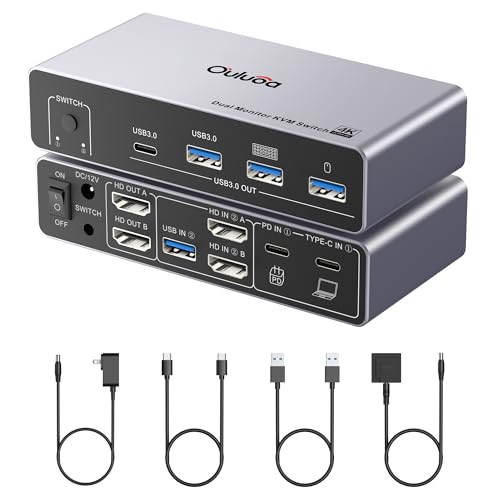
- Connects one desktop and one USB-C laptop
- 8K@60Hz desktop output and dual HDMI displays
- 100W PD plus four shared USB ports
Best For: Desktop-and-laptop workstations needing charging and display expansion
Best DisplayPort High-Refresh Pick

- Shares one DisplayPort monitor between two computers
- Supports 8K@60Hz and 4K@240Hz
- Four USB 3.0 ports with remote switching
Best For: High-refresh DisplayPort workstations using one monitor
Best 4-Port Powered KVM Switch
4K HDMI USB 3.0 KVM for 4 Computers

- Switches four HDMI computers through one monitor
- Supports 4K at 60Hz
- Includes USB 3.0, USB-C, and wired remote control
Best For: Multi-computer office workstations
Best Triple-Monitor Powered KVM Switch

- Shares three monitors between two computers
- Supports 8K at 60Hz and 4K at 240Hz
- Includes four USB 3.0 ports and desktop controller
Best For: Triple-display workstations and content creators
Best Compact Powered KVM Switch
8K HDMI USB 3.0 KVM for 2 Computers

- Shares one monitor and three USB 3.0 devices
- Supports 8K at 30Hz and 4K at 240Hz
- Switches by button or wired remote
Best For: Two-computer, single-monitor setups
Premium Dual-Monitor Power
8K Dual-Monitor HDMI KVM Switch

- Dual-monitor control for two computers
- 8K@60Hz and 4K@120Hz support
- Four USB 3.0 ports plus wired remote
Best For: High-resolution dual-monitor work and gaming setups
Flexible Single-Display Switching

- Shares one 4K monitor between two computers
- Three USB-A and one USB-C port
- Button and wired-remote switching
Best For: Single-monitor desks with mixed USB peripherals
Complete Desk-Control Bundle
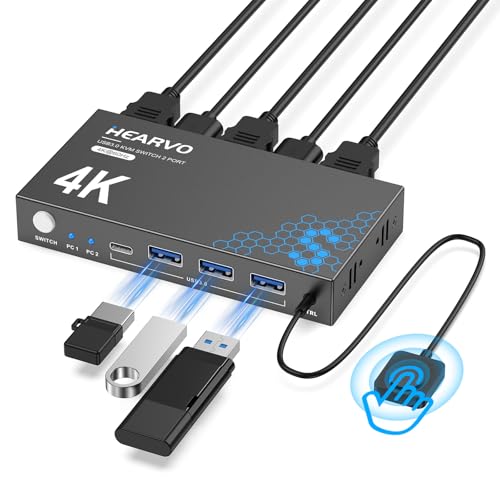
- 4K@60Hz single-monitor switching
- Four USB 3.0 ports including USB-C
- Includes remote, cables, and anti-slip pads
Best For: Ready-to-install home and office workstations
Best Dual-Interface Pick – Unitek HDMI/DisplayPort Dual-Monitor KVM
For shoppers comparing powered kvm switches, the Unitek is a flexible option for two desktop computers sharing two monitors. Its HDMI and DisplayPort inputs, 4K@60Hz support, USB 3.0 connectivity, and included 5V/2A adapter make it suited to a multi-device workstation.
Best For: Desktop users who need dual-monitor HDMI and DisplayPort connectivity with powered USB peripherals.
Pros:
- Supports two computers, two monitors, and up to four USB devices.
- Offers up to 4K@60Hz, HDR, 3D, HDMI 2.0, and HDCP support.
- Includes a 5V/2A power adapter and wired desktop controller.
- Provides button and remote switching with driver-free setup.
Cons:
- Designed for desktop hosts and explicitly not compatible with laptops.
- Simultaneous HDMI and DisplayPort video requires all specified USB and video cables.
The Unitek stands out when your setup mixes HDMI and DisplayPort and needs reliable power for several USB accessories. Confirm that both source computers are desktops and have the required outputs before buying.
Best HDMI Office Setup – UGREEN Dual-Monitor HDMI KVM
This UGREEN model is among the more practical powered kvm switches for a two-computer HDMI workstation. It shares two monitors and four USB 3.0 ports, supports extend or mirror modes, and includes the cables, power adapters, and desktop controller needed for setup.
Best For: Home and office users with two HDMI-equipped computers and dual-screen workflows.
Pros:
- Controls two computers and two monitors with one keyboard and mouse.
- Supports 4K@60Hz, HDMI 2.0, HDR10+, HDCP, and 3D.
- Includes three USB-A ports, one USB-C port, and up to 5Gbps USB transfer speeds.
- Offers button or desktop-controller switching and broad Windows, macOS, and Linux compatibility.
Cons:
- It is HDMI-only and does not support DisplayPort.
- Each computer needs two HDMI cables and one USB-A cable.
- It does not support EDID emulation or keyboard hotkey switching.
Choose this switch if both computers and monitors use HDMI and you value a complete accessory bundle. Keep output HDMI cables within the recommended length and connect the power supply for normal USB operation.
Best USB-C Docking Option – 8K Dual-Monitor KVM with 100W PD
For a mixed desktop-and-laptop workspace, this powered kvm switch combines dual-monitor control with USB-C docking features. It supports high-resolution output, four shared USB ports, external 12V power, and 100W Power Delivery for compatible laptop setups.
Best For: Users switching between one desktop and one USB-C laptop while sharing two HDMI monitors and peripherals.
Pros:
- Supports two HDMI monitors in extended or mirrored mode.
- Desktop output reaches 8K@60Hz, while the laptop supports 4K@60Hz through USB-C.
- Includes 100W PD charging, a 12V adapter, and four USB expansion ports.
- Comes with a wired remote, USB-C cable, USB 3.0 cable, and 12-month warranty.
Cons:
- macOS works in SST mode only; MST display mode requires Windows.
- The four USB ports share bandwidth.
- Short HDMI cables are recommended for stable signal transmission.
This is the most feature-rich choice here for a desktop-plus-laptop desk, especially when charging and peripheral sharing matter. Check your laptop’s USB-C display capability and operating system limitations before purchase.
Best DisplayPort High-Refresh Pick – UGREEN 8K DisplayPort KVM
This UGREEN model is a focused choice among powered kvm switches for two computers sharing one DisplayPort monitor. It supports up to 8K@60Hz, high refresh rates up to 4K@240Hz, four USB 3.0 ports, and both button and desktop-controller switching.
Best For: DisplayPort users who need one-monitor switching with high-resolution or high-refresh-rate support.
Pros:
- Supports up to 8K@60Hz and up to 4K@240Hz with compatible equipment.
- Shares one monitor and four USB 3.0 peripherals between two computers.
- Includes two USB-A-to-C cables and a desktop controller.
- Works with Windows, macOS, and Linux without driver installation.
Cons:
- Supports one monitor only and has no HDMI interface.
- DisplayPort cables, USB-C power cable, and power adapter are not included.
- It lacks EDID emulation, hotkey switching, and switching while a computer is asleep.
Consider this switch when your setup is DisplayPort-based and refresh rate is more important than dual-monitor support. Budget for compatible DisplayPort cables and a USB-C power source, and connect both USB cables as directed.
Best 4-Port Powered KVM Switch – 4K HDMI USB 3.0 KVM for 4 Computers
This powered KVM switch is designed for users who need to control four HDMI computers from one monitor, keyboard, and mouse. It supports 4K at 60Hz, includes three USB 3.0 ports plus USB-C connectivity, and offers both front-panel and wired-remote switching.
Best For: Multi-computer office workstations that need straightforward 4K switching and shared USB accessories.
Pros:
- Controls four computers through one HDMI display setup.
- Supports up to 3840×2160 at 60Hz and lower resolutions.
- Includes three USB 3.0 ports, USB-C connectivity, and two physical switching methods.
- Package includes HDMI, USB, power, controller, and remote cables.
Cons:
- Does not support hotkey switching.
- Requires computers with HDMI output and USB ports.
With its four-port capacity and included accessories, this model is a practical choice when button or wired-remote control is preferable to keyboard shortcuts.
Best Triple-Monitor Powered KVM Switch – UGREEN 8K Triple-Monitor KVM
This powered KVM switch targets demanding dual-computer, triple-monitor setups. Its two DisplayPort 1.4 inputs and HDMI 2.1 connection support high refresh rates and resolutions, while four USB 3.0 ports let both computers share common peripherals.
Best For: Content creators, IT professionals, and home-office users with two computers and three compatible displays.
Pros:
- Switches between two computers while sharing three monitors.
- Supports up to 8K at 60Hz, along with 4K at up to 240Hz.
- Offers mirror and extended display modes plus button or desktop-controller switching.
- Includes required DP, HDMI, USB, power, and controller cables.
Cons:
- Both computers must support triple-monitor output for all three displays.
- Does not support keyboard hotkeys or EDID emulation.
- Requires external power and specific two-DP-plus-one-HDMI connections per computer.
This is the most capable option for a multi-display desk, but compatibility checks are essential before purchase, especially for graphics outputs, cables, and monitor support.
Best Compact Powered KVM Switch – 8K HDMI USB 3.0 KVM for 2 Computers
This two-port powered KVM switch lets two computers share one HDMI monitor, keyboard, mouse, and other USB accessories. It supports high-resolution HDMI output, including 8K at 30Hz and 4K at up to 240Hz, with button and wired-remote switching.
Best For: Two-computer setups that use one monitor and need high-refresh-rate HDMI support.
Pros:
- Shares one monitor and three USB 3.0 ports between two computers.
- Supports 8K at 30Hz and 4K at up to 240Hz.
- Offers adaptive EDID and broad Windows, Linux, and Mac compatibility.
- Includes USB cables and a wired remote.
Cons:
- Does not support hotkey switching.
- High-resolution operation requires suitable HDMI 2.1 cables; cables for the monitor and computer connections must be supplied separately.
- The supplied notes describe plug-and-play use but also instruct users to connect all cables.
Choose this model when a two-PC, single-monitor setup matters more than multi-display expansion, particularly if you want strong 4K refresh-rate support and simple physical switching.
Premium Dual-Monitor Power – 8K Dual-Monitor HDMI KVM Switch
For demanding workstations and gaming desks, this powered KVM switch controls two computers across two monitors while sharing one keyboard, mouse, and USB setup. It supports up to 8K at 60Hz or 4K at 120Hz, making it a strong fit when high-resolution output and smooth refresh rates matter.
Best For: Dual-monitor users who need high-resolution video, fast USB sharing, and stable powered operation.
Pros:
- Supports dual-monitor mirror and extend modes for Windows, Mac, and Linux.
- Handles 8K@60Hz and 4K@120Hz video output.
- Provides four USB 3.0 ports with up to 5Gbps transfer speeds and supported charging protocols.
- Includes a wired remote, 5V/2A adapter, and braided 8K HDMI cable.
Cons:
- Requires a powered adapter, so it is less minimal than an unpowered switch.
- Its dual-monitor feature may be more than needed for a basic single-display setup.
The metal housing, GL3510 chipset, and included power adapter are designed for consistent performance with multiple connected devices. Choose it when your setup benefits from two displays and premium HDMI bandwidth rather than simple one-monitor switching.
Flexible Single-Display Switching – 4K HDMI KVM with USB-C
This powered KVM switch combines HDMI and USB switching for two computers sharing one monitor, keyboard, and mouse. Its four USB 3.0 ports—including three USB-A ports and one USB-C port—make it practical for desks with several peripherals, while 4K@60Hz support keeps the shared display sharp.
Best For: Single-monitor offices and home workstations that need broad USB peripheral compatibility.
Pros:
- Supports 4K@60Hz, HDCP 2.2, 4K@30Hz, 2K, 3D, and 1080p formats.
- Offers three USB-A ports and one USB-C port with up to 5Gbps transfer speeds.
- Switches from the unit or the included wired remote.
- Adaptive EDID helps optimize display settings, and the design is plug and play.
Cons:
- Supports one shared monitor rather than a dual-monitor arrangement.
- The supplied notes describe a compact single-display setup, so it may not suit more advanced multi-screen workstations.
With wide operating-system compatibility and ports for devices such as storage drives, webcams, printers, and headsets, this model focuses on everyday versatility. It is a sensible choice when one 4K monitor is enough and USB-C connectivity is useful.
Complete Desk-Control Bundle – 4K HDMI KVM with Wired Remote
For a straightforward two-computer, one-monitor setup, this powered KVM switch combines 4K HDMI switching with four USB 3.0 peripheral ports. It includes a wired remote and connection cables, helping keep the switch tucked away while maintaining quick access to computer selection.
Best For: Users who want a ready-to-install 4K single-monitor KVM kit with a wired remote.
Pros:
- Shares one monitor, keyboard, and mouse between two computers.
- Supports 4K@60Hz, HDCP 2.2, 4K@30Hz, 2K, 3D, and 1080p.
- Includes three USB-A and one USB-C USB 3.0 ports for peripherals.
- Package includes two USB 3.0 cables, a wired remote, manual, and anti-slip pads.
Cons:
- It is limited to one shared monitor.
- Its feature set is aimed at standard 4K switching rather than 8K or dual-monitor use.
Adaptive EDID and plug-and-play installation are useful for reducing setup friction, while the included accessories make this version convenient to deploy. Pick it when the complete bundle and single-monitor format match your workspace.
How We Picked These Powered Kvm Switches
We selected models that cover the most common multi-computer setups, including one-monitor and dual-monitor workstations, HDMI and DisplayPort systems, USB-C laptop docks, and configurations supporting two to four computers. We also considered advertised resolution and refresh-rate support, USB peripheral connectivity, switching methods, operating-system compatibility, and practical desk integration.
Specifications can vary by computer, cable, monitor, and operating system. Before buying, confirm that the switch supports the exact ports, resolution, refresh rate, and number of displays you plan to use.
Quick Comparison
- Best for dual-monitor setups: Choose a model with two independent video outputs and matching inputs for both computers.
- Best for high-resolution displays: Look for 8K at 60Hz or 4K at 120Hz support, while checking whether that performance applies to one or multiple displays.
- Best for USB-C laptops: A USB-C KVM docking station can combine video expansion, charging, and peripheral sharing, but verify host-device compatibility.
- Best for several computers: Four-port KVM switches let one monitor and USB setup serve more systems, although they usually offer fewer multi-monitor features.
- Best for simple office use: A compact HDMI 4K switch with USB 3.0 is often sufficient for two computers and standard productivity displays.
Key Buying Factors for Powered Kvm Switches
Video Ports and Display Count
Match the switch’s HDMI, DisplayPort, or USB-C inputs and outputs to your computers and monitors. A dual-monitor switch cannot create two independent displays unless the connected computers and cables provide the required video signals.
Resolution and Refresh Rate
4K at 60Hz is suitable for most office and creative work. Gamers and users with newer high-refresh monitors should consider 4K at 120Hz or higher, while 8K support is most useful when the entire system—including graphics hardware and cables—supports it.
USB Connectivity
Count the peripherals you need to share. USB 3.0 ports are preferable for external drives, webcams, and other higher-bandwidth devices; basic keyboards and mice can work through slower USB connections. Check whether USB switching is automatic or tied to the video input.
Power, Switching, and Compatibility
Powered models generally provide more reliable operation with multiple displays and USB accessories than bus-powered alternatives. Review the included power supply, switching button or remote, hotkey support, EDID behavior, and compatibility with Windows, macOS, and Linux before purchase.
Who Should Buy Which Powered Kvm Switches?
Dual-monitor professionals should prioritize a two-monitor HDMI or DisplayPort model with reliable USB sharing. Hybrid workers may prefer a USB-C docking KVM for quickly moving between a laptop and desktop. Gamers and video editors should focus on refresh-rate support, bandwidth, and DisplayPort or HDMI specifications rather than resolution alone. Small offices and technicians can benefit from a four-computer KVM when one display and one set of peripherals must serve several systems. For a straightforward two-computer desk, a compact 4K HDMI model is usually the simplest and most cost-effective choice.