Managing two or more computers from one desk is easier with the right KVM switch. These models cover practical single-monitor setups, dual- and triple-display workstations, high-refresh gaming, and remote access over Wi-Fi.
Our selection focuses on resolution support, refresh rates, USB connectivity, display compatibility, switching convenience, and the number of computers and monitors each device can handle.
Best 10 Kvm Switches Picks for 2026
Best 4-Computer HDMI Hub

- Controls four computers from one monitor
- Supports 4K at 60Hz
- Shares four USB 3.0 devices
Best For: Multi-computer office and classroom setups
Best Remote-Access KVM
- Offers remote KVM access over Wi-Fi 6
- Passes through 4K video at 30fps
- Supports browser, app, and self-hosted access
Best For: Remote administration and home labs
Best USB-C HDMI KVM
- Shares one 4K monitor across four computers
- Includes four USB 3.0 and two USB 2.0 ports
- Uses EDID emulation for smoother switching
Best For: Peripheral-heavy productivity workstations
Best Dual-Monitor DisplayPort KVM
2-Computer 4K 144Hz DisplayPort KVM

- Shares two monitors between two computers
- Supports 4K at 144Hz
- Includes four USB 3.0 ports and desktop controller
Best For: High-refresh dual-monitor workstations
Best for a Simple Two-Computer Setup

- Shares one 4K monitor between two computers
- Includes three USB-A and one USB-C port
- Supports button and wired-remote switching
Best For: Single-monitor home offices and workstations
Best for Triple-Monitor Workflows

- Shares three monitors between two computers
- Supports up to 8K@60Hz and 4K@240Hz
- Includes cables, power adapter, and desktop controller
Best For: Three-monitor creator and IT workstations
Best for Dual HDMI Displays

- Shares two HDMI monitors between two computers
- Supports 8K@60Hz and 4K@120Hz
- Includes four USB 3.0 ports and 12V power
Best For: Dual-monitor HDMI workstations
Best Dual-Monitor HDMI Pick

- Controls two computers across two HDMI monitors
- Four USB 3.0 ports for shared peripherals
- Supports 4K@60Hz and extended or mirrored modes
Best For: HDMI-based dual-monitor home and office setups
Best Mixed-Port Option
HDMI+DisplayPort Dual-Monitor KVM

- Combines HDMI and DisplayPort inputs
- Supports dual monitors at up to 4K@60Hz
- Includes four USB 3.0 ports and wired switching
Best For: Two-computer desks using matching HDMI and DisplayPort connections
Best Single-Monitor Value

- Switches two computers through one HDMI monitor
- Four USB ports for shared keyboard, mouse, and peripherals
- Supports 4K@60Hz with button or desktop-controller switching
Best For: Single-monitor HDMI workstations and gaming setups
Best 4-Computer HDMI Hub – 4-Port 4K HDMI KVM Switch
If you need one display and one set of peripherals for several systems, this 4-port HDMI KVM switch is a practical choice. It lets you share a monitor and four USB 3.0 devices among four computers, with switching handled by the front-panel buttons or included remote control.
Best For: Offices, classrooms, and workstations managing four computers from one 4K display.
Pros:
- Supports up to 4K at 60Hz and is backward compatible with lower resolutions.
- Shares four USB 3.0 peripherals, with data speeds up to 5Gbps.
- Offers remote-control and push-button switching without software drivers.
- Includes a wired infrared extension for positioning the switch away from the desk.
Cons:
- Hotkey switching is not supported.
- Achieving 4K at 60Hz requires compatible source devices and cables.
This model suits buyers who want straightforward four-computer control and plenty of fast USB connectivity. Its physical controls and remote are useful for shared work areas, though users wanting keyboard shortcuts should consider another KVM switch.
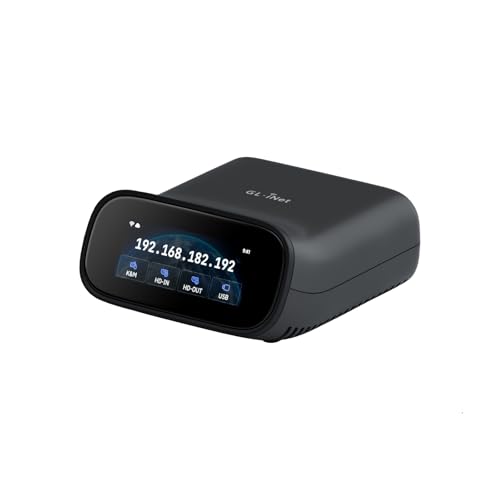
Best Remote-Access KVM – GL.iNet Comet Pro Wi-Fi 6 KVM
For remote administration rather than simple desk-side switching, the GL.iNet Comet Pro brings KVM access over Wi-Fi 6 or a wired connection. This remote KVM supports browser-based control, app access, 4K video passthrough, and two-way audio for managing systems away from the local display.
Best For: Home labs, IT support, remote recovery, and users who need BIOS or operating-system access from a distance.
Pros:
- Provides 4K at 30fps video passthrough with H.264 encoding.
- Supports dual-band Wi-Fi 6 plus wired connectivity.
- Enables remote access through a web interface or GLKVM apps on major platforms.
- Includes Tailscale support and a self-hosted cloud option.
Cons:
- Remote power control and hard-reset functions require separately sold ATX Board or Fingerbot accessories.
- It is designed for remote access, not for switching several computers to one local monitor.
The Comet Pro is a specialized KVM switch for remote infrastructure management. Its touchscreen, secure networking options, and recovery capabilities make it more suitable for technical users than for a conventional multi-PC desktop setup.
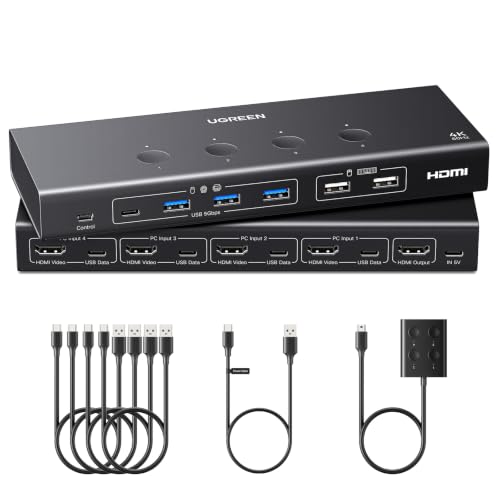
Best USB-C HDMI KVM – UGREEN 4-Computer 6-Port KVM
This UGREEN KVM switch is built for sharing one monitor and up to six USB peripherals between four computers. It combines 4K at 60Hz HDMI support with USB 3.0 and USB 2.0 ports, while EDID emulation helps preserve display settings when switching between hosts.
Best For: Productivity setups that need shared storage, printers, webcams, keyboards, or mice across four computers.
Pros:
- Supports 4K at 60Hz, HDR, 3D, and HDMI 2.0.
- Provides four USB 3.0 ports and two USB 2.0 ports.
- EDID emulation can help prevent resolution drops and window rearrangement.
- Offers front-button and wired desktop-controller switching.
Cons:
- HDMI cables and the power adapter are not included.
- Each computer requires an HDMI cable and USB-A-to-C data cable.
- It is not supported with docking stations.
Choose this model when peripheral sharing is as important as video switching. It offers more USB capacity than a basic KVM switch, but setup requires the correct cables, external power, and attention to the manufacturer’s laptop and connection requirements.
Best Dual-Monitor DisplayPort KVM – 2-Computer 4K 144Hz DisplayPort KVM
Gamers and multitasking professionals who need two displays should consider this DisplayPort KVM switch. It lets two computers share dual monitors and four USB devices, with support for extended or copy display modes and resolutions up to 4K at 144Hz.
Best For: Dual-monitor workstations and high-refresh-rate setups using DisplayPort graphics outputs.
Pros:
- Supports dual displays with extended and copy modes.
- Handles resolutions up to 4K at 144Hz with up to 48Gbps video bandwidth.
- Shares four USB 3.0 peripherals between two computers.
- Includes a desktop controller and 12V power adapter for convenient switching and stable USB operation.
Cons:
- Each computer needs two DisplayPort cables and one USB cable; DisplayPort cables are not included.
- Keyboard shortcut switching is not supported.
- Each computer must support multiple monitors and have two DisplayPort outputs.
This is the strongest fit for a dual-screen DisplayPort setup where high refresh rates matter. Its requirements are more demanding than a single-monitor HDMI KVM switch, but the 4K 144Hz capability and dual-display support make it well suited to advanced work or gaming desks.
Best for a Simple Two-Computer Setup – Compact 4K HDMI KVM
This HDMI KVM switch is a practical choice for sharing one monitor, keyboard, mouse, and other USB accessories between two computers. It supports 4K at 60Hz, includes USB-A and USB-C connectivity, and offers both onboard-button and wired-remote switching.
Best For: Home offices and workstations that need one-monitor control of two computers without installing drivers.
Pros:
- Supports 4K@60Hz, HDCP 2.2, 2K, 3D, and 1080p output.
- Provides four USB 3.0 ports, including three USB-A ports and one USB-C port.
- Includes adaptive EDID and plug-and-play setup with no separate power supply required.
- Offers both push-button and wired-remote switching.
Cons:
- Limited to one shared monitor and two connected computers.
- USB 3.0 cables are included, but the notes do not indicate that HDMI cables are included.
For buyers who do not need a dual- or triple-monitor arrangement, this model combines straightforward switching with useful 4K output and flexible peripheral sharing. Its compact two-computer design is best suited to a conventional desk setup.
Best for Triple-Monitor Workflows – UGREEN 8K Triple-Display KVM
This UGREEN KVM switch is designed for demanding multi-display setups, letting two computers share three monitors and four USB 3.0 peripherals. Its two DisplayPort inputs and one HDMI input per computer support high refresh rates and resolutions, while a desktop controller provides convenient switching.
Best For: Content creators, IT professionals, and home offices with computers that support three-monitor output.
Pros:
- Supports three monitors with DisplayPort 1.4 and HDMI 2.1 outputs up to 8K@60Hz.
- Offers support for 4K up to 240Hz, HDR10+, VRR, FreeSync, and G-Sync.
- Includes four USB 3.0 ports, required signal cables, a power adapter, and desktop controller.
- Supports mirrored or extended triple-monitor display modes.
Cons:
- Both computers must support triple-monitor output, with two DisplayPort ports and one HDMI port each.
- Requires the included power adapter and does not support keyboard shortcuts or EDID emulation.
- Cable length should remain within 2 meters for 8K operation.
This is the most capable option here for a three-screen workspace, but compatibility requirements are significant. Verify each computer’s graphics outputs and multi-monitor support before buying, especially if you plan to use extended mode or 8K refresh rates.
Best for Dual HDMI Displays – 8K Dual-Monitor KVM
This dual-monitor HDMI KVM switch lets two computers share two displays, four USB 3.0 peripherals, and one keyboard-and-mouse setup. It supports mirrored or extended display modes and includes a 12V power adapter for more stable operation with connected USB devices.
Best For: Dual-monitor users whose computers provide two HDMI outputs and support extended displays.
Pros:
- Supports up to 8K@60Hz and 4K@120Hz, with backward compatibility for lower resolutions.
- Provides two HDMI ports and four USB 3.0 ports with up to 5Gbps transfer speeds.
- Offers copy and extended display modes for two monitors.
- Includes panel-button and external wired-controller switching.
Cons:
- Each computer needs two HDMI outputs and support for dual-monitor copy or extend modes.
- Keyboard-shortcut switching is not supported.
- A 12V power adapter is needed for stable use with high-power USB devices.
This model is a strong fit when two HDMI-connected monitors are central to your workflow. Its external power supply helps support shared USB accessories, but buyers should confirm their computers have the required dual HDMI outputs before choosing it.
Best Dual-Monitor HDMI Pick – UGREEN 2-Monitor 4K KVM
For shoppers comparing kvm switches for a two-computer, two-monitor workspace, this UGREEN model offers HDMI connectivity, 4K@60Hz support, and shared USB 3.0 peripherals. It supports extended and mirrored displays and switches through either the unit’s button or included desktop controller.
Best For: Home offices and professional setups using two HDMI monitors with two computers.
Pros:
- Supports two monitors and two computers with extended or mirrored display modes.
- Provides four USB 3.0 ports, including USB-A and USB-C, for peripherals and storage.
- Includes HDMI and USB cables, power adapters, and a desktop controller.
Cons:
- Does not support DisplayPort, EDID emulation, or keyboard hotkey switching.
- Each computer requires two HDMI cables and one USB-A connection.
- The two monitors display video from the selected computer rather than both computers simultaneously.
This is a practical choice when your setup is HDMI-based and you need dual-screen control from one keyboard and mouse. Check cable lengths and confirm that each computer supports dual displays before buying.
Best Mixed-Port Option – HDMI+DisplayPort Dual-Monitor KVM
This HDMI+DisplayPort model is among the more flexible kvm switches for two computers sharing two monitors, provided each computer and monitor has the required matching ports. It supports 4K@60Hz, four USB 3.0 peripherals, and switching from either the front button or wired controller.
Best For: Users who need a dual-monitor KVM with one HDMI connection and one DisplayPort connection per computer.
Pros:
- Supports two monitors, two computers, and extended or copy display modes.
- Handles resolutions up to 4K@60Hz and is backward compatible with lower resolutions.
- Offers four USB 3.0 ports and includes an external 12V/1A power adapter.
Cons:
- Does not convert HDMI signals to DisplayPort or DisplayPort signals to HDMI.
- Each computer’s HDMI and DisplayPort inputs must connect to that same computer.
- Keyboard hotkey switching is not supported.
This model can simplify a mixed-port desk, but compatibility checks are essential. Confirm that both computers support dual displays and that the cables and monitors support the desired 4K@60Hz output.
Best Single-Monitor Value – UGREEN 1-Monitor 4K KVM
For a simpler desk, this UGREEN HDMI KVM switch lets one monitor, keyboard, mouse, and other USB devices serve two computers. It supports 4K@60Hz, plug-and-play operation across common operating systems, and switching through a button or included desktop controller.
Best For: Home offices, gaming rooms, and workspaces that switch two computers through one HDMI monitor.
Pros:
- Shares one HDMI monitor and four USB ports between two computers.
- Supports 4K@60Hz, HDMI 2.0, HDR, and lower resolutions including 1440p@120Hz.
- Includes two USB A-to-B cables, HDMI cables, and a desktop controller.
Cons:
- Supports only one monitor and does not work with a docking station.
- Both USB A-to-B cables must be connected for normal keyboard and mouse operation.
- Does not support EDID emulation or hotkey switching.
This is a straightforward option if your setup needs one shared HDMI display rather than dual-monitor control. For reliable 4K@60Hz operation, use suitable cables within the stated length limit and verify matching input and output resolutions.
How We Picked the Best Kvm Switches
We evaluated these Kvm Switches by matching their specifications to common desk setups rather than treating every model as interchangeable. Key considerations included supported video inputs and outputs, maximum resolution and refresh rate, USB hub capacity, switching methods, EDID behavior, and compatibility with modern computers and monitors.
We also considered the practical differences between HDMI, DisplayPort, mixed-interface, single-monitor, and multi-monitor designs. A switch that supports 8K video may not be the best choice for a workstation that needs two extended displays, while a compact two-computer model may be more suitable for a home office.
Quick Comparison
| Setup | Best suited to | What to prioritize |
|---|---|---|
| 1 monitor, 2 computers | Home offices and basic desktops | 4K support, reliable USB switching, simple controls |
| 1 monitor, 4 computers | Shared workstations and labs | Four inputs, EDID, USB 3.0 bandwidth |
| 2 monitors, 2 computers | Productivity and creator setups | Dual-display support and matching output types |
| 3 monitors, 2 computers | Advanced workstations | Three-display compatibility, sufficient cables, stable switching |
| Remote KVM | Headless systems and remote administration | Network reliability, passthrough quality, secure access |
Key Buying Factors for Kvm Switches
Video Ports, Resolution, and Refresh Rate
Start by checking the exact ports on both your computers and displays. HDMI and DisplayPort are not automatically interchangeable, and adapters can limit resolution or refresh rate. For office work, 4K at 60Hz is usually sufficient. Gaming and motion-sensitive work may benefit from 4K at 120Hz or 144Hz, provided the computers, cables, and monitors all support it.
Single or Multiple Monitors
A dual-monitor KVM must support extended displays if you want separate desktop areas on each screen. Verify whether the advertised monitor count describes simultaneous outputs, mirrored displays, or a particular combination of HDMI and DisplayPort connections.
USB Devices and Switching
Count the peripherals you plan to share, such as a keyboard, mouse, webcam, storage drive, microphone, or printer. USB 3.0 ports are preferable for fast storage, but some switches reserve certain ports for keyboard and mouse functions. Check the total port count and whether switching is controlled by a button, wired remote, hotkey, or software.
EDID and Compatibility
EDID management helps computers maintain a stable display connection when you switch between systems. It can reduce window rearrangement, blank screens, and resolution changes, although operating-system and graphics-driver behavior still varies.
Who Should Buy Which Kvm Switches?
Choose a compact single-monitor model if you alternate between a work computer and a personal PC. A four-computer switch is better for labs, trading desks, support stations, or anyone managing several systems. For productivity, design, or development, select a dual-monitor KVM with the correct extended-display support. Users with three displays should confirm every output path before buying.
High-refresh HDMI or DisplayPort models are the right fit for gaming and demanding visual work, while a remote Wi-Fi KVM suits administrators who need access to a computer without being physically connected to it. In every case, verify port types, cable requirements, operating-system support, and the exact resolution and refresh rate you intend to use.