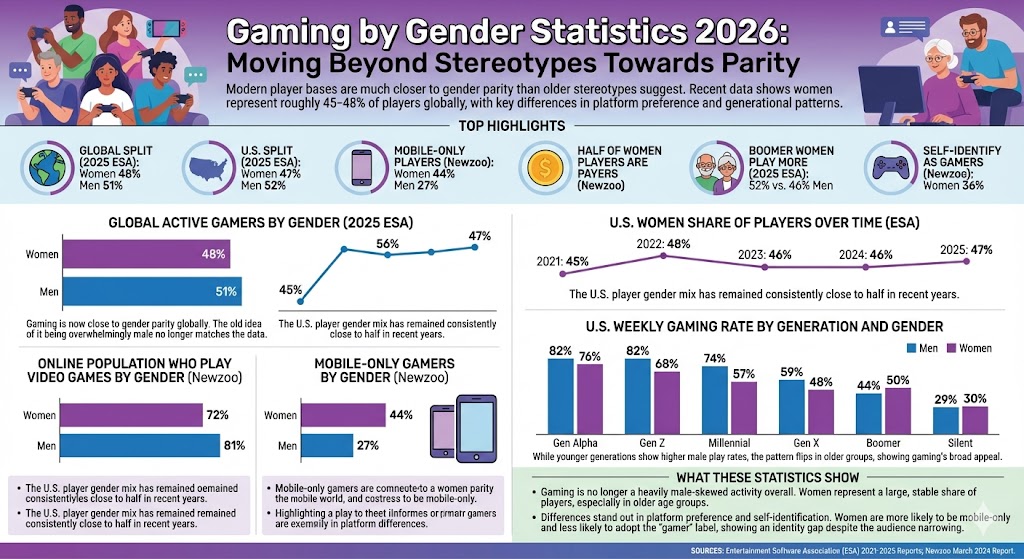
These gaming by gender statistics show how modern player bases are much closer to parity than older stereotypes suggest. Recent U.S. and global studies place women at roughly 45% to 48% of players overall, while the biggest differences now show up in platform preference, self-identification, and age-based play patterns.
ESA’s 2025 global report found active gamers were split 48% women and 51% men.
ESA’s 2025 U.S. report found the player base was 47% women and 52% men.
Across ESA’s 2021 to 2025 U.S. datasets, women accounted for between 45% and 48% of players.
Newzoo found 72% of women in its surveyed online population played video games, versus 81% of men.
In Newzoo’s 2023 gamer cohort, women made up 45% of players and men made up 55%.
Newzoo found 44% of women players were mobile-only, compared with 27% of men.
Half of women players in Newzoo’s study were also payers.
ESA’s 2024 U.S. generation data showed women had higher weekly play rates than men among boomers and the silent generation.
ESA’s 2025 U.S. report said 52% of boomer women play video games, versus 46% of boomer men.
Newzoo found only 36% of women players described themselves as gamers, even though women represented a large share of the total audience.
Global active gamers by gender
Label
Bar
Value
Women
48%
Men
51%
Max = 51%. Widths: Women 94.12%, Men 100.00%
At a global level, gaming is now close to gender parity. That does not mean behavior is identical across groups, but it does mean the old idea that gaming is overwhelmingly male no longer matches the current audience data.
U.S. player gender mix has been relatively stable in recent years. Women have remained close to half of all players, which makes gender composition one of the most balanced parts of the broader media and entertainment landscape.
Online population who play video games by gender
Label
Bar
Value
Women
72%
Men
81%
Max = 81%. Widths: Women 88.89%, Men 100.00%
This comparison shows that the gender gap widens somewhat when measured against the broader online population instead of the active gamer base. Even so, the female participation rate is still very high, which helps explain why women make up such a large share of players overall.
Mobile-only gamers by gender
Label
Bar
Value
Women
44%
Men
27%
Max = 44%. Widths: Women 100.00%, Men 61.36%
Platform mix is one of the clearest places where gender differences still appear. Women in Newzoo’s dataset were much more likely to be mobile-only players, while men were more likely to spread play across multiple devices.
U.S. weekly gaming rate by generation and gender
Label
Bar
Value
Gen Alpha men
82%
Gen Alpha women
76%
Gen Z men
82%
Gen Z women
68%
Millennial men
74%
Millennial women
57%
Gen X men
59%
Gen X women
48%
Boomer men
44%
Boomer women
50%
Silent men
29%
Silent women
30%
Max = 82%. Widths: Gen Alpha men 100.00%, Gen Alpha women 92.68%, Gen Z men 100.00%, Gen Z women 82.93%, Millennial men 90.24%, Millennial women 69.51%, Gen X men 71.95%, Gen X women 58.54%, Boomer men 53.66%, Boomer women 60.98%, Silent men 35.37%, Silent women 36.59%
Age matters as much as gender. Among younger cohorts, male weekly play rates remain higher, but the pattern flips in older groups. That reversal is one of the clearest signs that gaming has broadened well beyond the traditional young-male stereotype.
What these gaming by gender statistics show
The clearest takeaway is that gaming is no longer a heavily male-skewed activity in overall audience terms. Women now represent a large and stable share of players in both U.S. and global datasets, and in some older age groups they are even more likely to play than men.
Where gender differences still stand out is in how people play and how they describe themselves. Women are more likely to be mobile-only players, while men are more likely to span platforms and to adopt the gamer label. That means the audience gap has narrowed much faster than the identity gap.
It is also important to compare studies carefully. Some sources measure active gamers who play at least one hour per week, while others measure the online population that has played within a recent period. Even with those methodological differences, the broad story stays consistent: gaming is now a mass-market behavior shared across genders.
Sources
Entertainment Software Association, 2021 Essential Facts About the Video Game Industry
Entertainment Software Association, 2022 Essential Facts About the Video Game Industry
Entertainment Software Association, Video Games Remain America’s Favorite Pastime With More Than 212 Million Americans Playing Regularly, July 2023
Entertainment Software Association, Video Games Remain Lifelong Source of Entertainment for 190.6 Million Americans, May 2024
Entertainment Software Association, 2024 Essential Facts About the U.S. Video Game Industry
Entertainment Software Association, Annual ESA Study Reveals Video Games’ Universal Appeal Across Generations, June 2025
Entertainment Software Association, Power of Play: 2025 Global Video Games Report
Newzoo, Spotlighting women gamers and how they play and spend on video games, March 2024
Check out the 10 best gaming chairs with speakers for an immersive experience in 2026, and discover which one will elevate your gameplay to new heights.