Choosing among USB logic analyzers is easier when you match channel count, sampling speed, memory depth, and protocol support to the signals you actually need to capture.
This roundup covers compact entry-level analyzers, portable midrange instruments, and high-speed models for demanding embedded, FPGA, and digital-bus debugging.
Best 10 USB Logic Analyzers Picks for 2026
Best Budget 8-Channel Pick
HiLetgo 24MHz USB Logic Analyzer

- Eight digital channels
- Sampling rates up to 24 MHz
- Useful for UART, I2C, and SPI debugging
Best For: Entry-level embedded debugging and digital signal analysis
Best for Protocol Coverage
LA1010 16-Channel USB Logic Analyzer

- 16 input channels
- 100 MHz sampling per channel
- Decodes 30+ protocols
Best For: Complex embedded-system debugging and multi-signal monitoring
Best DIY-Compatible Option
Comidox 24MHz 8-Channel Analyzer

- Supports Saleae software and PulseView
- Automatic UART, SPI, and I2C analysis
- Includes USB cable and 10 Dupont lines
Best For: Arduino, robotics, and maker-project debugging
Best High-Speed Choice
DSLogic Plus 400MHz Logic Analyzer

- 16 channels with up to 400 MHz sampling
- 256 Mbits onboard memory
- Dual buffered and streaming modes
Best For: Advanced digital analysis and high-speed multi-channel captures
Best for Flexible Prototyping
8-Channel 24MHz Logic Analyzer

- Eight channels for I2C, SPI, and UART debugging
- Breadboard adapter, breakout board, and clips included
- USB-A and USB-C cables with cross-platform support
Best For: Arduino, ESP32, Raspberry Pi, and breadboard projects
Best for High-Speed Capture
DSLogic U3Pro32 32-Channel Analyzer

- Up to 1GHz sampling across a flexible channel configuration
- 32 channels with stream and buffered capture modes
- 2Gbits memory and DSView support for Windows, macOS, and Linux
Best For: Advanced embedded debugging and dense multi-signal systems
Best for Protocol Decoding
LA2016 16-Channel 200MHz Analyzer

- 16 channels with 200MHz sampling and 1Gbits memory
- Decodes more than 20 protocols, including CAN and JTAG
- Portable USB-powered kit with probes and hook clips
Best For: Protocol-focused debugging on Windows, Mac OS, and Linux
Flexible Streaming Pick
DSLogic 16-Channel USB Analyzer
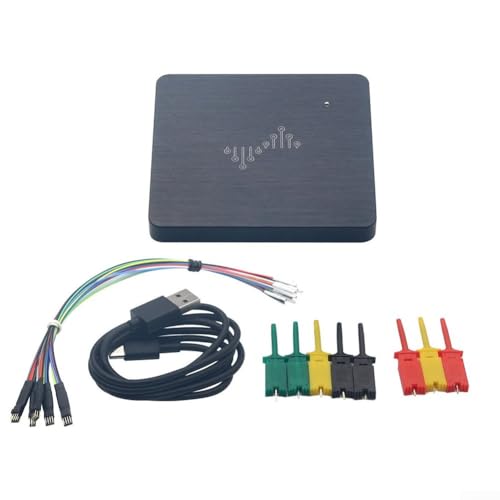
- 100MHz sampling across 16 channels
- Streaming and buffered capture modes
- Includes clips, cables, and Type-C lead
Best For: Flexible signal capture with broad threshold adjustment
High-Speed Protocol Pick

- 500MS/s sampling with 10GB depth
- Decodes UART, I2C, SPI, CAN, and more
- Works with Windows, macOS, and Linux
Best For: Fast embedded debugging and protocol analysis
Balanced USB-C Pick

- 400MHz sampling across 16 channels
- 256Mbit onboard capture memory
- Compatible with Windows, macOS, and Linux
Best For: Portable general-purpose digital debugging
Best Budget 8-Channel Pick – HiLetgo 24MHz USB Logic Analyzer
This compact HiLetgo is a practical entry point for USB logic analyzers, offering eight digital channels and sampling rates up to 24 MHz. It is suited to everyday embedded-system debugging, especially when you need to inspect UART, I2C, or SPI signals without a more advanced instrument.
Best For: Arduino and embedded projects, basic digital signal analysis, and hardware testing within 5.25V input limits.
Pros:
- Eight channels with sampling rates up to 24 MHz.
- Supports a broad range of selectable sampling rates from 25 kHz to 24 MHz.
- 1 MΩ input impedance and included USB cable with EMI ferrite ring.
Cons:
- Eight channels may be limiting for larger digital systems.
- Its general applications are best suited to signals around 10 MHz rather than demanding high-speed work.
The HiLetgo is a straightforward, low-cost option for learning and routine debugging. Its 8-channel layout and 24 MHz ceiling cover common microcontroller communication tasks, but users working with more channels or higher-speed signals should consider a more capable analyzer.
Best for Protocol Coverage – LA1010 16-Channel USB Logic Analyzer
The LA1010 stands out among USB logic analyzers for its 16 input channels, 100 MHz sampling rate per channel, and broad protocol-decoding support. Its included KingstVIS software displays captured signals on a computer and supports Windows, macOS, and Linux.
Best For: Embedded developers who need to monitor many digital lines and decode protocols such as I2C, SPI, UART, CAN, and related interfaces.
Pros:
- Captures 16 digital signals simultaneously at up to 100 MHz per channel.
- Decodes more than 30 standard protocols, according to the supplied specifications.
- Supports Windows, macOS, and Linux with USB 2.0 connectivity.
Cons:
- Its feature set may be more than needed for simple, single-bus troubleshooting.
- The supplied specifications do not identify a standalone display, so computer software is central to operation.
For users who want channel count and protocol analysis in one package, the LA1010 is a strong choice. Its cross-platform support and 16-channel design make it more versatile than basic eight-channel analyzers for complex embedded systems.
Best DIY-Compatible Option – Comidox 24MHz 8-Channel Analyzer
This Comidox USB logic analyzer is designed for accessible DIY troubleshooting, with eight digital channels, a 24 MHz maximum sampling rate, and compatibility with Saleae Logic Analyzer software and PulseView. It includes a USB cable and Dupont wires for quick connection to development boards.
Best For: Arduino, ARM, FPGA, robotics, and other projects using UART, SPI, or I2C communication.
Pros:
- Works with Saleae Logic Analyzer software and PulseView.
- Offers automatic analysis for UART, I2C, SPI, and other standard protocols.
- Includes 10 Dupont lines along with the analyzer and USB cable.
Cons:
- Only eight digital channels are available.
- The 24 MHz sampling rate is aimed at general-purpose debugging rather than high-speed analysis.
- Its stated voltage range and 1.5V threshold require attention when connecting different systems.
The Comidox is an appealing choice when software flexibility and included hookup accessories matter. It covers common maker and embedded tasks well, provided the signal count, voltage range, and sampling speed fit the project.
Best High-Speed Choice – DSLogic Plus 400MHz Logic Analyzer
The DSLogic Plus is the high-performance option in this USB logic analyzers roundup, combining 16 channels, up to 400 MHz sampling in buffer mode, and 256 Mbits of onboard memory. Its dual-mode design supports either high-speed buffered capture or long-duration streaming to a computer.
Best For: Engineers and advanced developers analyzing faster digital systems, longer captures, or multiple signals at once.
Pros:
- Provides 16 digital channels and up to 400 MHz sampling in buffer mode.
- Offers 256 Mbits of onboard SDRAM and up to 16G sample depth in stream mode.
- Includes adjustable thresholds, shielded fly wires, and an aluminum case.
- DSView supports Windows, macOS, Linux, and nearly 100 protocol decoders.
Cons:
- Maximum sampling rates depend on the selected number of channels and operating mode.
- The advanced feature set may be unnecessary for basic UART or I2C checks.
- Uses a USB 2.0 Type-C interface rather than a simpler legacy USB connector.
The DSLogic Plus is the best fit when capture speed, memory, and channel flexibility take priority. Its dual capture modes make it more adaptable than entry-level analyzers, while DSView provides a broad software environment for detailed analysis.
Best for Flexible Prototyping – 8-Channel 24MHz Logic Analyzer
The LONELY BINARY kit is a practical entry point for USB logic analyzers, combining eight channels, 24MHz capture, and breadboard-friendly accessories. It supports common debugging tasks involving I2C, SPI, and UART, while its USB-A and USB-C cables help connect it to a range of computers.
Best For: Hobbyists, students, and embedded developers working with Arduino, ESP32, Raspberry Pi, IoT, or other breadboard-based projects.
Pros:
- Eight channels provide more flexibility than basic four-channel models.
- Includes breakout and breadboard adapters for solder-free connections.
- Works with Windows, Mac, Linux, and Ubuntu using open-source software.
- Includes test clips, alligator clips, jumper wires, and a storage case.
Cons:
- The 24MHz capture rate is more limited than higher-end analyzers.
- The kit is focused on digital signal analysis rather than general-purpose instrumentation.
Choose this model when convenient connections and a complete accessory bundle matter more than maximum speed. It is a well-equipped option for learning, prototyping, and routine microcontroller communication debugging.
Best for High-Speed Capture – DSLogic U3Pro32 32-Channel Analyzer
The DSLogic U3Pro32 is a high-performance choice among USB logic analyzers, offering 32 channels, sampling rates up to 1GHz, and a USB 3.0 Type-C connection. Its dual capture modes let you prioritize long real-time recordings or high-speed buffered acquisition.
Best For: Advanced embedded debugging, dense multi-signal systems, and users who need high sampling rates, deep memory, or extensive protocol-decoding support.
Pros:
- Supports up to 32 digital channels and 1GHz sampling.
- Offers stream mode for long captures and buffer mode for high-speed sampling.
- Includes 2Gbits of onboard DDR3 memory and up to 16G sample depth in stream mode.
- DSView works with Windows, macOS, and Linux and supports nearly 100 protocol decoders.
Cons:
- Its advanced capabilities may be excessive for simple hobby projects.
- USB 3.0 Type-C connectivity may require an adapter on older computers.
This is the strongest fit in the group for demanding digital capture. The combination of channel density, speed, memory, adjustable threshold, and shielded wiring gives experienced users substantial flexibility for complex waveform analysis.
Best for Protocol Decoding – LA2016 16-Channel 200MHz Analyzer
The LA2016 is a portable USB logic analyzer for users who want broad protocol coverage without moving to a 32-channel unit. It captures 16 signals at up to 200MHz, includes 1Gbits of memory, and uses PC software that can decode more than 20 protocols.
Best For: Developers and technicians analyzing I2C, SPI, UART, CAN, JTAG, Modbus, and other supported buses on Windows, Mac OS, or Linux.
Pros:
- Captures 16 channels at up to 200MHz with 1Gbits of deep memory.
- Software decodes more than 20 protocols, including CAN, I2S, USB1.1, and JTAG.
- Includes waveform compression, data export, saving functions, and a PWM generator.
- Portable, USB-powered design includes probes, hook clips, and a USB cable.
Cons:
- It has fewer channels and a lower maximum sampling rate than the DSLogic U3Pro32.
- The listed operating-system support specifically references older Windows versions through Windows 10.
The LA2016 balances useful speed, channel count, and software features. It makes particular sense when automated protocol decoding and portability are more important than the extreme sampling performance of premium USB logic analyzers.
Flexible Streaming Pick – DSLogic 16-Channel USB Analyzer
For buyers comparing usb logic analyzers, this DSLogic model combines 16 channels with up to 100MHz sampling and Type-C connectivity. Its streaming and buffered modes make it adaptable for real-time transfers or longer captures, while adjustable thresholds support signals from 2V to 5.0V.
Best For: Embedded developers and electronics hobbyists who want flexible capture modes, broad voltage-threshold support, and a complete starter accessory package.
Pros:
- Captures up to 16 digital channels at 100MHz.
- Supports streaming and buffered operating modes.
- Includes signal clips, flexible flat cables, and a Type-C data cable.
- Provides overvoltage and electrostatic discharge protection.
Cons:
- Its 100MHz sampling rate is lower than the faster analyzers in this roundup.
- The supplied notes do not specify operating-system compatibility or included analysis software.
This is a practical, well-equipped option when flexible workflows and protection features matter more than maximum sampling speed. The adjustable thresholds and included accessories also reduce setup friction for varied digital-signal work.
High-Speed Protocol Pick – LA5016 500MS/s Logic Analyzer
This LA5016 stands out among usb logic analyzers with 500MS/s sampling, 16 channels, and 10GB of depth for detailed MCU, ARM, and FPGA debugging. Its software can display, analyze, export, and save captures while decoding several widely used protocols.
Best For: Developers who need fast multichannel captures, deep memory, cross-platform desktop support, and protocol decoding for embedded systems.
Pros:
- Offers 500MS/s sampling and 10GB memory depth.
- Captures 16 digital signals simultaneously.
- Decodes UART/RS-232/485, I2C, SPI, CAN, USB1.1, and HDMI CEC.
- Supports Windows, macOS, and Linux.
Cons:
- The product details list a 20MHz frequency specification, which may require clarification for some use cases.
- Its feature-rich software and protocol options may be more than casual users need.
With the highest stated sampling rate in this group and extensive decoding support, the LA5016 is the strongest fit for demanding embedded debugging. Cross-platform compatibility adds flexibility for teams using different desktop operating systems.
Balanced USB-C Pick – BINGOX 400MHz Logic Analyzer
BINGOX USB Logic Analyzer, 16 Channels, 400MHz Sampling Rate, 256Mbit Memory, USB-C Interface
Check Price On AmazonFor usb logic analyzers that balance speed and portability, this 16-channel BINGOX model offers up to 400MHz sampling, 256Mbit onboard memory, and a USB-C interface. It is designed for digital troubleshooting, embedded development, FPGA testing, and protocol analysis across major desktop platforms.
Best For: Makers, students, technicians, and developers seeking a compact USB-C analyzer with high sampling speed and broad operating-system compatibility.
Pros:
- Analyzes up to 16 digital signals simultaneously.
- Provides sampling rates up to 400MHz for fast signal details.
- Includes 256Mbit of onboard memory for high-speed capture.
- Supports Windows, macOS, and Linux.
Cons:
- Its 256Mbit memory is less than the LA5016’s stated 10GB depth.
- The supplied notes do not name the supported protocols.
This model offers a compelling middle ground: faster sampling than the DSLogic while retaining a compact USB-C design and 16-channel coverage. It is a sensible choice for general digital debugging when you do not need the LA5016’s specified deep memory.
How We Picked These USB Logic Analyzers
We selected models across several performance tiers so you can compare practical options rather than focusing only on headline specifications. The lineup includes 8-, 16-, and 32-channel analyzers, sampling rates from 24MHz to 1GHz, and both standard USB and USB-C connections.
We also considered useful debugging features such as protocol support for UART, I2C, SPI, CAN, and PWM, software compatibility, onboard memory, portability, included breakout hardware, and suitability for Arduino, ARM, FPGA, and general embedded projects. Since advertised specifications can vary by operating mode and software, verify the manufacturer’s documentation before purchase.
Quick Comparison
| Best For | What to Prioritize | Typical Choice |
|---|---|---|
| Learning and simple serial debugging | Low cost, 8 channels, protocol decoding | 24MHz USB analyzer |
| General embedded development | 16 channels, 100–200MHz sampling | LA1010 or LA2016 class |
| Deeper captures and faster buses | High sample rate, larger memory | DSLogic Plus or 400MHz model |
| Advanced FPGA and high-speed work | Many channels, 1GHz sampling, USB 3.0 | DSLogic U3Pro32 |
Key Buying Factors for USB Logic Analyzers
Channels and Sampling Rate
Choose enough channels to monitor every relevant signal plus a ground reference. Eight channels are often adequate for basic UART, I2C, or SPI work, while 16 channels provide more flexibility for parallel buses and multi-signal debugging. Sampling rate should be comfortably higher than the signal frequency; faster rates preserve more timing detail, especially around edges and glitches.
Memory Depth and Transfer Method
Memory determines how long a device can capture data at a given sampling rate. Larger buffers are valuable when a fault occurs infrequently or when you need to examine a long startup sequence. USB transfer design also matters: real-time streaming can be useful for extended captures, while onboard memory helps prevent dropped data during short, high-speed events.
Software, Protocols, and Compatibility
Confirm that the analyzer’s software runs on your operating system and supports the decoders you need. UART, I2C, and SPI are common requirements, while CAN, PWM, and custom or parallel protocols may require a more capable platform. Check whether the software is genuinely included, whether drivers are available, and whether the interface is easy to configure.
Electrical Safety and Accessories
Logic analyzers are not automatically safe for every voltage level. Check input thresholds, maximum voltage, grounding requirements, and whether the device is suitable for 1.8V, 3.3V, or 5V logic. Breakout boards, grabber leads, a reliable USB cable, and a ferrite filter can make a low-cost kit much more convenient.
Who Should Buy Which USB Logic Analyzers?
Beginners, students, and hobbyists debugging Arduino or basic serial buses should start with an affordable 8-channel analyzer. Choose a 16-channel, 100–200MHz model for broader embedded work, multiple buses, and more detailed timing analysis. Developers working with faster interfaces, long captures, or complex systems should consider 400–500MHz options with deeper memory. For demanding FPGA, processor, and high-speed digital debugging, a 32-channel analyzer with 1GHz sampling and USB 3.0 offers the most headroom.