Finding the best subwoofers for small rooms means balancing bass impact with cabinet size, placement flexibility, and control. A subwoofer that sounds impressive in a large showroom can overwhelm a bedroom, apartment, or compact media room.
This roundup compares compact powered subs, wireless soundbar systems, and one passive option across different budgets and setups. Use the guide below to match woofer size, connectivity, and output to your room and listening habits.
Best 10 Subwoofers for Small Rooms Picks for 2026
Compact Bass Pick
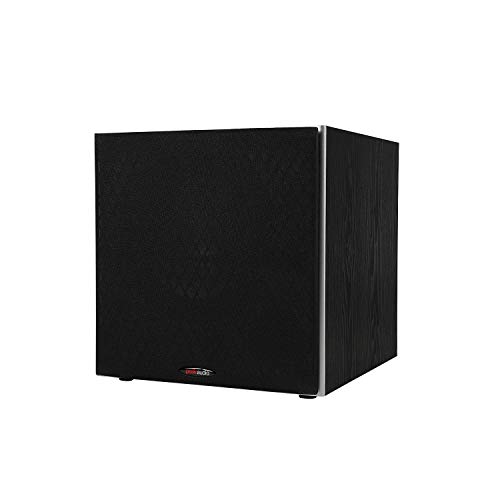
- 10-inch woofer with directed port
- Up to 100 watts of built-in power
- 80–160 Hz adjustable crossover
Best For: Small- to mid-size home theater rooms
All-in-One Surround Choice
ULTIMEA Poseidon M60 Soundbar System

- 5.1-channel sound with Dolby Atmos
- Dedicated wired subwoofer included
- App EQ and surround-level controls
Best For: Small-room TV, movie, and gaming setups
High-Output Option

- 12-inch spun-copper woofer
- 200-watt amplifier, 400-watt maximum output
- 29–120 Hz response at ±3 dB
Best For: Small rooms needing powerful cinematic bass
Space-Saving Connectivity Pick
BESTISAN SW65D 6.5-inch Subwoofer
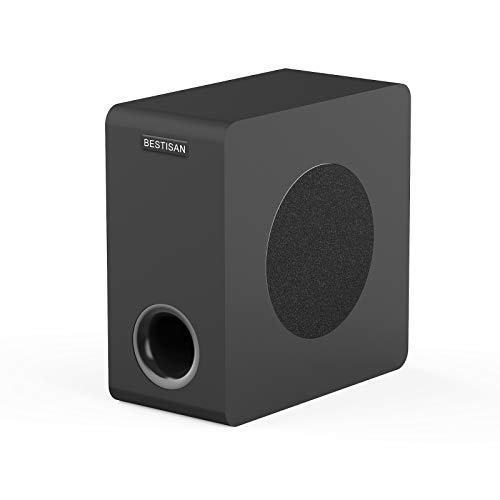
- Compact 6.5-inch side-firing woofer
- RCA, AUX, LFE, and high-level inputs
- 35–200 Hz stated frequency response
Best For: Compact TV and bookshelf-speaker systems
Best Wireless Setup

- Wireless subwoofer for flexible placement
- 240W peak 2.1-channel system
- App EQ and dialogue enhancement
Best For: Small-room TV, gaming, and cable-free setups
Best Dedicated Bass Upgrade
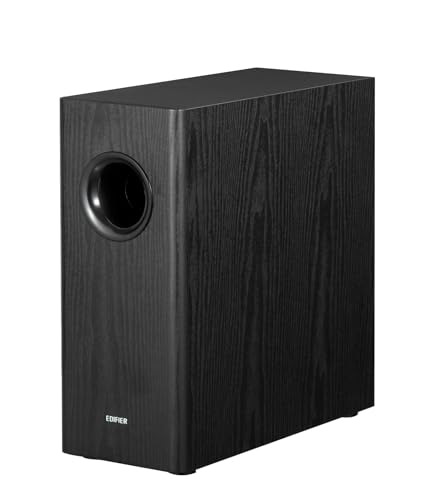
- 8-inch woofer with 35Hz response
- Adjustable crossover and phase controls
- 70W RMS built-in amplifier
Best For: RCA-equipped bookshelf-speaker and stereo systems
Best Compact Wired Option
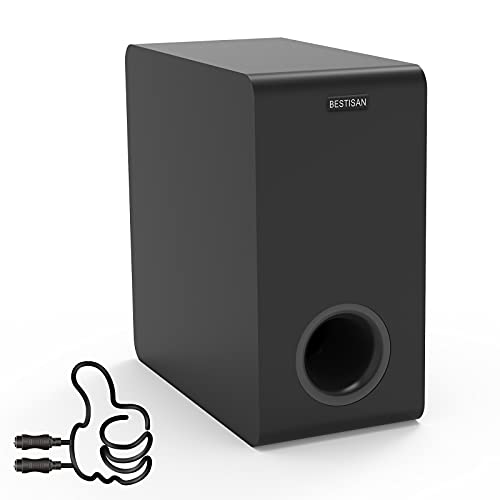
- Compact 6.5-inch side-firing design
- 60W maximum output with bass controls
- RCA and auxiliary connectivity
Best For: Space-conscious wired TV and home-theater setups
Compact Powerhouse
Rockville Rock Shaker 6.5-inch

- 100W RMS and 200W peak output
- Adjustable crossover and phase controls
- RCA and speaker-level connectivity
Best For: Small-room home theater, music, and gaming
Easy-Tuning Pick

- DSP with 60W RMS and 100W peak power
- Low-pass dial and 0–180° phase switch
- Compact down-firing MDF design
Best For: Small wired soundbar, desktop, and home theater setups
Budget Passive Option

- 100W RMS and 150W peak output
- Down-firing 6.5-inch woofer
- MDF cabinet with anti-shock base
Best For: Small to mid-size rooms with an existing amplifier or receiver
Compact Bass Pick – Polk Audio PSW10
The Polk Audio PSW10 is a practical choice for shoppers looking at subwoofers for small rooms. Its 10-inch driver, compact floor-standing design, and built-in amplification add weight to music and movie sound without requiring a separate amplifier.
Best For: Small- to mid-size rooms, home theater upgrades, and listeners who want straightforward wired integration.
Pros:
- 10-inch Dynamic Balance woofer with a configured directed port for added bass depth.
- Built-in 50-watt RMS amplifier with up to 100 watts of power.
- Continuously variable 80–160 Hz crossover and phase toggle support system setup.
- Offers speaker- and line-level connections for compatibility with existing systems.
Cons:
- Its 17-inch depth may require careful placement in especially tight rooms.
- Wired connectivity means it needs a direct cable connection to the system.
- It is not waterproof.
The PSW10 balances useful adjustability and strong output with a relatively compact enclosure. It is a sensible pick when you want dedicated bass for a small-room system without moving to a larger 12-inch subwoofer.
All-in-One Surround Choice – ULTIMEA Poseidon M60 Soundbar System
The ULTIMEA Poseidon M60 is an all-in-one option for shoppers seeking subwoofers for small rooms as part of a complete sound system. Its soundbar, wired subwoofer, Dolby Atmos support, and app controls are designed to simplify immersive audio without adding rear speakers.
Best For: Small-room TV setups, movies, gaming, and users who want surround sound with simplified installation.
Pros:
- Combines five built-in soundbar speakers with a dedicated wired subwoofer.
- Supports Dolby Atmos through HDMI eARC and includes CEC integration.
- VoiceMX processing is designed to improve dialogue clarity.
- App control provides a 10-band EQ, sound presets, and adjustable surround levels.
Cons:
- The subwoofer is wired rather than wireless.
- This is a complete soundbar system, not a standalone subwoofer for an existing receiver.
- It is not water resistant.
The Poseidon M60 makes the most sense when the goal is a tidy, room-friendly home theater package rather than a separate bass-only upgrade. Its flexible DSP and eARC connection add useful control for compact entertainment spaces.
High-Output Option – Klipsch R-120SW
The Klipsch R-120SW brings substantially more driver area and output than many compact subwoofers for small rooms. Its 12-inch spun-copper woofer and 200-watt amplifier are aimed at listeners who want powerful cinematic bass and have enough floor space for a larger cabinet.
Best For: Small rooms that need high-impact movie bass and can accommodate a larger floor-standing enclosure.
Pros:
- 12-inch high-excursion spun-copper woofer.
- 200 watts of amplifier power and 400 watts of maximum acoustic output.
- 29–120 Hz frequency range at ±3 dB.
- Rear-firing bass-reflex port supports the cabinet design.
Cons:
- Its 19.2-inch depth and 31-pound weight make it less space-conscious than smaller models.
- It uses wired RCA connectivity.
- Its high output may be more than necessary for some small-room setups.
The R-120SW is a performance-forward choice rather than the most compact one. Consider it when impactful bass is the priority and placement space is available for its deeper, heavier cabinet.
Space-Saving Connectivity Pick – BESTISAN SW65D 6.5-inch Subwoofer
The BESTISAN SW65D is a compact powered option for shoppers comparing subwoofers for small rooms. Its 6.5-inch side-firing woofer, bottom port, and multiple input types make it easy to add low-end support to a TV, soundbar, bookshelf speakers, or home theater system.
Best For: Compact living rooms, desktop-sized audio areas, and systems that need flexible wired input options.
Pros:
- Space-saving 6.5-inch enclosure with a side-firing woofer.
- 35–200 Hz stated frequency response for broad bass adjustment.
- Includes RCA, 3.5mm AUX, LFE, and high-level speaker inputs and outputs.
- Bass-reflex cabinet with bottom port and internal bracing is designed to reduce resonance.
Cons:
- The 6.5-inch driver may provide less output than larger 10- or 12-inch models.
- The manufacturer recommends pairing it with devices outputting no more than 850 mV.
- It is wired and not water resistant.
The SW65D stands out for fitting into tighter spaces while supporting several connection methods. It is a practical match for modest systems where easy integration and a smaller footprint matter more than maximum room-filling output.
Best Wireless Setup – ULTIMEA Poseidon M30 Soundbar
For shoppers comparing subwoofers for small rooms, the ULTIMEA Poseidon M30 is a convenient 2.1-channel soundbar system with a wireless subwoofer. Its cable-free bass module, compact soundbar profile, app controls, and dialogue-enhancement features make it a flexible choice for a TV, desk, or modest home theater.
Best For: Small-room TV viewing, gaming, and listeners who want flexible subwoofer placement without running an audio cable.
Pros:
- Wireless subwoofer allows flexible placement around the room.
- 240W peak output and BassMX technology support impactful low-frequency sound.
- App includes a 10-band equalizer and 121 EQ presets.
- VoiceMX is designed to make dialogue clearer.
Cons:
- The system is a soundbar package rather than a standalone upgrade for an existing stereo system.
- The subwoofer uses a 5.25-inch driver, so it may not deliver the scale of a larger dedicated subwoofer.
- Its wireless connection still requires a separate power outlet for the subwoofer.
The Poseidon M30 is particularly practical when placement flexibility matters in a compact room. HDMI ARC, optical, and Bluetooth 6.0 provide several connection options, while app-based EQ lets you tailor the presentation for movies, music, or games.
Best Dedicated Bass Upgrade – Edifier T5s Powered Subwoofer
The Edifier T5s is a powered subwoofer for small rooms that combines an 8-inch long-throw woofer with a relatively slim cabinet. With 70W RMS output, adjustable crossover and phase controls, and RCA connectivity, it is suited to adding deeper bass to compatible bookshelf speakers, amplifiers, or home-audio systems.
Best For: Small-room stereo or home-theater systems with an RCA subwoofer output, especially users who want adjustable integration controls.
Pros:
- 8-inch woofer and 35Hz frequency response provide deep bass potential.
- Low-pass filter adjusts from 30Hz to 160Hz, with a 0°/180° phase selector.
- Built-in 70W RMS Class-D amplifier supports plug-and-play operation.
- Auto-standby helps reduce power use after inactivity.
Cons:
- It is wired and requires RCA connections rather than wireless placement.
- The cabinet is slim but relatively tall at 16.14 inches.
- Series connection without a sub-out requires main speakers with a compatible line input.
The T5s offers more conventional subwoofer integration than an all-in-one soundbar system. Its tuning controls are useful for blending bass in a compact space, but buyers should confirm their source or speakers provide the required RCA or compatible line-level connection.
Best Compact Wired Option – BESTISAN SW65D Subwoofer
The BESTISAN SW65D is a compact powered subwoofer for small rooms, measuring 6.3 by 12.6 by 12.6 inches. Its 6.5-inch side-firing design, adjustable bass and volume controls, and wired RCA or auxiliary connectivity make it a straightforward way to add low-end impact without taking up the footprint of a larger subwoofer.
Best For: Compact home-theater or television setups that need a simple, space-conscious wired bass upgrade.
Pros:
- Compact enclosure is easier to place in limited floor space.
- 6.5-inch side-firing design is intended to help distribute sound through the room.
- Controls allow bass and volume adjustments for room acoustics and preference.
- Includes straightforward RCA and auxiliary connectivity.
Cons:
- Its 60W maximum output is lower than the Edifier T5s and ULTIMEA system.
- The wired design limits placement flexibility.
- The supplied frequency-response specification is listed as 35–200Hz, without a separately stated RMS power rating.
The SW65D makes sense when cabinet size and simple setup are higher priorities than maximum output. It can complement a TV, receiver, soundbar, or bookshelf-speaker system, provided the source offers a suitable wired connection and the available space accommodates its 12.6-inch depth.
Compact Powerhouse – Rockville Rock Shaker 6.5-inch
For shoppers comparing subwoofers for small rooms, the Rockville Rock Shaker combines a compact cabinet with 100W RMS power and a 6.5-inch woofer. Its adjustable crossover and phase controls help you tailor the bass to your existing speakers and room.
Best For: Small-room home theater, music, and gaming setups that need flexible wired connectivity.
Pros:
- Compact design fits neatly into space-conscious setups.
- 100W RMS and 200W peak output provide substantial low-frequency impact.
- Adjustable crossover and phase controls support precise system integration.
- RCA and speaker-level inputs and outputs offer broad compatibility.
Cons:
- Wired connectivity only; Bluetooth and other wireless options are not listed.
- The supplied dimensions vary between the compact-design description and the detailed specifications, so confirm available space before buying.
The Rock Shaker is a practical choice when you want adjustable, room-friendly bass without a large enclosure. Its control options and connection flexibility make it especially useful for customizing a compact home theater system.
Easy-Tuning Pick – LITTOAK BS02 6.5-inch
The LITTOAK BS02 is designed for subwoofers for small rooms, with a compact footprint, down-firing woofer, and 60W RMS Class-D amplification. DSP, a low-pass dial, and a phase switch make it easier to balance bass with your main speakers.
Best For: Compact wired systems using a soundbar, AV receiver, computer, or other compatible line-level source.
Pros:
- DSP and Class-D amplification deliver up to 100W peak power.
- 40Hz–250Hz response, low-pass adjustment, and phase switching enable detailed tuning.
- Down-firing design and MDF cabinet help support consistent, low-distortion bass.
- Compact 9.96-inch square footprint fits under TVs or in entertainment centers.
Cons:
- Only wired outputs are supported; Bluetooth, USB, and optical connections are not compatible.
- Its 60W RMS rating is lower than some larger powered subwoofers.
With useful tuning controls and a genuinely compact footprint, the BS02 suits listeners who want to fine-tune bass without giving up much floor space. Check your source device for a compatible LFE or line-level output before purchasing.
Budget Passive Option – Audio Fantasy SUB65
The Audio Fantasy SUB65 is a passive alternative for subwoofers for small rooms, using a compact 6.5-inch down-firing woofer in an MDF cabinet. It delivers 100W RMS and 150W peak power, but it requires an external amplifier or receiver to operate.
Best For: Small to mid-size rooms where an existing amplifier or receiver can provide the required speaker connection.
Pros:
- 100W RMS and 150W peak ratings support strong bass output for its size.
- Dense MDF construction is designed to reduce acoustic resonance.
- Down-firing woofer and anti-shock base promote stability and ground-reflected bass.
- Compact 8.6-inch square footprint is easy to place in smaller systems.
Cons:
- Passive design requires a separate amplifier or receiver and cannot operate by itself.
- Uses standard speaker wire rather than a powered subwoofer connection.
- Buyers may need their own cables for interfaces beyond the stated RCA-based amplifier connection.
The SUB65 makes sense when you already own suitable amplification and want a compact bass speaker rather than a powered all-in-one unit. Its passive design can integrate with an existing system, but amplifier compatibility should be confirmed first.
How We Picked the Best Subwoofers for Small Rooms
We focused on compact models and complete soundbar systems that can add low-frequency impact without demanding a large dedicated listening space. Our comparison considers enclosure size, woofer diameter, amplifier power, frequency claims, setup requirements, and compatibility with common TVs, receivers, and home theater systems.
Powered models receive particular attention because their built-in amplifiers simplify installation. Wireless soundbar packages can be a better fit when convenience and minimal cabling matter more than flexible component upgrades. The passive subwoofer is best considered only by shoppers who already have a suitable amplifier or receiver.
Quick Comparison
| Type | Best for | Main advantage | Potential limitation |
|---|---|---|---|
| Compact powered subwoofer | Existing stereo or home theater systems | Simple integration and dedicated bass | Usually requires a subwoofer output or compatible line connection |
| Wireless soundbar system | TV-focused setups | Fast installation with matched components | Less flexible than separate hi-fi components |
| Passive subwoofer | Custom systems with an amplifier | Can integrate into a tailored audio setup | Needs appropriate amplification and wiring |
Key Buying Factors for Subwoofers for Small Rooms
Size and Output
A 6.5-inch or 8-inch woofer is often easier to manage in a compact room, while a 10-inch model can deliver deeper, more forceful bass if you have space and appropriate volume control. Bigger is not automatically better: excessive output can create boomy peaks and disturb nearby rooms.
Powered Versus Passive Design
Choose a powered sub when you want the simplest upgrade. It includes its own amplifier and commonly offers level and crossover controls. A passive model is suitable only when your receiver or external amplifier is designed to power it safely.
Connectivity and Compatibility
Check whether your source provides a dedicated subwoofer output, stereo RCA connections, speaker-level outputs, or wireless pairing. Soundbar systems generally work best as matched packages; a standalone subwoofer may not pair directly with a proprietary soundbar.
Placement and Adjustment
Small rooms produce strong reflections, so placement matters as much as specifications. Start near the front wall, avoid pushing the cabinet tightly into a corner, and adjust volume and crossover gradually. App control, DSP, or phase controls can make tuning easier when available.
Who Should Buy Which Subwoofers for Small Rooms?
Choose a compact powered subwoofer if you already own bookshelf speakers, a stereo receiver, or a home theater receiver and want more impact without replacing the system.
Choose a wireless soundbar package if your priority is improving TV audio with minimal wiring and straightforward installation. These systems are especially practical for apartments, bedrooms, and small living rooms.
Choose a larger compact subwoofer if you watch action films, listen to electronic music, or want stronger low-end presence, provided you can control the volume and accommodate the cabinet.
Choose the passive option only if you understand amplifier matching and are building a component-based system. For most shoppers, a powered model offers easier setup and fewer compatibility concerns.