Small rooms demand stage monitors that deliver clear vocals and instruments without overwhelming the space. The right wedge or personal monitor can improve performance while keeping setup practical.
These 10 options include powered and passive designs in several sizes, with features suited to home rehearsals, compact venues, churches, DJs, and live bands.
Best 10 Stage Monitors for Small Rooms Picks for 2026
Compact Powered Pick

- 350W powered 8-inch monitor
- Built-in mixer with Bluetooth
- Wedge design and pole socket
Best For: Small gigs, home studios, and portable monitoring
Budget Passive Wedge
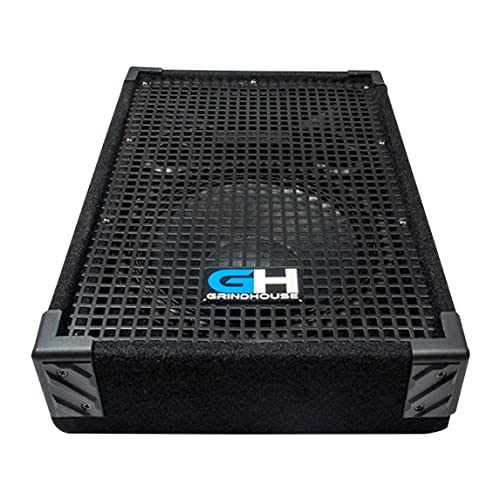
- 10-inch passive floor monitor
- 300W RMS, 600W peak rating
- 1/4-inch and speaker-wire connections
Best For: Existing amplified PA and karaoke setups
Controlled Powered Monitor

- Powered 12-inch monitor system
- Adjustable feedback filter and limiter
- XLR, 1/4-inch, RCA, and Speakon inputs
Best For: Live performance setups needing feedback control
Reliable Passive Performer

- 12-inch two-way floor monitor
- 300W program, 600W peak handling
- Pole socket and rugged cabinet features
Best For: Live sound systems with external amplification
Compact Passive Monitor

- 10-inch woofer with 1-inch compression tweeter
- 150W RMS / 300W peak at 8 ohms
- Parallel 1/4-inch jacks for daisy chaining
Best For: Small-room live sound setups with a separate amplifier
Personal Vocal Monitor

- Compact 3-inch ceramic driver
- 25-watt output with 150Hz–17kHz response
- Stand/wall mount and rubber feet included
Best For: Near-field monitoring in intimate rooms or compact installations
Powered Feedback-Controlled Wedge

- 300-watt active 2-way monitor system
- 12-inch woofer and 1-inch compression driver
- Feedback filter, limiter, EQ, and processor built in
Best For: Small venues needing a powered monitor with onboard control
Rugged Pair Pick
Rockville RSM12P 12-inch Passive Monitors

- Matched pair of 12-inch passive wedges
- Speakon and 1/4-inch input/thru connections
- Rugged cabinets with broad 70° x 50° dispersion
Best For: Bands, worship spaces, rehearsals, and DJs needing two durable monitors
Compact All-in-One Pick

- Active 150-watt Class-D speaker
- Four-channel mixer and three-band EQ
- Built-in USB MP3 player in a compact cabinet
Best For: Small-room monitoring, multimedia, meetings, and intimate gigs
Portable Powered Pick
Gemini AS-2108P 8-inch Monitor

- 300-watt powered 8-inch speaker
- Multiple wired inputs plus XLR mix output
- 11-pound ABS cabinet with handle and pole mount
Best For: Rehearsals, small venues, church services, and portable DJ monitoring
Compact Powered Pick – ALTO TX408
For stage monitors for small rooms, the ALTO TX408 stands out as a compact powered option with built-in mixing and flexible placement. Its 8-inch woofer, 350W amplification, wedge-monitor configuration, and pole socket suit intimate performances, home studios, and small gigs.
Best For: Small live performances, DJs, home studios, presentations, and fitness practice where portability and integrated amplification matter.
Pros:
- Powered 350W design avoids the need for a separate amplifier.
- Built-in mixer supports microphone, line-level, and Bluetooth inputs.
- Compact 8-inch cabinet includes a wedge-monitor design, handles, and a 36mm pole socket.
- Bluetooth streaming and True Wireless Stereo add setup flexibility.
Cons:
- Not water resistant.
- Bluetooth range is listed at up to 75 feet, which may be more than needed in a small room.
The TX408 is the most space-conscious choice here, especially when you want simple setup and onboard source mixing. Its 8-inch format favors convenience and portability over the larger drivers found on the passive and 12-inch alternatives.
Budget Passive Wedge – Grindhouse GH10M
The Grindhouse GH10M is a straightforward passive wedge for stage monitors for small rooms when you already have an amplifier or powered mixer. Its 10-inch driver, floor-monitor cabinet, and 300W RMS rating provide a practical fit for PA, DJ, karaoke, and live-sound setups.
Best For: Buyers who need a wired passive floor monitor for PA systems, DJ monitors, karaoke, or live sound.
Pros:
- 10-inch passive wedge format is suited to floor monitoring.
- Rated for 300W RMS and 600W peak power.
- Wired connectivity includes 1/4-inch TS and speaker-wire terminals.
Cons:
- Requires a compatible external amplifier or powered mixer.
- No wireless connectivity or Bluetooth.
- Not water resistant.
The GH10M makes sense for a room-sized PA system built around existing amplification. It offers a larger driver than the ALTO while keeping the design simple, but the passive configuration means your amplifier, cabling, and system matching need careful attention.
Controlled Powered Monitor – Behringer EUROLIVE F1220D
The Behringer EUROLIVE F1220D brings a powered 12-inch monitor format to stage monitors for small rooms, with Class-D amplification, an adjustable feedback filter, and an integrated limiter. It is a useful choice when you want substantial low-frequency capability and additional system protection in a compact live-performance setup.
Best For: Live performers and music playback users who want a powered 12-inch monitor with feedback control.
Pros:
- Powered monitor uses Class-D amplifier technology.
- Adjustable feedback filter helps with system control.
- Integrated limiter provides speaker protection.
- Offers XLR, 1/4-inch, RCA, and Speakon connectivity.
Cons:
- The 12-inch cabinet is larger than the ALTO TX408.
- At 23.6 pounds, it is less portable than the smaller powered option.
- Not water resistant.
The F1220D is a strong middle-ground option for small venues that can accommodate a larger wedge. Its feedback filter and limiter are particularly practical for live use, while the broad connection selection supports varied wired setups.
Reliable Passive Performer – Yamaha BR12M
The Yamaha BR12M is a passive 12-inch floor monitor for stage monitors for small rooms when clear, conventional wired monitoring is the priority. It combines a 12-inch woofer, 1-inch compression driver, 300W program handling, and a built-in pole socket in a rugged cabinet designed for sound reinforcement.
Best For: Live performances, public-address systems, sound reinforcement, and stage setups with an existing amplifier or mixer.
Pros:
- 12-inch woofer and 1-inch compression driver provide a full two-way monitor design.
- Handles 300W program and 600W peak power.
- Built-in pole socket supports stand mounting.
- Cabinet includes steel handles, corner protectors, and protection circuitry.
Cons:
- Passive design requires an external amplifier.
- Larger 12-inch cabinet may take more floor space in a small room.
- No wireless connectivity.
The BR12M is best suited to buyers building a traditional amplified monitor system around Yamaha’s durable cabinet design. It offers more physical scale than the 8-inch powered option, so confirm that your room and amplifier can support the added size and power requirements.
Compact Passive Monitor – Sound Town METIS-10M
The Sound Town METIS-10M is a practical passive option for stage monitors for small rooms, especially when you already have a compatible amplifier. Its 10-inch woofer, 1-inch compression tweeter, and floor-standing cabinet suit live music, church, and bar applications.
Best For: Small-room performers who need a durable, amp-powered floor monitor with straightforward daisy-chaining.
Pros:
- Handles 150W RMS and 300W peak at 8 ohms.
- Combines a 10-inch woofer with a 1-inch compression tweeter.
- Parallel 1/4-inch jacks support easy connection and daisy chaining.
- Carpet finish, metal grille, metal corners, and a recessed handle aid portability.
Cons:
- It is passive, so a separate amplifier is required.
- The cabinet is larger than a personal desktop-style monitor.
Choose the METIS-10M when you value conventional passive-speaker flexibility and rugged construction over an all-in-one powered design.
Personal Vocal Monitor – Galaxy Audio NSPA Nano Spot
The Galaxy Audio NSPA Nano Spot is a compact choice for stage monitors for small rooms where space matters more than high output. Its 3-inch ceramic driver, 25-watt rating, included stand/wall mount, and rubber feet make it suited to close-range personal monitoring.
Best For: Vocalists, presenters, and compact installations needing a small monitor with flexible placement.
Pros:
- Compact 3-inch monitor with 25 watts of output.
- Includes a stand/wall bracket mount kit and rubber feet.
- Offers a 150Hz–17kHz frequency response.
- Supports 24VDC phantom power and includes an 18VDC power supply.
Cons:
- The small driver and 25-watt output are less suited to large or loud stages.
- Its stated frequency response does not extend as low as larger monitors.
The NSPA is a space-saving personal monitor rather than a full-range floor wedge, making it most appropriate for intimate rooms and near-field listening.
Powered Feedback-Controlled Wedge – Behringer EUROLIVE F1320D
The Behringer EUROLIVE F1320D brings built-in amplification to stage monitors for small rooms while retaining enough capability for live and playback applications. Its 12-inch woofer, 1-inch compression driver, integrated processor, feedback filter, and limiter provide a feature-rich floor-monitor setup.
Best For: Small venues and rehearsal spaces that want an active monitor with onboard control and speaker protection.
Pros:
- Built-in 300-watt Class-D amplifier simplifies setup.
- Uses a 12-inch woofer and 1-inch compression driver.
- Adjustable feedback filter and integrated limiter support controlled operation.
- Includes a 3-band EQ and integrated sound processor.
Cons:
- At 33.1 pounds and 19.5 inches in each listed depth and width dimension, it is less compact than personal monitors.
- It is corded and wired rather than a wireless monitor solution.
The F1320D is a strong fit when you want powered convenience and feedback-management features, provided your small room can accommodate its larger 12-inch cabinet.
Rugged Pair Pick – Rockville RSM12P 12-inch Passive Monitors
For stage monitors for small rooms, the Rockville RSM12P offers a matched pair of traditional floor wedges with 12-inch woofers, broad dispersion, and flexible cabling. These are passive speakers, so you will need a compatible amplifier or powered mixer.
Best For: Small bands, worship spaces, rehearsals, and DJs who need two durable wedge monitors with daisy-chain connectivity.
Pros:
- Matched two-speaker package with 12-inch low-frequency drivers and titanium compression horns.
- Speakon and 1/4-inch input and thru connectors support flexible setups and daisy-chaining.
- 70° x 50° waveguide, steel grilles, recessed handles, and rubber feet suit regular stage use.
- Can also be pole-mounted as mains when needed.
Cons:
- Passive design requires a separate amplifier or powered mixer.
- At about 36.8 pounds per cabinet, they are less portable than compact powered monitors.
- The larger 12-inch cabinet may take more floor space in especially tight rooms.
The RSM12P is a sensible choice when you want a complete pair and prioritize coverage, rugged construction, and conventional pro-audio connections over minimum size.
Compact All-in-One Pick – Behringer EUROLIVE B207MP3
Behringer EUROLIVE B207MP3 Active 150 Watt 6.5" PA/Monitor Speaker System with MP3 Player
Check Price On AmazonThe Behringer EUROLIVE B207MP3 is a compact active option for stage monitors for small rooms. Its built-in 150-watt Class-D amplifier, four-channel mixer, three-band EQ, and USB MP3 player reduce the amount of extra equipment needed.
Best For: Vocal and keyboard monitoring, home recording spaces, intimate gigs, meetings, and multimedia setups where compact convenience matters.
Pros:
- Built-in 150-watt amplification avoids the need for a separate power amp.
- Four-channel mixer with three-band EQ provides useful onboard control.
- USB MP3 playback adds a convenient way to play audio files.
- Compact 12.4-pound cabinet is easy to place and transport.
Cons:
- The 6.5-inch driver is less suited to substantial low-end output than larger monitors.
- It is sold as a single speaker rather than a matched pair.
- Its feature set may be more than needed for a simple monitor-only setup.
With its integrated mixer and media player, the B207MP3 is particularly practical when a small room setup needs monitoring plus simple playback without a separate mixer and amplifier rack.
Portable Powered Pick – Gemini AS-2108P 8-inch Monitor
For stage monitors for small rooms, the Gemini AS-2108P combines an 8-inch woofer with built-in 300-watt amplification in an 11-pound cabinet. Its wired inputs make it a straightforward choice for rehearsals, small venues, and performers who want a self-contained monitor.
Best For: Small live-music spaces, church services, band practice, electric drums, and DJ setups that benefit from easy transport and direct wired connections.
Pros:
- Powered design includes 300 watts without requiring an external amplifier.
- Two switchable XLR/1/4-inch mic and line inputs, RCA, AUX, and XLR mix output support varied sources.
- Lightweight ABS cabinet, top handle, and 35mm pole mount make placement and transport simple.
- Onboard bass and treble controls and clip LED protection aid basic setup and operation.
Cons:
- It is a single speaker, so a second unit is needed for stereo or two monitor positions.
- The wired-only design does not provide Bluetooth playback.
- An 8-inch woofer offers less low-frequency scale than a larger 12-inch monitor.
The AS-2108P is a practical middle ground: more self-contained than a passive wedge and more portable than a large monitor, while retaining the wired connections useful for live sound.
How We Picked the Best Stage Monitors for Small Rooms
We focused on monitor speakers that balance intelligibility, output, portability, and usable placement in compact performance spaces. The selection includes powered models for simple setups, passive wedges for systems that already have amplification, and smaller personal monitors for near-field listening.
We also considered driver size, power handling, connection options, feedback-control features, enclosure design, and the practical needs of singers, instrumentalists, presenters, DJs, and small bands. In a small room, maximum wattage alone is not a reliable measure of performance; controlled coverage and clear midrange often matter more.
Quick Comparison
| Type | Best For | Main Advantage | Potential Trade-Off |
|---|---|---|---|
| Powered wedge | Fast, self-contained setups | Built-in amplification | Requires nearby power |
| Passive wedge | Existing PA systems | Flexible amplifier matching | Needs an external amplifier |
| Personal monitor | Individual performers | Compact, focused monitoring | Less room-filling output |
| 12-inch monitor | Bands needing fuller low end | Greater headroom and bass | Larger footprint and weight |
Key Buying Factors for Stage Monitors for Small Rooms
Powered or Passive Design
Powered monitors simplify setup because the amplifier is built into the cabinet. They are a strong choice for solo performers and small groups. Passive models can be economical when you already own a compatible amplifier or powered mixer, but impedance and power matching are essential.
Size, Coverage, and Volume
An 8-inch or 10-inch monitor is often easier to position in a tight room and can provide sufficient vocal clarity. A 12-inch cabinet may offer more low-frequency authority, but it can take up more stage space and encourage excessive volume. Choose enough headroom to avoid distortion, not simply the highest advertised wattage.
Feedback Control and Connections
Look for useful input and output connections, level controls, and feedback-reduction features when available. Place the monitor in front of the microphone’s rejection zone, aim it toward the performer’s ears, and keep unnecessary low-frequency content out of the monitor mix.
Portability and Placement
Wedge-shaped cabinets are convenient for floor monitoring, while lighter compact speakers are easier to move between rehearsals and gigs. Check dimensions, handles, power-cable access, and whether the cabinet can be used on a stand if your setup may change.
Who Should Buy Which Stage Monitors for Small Rooms?
Choose a compact powered model for solo performers, presenters, and home rehearsal spaces where quick setup matters. Pick a 10-inch wedge for small bands, DJs, bars, and churches that need a practical balance of vocal clarity and output. A 12-inch monitor is better for performers who need more low-end presence or greater headroom, provided the room can accommodate it.
Choose a passive wedge when you already have suitable amplification and want to build around an existing PA. For singers or musicians who need highly focused, close-range monitoring rather than room coverage, a personal monitor can be the most space-efficient solution. Before buying, confirm your mixer outputs, amplifier requirements, available floor space, and expected sound levels.