The right radio transmitter can make an RC model easier to control, more responsive, and more enjoyable to upgrade. However, channel count, receiver compatibility, range, ergonomics, and model type all matter when choosing a system.
We’ve selected 10 RC transmitters for hobbyists covering beginner-friendly car radios, feature-rich surface systems, and versatile aircraft-capable controllers. Use the guide below to narrow the list by compatibility, controls, and budget.
Best 10 Rc Transmitters for Hobbyists Picks for 2026
Versatile 6-Channel Control

- Six-channel control with included FS-BS6 receiver
- 20-model memory with separate settings
- ABS, crawler, SVC, gyro, and fail-safe functions
Best For: Multi-model car and boat hobbyists
Advanced Spektrum Surface Control
- Supports DSMR and SLT protocols
- Twelve fully proportional channels
- Backlit LCD and USB update connectivity
Best For: Spektrum users needing expansive surface controls
Long-Range Gyro Control

- Up to 400-meter stated control range
- Included R6FG receiver with gyro
- Telemetry, mixing, ABS, and fail-safe features
Best For: Multi-vehicle hobbyists wanting gyro-assisted control
Expandable Entry-Level Radio
- Six default channels, expandable to ten
- Bidirectional sensor-data communication
- Supports PWM, PPM, i-BUS, and S-BUS devices
Best For: Hobbyists seeking an adaptable starter radio
Long-Range Control

- 7 channels with programmable controls and mixing
- Up to 1,900 feet of claimed range
- Telemetry and built-in receiver gyro
Best For: Advanced RC cars, crawlers, boats, and tanks
Versatile Air Radio

- Includes FS-i6 transmitter and FS-iA6B receiver
- 6 channels for aircraft and multirotors
- AFHDS 2A frequency-hopping signal
Best For: Airplane, helicopter, glider, and quadcopter pilots
Simple Vehicle Control

- Includes transmitter, receiver, and lanyard
- About 150 meters of stated control distance
- Mixing and vehicle-light controls included
Best For: Basic RC cars, crawlers, boats, tanks, and robots
Best Long-Range Pick
DUMBORC X6PM-350 Mini 6CH Transmitter

- 400-meter claimed control range and 3ms response
- Six channels with expanded mixing controls
- Includes X6FG gyro receiver and throttle limiter
Best For: Versatile RC model builders and beginners practicing at controlled speeds
Best Memory Features
Flysky FS-GT3B 3CH Transmitter

- 2.4GHz frequency hopping helps resist interference
- Model memory and detailed tuning adjustments
- Suitable for RC cars, trucks, crawlers, and boats
Best For: Hobbyists who prioritize model setup and response tuning
Best Beginner-Friendly Controls

- Throttle-speed switch supports controlled practice
- 400-meter claimed range and 3ms response
- Includes receiver, neck strap, and one-hand accessory
Best For: New RC drivers and families using cars, boats, tanks, or trucks
Versatile 6-Channel Control – Flysky FS-GT5
For hobbyists comparing RC transmitters for hobbyists, the Flysky FS-GT5 is a versatile surface-radio option for cars, boats, and other compatible models. Its six-channel setup, model memory, and driving-focused controls make it practical for switching between different vehicles and setups.
Best For: Hobbyists who want one transmitter for multiple RC cars or boats, including crawlers and models that benefit from braking or stability controls.
Pros:
- Includes the FS-BS6 receiver with six-channel output.
- Stores settings for up to 20 models, with separate parameters and model names.
- Offers ABS braking, fail-safe protection, crawler mode, SVC, and gyro stability functions.
Cons:
- The feature set may be more than needed for basic one-model operation.
- Compatibility is centered on suitable surface models and the included receiver system.
The FS-GT5 stands out when adjustable vehicle control and multi-model memory matter more than keeping the transmitter completely basic. It is a strong fit for hobbyists managing several compatible cars or boats.
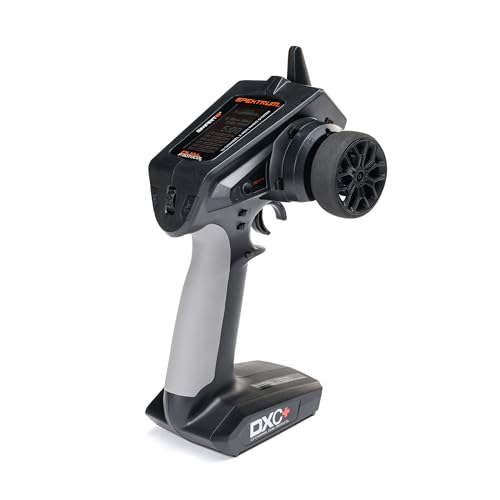
Advanced Spektrum Surface Control – Spektrum DXC+ 12-Channel
The Spektrum DXC+ is aimed at hobbyists seeking capable RC transmitters for hobbyists with a broad control layout and modern connectivity. It provides DSMR and SLT protocol compatibility, twelve fully proportional channels, and a backlit display for easier setup and visibility.
Best For: Spektrum users who need multiple proportional channels and compatibility with DSMR+ or SLT-equipped devices.
Pros:
- Supports both DSMR and SLT protocols.
- Provides twelve fully proportional channels with steering and throttle mixes.
- Includes a backlit LCD screen and USB connectivity for firmware updates and VRC compatibility.
Cons:
- This listing is for the transmitter only, so a compatible receiver may be needed separately.
- Its advanced channel count may be unnecessary for simpler RC setups.
The DXC+ makes the most sense for hobbyists already using compatible Spektrum equipment or those who expect to use several proportional controls. Its display, protocol support, and USB functions add flexibility for more involved setups.
Long-Range Gyro Control – Radiolink RC4GS V3
The Radiolink RC4GS V3 is a practical choice among RC transmitters for hobbyists who want long-range surface control and useful telemetry. With an included R6FG gyro receiver, programmable mixing, and support for several vehicle types, it is suited to crawlers, drift cars, boats, tanks, and more.
Best For: Hobbyists running varied surface models who want gyro assistance, voltage telemetry, and extended control range.
Pros:
- Offers a stated control range of up to 400 meters.
- Includes a built-in gyro with transmitter-adjustable sensitivity.
- Provides voltage telemetry, ABS, fail-safe, dual-rate, timers, cruise control, and programmable mixing.
Cons:
- Telemetry requires a compatible telemetry receiver such as the R7FG, R8FG, or R8FGH.
- The many adjustable functions may require more setup than a basic radio.
The RC4GS V3 is particularly appealing for enthusiasts who want one radio to cover multiple specialized vehicles. Its included gyro receiver and extensive tuning options give it more capability than a straightforward surface transmitter.
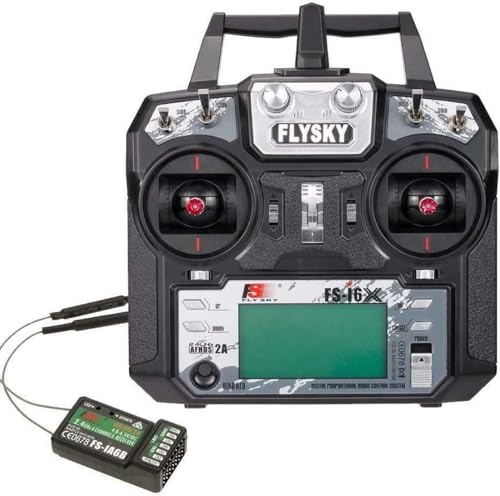
Expandable Entry-Level Radio – Flysky FS-i6X
Flysky FS-i6X 6-10(Default 6)CH 2.4GHz AFHDS RC Transmitter w/ FS-iA6B Receiver
Check Price On AmazonThe Flysky FS-i6X is a flexible option for hobbyists comparing RC transmitters for hobbyists across models that support PWM, PPM, i-BUS, or S-BUS connections. It comes with an FS-iA6B receiver and combines bidirectional communication with low-power operation and sensor-data support.
Best For: Hobbyists who want an adaptable transmitter and receiver set with simulator support, expandable channel capability, and telemetry-ready communication.
Pros:
- Offers six default channels with support for up to ten channels.
- Supports bidirectional data, including temperature and altitude sensor information.
- Uses unique transmitter-receiver pairing and supports PWM, PPM, i-BUS, and S-BUS-compatible devices.
Cons:
- It is not water resistant.
- Some advanced sensor and connection features depend on compatible equipment.
The FS-i6X is a sensible starting point for hobbyists who want room to expand beyond basic controls. Its broad connection support and bidirectional communication make it useful across several compatible RC and simulator applications.
Long-Range Control – Radiolink RC6GS V3
For hobbyists comparing rc transmitters for hobbyists, the Radiolink RC6GS V3 stands out as a feature-rich surface radio for cars, crawlers, boats, tanks, and drifting models. Its 7-channel layout, telemetry support, and claimed 1,900-foot range make it suited to more advanced vehicle setups.
Best For: RC hobbyists who need long-range control, telemetry, gyro assistance, or multiple vehicle functions.
Pros:
- Claimed control distance of up to 1,900 feet with support for more than 30 systems operating in the same area.
- Real-time vehicle battery-voltage and RSSI telemetry with compatible R7FG, R8FG, or R8FGH receivers.
- Built-in R7FG gyro supports straight-line control and adjustable sensitivity for drifting and on-road cars.
- Customizable channels and dual-program mixing support crawlers, tanks, dual-ESC vehicles, and other complex builds.
Cons:
- Telemetry features require a compatible telemetry receiver.
- The extensive channel and mixing options may be more than beginners need.
The RC6GS V3 is a strong choice when expandability matters more than simplicity. Its receiver-based gyro, telemetry, and programmable controls give experienced surface-model users room to grow.
Versatile Air Radio – Flysky FS-i6 6-Channel Set
The Flysky FS-i6 is a practical option for hobbyists seeking rc transmitters for hobbyists that can handle aircraft and multirotor models. This 6-channel 2.4GHz set includes the FS-iA6B receiver and uses AFHDS 2A frequency-hopping communication.
Best For: Hobbyists learning or practicing control of airplanes, helicopters, gliders, and quadcopters.
Pros:
- Includes both the FS-i6 transmitter and FS-iA6B receiver.
- 6-channel control supports a range of aircraft and multirotor configurations.
- AFHDS 2A communication uses frequency hopping across the 2.405–2.475GHz range.
- Supports PWM, PPM, and i.BUS connections for compatible setups.
Cons:
- Requires four AA batteries.
- The supplied notes identify it primarily for aircraft and multirotor use rather than surface vehicles.
With a receiver included and several connection formats supported, the FS-i6 is a sensible entry point for pilots who want a dedicated air-model radio without immediately moving to a more complex system.
Simple Vehicle Control – 4CH 2.4G RC Transmitter Set
RC Remote Control 4CH 2.4G Transmitter with Receiver and Lanyard for RC Car Crawler Boat
Check Price On AmazonFor shoppers looking at rc transmitters for hobbyists, this 4-channel 2.4G set offers straightforward control for compatible RC cars, crawlers, boats, tanks, and robots. It includes a receiver and lanyard, plus mixing and lighting controls for everyday vehicle use.
Best For: Hobbyists who want a basic vehicle transmitter with steering-throttle mixing and built-in light control.
Pros:
- FHSS 2.4G technology provides stated anti-interference performance and control at distances of about 150 meters.
- CH1 and CH2 mixing can coordinate steering and throttle through the throttle stick or steering wheel.
- Built-in controls operate left, right, and head lights.
- Includes an adjustable 13- to 21-inch neck lanyard and supports many vehicle scales from 1/10 to 1/24.
Cons:
- The transmitter is compatible only with the receiver included in this set.
- With four channels, it offers less expansion than more advanced multi-channel radios.
This set is best when convenience and basic vehicle functionality are the priorities. Its receiver pairing limitation is important to note, but the included lanyard, lighting controls, and mixing mode add useful everyday value.
Best Long-Range Pick – DUMBORC X6PM-350 Mini 6CH Transmitter
For hobbyists comparing rc transmitters for hobbyists, the DUMBORC X6PM-350 stands out with six channels, a claimed control range of up to 400 meters, and a fast 3ms response time. Its throttle-speed limiter also makes it easier to practice at a controlled pace.
Best For: Hobbyists who want broad model compatibility, programmable mixing, and beginner-friendly speed control.
Pros:
- Six-channel control with mixing support for channels 1–2 and 3–4.
- Includes the X6FG gyro receiver and supports several compatible DUMBORC receivers.
- Offers low-voltage alarms, brake and fail-safe functions, simulator support, and a 400-meter claimed range.
- Compact, lightweight design with wireless trainer and head-tracking support.
Cons:
- Simulator use requires a separate dongle.
- Recommended for users aged 14 and up.
- Its many adjustment and mixing options may be more than beginners need.
The X6PM-350 is a flexible choice for drivers who expect to experiment with different RC cars, boats, tanks, and trucks. The included gyro receiver and throttle limiter add useful capability without requiring a larger transmitter.
Best Memory Features – Flysky FS-GT3B 3CH Transmitter
The Flysky FS-GT3B is a practical option among rc transmitters for hobbyists who want familiar setup controls and model memory. Its 2.4GHz system uses frequency hopping and transmitter-receiver ID pairing to help maintain a reliable connection for compatible RC vehicles and boats.
Best For: RC car, truck, crawler, and boat users who value adjustable steering, throttle, and servo settings.
Pros:
- 2.4GHz frequency-hopping system is designed to resist interference.
- Includes model memory, steering and throttle trim, dual rate, endpoint, ABS, and exponential settings.
- Three channels suit many RC cars, trucks, crawlers, and boats.
- Unique transmitter ID pairing adds an extra connection-management feature.
Cons:
- Three channels provide less expansion room than six-channel alternatives.
- The supplied notes do not specify a maximum control range.
- Recommended for users aged 14 and up.
Choose the FS-GT3B when tuning flexibility matters more than a high channel count. Its trim, endpoint, ABS, and exponential settings give hobbyists useful control over how their model responds.
Best Beginner-Friendly Controls – DUMBORC X4 4CH Transmitter
The ATA HOBBY DUMBORC X4 is a straightforward pick among rc transmitters for hobbyists, combining four channels with a one-switch throttle-speed adjustment. It also includes a receiver, neck strap, and one-hand control accessory for more approachable operation.
Best For: Beginners, kids, and RC drivers who need simple speed control for cars, boats, tanks, trucks, or crawlers.
Pros:
- Claims up to 400 meters of control range and a 3ms response time.
- Throttle-speed adjustment helps new drivers avoid immediately using full speed.
- Supports channel mixing, fail-safe, brake, low-voltage alarm, and simulator use.
- Can be powered by four AA batteries, a USB port, or a 2–3S lithium battery socket.
Cons:
- Simulator use requires a separate dongle.
- The lighting, dig, or winch functions require an additional switch board.
- Four channels offer less control capacity than six-channel transmitters.
The X4 focuses on accessible operation and flexible power options rather than advanced channel capacity. Its throttle limiter, included accessories, and broad model compatibility make it a sensible starter set.
How We Picked These Rc Transmitters for Hobbyists
We focused on complete transmitter-and-receiver systems and transmitter-only options from recognizable RC radio families. The selection spans two-stick aircraft radios, pistol-grip surface transmitters, and models designed for cars, crawlers, boats, helicopters, airplanes, and multirotors.
We compared channel capacity, receiver features, compatibility, control layout, included accessories, and the kinds of adjustments a hobbyist is likely to need. Because specifications and package contents can vary by seller, confirm the exact receiver, firmware, and regional version before ordering.
Quick Comparison
| Best For | Look For | Shortlist Examples |
|---|---|---|
| Basic RC cars and boats | Simple 2.4GHz operation and dependable receiver pairing | 4-channel and 3-channel systems |
| Crawlers and drift cars | Extra channels, mixing, endpoints, and gyro support | Radiolink RC4GS V3, DUMBORC X6PM-350 |
| Advanced surface models | More channels, telemetry, model memory, and tuning controls | Radiolink RC6GS V3, Spektrum DXC+ |
| Aircraft and multirotors | Two-stick layout, programmable mixes, and compatible receivers | Flysky FS-i6 and FS-i6X |
Key Buying Factors for Rc Transmitters for Hobbyists
Model Compatibility
Start with the vehicle, not the transmitter. Pistol-grip radios are generally intended for surface models, while two-stick systems are better suited to airplanes, helicopters, gliders, and multirotors. Check whether the included receiver supports your servo layout, ESC, gyro, and power system.
Channel Count and Expansion
Four channels can cover basic steering, throttle, and a few accessories. Six or more channels provide room for lights, winches, gearboxes, smoke systems, auxiliary servos, or aircraft functions. More channels are useful only if the transmitter offers practical programming and compatible receivers are available.
Range, Signal System, and Receiver Features
2.4GHz systems reduce interference compared with older frequency-based radios, but real-world range depends on antennas, installation, terrain, and local conditions. Receivers with built-in gyros can help stabilize some surface models, although they require correct setup and are not a substitute for proper driving technique.
Ergonomics and Programming
Consider whether you prefer a wheel-and-trigger pistol grip or dual sticks. Look for comfortable controls, a readable display, trim access, endpoint adjustment, fail-safe settings, model memory, and an easy binding process. These details matter more as you maintain multiple vehicles.
Receiver Availability and Cost
A low-priced transmitter may become expensive if replacement receivers are hard to find. Before buying, check the price and availability of spare receivers, the number of supported models, and whether the system locks you into one brand’s ecosystem.
Who Should Buy Which Rc Transmitters for Hobbyists?
Choose a simple four- or three-channel package if you need an affordable replacement radio for a basic car, crawler, or boat. Pick a six-channel surface transmitter if you expect to add lights, a winch, a gearbox, or gyro-assisted control. A seven- or 12-channel system makes more sense for advanced builds and users who want greater programming headroom.
For airplanes, helicopters, gliders, and multirotors, prioritize a two-stick Flysky-style system with the appropriate receiver and programmable mixes. If you operate several surface models, favor a transmitter family with affordable receivers and model memory. Finally, if you are replacing an existing radio, verify protocol compatibility first; receivers from different systems are usually not interchangeable.