Choosing a keyboard switch by spec alone is risky. A mechanical keyboard switch tester lets you feel travel, spring weight, tactility, and sound before you buy a full set.
Below, we’ve rounded up 10 of the best testers for different needs, from compact samplers to large kits with linear, tactile, silent, and magnetic options.
Best 10 Mechanical Keyboard Switch Tester Picks for 2026
Compact pick

- 9 switch samples in one compact tester
- Includes keycap puller and O-rings
- Transparent acrylic design for easy switch ID
Best For: shoppers comparing a few Cherry MX switch feels
Balanced choice

- 12 Cherry MX switches for a broader test set
- Printed PBT keycaps make identification easy
- Includes keycap puller and 24 O-ring samples
Best For: people who want a mid-size Cherry MX switch tester
Kailh-focused pick

- 24 detachable Kailh switches in one set
- Acrylic base with blank keycaps
- Compatible with keyboards and gaming consoles
Best For: buyers comparing Kailh switch options
9-Switch Sampler
Gateron & Zealio Compact Tester

- 9-position acrylic tester
- Mixed Gateron and Zealio samples
- Includes clear R4 keycaps
Best For: Quick side-by-side testing of a small mix of Gateron and Zealio switches
81-Key Switch Board

- 81-key acrylic testing board
- Blank keycaps and transparent base
- Detachable design for easier handling
Best For: Comparing a very large set of Kailh switches on a full-size tester
30-Key Premium Sampler

- 30 DUROCK switch samples
- Includes switch puller
- Covers linear, tactile, silent, and HE magnetic styles
Best For: Exploring a wide DUROCK sampler with multiple switch styles in one kit
Budget 16-Key Tester

- Includes 16 switches and 16 keycaps
- Compact acrylic 16-way tester
- Lightweight 60 g build
Best For: Simple side-by-side switch feel comparisons
Premium 100-Switch Kit
Keychron Switch Tester 100 Max Edition
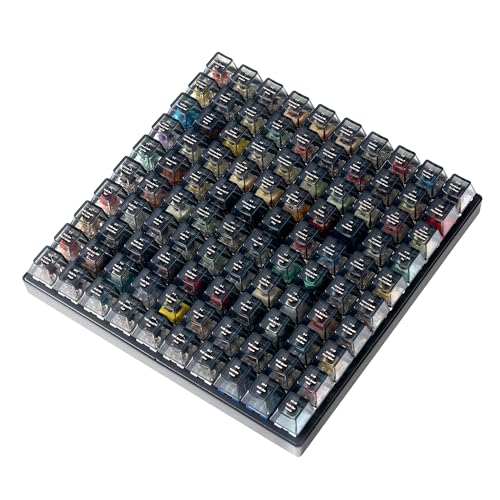
- 100 labeled switches included
- Adds 12 Hall Effect magnetic switches
- Steel plate and foam for realistic feel
Best For: Deep comparison of mechanical and Hall Effect switches
Compact pick – 9-Key Cherry MX Sampler
If you want a simple mechanical keyboard switch tester for comparing a few Cherry MX-style feels, this 9-key sampler keeps things straightforward. It gives you nine different switches in one small acrylic block, plus extra O-rings, so you can check feel, sound, and travel before committing to a full keyboard.
Best For: Buyers who want a compact Cherry MX switch tester with bonus O-rings and a keycap puller.
Pros:
- Includes 9 switch types for side-by-side comparison.
- Comes with a keycap puller for easy switch/keycap handling.
- Includes 9 40A-L and 9 40A-R O-ring samples.
- Transparent acrylic base makes the switches easy to identify.
Cons:
- Only covers 9 switches, so it is less broad than larger samplers.
- Not water resistant.
This is a practical entry-level sampler if you mainly want to narrow down your favorite Cherry MX feel without a lot of clutter. The included O-rings add extra value if you also want to compare dampened key travel.
Large variety pick – 35-Switch GATERON Sampler
If you want a mechanical keyboard switch tester with a much wider sample pool, this 35-piece GATERON set is built for exploration. It mixes magnetic, MX, and wall-stem switches, making it useful for DIY keyboard users who want to compare different typing feels, sound profiles, and mounting styles in one box.
Best For: Enthusiasts who want a large GATERON sampler with magnetic and standard switch options.
Pros:
- Large 35-switch assortment covers many GATERON switch families.
- Includes magnetic and mechanical switch types for broader comparison.
- 5-pin structure is described as more reliable for many setups.
- Acrylic package box can double as a lubing station.
Cons:
- More specialized than a basic Cherry MX-only sampler.
- Warranty is short at 1 month.
This set stands out if you are serious about testing multiple GATERON options before choosing a board or building a custom keyboard. The mix of switch types makes it better suited to hobbyists than casual first-time buyers.
Balanced choice – 12-Key Cherry MX Sampler
This mechanical keyboard switch tester is a strong middle-ground option if you want more variety than a 9-key sampler without jumping to a huge kit. It includes 12 Cherry MX switches, printed PBT keycaps, a keycap puller, and 24 O-rings, so you can compare switch feel and dampening in a more organized way.
Best For: Buyers who want a Cherry MX sampler with labeled PBT keycaps and extra O-rings.
Pros:
- Includes 12 Cherry MX switch types for broader comparison.
- Printed PBT keycaps help identify each switch easily.
- Comes with 24 O-rings, split between 40A-L and 40A-R samples.
- Keycap puller is included for simple handling.
Cons:
- Still limited to the Cherry MX family.
- Bulkier than a smaller 9-key tester.
For most shoppers, this hits a good balance of coverage and convenience. The printed PBT caps make it especially easy to keep track of what you are feeling, which is helpful when you are deciding on a full-size mechanical keyboard.
Kailh-focused pick – 24-Switch Kailh Tester
If your goal is to compare Kailh switch options in a simple, desktop-friendly format, this mechanical keyboard switch tester keeps the focus on the switches themselves. With 24 detachable Kailh switches, an acrylic base, and blank keycaps, it offers a clean way to feel different Kailh colors and weights before choosing a keyboard.
Best For: Shoppers focused on Kailh switch comparison with a durable acrylic display.
Pros:
- Includes 24 detachable Kailh switches for side-by-side testing.
- Acrylic base adds durability and a clean presentation.
- Blank keycaps keep the layout uncluttered.
- Compatible with keyboards and gaming consoles.
Cons:
- Blank keycaps may make switch identification less immediate.
- More specific to Kailh switches than mixed-brand testers.
This is a straightforward choice for buyers who already know they want to explore Kailh switch feel variations. It is less about extras and more about giving you a practical way to compare tactile differences before a purchase.
9-Switch Sampler – Gateron & Zealio Compact Tester
9 Key Gateron Green Clear White Gray Clear Zealio Purple Switches Shaft Testing Tool Switch Tester
Check Price On AmazonIf you’re comparing a few mechanical keyboard switch options, this mechanical keyboard switch tester keeps things simple with a compact 9-position acrylic layout. It includes mixed Gateron and Zealio samples, plus clear R4 keycaps, so you can feel how different switch types behave before buying a full set.
Best For: Quick side-by-side testing of a small mix of Gateron and Zealio switches.
Pros:
- Includes 9 switch positions for fast comparisons
- Built with an acrylic frame and clear R4 caps
- Supplied with Gateron and Zealio switch samples
- Compact size makes it easy to keep on a desk
Cons:
- Only a switch tester; no keyboard included
- Limited to the included switch samples
For buyers who want a straightforward feel test rather than a large sampler, this is a practical low-friction option. Its small footprint and mixed switch selection make it useful for narrowing down a preference quickly.
81-Key Switch Board – Kailh Full Layout Tester
This mechanical keyboard switch tester is built for buyers who want a broad comparison across many Kailh switch options at once. The 81-key acrylic board and blank keycaps give you a large testing surface, making it easier to judge feel across a wider spread of switch types.
Best For: Comparing a very large set of Kailh switches on a full-size tester.
Pros:
- Large 81-key layout for broad switch comparisons
- Acrylic base with about 10mm thickness
- Detachable design helps make testing more comfortable
- Includes blank keycaps and a transparent base
Cons:
- Focused on Kailh switch models
- Not water resistant
If you want a more complete sampling board instead of a small novelty tester, this one gives you a much wider view of how switches feel. The larger layout is especially useful when you want to compare multiple variants without swapping parts constantly.
30-Key Premium Sampler – DUROCK Switch Test Kit
For shoppers exploring a broader range of tactile, linear, silent, and magnetic options, this mechanical keyboard switch tester offers a curated 30-key DUROCK sample set. It is designed as a practical test kit, with an acrylic tester and a switch puller included so you can swap and compare samples easily.
Best For: Exploring a wide DUROCK sampler with multiple switch styles in one kit.
Pros:
- Includes 30 popular DUROCK switch samples
- Covers multiple styles, including linear, tactile, silent, and HE magnetic
- Comes with a stainless steel switch puller
- Acrylic tester has smooth surfaces and rounded corners
Cons:
- Limited to DUROCK switches
- More of a sampler kit than a compact single-switch tester
This is a strong pick if you want variety and don’t want to guess from a few isolated switch samples. It gives you enough range to compare feel categories and helps you narrow down a favorite before committing to a build.
Budget 16-Key Tester – 16-Key Kailh Box Tester
If you want a mechanical keyboard switch tester for quickly comparing 16 MX-style switches side by side, this compact acrylic board keeps things simple. It’s a practical way to feel different Kailh Box, Jade, Navy, Royal, Pink, and Red shaft switches before committing to a build.
Best For: Buyers who want a straightforward 16-switch comparison tool for testing feel before purchasing switches.
Pros:
- Includes 16 switches plus 16 keycaps for immediate testing.
- Uses an acrylic frame with a compact, lightweight 60 g design.
- Built as a 16-way tester with through-hole, manual push-button operation.
- Compatible with keyboard-style switch evaluation.
Cons:
- The acrylic cutout may be a little loose due to material tolerances.
- No dust cover or premium enclosure is included.
Overall, this is a no-frills option for basic switch comparison when you mainly care about trying a small set of switches. It’s best suited to shoppers who value simplicity and low-commitment testing over extra features.
Portable Tester with Cover – Akko 16-Key Switch Tester
This mechanical keyboard switch tester is designed for trying a variety of tactile, linear, and clicky switches at minimal cost. The acrylic 16-key layout and dust-proof cover make it a practical pick if you want a small tester you can carry around and use without much setup.
Best For: Shoppers who want a compact 16-switch tester with a protective cover and easy switch swapping.
Pros:
- Includes a dust-proof cover for storage and protection.
- Offers a mix of tactile, linear, and clicky switches from three brands.
- Comes with a keycap puller to help swap switches more easily.
- Compact enough to fit in a pocket and easy to transport.
Cons:
- Switch opener is not included.
- Still limited to 16 positions, so it’s not for broad comparison testing.
For buyers who want a practical starter tester, this one balances portability, protection, and variety. It’s a good fit if you want to sample common switch types before buying a full keyboard set.
Premium 100-Switch Kit – Keychron Switch Tester 100 Max Edition
If you’re comparing a lot of options, this mechanical keyboard switch tester gives you 100 labeled switches in one kit, including mechanical and Hall Effect magnetic models. The steel plate, acoustic foam, and two-stage kickstand make it feel closer to a real keyboard than a basic switch sample board.
Best For: Enthusiasts who want a large, realistic testing setup for both mechanical and Hall Effect switches.
Pros:
- Includes 100 total switches: Keychron, Gateron, Kailh, and Huano.
- Adds 12 Hall Effect magnetic switches for modern HE testing.
- Uses a steel plate, acoustic foam, and silicone foot pads for a more realistic feel.
- Comes with labeled black transparent keycaps and an adjustable two-stage kickstand.
Cons:
- No PCB is included, so it cannot connect to devices.
- Bulkier and heavier than smaller switch testers.
This is the most complete option in the group if you want to compare switch feel, sound, and travel across a wide range of models. It makes the most sense for buyers who want a serious evaluation tool rather than a simple sample board.
How We Picked These Mechanical Keyboard Switch Testers
We focused on variety, value, and real-world usefulness. The best kits offer a mix of switch types, enough samples to compare differences clearly, and practical extras like pullers, labeled caps, or a stable base. We also favored options that help buyers compare not just feel, but sound and actuation style.
Because switch preference is personal, the strongest picks cover both beginner-friendly samplers and broader kits for enthusiasts who want to test multiple families before choosing a board or building a custom keyboard.
Quick Comparison
Smaller testers are ideal if you only want to compare a few popular Cherry MX-style switches, while larger kits make more sense if you’re narrowing down between linear, tactile, silent, heavy, and magnetic switches. If you want the most complete overview, look for higher-key-count samplers with labeled caps and broader compatibility.
In short: compact kits are best for first-time buyers, mid-size testers suit most hobbyists, and large-format sets are the right choice for anyone comparing many switch families at once.
Key Buying Factors for a Mechanical Keyboard Switch Tester
Switch Types Included
Check whether the kit covers linear, tactile, clicky, silent, and magnetic switches. More variety is useful, but only if the switches match the kind of keyboard you plan to buy.
Number of Samples
More keys usually means better comparison coverage. A 9-key tester can be enough for a quick decision, while 16-key, 24-key, 30-key, 81-key, or 100-switch kits give a much broader view.
Mounting Style and Stability
Acrylic bases, labeled keycaps, and a solid layout make testing easier and more consistent. If the tester shifts around on your desk, it can distort the feel and sound.
Extras and Usability
Accessories such as keycap pullers, O-rings, dust covers, and labeled legends add convenience. These features are not essential, but they improve the overall testing experience.
Compatibility
Make sure the tester matches your switch ecosystem. Some kits are aimed at MX-style mechanical switches, while others include magnetic HE options or specific Kailh, Gateron, Akko, or Durock families.
Who Should Buy Which Mechanical Keyboard Switch Tester?
If you’re a first-time buyer, start with a compact Mechanical Keyboard Switch Tester that covers a few common switch types. It’s enough to learn whether you prefer light, heavy, tactile, or clicky switches.
If you’re building a custom board or upgrading an existing keyboard, a larger sampler is usually the better value because it helps you compare more options before committing. Enthusiasts exploring magnetic or hall-effect switches should prioritize kits that explicitly include those formats. For anyone who wants the simplest path, choose the tester that matches your current keyboard goals rather than the biggest kit available.