The best bench power supplies under $100 give hobbyists, students, and repair technicians adjustable voltage, useful current limits, and safer power control without the cost of professional lab equipment.
This roundup compares compact 30V and 32V supplies, higher-current switching models, linear-style units, and versatile power sources with USB charging, presets, displays, and protection features.
Best 10 Bench Power Supplies Under 100 Picks for 2026
Compact Charging Specialist

- 0–32V and 0–10A output range
- 20W USB-A and USB-C charging
- Intelligent battery charging mode
Best For: Compact electronics benches and battery projects
Precision Lab Pick

- 0–30V and 0–5A linear output
- 0.001V and 0.001A display resolution
- Four memory recall buttons
Best For: Repeatable lab and hobbyist testing
High-Current 12V Source

- 12V output adjustable by ±10%
- Up to 50A and 600W capacity
- Cooling fan and multiple protections
Best For: High-power 12V equipment and lighting
Feature-Rich 10A Workbench Pick
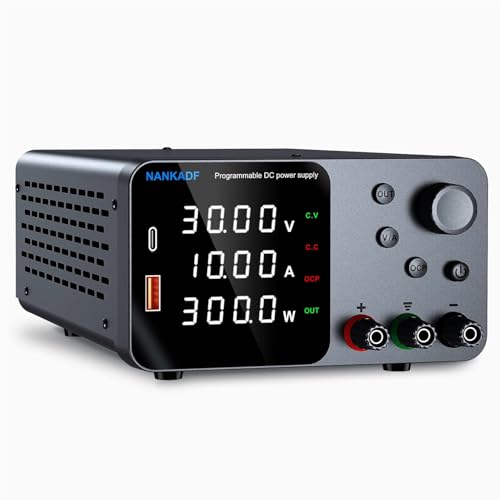
- 0–30V and 0–10A, 300W output
- Automatic CV/CC switching
- 18W USB-A and USB-C charging
Best For: Repair benches and electronics prototyping
High-Current LED Power
ALITOVE 12V 30A Switching Supply

- 12V output with up to 30A capacity
- Three output channels and adjustable voltage
- Overload, thermal, and short-circuit protection
Best For: Indoor 12V LED, CCTV, radio, and maker projects
Programmable Precision
FNIRSI DPS-150 Variable DC Supply

- 30V, 5A, and 150W adjustable output
- PC-programmable presets and multiple input modes
- 2.8-inch flip IPS display with low-ripple output
Best For: Compact electronics testing and DIY bench work
High-Current Benchtop Choice

- Adjustable 9V–15V or fixed 13.8V output
- 30A, 450W capacity with multiple front connections
- Cooling fan, analog meters, and protection features
Best For: Home labs and sustained high-current DC equipment use
Best High-Power Precision

- 0–32V and 0–10.1A adjustable output
- 4-digit display with fine resolution
- Memory, key lock, USB charging, and protections
Best For: High-power electronics testing in a compact workspace
Best Portable Option

- 95g portable design with USB-C input
- 0–30V and 0–5A regulated output
- 10 presets plus PC software and data logging
Best For: Field repairs, mobile labs, and compact electronics projects
Best for Repair Benches

- 0–30V and 0–10A regulated output
- Three memory presets and encoder adjustment
- Output switch, OCP protection, and key lock
Best For: Electronics repair, diagnostics, and repeatable bench testing
Compact Charging Specialist – Jesverty SPS-3010C
For shoppers comparing bench power supplies under 100, the Jesverty SPS-3010C stands out as a compact 0–32V, 0–10A switching supply with convenient USB charging and battery-focused features. Its coarse and fine encoder controls provide 0.01V and 0.001A adjustment resolution, while the output switch helps keep testing more controlled.
Best For: Hobby electronics, Arduino and Raspberry Pi projects, battery charging, and space-constrained workbenches.
Pros:
- Encoder controls offer convenient coarse and fine voltage and current adjustment.
- Includes USB-A and USB-C ports with up to 20W quick charging.
- Intelligent charging can stop automatically when a battery is full.
- Compact, lightweight design with selectable 115V/230V input.
Cons:
- The plastic and polycarbonate enclosure may feel less substantial than a metal lab supply.
- USB charging output is rated at 20W, so it is not intended for high-power USB loads.
The SPS-3010C is a practical choice when portability, straightforward controls, and integrated charging matter more than a traditional heavy-duty laboratory enclosure.
Precision Lab Pick – KORAD KA3005D 30V 5A
The KORAD KA3005D is a strong contender among bench power supplies under 100 for users who prioritize controlled adjustments and clear readings. This 0–30V, 0–5A linear supply uses a digital encoder, four-digit display, memory recall buttons, and selectable constant-voltage or constant-current operation.
Best For: Small laboratories, electronics hobbyists, repair work, and applications needing repeatable voltage and current settings.
Pros:
- Provides 0.001V and 0.001A display resolution.
- Four memory buttons can save time when returning to common settings.
- Includes overload, short-circuit, and thermal protection.
- Output on/off and lock buttons help prevent accidental live changes.
Cons:
- Its 5A maximum output is lower than several 10A alternatives.
- The listed 10-pound weight and 13 x 10 x 8-inch dimensions make it less portable.
Choose the KA3005D if precision, repeatability, and a traditional linear-supply format are your priorities, particularly for a permanent bench setup.
High-Current 12V Source – VAYALT 12V 50A 600W
The VAYALT 12V-600W is a specialized option in the bench power supplies under 100 category. Rather than offering adjustable laboratory voltage and current ranges, it converts 110V/220V AC to an adjustable 12V output capable of up to 50A, making it better suited to fixed-voltage equipment and higher-power 12V projects.
Best For: CCTV systems, LED strips, 3D printers, automation equipment, and other 12V loads requiring substantial current.
Pros:
- Up to 600W and 50A capacity for demanding 12V applications.
- Supports 110V/220V AC input with adjustable 12V output.
- Cooling fan, heat sink, and ventilation openings support heat management.
- Includes overload, overcurrent, and short-circuit protection.
Cons:
- It is not a general-purpose variable bench supply with a broad adjustable voltage range.
- Its open terminal-style design requires careful wiring and load matching.
- The notes caution that motors and resistive loads may require substantial power headroom.
The VAYALT makes sense when your project is centered on high-current 12V distribution. It is less appropriate for delicate circuit debugging or experiments requiring fine voltage adjustment.
Feature-Rich 10A Workbench Pick – NANKADF 0–30V 10A
For buyers looking at bench power supplies under 100, the NANKADF 0–30V, 0–10A model combines a broad output range with useful controls for repair and prototyping. Its encoder provides 0.01V and 0.001A adjustment resolution, while automatic CV/CC switching, output control, and short-circuit alerts add convenience during hands-on testing.
Best For: Electronics repair, prototyping, automotive diagnostics, LED testing, and USB device charging.
Pros:
- Offers 0–30V and 0–10A output with 300W capacity.
- Automatic CV/CC switching responds as the load reaches its limit.
- Includes output enable/disable, power-off memory, and short-circuit alarm.
- USB-A and USB-C ports support up to 18W quick charging each.
Cons:
- The listed input range is 100–120V AC, limiting international flexibility.
- Its one-year warranty is shorter than the VAYALT model’s stated two-year warranty.
The NANKADF is a versatile bench option for users who want high current, convenient digital control, and integrated USB charging in one unit.
High-Current LED Power – ALITOVE 12V 30A Switching Supply
For shoppers comparing bench power supplies under 100, the ALITOVE S-360-12 is a high-current 12V source designed for fixed-voltage applications. It accepts 110V or 220V AC input and provides up to 30A, with adjustable output voltage, three output channels, and built-in protections.
Best For: LED strips, CCTV systems, ham radio equipment, 3D printers, and other indoor 12V projects requiring substantial current.
Pros:
- Provides up to 12V DC and 30A output.
- Includes overload, overvoltage, thermal, and short-circuit protection.
- Fan activates at approximately 113°F for temperature-based cooling.
Cons:
- Designed for indoor use only.
- It is a switching adapter rather than a traditional variable laboratory bench supply.
- Wall-mount design may be less convenient for portable bench setups.
The ALITOVE is a practical choice when your priority is dependable, high-current 12V power rather than broad voltage adjustment. Its protection features and three output channels add flexibility for installations and hobby projects.
Programmable Precision – FNIRSI DPS-150 Variable DC Supply
Among bench power supplies under 100, the FNIRSI DPS-150 stands out for compact electronic testing and adjustment work. It delivers up to 30V and 5A, supports CC/CV operation, and uses a 2.8-inch IPS display with fine-grained voltage and current readings.
Best For: Electronics testing, DIY projects, programmable output setups, and users who want a compact display-driven supply.
Pros:
- Offers adjustable output up to 30V, 5A, and 150W.
- Supports PC, QC, and DC input modes plus PC-programmable output.
- Includes eight listed safety protections and low reported power ripple below 20mV.
- Flip-capable IPS screen provides numerical and curve displays.
Cons:
- The product is listed without a power adapter.
- A reverse-current protection module is strongly recommended when charging batteries.
- Its 5A maximum output is lower than high-current 12V supplies.
The DPS-150 is the most feature-focused option here for bench electronics work. Its programmable presets, detailed display, and multiple connection methods are useful for repeatable testing, provided you supply the required adapter and observe the battery-charging precaution.
High-Current Benchtop Choice – Jesverty SPS-30II 30A Supply
For buyers seeking bench power supplies under 100 with substantial current capacity, the Jesverty SPS-30II provides adjustable 9V–15V output or a fixed 13.8V setting. Its front panel combines screw-type main terminals, auxiliary snap-in terminals, a cigarette lighter socket, and analog V/A meters.
Best For: Home labs, communications equipment, and DC devices that need adjustable 9V–15V output at up to 30A.
Pros:
- Supplies up to 30A and 450W with continuously adjustable 9V–15V output.
- Offers main screw terminals, auxiliary terminals, and a cigarette lighter socket.
- Forced-air cooling supports continuous operation under heavy loads.
- Includes short-circuit protection and automatic current limiting.
Cons:
- Its output range is limited to 9V–15V rather than broad laboratory voltage ranges.
- Analog meters may be less precise to read than a digital display.
- The 2.32 kg unit is less portable than compact low-current supplies.
The SPS-30II is a strong fit when current capacity and convenient front-panel connections matter more than a wide voltage range. Its 13.8V setting, cooling fan, and two-year warranty make it especially practical for sustained DC equipment use.
Best High-Power Precision – Compact 300W Bench Supply
For shoppers comparing bench power supplies under 100, the YITRANIC 3010MS stands out with adjustable 0–32V and 0–10.1A output, a 4-digit display, and a compact 300W design. Its encoder control, memory function, and output switch make it practical for repeatable electronics testing.
Best For: Electronics projects, repair work, and users who need high output power in a compact enclosure.
Pros:
- Adjustable 0–32V and 0–10.1A output with 0.01V/0.001A display resolution
- Compact 1kg housing delivers up to 300W
- Includes memory recall, key lock, output switch, and five protection features
- Built-in 18W QC3.0 USB charging port
Cons:
- Its 300W capacity may be more than needed for basic low-power projects
- Cooling uses a fan, which may be less quiet than fanless alternatives
The 3010MS is a strong choice when you want broad voltage and current adjustment without taking up much bench space. Auto CV/CC switching and multiple safeguards add convenience for both experienced users and learners.
Best Portable Option – DP100 USB-C Mini Power Supply
Among bench power supplies under 100, the DP100 is the portability specialist. This 95g unit provides adjustable 0–30V and 0–5A output, runs from a USB-C-compatible 5–32V input, and supports up to 100W for field repairs, prototyping, and compact workspaces.
Best For: Mobile technicians, makers, students, and anyone powering circuits away from a traditional bench.
Pros:
- Extremely lightweight 95g design with USB-C input compatibility
- 0–30V/0–5A output with 0.01V and 0.001A resolution
- Stores up to 10 presets and supports PC software, data logging, and mouse control
- Fanless operation and claimed 97% efficiency
Cons:
- 100W maximum output is lower than the other listed supplies
- Requires a suitable USB-C, power bank, or other 5–32V input source
The DP100 is a practical alternative to a full-size benchtop unit when space and portability matter most. Its preset modes and computer control also make it useful for repeatable or automated testing.
Best for Repair Benches – WANPTEK 30V 10A Supply
For buyers looking at bench power supplies under 100 for repair and diagnostics, the WANPTEK TPS-C3010 provides adjustable 0–30V and 0–10A output in a space-saving benchtop format. Its encoder adjustment, three memory presets, output switch, and OCP protection support routine troubleshooting and testing.
Best For: Electronics repair benches, component testing, and repetitive lab or maintenance workflows.
Pros:
- Regulated 0–30V and 0–10A output with a clear 4-digit LED display
- Digit-by-digit encoder adjustment for fine tuning
- Three memory presets speed up recurring tests
- Output switch, OCP protection, key lock, and USB fast charging add convenience
Cons:
- Supplied test leads are not intended for heavy, extended high-current use
- U.S. users must set the rear 115V/230V input switch correctly before operation
The WANPTEK offers a balanced feature set for everyday repair work, especially when you regularly repeat the same voltage and current settings. Plan to use adequately rated test leads for sustained high-current projects.
How We Picked the Best Bench Power Supplies Under 100
We focused on the specifications that matter most for practical bench work: adjustable voltage and current ranges, regulation, display readability, output controls, protection features, cooling, portability, and connection options. The selection includes common 30V/5A and 30V/10A designs, as well as higher-current 12V supplies intended for CCTV, LED strips, radios, and other fixed-voltage equipment.
Because prices and included accessories can change, verify the current listing for output ratings, input-voltage compatibility, warranty coverage, and whether cables or test leads are included.
Quick Comparison
| Type | Best for | Typical strength | Potential trade-off |
|---|---|---|---|
| 30V/5A adjustable | General electronics and repair | Balanced control and size | Less current headroom |
| 30V/10A adjustable | Higher-power projects | More output capacity | Larger or noisier cooling systems |
| Linear-style supply | Sensitive circuits and testing | Typically lower electrical noise | Heavier and less efficient |
| 12V high-current switching | LEDs, CCTV, radios, and automotive accessories | High current at a low price | Usually limited voltage adjustment |
| Mini or portable supply | Small workspaces and travel | Compact footprint | May have fewer terminals and controls |
Key Buying Factors for Bench Power Supplies Under 100
Voltage and Current Range
Choose a variable 0–30V or 0–32V model for the broadest range of low-voltage projects. A 5A unit is suitable for most circuit testing, while a 10A model provides more margin for motors, lighting, and power-hungry prototypes. Do not confuse maximum current with continuous performance; check the listing and cooling design.
Regulation, Ripple, and Supply Type
Switching supplies are generally compact, efficient, and affordable, but they can produce more electrical noise. A linear or linear-style design may be preferable for sensitive analog circuits, audio work, and measurements. For ordinary repairs and digital projects, a regulated switching supply is often the better value.
Controls, Display, and Protection
An encoder knob, separate voltage and current adjustment, clear four-digit display, output switch, memory presets, and over-current protection can make daily use much easier. Constant-voltage and constant-current modes are especially useful when protecting LEDs, batteries, or experimental circuits.
Connections and Cooling
Look for secure binding posts or screw terminals, plus USB or USB-C only if you genuinely need charging or accessory power. Fan cooling can support higher loads, but it may add noise. Leave ventilation space around the supply and avoid exceeding its rated duty cycle.
Who Should Buy Which Bench Power Supplies Under 100?
For a general-purpose home electronics bench, choose a 30V/5A or 30V/10A adjustable model with an output switch, digital display, and over-current protection. Beginners and students benefit from intuitive encoder controls and preset memory functions. Makers working with larger loads should prioritize the 10A options and robust cooling.
Choose a linear-style supply when low noise matters more than weight and efficiency. For fixed 12V installations such as LED strips or CCTV, a dedicated 30A or 50A switching converter is more appropriate than a laboratory supply, provided its terminals are enclosed or safely installed. Portable users should favor a compact 30V/5A unit, while battery work requires careful attention to charging mode, voltage limits, polarity, and safe supervision.