DJ controllers with performance pads make it easier to trigger hot cues, loops, samples, and effects without taking your hands off the mix. The right model can turn a basic setup into a more expressive performance tool.
This roundup covers beginner-friendly controllers, full-size four-channel decks, scratch-focused options, standalone samplers, and compact pad-based gear so you can match features to your workflow and budget.
Best 10 Dj Controllers with Performance Pads Picks for 2026
Flagship Open-Format Pick

- Track Separation supports live vocal, drum, and instrument remixes.
- Four-channel layout follows a club-standard workflow.
- Rekordbox, Serato DJ Pro, and DMX lighting support included.
Best For: Open-format DJs wanting advanced performance control
Feature-Packed Value Pick

- Four-deck Serato DJ Lite control with a built-in 24-bit interface.
- Eight performance pads per deck handle cues, loops, cuts, and samples.
- Jog displays show BPM, platter position, pitch, and beats remaining.
Best For: Serato users seeking versatile controls at a lighter weight
Standalone Performance Add-On

- Runs as a standalone sampler and sequencer without a laptop.
- Sixteen velocity-sensitive pads enable expressive live triggering.
- PRO DJ LINK synchronizes samples with CDJs and DJM mixers.
Best For: Live performers adding samples and patterns to DJ sets
Beginner-Friendly Learning Pick
Hercules DJControl Inpulse 300 MK2

- Two-deck layout supports core DJing techniques.
- Built-in light guides assist with manual beatmatching.
- USB connectivity works with Mac and PC and supports streaming services.
Best For: Beginners learning beatmatching and two-deck mixing
Scratch-Ready Control

- Battle-style two-channel layout
- On-jog playback displays
- Hot Cue and sample pads
Best For: Scratch and open-format DJs
Portable Party Starter

- Eight pads per deck
- Built-in synchronized light show
- Bluetooth MIDI and USB-C
Best For: Beginner and casual party mixing
Easy Learning All-Rounder

- 16 versatile performance pads
- Smart Fader for easier transitions
- PC, Mac, iOS, and Android support
Best For: Learners and improving DJs
Complete Beginner Kit

- Two-channel controller with jog wheels
- Includes speakers, headphones, and software
- Works with PC and Mac
Best For: Beginners wanting a complete home DJ setup
Ableton Pad Performance

- 64 RGB pads for clip launching
- Nine assignable faders
- USB-powered Ableton Live control
Best For: Ableton Live looping and live performance
Portable Stem Mixing
Hercules DJControl Inpulse 200 MK3
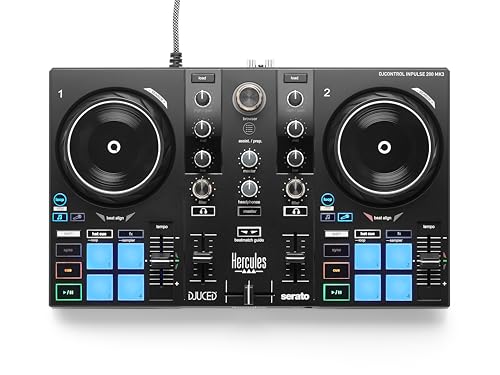
- Lightweight 2.2-pound controller
- Serato Lite and DJ Academy tutorials
- Stem separation and streaming support
Best For: Portable beginner mixing and remixing
Flagship Open-Format Pick – Pioneer DJ DDJ-FLX10
For DJs seeking dj controllers with performance pads and a professional four-channel workflow, the Pioneer DJ DDJ-FLX10 is built for serious hobbyists, mobile DJs, and pros. Its track-separation features, large jog displays, and rekordbox/Serato compatibility make it a flexible choice for prepared sets and live remixing.
Best For: Open-format DJs who want club-style controls, live track separation, and lighting integration.
Pros:
- Track Separation splits songs into vocals, drums, and instruments for live mashups.
- Four-channel layout and professional effects mirror a CDJ/DJM booth workflow.
- Large jog wheels include multicolor displays with waveform, artwork, and playing-part information.
- Works with rekordbox and Serato DJ Pro and includes DMX output for lighting.
Cons:
- At 14.8 pounds, it is less portable than lighter two-deck controllers.
- Its advanced feature set may be more than beginners need.
The DDJ-FLX10 is the strongest option here for a future-focused, performance-heavy setup, especially if four-channel control and live remixing are priorities.
Feature-Packed Value Pick – Numark Mixtrack Platinum FX
The Numark Mixtrack Platinum FX combines dj controllers with performance pads, four-deck control, and a built-in 24-bit audio interface in a relatively lightweight package. It is designed for Serato DJ Lite users who want visual jog displays, quick effects, loops, cues, and samples without a complicated setup.
Best For: Budget-conscious DJs who want a broad set of hands-on controls and easy Serato integration.
Pros:
- Includes Serato DJ Lite and provides four decks of control.
- Six-inch jog wheels display BPM, platter position, beats remaining, and pitch information.
- Eight performance pads per deck support cues, loops, fader cuts, and samples.
- USB bus power, microphone input, headphone output, and RCA output support a straightforward setup.
Cons:
- It is designed around Serato DJ Lite rather than a standalone workflow.
- The compact 9.48-by-21.61-by-2-inch design may offer less physical room than larger four-channel controllers.
With strong pad coverage and useful visual feedback, the Mixtrack Platinum FX is a practical entry point for learning effects, loops, and multi-deck mixing.
Standalone Performance Add-On – Pioneer DJ DJS-1000
The Pioneer DJ DJS-1000 takes a different approach to dj controllers with performance pads: it is a standalone sampler and sequencer rather than a conventional laptop-based controller. Its 16 velocity-sensitive pads, seven-inch touchscreen, and step sequencer are aimed at DJs who want to trigger patterns, samples, edits, and original elements live.
Best For: Performing DJs who want laptop-free sampling and synchronized live pattern creation.
Pros:
- Standalone design supports hands-on performance without a laptop.
- Sixteen velocity-sensitive pads provide expressive sample and pattern triggering.
- Seven-inch touchscreen makes sequencing and performance control tactile.
- PRO DJ LINK synchronizes it with CDJs and DJM mixers.
Cons:
- It is a sampler and sequencer, not a conventional full DJ controller.
- At 15 pounds, it is relatively heavy for adding to a booth setup.
- Its workflow is focused on samples and patterns rather than general computer-based track mixing.
The DJS-1000 is best viewed as a creative performance centerpiece or companion unit for DJs who want live samples and sequencing alongside a linked booth system.
Beginner-Friendly Learning Pick – Hercules DJControl Inpulse 300 MK2
The Hercules DJControl Inpulse 300 MK2 is a straightforward two-deck option for shoppers comparing dj controllers with performance pads. It focuses on core mixing practice, including manual beatmatching with built-in light guides, while supporting Serato and DJUCED workflows on Mac and PC.
Best For: New DJs learning beatmatching and basic two-deck mixing with guided assistance.
Pros:
- Two-deck, full-featured layout is approachable for learning fundamental techniques.
- Built-in light guides help users manually beatmatch.
- Supports music stored on a computer and listed streaming services.
- Works with Mac and PC through USB.
Cons:
- It offers two decks rather than the four-channel control found on more advanced models.
- The supplied details identify DJUCED support, so software preferences may limit fit for some users.
- Its plastic construction may feel less substantial than heavier professional controllers.
The Inpulse 300 MK2 is a sensible starting point for developing timing and mixing habits, especially when guided beatmatching matters more than advanced club-style features.
Scratch-Ready Control – Pioneer DJ DDJ-REV5
The Pioneer DJ DDJ-REV5 is a strong choice among dj controllers with performance pads for DJs who want a battle-style workflow, full-size jog wheels, and flexible software support. Its on-jog displays help you monitor playback position while the pads provide quick access to Hot Cues and samples.
Best For: Scratch-focused DJs, open-format performers, and users choosing between rekordbox and Serato DJ Pro.
Pros:
- Battle-style two-channel layout with full-size jog wheels
- On-jog displays show playback position
- Includes rekordbox and Serato DJ Pro support
- Performance pads can trigger samples and Hot Cues
Cons:
- At 14 pounds, it is less portable than compact controllers
- Its scratch-oriented layout may be more specialized than a beginner-focused design
The DDJ-REV5 emphasizes hands-on scratch and performance control while retaining a professional DJM-style workflow. It makes the most sense for performers who value full-size controls and software choice over minimal size.
Portable Party Starter – Numark Party Mix III
The Numark Party Mix III is a compact option among dj controllers with performance pads, combining beginner-friendly mixing tools with built-in lights and Bluetooth MIDI. Eight backlit pads per deck support Hot Cues, loops, samples, and effects for hands-on party mixing.
Best For: First-time DJs, casual home users, and portable party setups using a laptop, tablet, smartphone, or power bank.
Pros:
- Eight backlit performance pads per deck
- Built-in beat-synchronized LED light show
- Compact 2.42-pound USB-powered design
- Includes Serato DJ Lite and Algoriddim djay access
Cons:
- Designed as a two-deck controller rather than a larger professional setup
- Main audio output is RCA, with headphone monitoring through a 1/8-inch connection
The Party Mix III prioritizes fun, portability, and an easy learning curve. Its performance pads and automatic visual effects make it especially suitable for casual sets and beginners who want a quick route to expressive mixes.
Easy Learning All-Rounder – Pioneer DJ DDJ-FLX4
The Pioneer DJ DDJ-FLX4 is an approachable pick among dj controllers with performance pads, offering a straightforward two-channel layout and 16 pads for Hot Cues, Pad FX, Beat Jump, and sampler control. Smart Fader can help new DJs blend tracks while they develop manual beatmatching skills.
Best For: Learners and improving DJs who want flexible device connectivity, streaming support, and room to build skills.
Pros:
- 16 performance pads with several performance modes
- Smart Fader simplifies volume, bass, and BPM transitions
- Works with PC, Mac, iPhone, iPad, and Android devices
- Supports rekordbox, Serato DJ, and djay
Cons:
- Two-channel, two-deck design may limit larger or more advanced setups
- Its learner-focused automation may be less appealing to DJs seeking fully manual control
The DDJ-FLX4 balances accessible features with useful performance controls, making it a practical controller for learning and casual live use. Its multi-device support also makes it easier to adapt as your setup changes.
Complete Beginner Kit – Hercules DJLearning Kit MK II
The Hercules DJLearning Kit MK II is an all-in-one starting point for shoppers seeking dj controllers with performance pads, though its supplied features focus more on jog-wheel mixing than pad-based performance. It combines a two-channel DJ controller with monitoring speakers, headphones, and DJUCED software, making it convenient for learning at home.
Best For: Beginners who want a bundled PC/Mac DJ setup with speakers and headphones included.
Pros:
- Includes the DJControl Inpulse 200 MK2, DJMonitor 32 speakers, headphones, software, and power cables.
- Supports DJUCED and Serato DJ Lite on PC or Mac.
- Provides jog wheels and a two-deck, two-channel layout for foundational mixing.
Cons:
- The supplied notes do not list dedicated performance pads.
- At 14.3 pounds, it is less travel-friendly than a controller-only setup.
- Its bundled speaker and headphone system may be unnecessary if you already own monitoring gear.
This kit is strongest as a complete beginner package rather than a pad-focused performance controller. Choose it when convenience and included monitoring equipment matter more than advanced pad controls.
Ableton Pad Performance – Akai APC Mini MK2
The Akai APC Mini MK2 is a strong fit for shoppers comparing dj controllers with performance pads for clip launching, looping, and live electronic performance. Its 64 RGB pads provide visual feedback, while nine assignable faders add hands-on mixer and device control in Ableton Live.
Best For: Ableton Live users who want a compact pad controller for clip launching, looping, and live performance.
Pros:
- Offers an 8×8 matrix of 64 RGB pads for launching clips and samples.
- Includes eight assignable faders plus a master fader for mixer control.
- Provides Drum and Note modes, with 1:1 Ableton Live mapping from version 11.2.7 onward.
- USB-powered, compact, and compatible with Mac and Windows.
Cons:
- Its supported software is Ableton Live rather than traditional DJ software.
- It has no listed audio outputs or standalone operation; it connects through USB.
- It is a MIDI pad controller, not a conventional two-deck DJ mixer with jog wheels.
For pad-centered performance, this is the most directly targeted option in the group. It makes sense for producers and live performers working inside Ableton Live, but less so for users who need standard DJ-deck workflows.
Portable Stem Mixing – Hercules DJControl Inpulse 200 MK3
The Hercules DJControl Inpulse 200 MK3 is a compact two-channel option for beginners comparing dj controllers with performance pads, although the supplied notes emphasize jog wheels, guided mixing, and stem separation rather than dedicated pad specifications. It adds Serato Lite, DJ Academy tutorials, streaming access, and a built-in virtual sound card for a flexible starter setup.
Best For: Beginners who prioritize portability, guided beatmatching, streaming libraries, and stem-based remixing.
Pros:
- Compact 2.2-pound design fits easily into a backpack.
- Includes Serato Lite and step-by-step DJ Academy tutorials.
- Supports stem separation for isolating vocals and instrumentals during performances.
- Beatmatch Guide LEDs and Intelligent Music Assistant help with transitions and track selection.
Cons:
- The supplied details do not specify dedicated performance pads.
- Its two-channel layout is geared toward beginner mixing rather than larger multi-deck setups.
- Some streaming features depend on supported services and software integration.
This controller is a practical choice when portability and learning aids are more important than pad-heavy control. Its stem separation and streaming support give beginners extra creative options without making the hardware bulky.
How We Picked These Dj Controllers with Performance Pads
We selected models across several skill levels and use cases, including home practice, mobile performance, scratching, party mixing, sampling, and advanced four-deck setups. We considered pad functionality, deck layout, software compatibility, jog-wheel control, portability, learning features, connectivity, and overall value. Because “performance pad” can describe anything from basic cue triggers to a dedicated sampler grid, the list includes both traditional DJ controllers and pad-focused performance hardware.
Quick Comparison
| Best For | Recommended Type | What to Prioritize |
|---|---|---|
| Beginners | Two-deck controller | Guided lessons, simple controls, included software |
| Creative mixing | Pad-equipped performance controller | Hot cues, loops, samples, and effects |
| Scratch performance | Scratch-oriented controller | Responsive jog wheels, crossfader feel, deck control |
| Large sets | Four-channel controller | Multiple inputs, track separation, expanded mixer section |
| Sampling | Standalone sampler or MIDI pad controller | Pad layout, sequencing, storage, and software integration |
Key Buying Factors for Dj Controllers with Performance Pads
Pad Layout and Functions
Check how many pads are available and what they control. Hot cues and loops are useful for conventional mixing, while sampler, stem, roll, and slicer modes are better for live remixing. RGB feedback and velocity sensitivity can also improve accuracy during performance.
Software and Compatibility
Confirm that the controller works with your preferred platform, such as Serato DJ, rekordbox, DJUCED, or another compatible application. Included software can reduce setup costs, but advanced features may require a paid upgrade. Also check whether the unit requires a computer or can operate independently.
Decks, Mixer Controls, and Connectivity
Two-deck controllers are generally easier to learn and transport, while four-channel models offer more room for layered transitions. Look for balanced outputs when connecting to larger sound systems, microphone inputs if you host events, and USB or Bluetooth features that suit your setup.
Portability and Learning Curve
Compact controllers are convenient for bedrooms, travel, and casual parties, but smaller jog wheels and fewer controls may limit advanced performance. Beginners should favor clear layouts and helpful tutorials; experienced DJs may prefer deeper customization and dedicated controls.
Who Should Buy Which Dj Controllers with Performance Pads?
New DJs should start with a straightforward two-deck model or a learning bundle that includes headphones and speakers. Choose a compact party controller if portability, Bluetooth playback, and built-in lighting matter most. Scratch DJs should prioritize jog-wheel response and crossfader design, while open-format performers benefit from versatile pads and broad software support. DJs who mix multiple decks or use stems should consider a larger four-channel controller. For beat makers and live samplers, a dedicated standalone sampler or USB MIDI pad controller may complement—or replace—a traditional DJ deck.